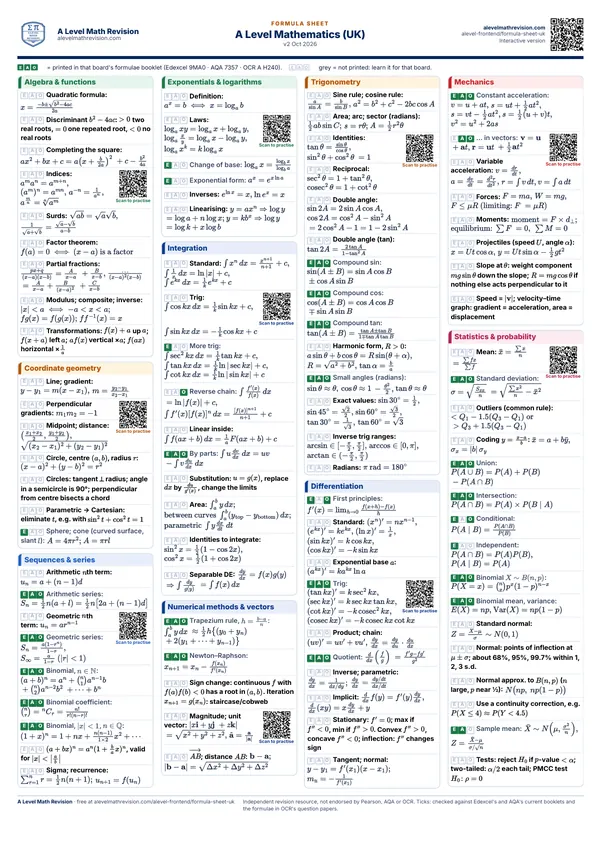
Every formula for UK A Level Mathematics on one A4 page. The E A O ticks show whether the Edexcel or AQA booklet, or the formulae printed in OCR’s question papers, give it. No tick means you must learn it for your board.
Official booklet: Pearson Edexcel Mathematical Formulae and Statistical Tables (8MA0/9MA0), Issue 1, July 2017 (the edition on the board's website when we last checked it, October 2026). We link to the board's own copy and do not host it.
Quick answer: yes for Edexcel and AQA, which give you a formulae booklet in the exam (Edexcel 9MA0 booklet, PDF; AQA 7357 booklet, PDF). OCR A has no separate booklet: its formulae are printed in each question paper. None of them gives everything; a row with no tick for your board is one to learn.
Tick what you know: 0 of 94 (saved on this device). Tap a formula to copy its LaTeX.
No formulas match. Clear the search or pick another topic.
A Level Math Revisionalevelmathrevision.com
A Level Mathematics (UK)Edexcel 9MA0 · AQA 7357 · OCR A H240 · one-page formula sheet
E A O ticks = given by that board: Edexcel 9MA0 and AQA 7357 booklets, OCR A H240 question papers (no separate booklet). No tick: learn it.
Algebra & functions
···Quadratic formula:\(x=\frac{-b\pm\sqrt{b^2-4ac}}{2a}\)Use: Solving quadratics that do not factorise; "for what \(k\)" root questions
···Discriminant \(b^2-4ac\): \(>0\) two real roots, \(=0\) one repeated root, \(<0\) no real rootsUse: Decide how many real roots a quadratic has
···Completing the square:\(ax^2+bx+c=a\left(x+\tfrac b{2a}\right)^2\)\({}+c-\tfrac{b^2}{4a}\)Use: Completed-square form: solve equations; find the turning point
···Indices:\(a^ma^n=a^{m+n},\)\((a^m)^n=a^{mn},\)\(a^{-n}=\tfrac1{a^n},\)\(a^{\frac mn}=\sqrt[n]{a^m}\)Use: Negative and fractional indices; rewrite terms as \(ax^{n}\)
···Surds:\(\sqrt{ab}=\sqrt a\sqrt b,\)\(\frac1{\sqrt a+\sqrt b}=\frac{\sqrt a-\sqrt b}{a-b}\)Use: Simplify surds; rationalise denominators with the conjugate
···Factor theorem:\(f(a)=0\iff(x-a)\text{ is a factor}\)Use: Test whether \((x - a)\) is a factor; fully factorise cubics
···Partial fractions:\(\frac{px+q}{(x-a)(x-b)}=\frac{A}{x-a}\)\({}+\frac{B}{x-b},\)\(\frac{\dots}{(x-a)^2(x-b)}\)\({}=\frac{A}{x-a}+\frac{B}{(x-a)^2}\)\({}+\frac{C}{x-b}\)Use: Proper fractions with distinct or repeated linear factors
···Modulus; composite; inverse:\(|x|<a\iff-a<x<a;\)\(fg(x)=f(g(x));\)\(ff^{-1}(x)=x\)Use: Composite and inverse functions with their domains and rangesWatch for: Write the domain of \(f^{-1}\) every time; for \(fg(x)\), apply \(g\) first
···Transformations: \(f(x)+a\) up \(a\); \(f(x+a)\) left \(a\); \(af(x)\) vertical ×\(a\); \(f(ax)\) horizontal ×\(\tfrac1a\)Use: Combine transformations, tracking key pointsWatch for: Inside the bracket: horizontal and "opposite"
Watch for: Write the domain of \(f^{-1}\) every time (it is the range of \(f\))
···Line; gradient:\(y-y_1=m(x-x_1),\)\(m=\frac{y_2-y_1}{x_2-x_1}\)Use: Equation of a line from a gradient and a point, or two points
···Perpendicular gradients:\(m_1m_2=-1\)Use: Equations of parallel and perpendicular lines
···Midpoint; distance:\(\left(\tfrac{x_1+x_2}2,\tfrac{y_1+y_2}2\right),\)\(\sqrt{(x_2-x_1)^2+(y_2-y_1)^2}\)Use: Distance between two points; midpoint and perpendicular bisector
···Circles: tangent ⟂ radius; angle in a semicircle is 90°; perpendicular from centre bisects a chordUse: Tangent equations; the circumcircle of a triangle
···Parametric → Cartesian: eliminate \(t\), e.g. with \(\sin^2t+\cos^2t=1\)Use: Convert parametric equations to Cartesian form
✓··Sphere; cone (curved surface, slant \(l\)):\(A=4\pi r^2;\)\(A=\pi rl\)Use: Cone surface area when you are given the vertical height
✓✓✓Binomial coefficient:\(\binom nr={}^nC_r=\frac{n!}{r!(n-r)!}\)Use: Find a particular term or coefficient
✓✓✓Binomial, \(|x|<1\), \(n\in\mathbb Q\):\((1+x)^n=1+nx+\frac{n(n-1)}{1\times2}x^2+\cdots\)Use: \((1 + x)^{n}\) for negative and fractional \(n\), with validityWatch for: State the validity and compare to conclude
···\((a+bx)^n=a^n(1+\tfrac bax)^n\), valid for \(|x|<\left|\tfrac ab\right|\)Use: Take out a factor first to get the form \((1 + bx)^{n}\)Watch for: Write \(a^{n}(1 + \frac{bx}{a})^{n}\): raise the factor to the power
···Sigma; recurrence:\(\sum_{r=1}^nr=\tfrac12n(n+1);\)\(u_{n+1}=f(u_n)\)Use: Sigma notation; sequences from recurrence relations
···Definition:\(a^x=b\iff x=\log_ab\)Use: Convert between forms such as \(2^{5} = 32\) and \(\log_{2} 32 = 5\)
···Laws:\(\log_axy=\log_ax+\log_ay,\)\(\log_a\tfrac xy=\log_ax-\log_ay,\)\(\log_ax^k=k\log_ax\)Use: Solving log equations and linearising dataWatch for: Take the same log of both sides; one law per line
✓··Change of base:\(\log_ax=\frac{\log_bx}{\log_ba}\)Use: Solve equations such as \(3^{x} = 20\) by taking logarithms
✓··Exponential form:\(a^x=e^{x\ln a}\)Use: Gradient of \(y = e^{kx}\); rates of change
···Inverses:\(e^{\ln x}=x,\)\(\ln e^x=x\)Use: Natural logarithms to solve equations involving \(e^{x}\)
···Linearising:\(y=ax^n\Rightarrow\log y\)\({}=\log a+n\log x;\)\(y=kb^x\Rightarrow\log y\)\({}=\log k+x\log b\)Use: Change exponential relationships into linear form
Watch for: Take the same log of both sides, one law per line
···Sine rule; cosine rule:\(\frac a{\sin A}=\frac b{\sin B},\)\(a^2=b^2+c^2-2bc\cos A\)Use: A side and its opposite angle (sine); two sides and the angle between (cosine)
···Area; arc; sector (radians):\(\tfrac12ab\sin C;\)\(s=r\theta;\)\(A=\tfrac12r^2\theta\)Use: Arc lengths, sector areas and segments in radians
···Identities:\(\tan\theta=\frac{\sin\theta}{\cos\theta},\)\(\sin^2\theta+\cos^2\theta\)\({}=1\)Use: Simplify expressions and prove simple identities
···Reciprocal:\(\sec^2\theta=1+\tan^2\theta,\)\(\cosec^2\theta=1+\cot^2\theta\)Use: Equations mixing \(\tan^{2}\) and sec, or \(\cot^{2}\) and cosec
···Double angle:\(\sin2A=2\sin A\cos A,\)\(\cos2A=\cos^2A-\sin^2A\)\({}=2\cos^2A-1=1-2\sin^2A\)Use: Equations with \(2x\) and \(x\) together, and integrating \(\sin^{2} x\)
···Double angle (tan):\(\tan2A=\frac{2\tan A}{1-\tan^2A}\)Use: Simplify expressions with \(\tan 2\)A
✓✓✓Compound sin:\(\sin(A\pm B)=\sin A\cos B\)\({}\pm\cos A\sin B\)Use: Exact values such as \(\sin 75^\circ\)
✓✓✓Compound cos:\(\cos(A\pm B)=\cos A\cos B\)\({}\mp\sin A\sin B\)Use: Prove identities; solve equations such as \(\sin(x + 30^\circ) = 2 \cos x\)
···Harmonic form, \(R>0\):\(a\sin\theta+b\cos\theta=R\sin(\theta+\alpha),\)\(R=\sqrt{a^2+b^2},\)\(\tan\alpha=\tfrac ba\)Use: Maximum and minimum values; solving \(a \sin \theta + b \cos \theta = c\)Watch for: Expand, match coefficients, then divide for \(\tan \alpha\)
✓✓✓Small angles (radians):\(\sin\theta\approx\theta,\)\(\cos\theta\approx1\)\({}-\tfrac{\theta^2}2,\)\(\tan\theta\approx\theta\)Use: Simplify expressions for small \(\theta\) in radiansWatch for: Keep the whole angle in brackets: \(1 - \frac{(kx)^{2}}{2}\)
···Exact values:\(\sin30^\circ=\tfrac12,\)\(\sin45^\circ=\tfrac{\sqrt2}2,\)\(\sin60^\circ=\tfrac{\sqrt3}2,\)\(\tan30^\circ=\tfrac1{\sqrt3},\)\(\tan60^\circ=\sqrt3\)Use: sin, cos and tan of angles in all four quadrants
···Inverse trig ranges:\(\arcsin\in[-\tfrac\pi2,\tfrac\pi2],\)\(\arccos\in[0,\pi],\)\(\arctan\in(-\tfrac\pi2,\tfrac\pi2)\)Use: arcsin, arccos and arctan with restricted domains and ranges
···Radians:\(\pi\text{ rad}=180^\circ\)Use: Convert between degrees and radians
Watch for: Check the angle mode before every trig calculation
✓·✓First principles:\(f'(x)=\lim_{h\to0}\frac{f(x+h)-f(x)}{h}\)Use: Differentiate \(x^{2}\), \(x^{3}\) and \(\sin x\) from first principles
···Standard:\((x^n)'=nx^{n-1},\)\((e^{kx})'=ke^{kx},\)\((\ln x)'=\tfrac1x,\)\((\sin kx)'=k\cos kx,\)\((\cos kx)'=-k\sin kx\)Use: Every calculus question with exponentials, logs or trigExplained: Derivative of sin x · Power rule
···Exponential base \(a\):\((a^{kx})'=ka^{kx}\ln a\)Use: Differentiate \(a^{x}\)
···Product; chain:\((uv)'=uv'+vu',\)\(\frac{dy}{dx}=\frac{dy}{du}\cdot\frac{du}{dx}\)Use: Differentiating products and functions of functions
✓✓✓Quotient:\(\frac{d}{dx}\Big(\frac{f}{g}\Big)\)\({}=\frac{f'g-fg'}{g^2}\)Use: Differentiate quotients such as \(\sin x / x\)
···Inverse; parametric:\(\frac{dy}{dx}=\frac1{dx/dy};\)\(\frac{dy}{dx}=\frac{dy/dt}{dx/dt}\)Use: \(\frac{dy}{dx}\) for curves given parametrically
···Implicit:\(\tfrac{d}{dx}f(y)=f'(y)\tfrac{dy}{dx},\)\(\tfrac{d}{dx}(xy)=x\tfrac{dy}{dx}+y\)Use: Gradients of curves you cannot write as \(y = \ldots\)
···Stationary: \(f'=0\); max if \(f''<0\), min if \(f''>0\). Convex \(f''>0\), concave \(f''<0\); inflection: \(f''\) changes signUse: Classify stationary points; concave or convex; inflectionWatch for: \(f'' = 0\) is not enough: test the sign either side
···Tangent; normal:\(y-y_1=f'(x_1)(x-x_1);\)\(m_\text{n}=-\tfrac1{f'(x_1)}\)Use: Equations of the tangent and the normal at a point
Watch for: After \(f''(x) = 0\), test the sign of \(f''\) either side
···Standard:\(\int x^n\,dx=\tfrac{x^{n+1}}{n+1}+c,\)\(\int\tfrac1x\,dx=\ln|x|+c,\)\(\int e^{kx}\,dx=\tfrac1ke^{kx}+c\)Use: Reversing the standard derivatives
···Trig:\(\int\cos kx\,dx=\tfrac1k\sin kx+c,\)\(\int\sin kx\,dx=-\tfrac1k\cos kx+c\)Use: Reversing the standard derivatives
✓··More trig:\(\int\sec^2kx\,dx=\tfrac1k\tan kx+c,\)\(\int\tan kx\,dx=\tfrac1k\ln|\sec kx|+c,\)\(\int\cot kx\,dx=\tfrac1k\ln|\sin kx|+c\)Use: Integrate standard functions including \(\sec^{2} x\)
··✓Reverse chain:\(\int\frac{f'(x)}{f(x)}\,dx\)\({}=\ln|f(x)|+c,\)\(\int f'(x)[f(x)]^n\,dx=\frac{[f(x)]^{n+1}}{n+1}+c\)Use: Any fraction whose top is (a multiple of) the derivative of the bottom
···Linear inside:\(\int f(ax+b)\,dx=\tfrac1aF(ax+b)+c\)Use: Integrate \(e^{3x + 1}\) or \(\cos(2x - 1)\) by reversing the chain rule
✓✓✓By parts:\(\int u\frac{dv}{dx}\,dx=uv\)\({}-\int v\frac{du}{dx}\,dx\)Use: Integrate products such as \(x e^{x}\) and \(x^{2} \sin x\)Watch for: Bracket every negative; differentiate your answer to check
···Substitution: \(u=g(x)\), replace \(dx\) by \(\frac{du}{g'(x)}\), change the limitsUse: Choose a substitution; change the limits
···Area:\(\int_a^by\,dx;\)\(\text{between curves }\int_a^b(y_\text{top}-y_\text{bottom})\,dx;\)\(\text{parametric }\int y\tfrac{dx}{dt}\,dt\)Use: Areas under and between curves
···Identities to integrate:\(\sin^2x=\tfrac12(1-\cos2x),\)\(\cos^2x=\tfrac12(1+\cos2x)\)Use: Integrating \(\sin^{2}\) and \(\cos^{2}\)
···Separable DE:\(\frac{dy}{dx}=f(x)g(y)\)\({}\Rightarrow\int\frac{dy}{g(y)}\)\({}=\int f(x)\,dx\)Use: Separable differential equations: general and particular solutions
Watch for: Choose \(u\) to get simpler when differentiated (\(\ln x\) is the exception)
✓✓✓Trapezium rule, \(h=\tfrac{b-a}n\):\(\int_a^by\,dx\)\({}\approx\tfrac12h\big\{(y_0+y_n)\)\({}+2(y_1+\cdots+y_{n-1})\big\}\)Use: Estimate a definite integral; over or under from the shapeWatch for: \(h = \frac{b - a}{n}\) with \(n\) strips; brackets throughout
✓✓✓Newton–Raphson:\(x_{n+1}=x_n-\frac{f(x_n)}{f'(x_n)}\)Use: Find roots; explain failure near a stationary point
···Sign change: continuous \(f\) with \(f(a)f(b)<0\) has a root in \((a,b)\). Iteration \(x_{n+1}=g(x_n)\): staircase/cobwebUse: Locate a root by a change of signWatch for: Conclude: sign change and \(f\) continuous, so a root in the interval
···Magnitude; unit vector:\(|x\mathbf i+y\mathbf j\)\({}+z\mathbf k|\)\({}=\sqrt{x^2+y^2+z^2},\)\(\hat{\mathbf a}=\frac{\mathbf a}{|\mathbf a|}\)Use: Magnitudes, unit vectors and angles with the axes
···\(\overrightarrow{AB}\); distance \(AB\):\(\mathbf b-\mathbf a;\)\(|\mathbf b-\mathbf a|=\sqrt{\Delta x^2+\Delta y^2+\Delta z^2}\)Use: The vector between two points and the distance between them
Watch for: Sign change and \(f\) continuous on the interval, so a root in it
✓✓✓Constant acceleration:\(v=u+at,\)\(s=ut+\tfrac12at^2,\)\(s=vt-\tfrac12at^2,\)\(s=\tfrac12(u+v)t,\)\(v^2=u^2+2as\)Use: Straight-line motion with constant acceleration
·✓✓… in vectors:\(\mathbf v=\mathbf u\)\({}+\mathbf at,\)\(\mathbf r=\mathbf ut\)\({}+\tfrac12\mathbf at^2\)Use: Constant acceleration formulae in vector form
···Variable acceleration:\(v=\frac{dr}{dt},\)\(a=\frac{dv}{dt}=\frac{d^2r}{dt^2},\)\(r=\int v\,dt,\)\(v=\int a\,dt\)Use: Motion when the acceleration is not constant (suvat does not apply)Watch for: If a depends on \(t\), use calculus, not suvat
···Forces:\(F=ma,\)\(W=mg,\)\(F\le\mu R\ (\text{limiting: }F\)\({}=\mu R)\)Use: Every dynamics questionWatch for: After using \(g = 9.8\), give 2 or 3 s.f. with units
···Moments:\(\text{moment}=F\times d_\perp;\)\(\text{equilibrium: }\textstyle\sum F\)\({}=0,\ \sum M=0\)Use: Rods on supports, ladders and tipping questionsWatch for: Label every force; measure distances from the chosen point
···Projectiles (speed \(U\), angle \(\alpha\)):\(x=Ut\cos\alpha,\)\(y=Ut\sin\alpha-\tfrac12gt^2\)Use: Time of flight, range and greatest height
···Slope at \(\theta\): weight component \(mg\sin\theta\) down the slope; \(R=mg\cos\theta\) if nothing else acts perpendicular to itUse: Resolve forces parallel and perpendicular to an inclined plane
···Speed = \(|\mathbf v|\); velocity–time graph: gradient = acceleration, area = displacementUse: Displacement–time and velocity–time graphs
···Mean:\(\bar x=\frac{\sum x}n\)\({}=\frac{\sum fx}{\sum f}\)Use: Mean of raw and grouped data
✓✓✓Standard deviation:\(\sigma=\sqrt{\frac{S_{xx}}n}\)\({}=\sqrt{\frac{\sum x^2}n-\bar x^2}\)Use: Standard deviation from summary statistics such as \(\sum x\) and \(\sum x^{2}\)
···Coding \(y=\frac{x-a}b\):\(\bar x=a+b\bar y,\)\(\sigma_x=|b|\,\sigma_y\)Use: Getting back to the original data from coded summaries
✓✓✓Union:\(P(A\cup B)=P(A)+P(B)\)\({}-P(A\cap B)\)Use: Probabilities of unions, intersections and complements
✓✓✓Intersection:\(P(A\cap B)=P(A)\times P(B\mid A)\)Use: Probability problems with \(P(A \cap B) = P(A \mid B)P(B)\)
✓·✓Conditional:\(P(A\mid B)=\frac{P(A\cap B)}{P(B)}\)Use: Conditional probabilities from two-way tables and Venn diagramsWatch for: Divide by the probability of the event after the bar
✓··Independent:\(P(A\cap B)=P(A)P(B),\)\(P(A\mid B)=P(A)\)Use: Testing independence and reading two-way tables and Venn diagrams
✓✓✓Binomial \(X\sim B(n,p)\):\(P(X=x)=\tbinom nxp^x(1-p)^{n-x}\)Use: Recognise \(B(n, p)\) and state its conditionsWatch for: At least 8 means \(X \ge 8 = 1 - P(X \le 7)\)
✓✓✓Binomial mean, variance:\(E(X)=np,\)\(\mathrm{Var}(X)=np(1-p)\)Use: Mean and variance of a binomial distribution
···Standard normal:\(Z=\frac{X-\mu}\sigma\sim N(0,1)\)Use: Using the normal tables, and finding an unknown mean or standard deviationWatch for: Sketch, shade and write the probability before invNorm
···Normal: points of inflection at \(\mu\pm\sigma\); about 68%, 95%, 99.7% within 1, 2, 3 s.d.Use: Shape and properties of the normal distribution
···Normal approx. to \(B(n,p)\) (\(n\) large, \(p\) near ½):\(N\big(np,\ np(1-p)\big)\)Use: Approximate \(B(n, p)\) when \(n\) is large and \(p\) near 0.5
···Use a continuity correction, e.g. \(P(X\le4)\approx P(Y<4.5)\)Use: Approximating a binomial with a normalWatch for: Only use a continuity correction for a discrete distribution
✓✓·Sample mean:\(\bar X\sim N\!\left(\mu,\tfrac{\sigma^2}n\right),\)\(Z=\frac{\bar X-\mu}{\sigma/\sqrt n}\)Use: Hypothesis tests for the mean of a normal distribution
···Tests: reject \(H_0\) if \(p\)-value \(<\alpha\); two-tailed: \(\alpha/2\) each tail; PMCC test \(H_0\!:\rho=0\)Use: Binomial tests; halve the significance level for each tail
Watch for: Translate the words into an inequality first
Free to print for your classes. If you share it, please keep our name on it and credit “A Level Math Revision (alevelmathrevision.com)” with a link to this page.
A Level Mathematics (UK): the A4 sheetA Level Mathematics (UK): the A3 poster
Official booklet: the Pearson Edexcel Mathematical Formulae and Statistical Tables (8MA0/9MA0) (Pearson's formulae booklet (PDF)). You get a clean copy in the exam.
Is this the official Edexcel or AQA formulae booklet, or the OCR formulae page?
No. It is our own one-page summary, written independently by A Level Math Revision. In the exam Edexcel and AQA give you a formulae booklet; OCR has no separate booklet and prints its formulae in each question paper. The E A O ticks on this sheet show which results each board gives, so you know what to learn.
Which formulas do I have to learn?
The 64 rows with no tick (of 94 on the sheet) are given by no board, so everyone learns them. A row ticked for another board but not for yours is one to learn too.
How do I print it or read it on my phone?
Download the PDF: 1 page of A4 (853 KB), made to print on one sheet of paper. On a phone, this page shows the same formulas in one column, and the PDF has a bookmark for each section.
What other formats are there?
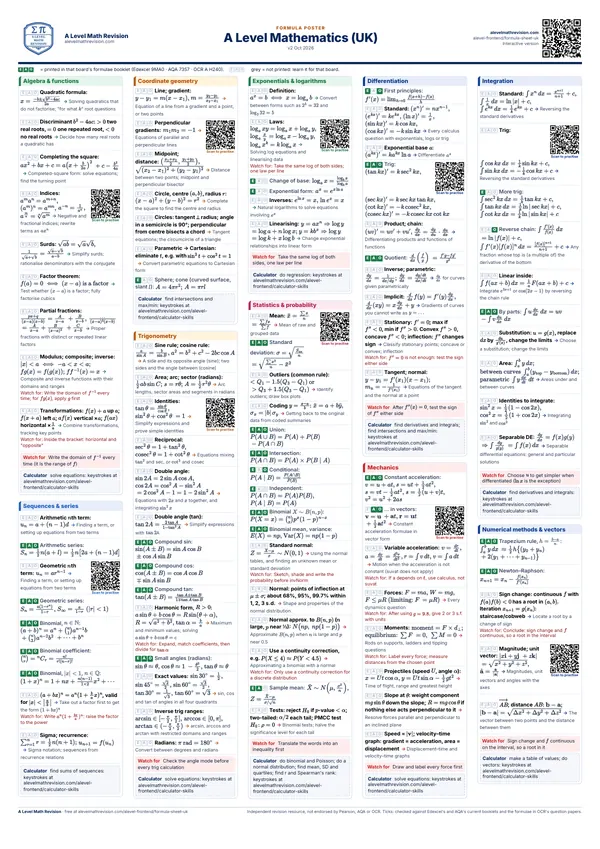
As well as the A4 sheet there is an A3 poster (it adds when to use each formula to learn, mistakes to watch for, and a QR code per topic that leads to practice), a print-friendly black and white A4 version, and a one-page sheet of only the formulas you must memorise. On this page you can also search, filter by topic, tick off the formulas you know and copy any formula as LaTeX.
Is it free?
Yes. Every PDF and this page are free to download and print, with no sign-up.
Make a free account: no card needed5 more practice questions on every topic with instant feedback, answers and mark schemes on free questions, 3 AI-marked answers a week, free, and your streak and progress on any device.