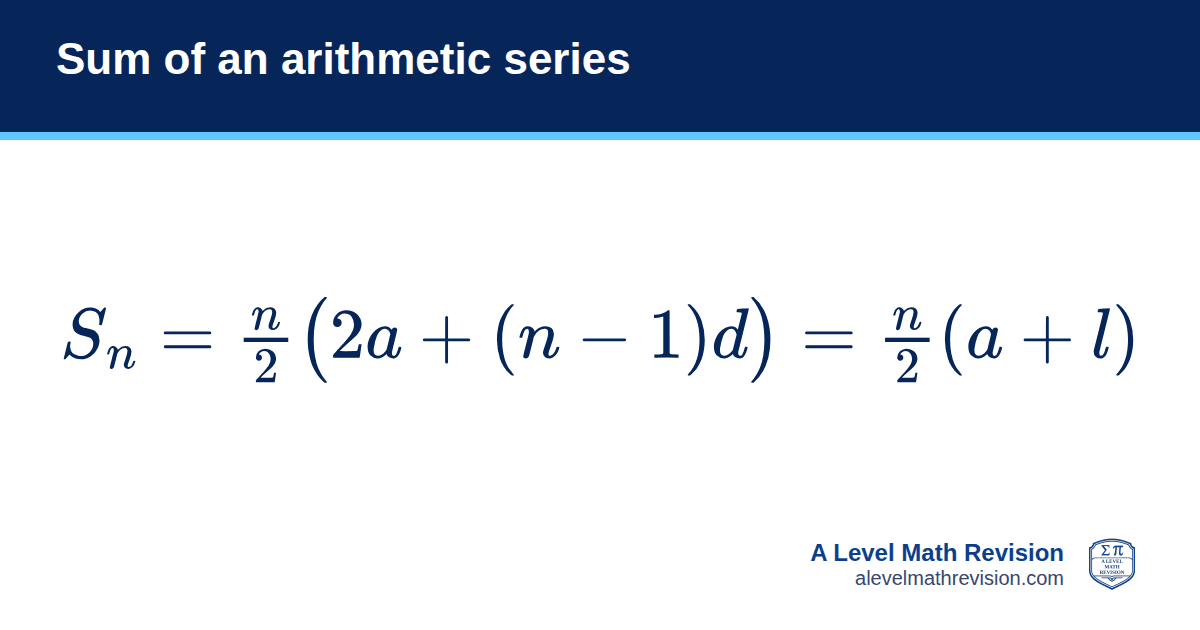
Sum of arithmetic series formula: Sₙ = n/2 (2a + (n − 1)d)
The sum of arithmetic series formula is Sₙ = n/2 × (2a + (n − 1)d) = n/2 × (a + l).
What each letter means
- \(S_n\) the sum of the first n terms
- \(a\) the first term
- \(d\) the common difference
- \(l\) the last term
- \(n\) the number of terms
When to use it
In A Level for totals that rise by a fixed amount, and with Σ notation: Σ (3r + 2) from r = 1 to 20 is an arithmetic series with a = 5, d = 3 and n = 20.
Worked example
Find the sum of all the multiples of 7 between 100 and 300.
- The terms are \(105, 112, \dots, 294\), so \(n=\dfrac{294-105}{7}+1=28\)
- \(S_{28}=\dfrac{28}{2}(105+294)=14\times399\)
Answer: \(5586\)
Common mistake
Misreading the limits of a sum. Σ from r = 5 to 20 has 16 terms, not 15.
Fix it with practice: Skill Builder: Arithmetic sequences & series (free account).
Try one yourself
One quick A Level Maths question on the sum of an arithmetic series. No sign-in needed.
Get 5 more like this — freeGoogle, Microsoft or email. No card needed.
On your A Level Maths course
| Course | In the exam |
|---|---|
| UK A Level (Edexcel, AQA, OCR) | Given by Edexcel, AQA and OCR |
| Edexcel International A Level | In Pearson’s IAL formulae booklet |
From our own A Level Maths formula sheets, in our words. Official: Pearson's formulae booklet (PDF) · AQA's formulae booklet (PDF) · OCR's H240 assessment page · Pearson's IAL formulae booklet (PDF).
Practise and revise
A Level Maths FAQ
Is the sum of an arithmetic series in the A Level formula booklet?
UK A Level (Edexcel, AQA, OCR): given by Edexcel, AQA and OCR. Edexcel International A Level: in Pearson’s IAL formulae booklet.
How do I prove the arithmetic series formula?
Write Sₙ forwards and backwards and add: each pair sums to 2a + (n − 1)d, and there are n pairs, so 2Sₙ = n(2a + (n − 1)d).
Our own wording, examples and card, checked by A Level Math Revision. Not produced or endorsed by Pearson Edexcel, AQA or OCR.