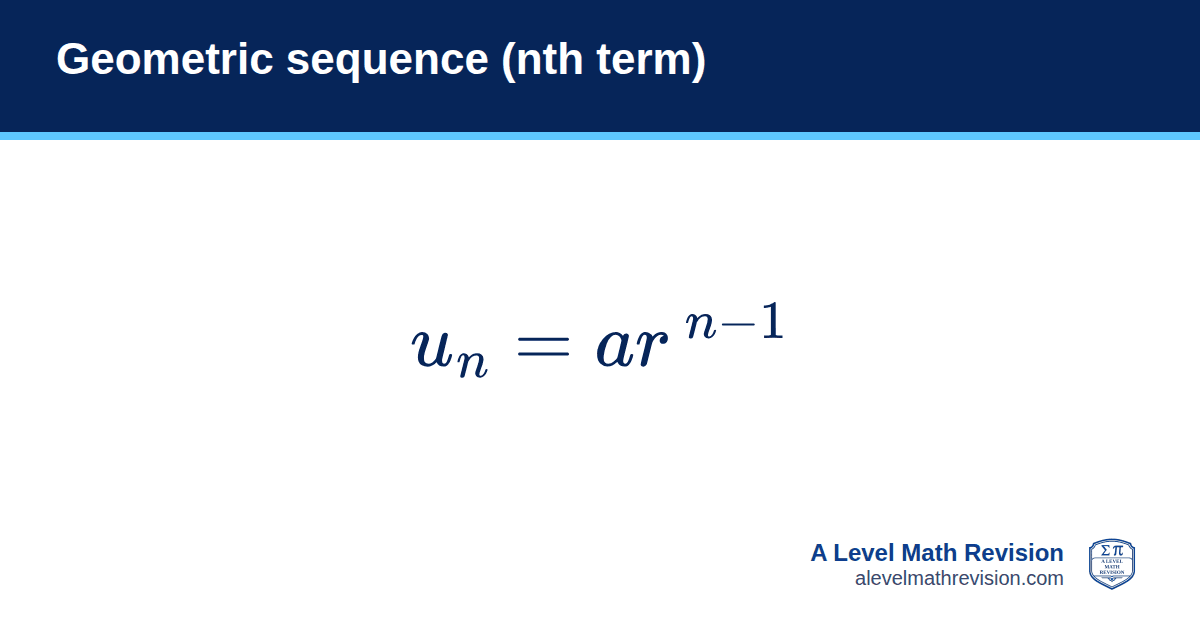
Geometric sequence formula: uₙ = arⁿ⁻¹
The geometric sequence formula is uₙ = arⁿ⁻¹.
What each letter means
- \(u_n\) the nth term
- \(a\) the first term
- \(r\) the common ratio
- \(n\) the position of the term
When to use it
When each term is the previous one multiplied by the same number: compound growth, depreciation, bouncing balls, populations.
Worked example
The 2nd term of a geometric sequence is 12 and the 5th term is 96. Find the common ratio and the first term.
- \(ar=12\) and \(ar^4=96\), so \(r^3=\dfrac{96}{12}=8\)
- \(r=2\), and \(a=\dfrac{12}{2}\)
Answer: \(r=2\), \(a=6\)
Common mistake
Using rⁿ instead of rⁿ⁻¹. The first term has not been multiplied by r at all, so the 8th term has r⁷.
On your course
| Course | In the exam |
|---|---|
| Edexcel A Level (9MA0) | Not in the Edexcel booklet: learn it |
| AQA or OCR A Level | Check your board’s formula booklet: AQA formulae booklet (PDF) · OCR A Level Maths assessment page |
From our own A Level Maths formula sheets, in our words. Official: Pearson's formulae booklet (PDF).
Practise and revise
- Practise A Level Maths practice
- Revise Sequences and series
- Print Edexcel A Level (9MA0) one-page formula sheet
Questions
What is the geometric sequence formula?
The geometric sequence formula is uₙ = arⁿ⁻¹. uₙ: the nth term; a: the first term; r: the common ratio; n: the position of the term.
Is the geometric sequence (nth term) given in the exam?
Edexcel A Level (9MA0): not in the Edexcel booklet: learn it. AQA or OCR A Level: check your board’s formula booklet. This comes from our own A Level Maths formula sheets; your teacher has the official booklet.
How do I find the common ratio?
Divide any term by the one before it: r = u₂ ÷ u₁. If you know two terms that are not next to each other, divide them to get a power of r and take the root.
Our own wording, examples and card, checked by A Level Math Revision. Not produced or endorsed by Pearson Edexcel, AQA or OCR.