A Level Math Revisionalevelmathrevision.com
Edexcel International A Level MathematicsP1 · P2 · P3 · P4 · S1 · M1 · one-page formula sheet
★ Learn it: not in the Pearson Edexcel IAL formulae booklet. In the booklet.
P1 · Pure 1
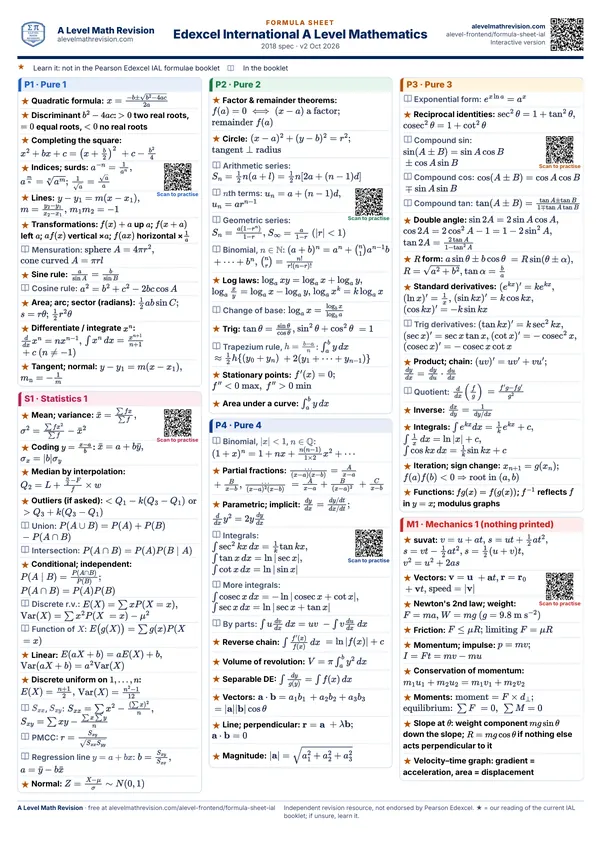
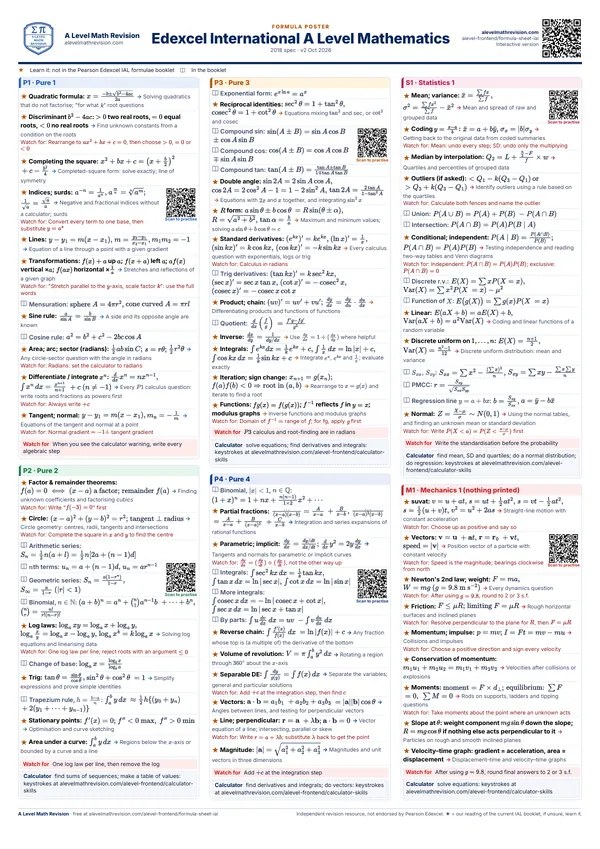
★Quadratic formula: \(x=\frac{-b\pm\sqrt{b^2-4ac}}{2a}\)Use: Solving quadratics that do not factorise; "for what \(k\)" root questions
★Discriminant \(b^2-4ac\): \(>0\) two real roots, \(=0\) equal roots, \(<0\) no real rootsUse: Find unknown constants from a condition on the rootsWatch for: Rearrange to \(ax^{2} + bx + c = 0\), then choose \(> 0\), \(= 0\) or \(< 0\)
★Completing the square: \(x^2+bx+c=\left(x+\tfrac b2\right)^2\) \({}+c-\tfrac{b^2}4\)Use: Completed-square form: solve exactly; line of symmetry
★Indices; surds: \(a^{-n}=\tfrac1{a^n},\) \(a^{\frac mn}=\sqrt[n]{a^m};\) \(\frac{1}{\sqrt a}=\frac{\sqrt a}a\)Use: Negative and fractional indices without a calculator; surdsWatch for: Convert every term to one base, then substitute \(y = a^{x}\)
★Lines: \(y-y_1=m(x-x_1),\) \(m=\frac{y_2-y_1}{x_2-x_1},\) \(m_1m_2=-1\)Use: Equation of a line through a point with a given gradientExplained: Equation of a straight line · Gradient formula
★Transformations: \(f(x)+a\) up \(a\); \(f(x+a)\) left \(a\); \(af(x)\) vertical ×\(a\); \(f(ax)\) horizontal ×\(\tfrac1a\)Use: Stretches and reflections of a given graphWatch for: "Stretch parallel to the \(y\)-axis, scale factor \(k\)": use the full words
Mensuration: \(\text{sphere }A=4\pi r^2,\) \(\text{cone curved }A=\pi rl\)Use: Volumes of revolution and combined solids such as cones
★Area; arc; sector (radians): \(\tfrac12ab\sin C;\) \(s=r\theta;\) \(\tfrac12r^2\theta\)Use: Any circle-sector question with the angle in radiansWatch for: Radians: set the calculator to radians
★Differentiate / integrate \(x^n\): \(\tfrac{d}{dx}x^n=nx^{n-1},\) \(\int x^n\,dx=\tfrac{x^{n+1}}{n+1}\) \({}+c\ (n\ne-1)\)Use: Every \(P1\) calculus question: write roots and fractions as powers firstWatch for: Always write \(+ c\)
★Tangent; normal: \(y-y_1=m(x-x_1),\) \(m_\text{n}=-\tfrac1m\)Use: Equations of the tangent and normal at a pointWatch for: Normal gradient \(= -1 \div\) tangent gradient
Watch for: When you see the calculator warning, write every algebraic step
P2 · Pure 2
★Factor & remainder theorems: \(f(a)=0\iff(x-a)\text{ a factor};\) \(\text{remainder }f(a)\)Use: Finding unknown coefficients and factorising cubicsWatch for: Write "\(f(-3) = 0\)" first
★Circle: \((x-a)^2+(y-b)^2=r^2;\) \(\text{tangent}\perp\text{radius}\)Use: Circle geometry: centres, radii, tangents and intersectionsWatch for: Complete the square in \(x\) and \(y\) to find the centre
Arithmetic series: \(S_n=\tfrac12n(a+l)=\tfrac12n[2a+(n-1)d]\)Use: Least \(n\) for which the sum exceeds a value
\(n\)th terms: \(u_n=a+(n-1)d,\) \(u_n=ar^{n-1}\)Use: Finding a term, or setting up equations from two terms
Geometric series: \(S_n=\frac{a(1-r^n)}{1-r},\) \(S_\infty=\frac a{1-r}\ (|r|<1)\)Use: Savings that grow by a fixed percentage; sum to infinityWatch for: Only use \(S\infty = \frac{a}{1 - r}\) when \(|r| < 1\)Explained: Sum of a geometric series · Sum to infinity of a geometric series
Binomial, \(n\in\mathbb N\): \((a+b)^n=a^n+\tbinom n1a^{n-1}b\) \({}+\cdots+b^n,\) \(\tbinom nr=\frac{n!}{r!(n-r)!}\)Use: Expand \((a + bx)^{n}\); find a specified coefficientWatch for: Bracket the second term, e.g. \((-x)^{2}\)
★Log laws: \(\log_axy=\log_ax+\log_ay,\) \(\log_a\tfrac xy=\log_ax-\log_ay,\) \(\log_ax^k=k\log_ax\)Use: Solving log equations and linearising dataWatch for: One log law per line; reject roots with an argument \(\le 0\)
Change of base: \(\log_ax=\frac{\log_bx}{\log_ba}\)Use: Convert between index and log form; evaluate logs
★Trig: \(\tan\theta=\frac{\sin\theta}{\cos\theta},\) \(\sin^2\theta+\cos^2\theta\) \({}=1\)Use: Simplify expressions and prove simple identities
Trapezium rule, \(h=\tfrac{b-a}n\): \(\int_a^by\,dx\) \({}\approx\tfrac12h\{(y_0+y_n)\) \({}+2(y_1+\cdots+y_{n-1})\}\)Use: Estimate an area; too big or too small from the shapeWatch for: \(h = \frac{b - a}{n}\) for \(n\) strips
★Stationary points: \(f'(x)=0;\) \(f''<0\text{ max},\ f''>0\text{ min}\)Use: Optimisation and curve sketching
★Area under a curve: \(\int_a^by\,dx\)Use: Regions below the \(x\)-axis or bounded by a curve and a line
Watch for: One log law per line, then remove the log
P3 · Pure 3
Exponential form: \(e^{x\ln a}=a^x\)Use: Exponential growth and decay modelsWatch for: \(e^{0} = 1\) at \(t = 0\); for "long term" let the exponential tend to 0
★Reciprocal identities: \(\sec^2\theta=1+\tan^2\theta,\) \(\cosec^2\theta=1+\cot^2\theta\)Use: Equations mixing \(\tan^{2}\) and sec, or \(\cot^{2}\) and cosec
Compound sin: \(\sin(A\pm B)=\sin A\cos B\) \({}\pm\cos A\sin B\)Use: Expand and simplify trigonometric expressions
Compound cos: \(\cos(A\pm B)=\cos A\cos B\) \({}\mp\sin A\sin B\)Use: Expand and simplify trigonometric expressions
Compound tan: \(\tan(A\pm B)=\frac{\tan A\pm\tan B}{1\mp\tan A\tan B}\)Use: Expand and simplify trigonometric expressions
★Double angle: \(\sin2A=2\sin A\cos A,\) \(\cos2A=2\cos^2A-1=1-2\sin^2A,\) \(\tan2A=\frac{2\tan A}{1-\tan^2A}\)Use: Equations with \(2x\) and \(x\) together, and integrating \(\sin^{2} x\)
★\(R\) form: \(a\sin\theta\pm b\cos\theta\) \({}=R\sin(\theta\pm\alpha),\) \(R=\sqrt{a^2+b^2},\) \(\tan\alpha=\tfrac ba\)Use: Maximum and minimum values; solving \(a \sin \theta + b \cos \theta = c\)
★Standard derivatives: \((e^{kx})'=ke^{kx},\) \((\ln x)'=\tfrac1x,\) \((\sin kx)'=k\cos kx,\) \((\cos kx)'=-k\sin kx\)Use: Every calculus question with exponentials, logs or trigWatch for: Calculus in radians
Trig derivatives: \((\tan kx)'=k\sec^2kx,\) \((\sec x)'=\sec x\tan x,\) \((\cot x)'=-\cosec^2x,\) \((\cosec x)'=-\cosec x\cot x\)Use: Combine with the chain, product and quotient rules
Quotient: \(\frac{d}{dx}\Big(\frac{f}{g}\Big)\) \({}=\frac{f'g-fg'}{g^2}\)Use: Differentiate quotients such as \(\frac{e^{x}}{x + 1}\)Watch for: Write \(u\), \(v\), \(u'\), \(v'\) first; the denominator is \(v^{2}\)
★Inverse: \(\frac{dx}{dy}=\frac1{dy/dx}\)Use: Use \(\frac{dy}{dx} = 1 \div (\frac{dx}{dy})\) where helpful
★Integrals: \(\int e^{kx}dx=\tfrac1ke^{kx}+c,\) \(\int\tfrac1x\,dx=\ln|x|+c,\) \(\int\cos kx\,dx=\tfrac1k\sin kx+c\)Use: Integrate \(e^{x}\), \(e^{kx}\) and \(\frac{1}{x}\); evaluate exactly
★Iteration; sign change: \(x_{n+1}=g(x_n);\) \(f(a)f(b)<0\Rightarrow\text{root in }(a,b)\)Use: Rearrange to \(x = g(x)\) and iterate to find a root
★Functions: \(fg(x)=f(g(x))\); \(f^{-1}\) reflects \(f\) in \(y=x\); modulus graphsUse: Inverse functions and modulus graphsWatch for: Domain of \(f^{-1} =\) range of \(f\); for fg, apply \(g\) first
Watch for: \(P3\) calculus and root-finding are in radians
P4 · Pure 4
Binomial, \(|x|<1\), \(n\in\mathbb Q\): \((1+x)^n=1+nx+\frac{n(n-1)}{1\times2}x^2+\cdots\)Use: Expanding \((a + bx)^{n}\) for negative or fractional \(n\)Watch for: Write \(a^{n}(1 + \frac{bx}{a})^{n}\) and state the validity
★Partial fractions: \(\frac{\dots}{(x-a)(x-b)}=\frac{A}{x-a}\) \({}+\frac{B}{x-b},\) \(\frac{\dots}{(x-a)^2(x-b)}\) \({}=\frac{A}{x-a}+\frac{B}{(x-a)^2}\) \({}+\frac{C}{x-b}\)Use: Integration and series expansions of rational functions
★Parametric; implicit: \(\frac{dy}{dx}=\frac{dy/dt}{dx/dt};\) \(\tfrac{d}{dx}y^2=2y\tfrac{dy}{dx}\)Use: Tangents and normals for parametric or implicit curvesWatch for: \(\frac{dy}{dx} = (\frac{dy}{dt}) \div (\frac{dx}{dt})\), not the other way up
Integrals: \(\int\sec^2kx\,dx=\tfrac1k\tan kx,\) \(\int\tan x\,dx=\ln|\sec x|,\) \(\int\cot x\,dx=\ln|\sin x|\)Use: Reversing the standard derivatives
More integrals: \(\int\cosec x\,dx=-\ln|\cosec x+\cot x|,\) \(\int\sec x\,dx=\ln|\sec x+\tan x|\)Use: Choose an efficient integration method
By parts: \(\int u\frac{dv}{dx}\,dx=uv\) \({}-\int v\frac{du}{dx}\,dx\)Use: Integrate products such as \(x \cos x\) and \(x e^{x}\)
★Reverse chain: \(\int\frac{f'(x)}{f(x)}\,dx\) \({}=\ln|f(x)|+c\)Use: Any fraction whose top is (a multiple of) the derivative of the bottom
★Volume of revolution: \(V=\pi\int_a^by^2\,dx\)Use: Rotating a region through \(360^\circ\) about the \(x\)-axis
★Separable DE: \(\int\frac{dy}{g(y)}=\int f(x)\,dx\)Use: Separate the variables; general and particular solutionsWatch for: Add \(+ c\) at the integration step, then find \(c\)
★Vectors: \(\mathbf a\cdot\mathbf b=a_1b_1\) \({}+a_2b_2+a_3b_3\) \({}=|\mathbf a||\mathbf b|\cos\theta\)Use: Angles between lines, and testing for perpendicular vectors
★Line; perpendicular: \(\mathbf r=\mathbf a\) \({}+\lambda\mathbf b;\) \(\mathbf a\cdot\mathbf b=0\)Use: Vector equation of a line; intersecting, parallel or skewWatch for: Write \(r = a + \lambda b\); substitute \(\lambda\) back to get the point
★Magnitude: \(|\mathbf a|=\sqrt{a_1^2+a_2^2+a_3^2}\)Use: Magnitudes and unit vectors in three dimensions
Watch for: Add \(+ c\) at the integration step
S1 · Statistics 1
★Mean; variance: \(\bar x=\frac{\sum fx}{\sum f},\) \(\sigma^2=\frac{\sum fx^2}{\sum f}-\bar x^2\)Use: Mean and spread of raw and grouped data
★Coding \(y=\frac{x-a}b\): \(\bar x=a+b\bar y,\) \(\sigma_x=|b|\sigma_y\)Use: Getting back to the original data from coded summariesWatch for: Mean: undo every step; SD: undo only the multiplying
★Median by interpolation: \(Q_2=L+\frac{\frac n2-F}{f}\times w\)Use: Quartiles and percentiles of grouped data
★Outliers (if asked): \(<Q_1-k(Q_3-Q_1)\) \(\text{or}\) \({}>Q_3+k(Q_3-Q_1)\)Use: Identify outliers using a rule based on the quartilesWatch for: Calculate both fences and name the outlier
Union: \(P(A\cup B)=P(A)+P(B)\) \({}-P(A\cap B)\)Use: Unions, intersections and complements from Venn diagrams
Intersection: \(P(A\cap B)=P(A)P(B\mid A)\)Use: Probability formulae for unions and intersections
★Conditional; independent: \(P(A\mid B)=\frac{P(A\cap B)}{P(B)};\) \(P(A\cap B)=P(A)P(B)\)Use: Testing independence and reading two-way tables and Venn diagramsWatch for: Independent: \(P(A \cap B) = P(A)P(B)\); exclusive: \(P(A \cap B) = 0\)
Discrete r.v.: \(E(X)=\sum xP(X=x),\) \(\mathrm{Var}(X)=\sum x^2P(X\) \({}=x)-\mu^2\)Use: \(E(X)\) and \(\operatorname{Var}(X)\) from a probability distributionWatch for: \(P(X = x) = F(x) - F(x - 1)\) from a cumulative function
Function of \(X\): \(E\big(g(X)\big)=\sum g(x)P(X\) \({}=x)\)Use: Expectation of a discrete random variable
★Linear: \(E(aX+b)=aE(X)+b,\) \(\mathrm{Var}(aX+b)=a^2\mathrm{Var}(X)\)Use: Coding and linear functions of a random variable
★Discrete uniform on \(1,\dots,n\): \(E(X)=\tfrac{n+1}2,\) \(\mathrm{Var}(X)=\tfrac{n^2-1}{12}\)Use: Discrete uniform distribution: mean and variance
\(S_{xx}\), \(S_{xy}\): \(S_{xx}=\sum x^2-\frac{(\sum x)^2}n,\) \(S_{xy}=\sum xy-\frac{\sum x\sum y}n\)Use: Sxx, Syy and Sxy from summary statisticsWatch for: Substitute the numbers visibly in a "show that"
PMCC: \(r=\frac{S_{xy}}{\sqrt{S_{xx}S_{yy}}}\)Use: Product moment correlation coefficient
Regression line \(y=a+bx\): \(b=\frac{S_{xy}}{S_{xx}},\) \(a=\bar y-b\bar x\)Use: Least squares regression line from summary statistics
★Normal: \(Z=\frac{X-\mu}\sigma\sim N(0,1)\)Use: Using the normal tables, and finding an unknown mean or standard deviationWatch for: Write \(P(X < a) = P(Z < \frac{a - \mu}{\sigma})\) first
Watch for: Write the standardisation before the probability
M1 · Mechanics 1 (nothing printed)
★suvat: \(v=u+at,\) \(s=ut+\tfrac12at^2,\) \(s=vt-\tfrac12at^2,\) \(s=\tfrac12(u+v)t,\) \(v^2=u^2+2as\)Use: Straight-line motion with constant accelerationWatch for: Choose up as positive and say so
★Vectors: \(\mathbf v=\mathbf u\) \({}+\mathbf at,\) \(\mathbf r=\mathbf r_0\) \({}+\mathbf vt,\) \(\text{speed}=|\mathbf v|\)Use: Position vector of a particle with constant velocityWatch for: Speed is the magnitude; bearings clockwise from north
★Newton's 2nd law; weight: \(F=ma,\) \(W=mg\ (g=9.8\text{ m s}^{-2})\)Use: Every dynamics questionWatch for: After using \(g = 9.8\), round to 2 or 3 s.f.
★Friction: \(F\le\mu R;\) \(\text{limiting }F=\mu R\)Use: Rough horizontal surfaces and inclined planesWatch for: Resolve perpendicular to the plane for \(R\), then \(F = \mu R\)
★Momentum; impulse: \(p=mv;\) \(I=Ft=mv-mu\)Use: Collisions and impulsesWatch for: Choose a positive direction and sign every velocity
★Conservation of momentum: \(m_1u_1+m_2u_2=m_1v_1+m_2v_2\)Use: Velocities after collisions or explosions
★Moments: \(\text{moment}=F\times d_\perp;\) \(\text{equilibrium: }\textstyle\sum F\) \({}=0,\ \sum M=0\)Use: Rods on supports, ladders and tipping questionsWatch for: Take moments about the point where an unknown acts
★Slope at \(\theta\): weight component \(mg\sin\theta\) down the slope; \(R=mg\cos\theta\) if nothing else acts perpendicular to itUse: Particles on rough and smooth inclined planes
★Velocity–time graph: gradient = acceleration, area = displacementUse: Displacement–time and velocity–time graphs
Watch for: After using \(g = 9.8\), round final answers to 2 or 3 s.f.