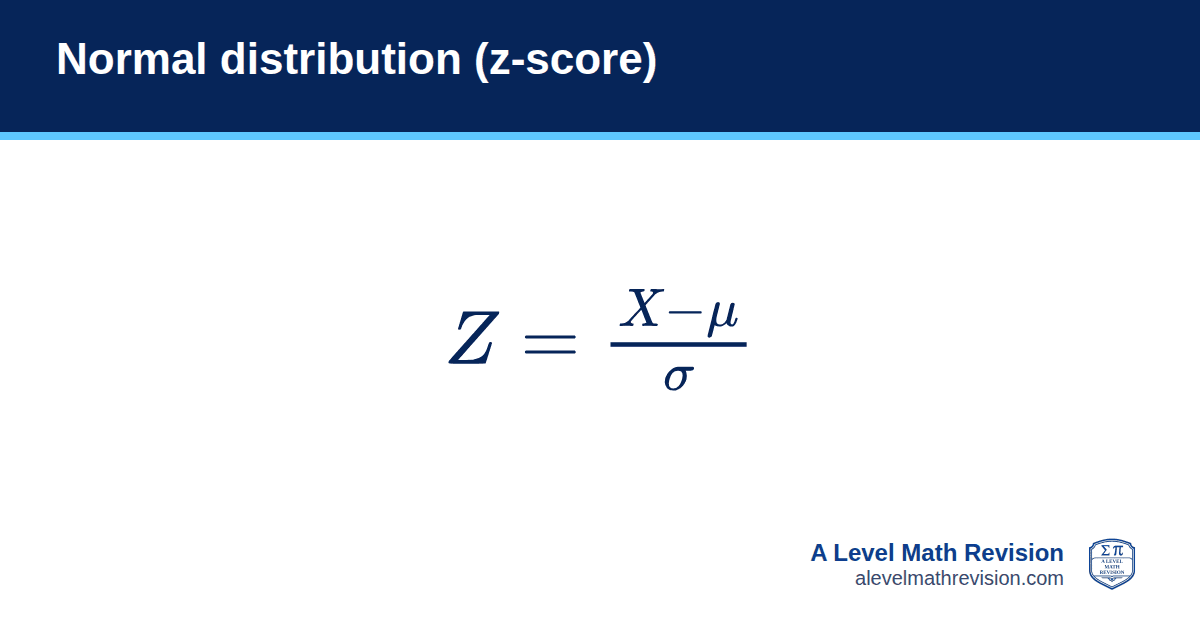
Normal distribution formula: z = (x − μ) / σ
The normal distribution formula is z = (x − μ) / σ, which turns X ~ N(μ, σ²) into Z ~ N(0, 1).
What each letter means
- \(X\) a normally distributed variable, X ~ N(μ, σ²)
- \(\mu\) the mean
- \(\sigma\) the standard deviation (the square root of the variance σ²)
- \(Z\) the standard normal variable, mean 0 and standard deviation 1
When to use it
In A Level statistics the calculator gives normal probabilities directly, so you standardise mainly when μ or σ is unknown: write P(X < a) as P(Z < (a − μ)/σ), find z with the inverse normal, then solve. The same idea gives z = (x̄ − μ)/(σ/√n) in a test for a mean.
Worked example
Heights are modelled by \(X\sim N(170,\,8^2)\) cm. Find \(P(X\gt180)\).
- \(z=\dfrac{180-170}{8}=1.25\)
- \(P(Z\gt1.25)=1-P(Z\lt1.25)\)
Answer: \(P(X\gt180)=0.106\) (3 s.f.)
Common mistake
Using σ instead of σ/√n in a test for a sample mean. The sample mean has X̄ ~ N(μ, σ²/n), so its standard deviation is σ/√n.
Fix it with practice: Skill Builder: The normal distribution (free account).
Try one yourself
One quick A Level Maths question on the normal distribution (z-score). No sign-in needed.
Get 5 more like this — freeGoogle, Microsoft or email. No card needed.
On your A Level Maths course
| Course | In the exam |
|---|---|
| UK A Level (Edexcel, AQA, OCR) | Not given by Edexcel, AQA or OCR: learn it |
| Edexcel International A Level | Not in the booklet: learn it |
From our own A Level Maths formula sheets, in our words. Official: Pearson's formulae booklet (PDF) · AQA's formulae booklet (PDF) · OCR's H240 assessment page · Pearson's IAL formulae booklet (PDF).
Practise and revise
A Level Maths FAQ
Is the normal distribution (z-score) in the A Level formula booklet?
UK A Level (Edexcel, AQA, OCR): not given by Edexcel, AQA or OCR: learn it. Edexcel International A Level: not in the booklet: learn it.
When can a normal distribution approximate a binomial one?
When n is large and p is close to 0.5. Use N(np, np(1 − p)) with a continuity correction: P(X ≤ 20) becomes P(Y < 20.5).
Our own wording, examples and card, checked by A Level Math Revision. Not produced or endorsed by Pearson Edexcel, AQA or OCR.