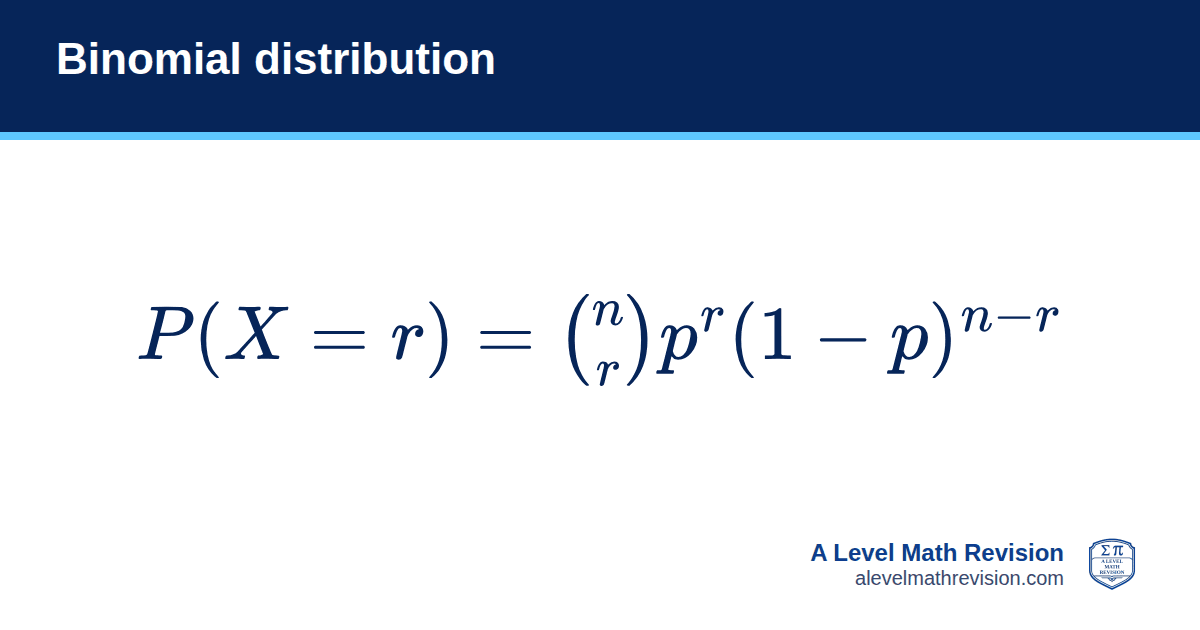
Binomial distribution formula: P(X = r) = nCr pʳ(1 − p)ⁿ⁻ʳ
The binomial distribution formula is P(X = r) = nCr × pʳ × (1 − p)ⁿ⁻ʳ.
What each letter means
- \(n\) the number of trials
- \(p\) the probability of success in one trial
- \(r\) the number of successes
- \(\binom{n}{r}\) nCr, the number of orders the successes can come in
When to use it
When there is a fixed number of independent trials, each with the same two outcomes and the same probability of success.
Worked example
\(X\sim B(12,\,0.25)\). Find \(P(X=3)\).
- \(P(X=3)=\binom{12}{3}(0.25)^3(0.75)^9=220\times0.25^3\times0.75^9\)
Answer: \(P(X=3)=0.258\) (3 s.f.)
Common mistake
Leaving out nCr. pʳ(1 − p)ⁿ⁻ʳ is the probability of one particular order only.
On your course
| Course | In the exam |
|---|---|
| Edexcel A Level (9MA0) | In the Edexcel formulae booklet |
| AQA or OCR A Level | Check your board’s formula booklet: AQA formulae booklet (PDF) · OCR A Level Maths assessment page |
From our own A Level Maths formula sheets, in our words. Official: Pearson's formulae booklet (PDF).
Practise and revise
Questions
What is the binomial distribution formula?
The binomial distribution formula is P(X = r) = nCr × pʳ × (1 − p)ⁿ⁻ʳ. n: the number of trials; p: the probability of success in one trial; r: the number of successes; nCr: nCr, the number of orders the successes can come in.
Is the binomial distribution given in the exam?
Edexcel A Level (9MA0): in the Edexcel formulae booklet. AQA or OCR A Level: check your board’s formula booklet. This comes from our own A Level Maths formula sheets; your teacher has the official booklet.
What are the mean and variance of a binomial distribution?
For X ~ B(n, p): E(X) = np and Var(X) = np(1 − p).
Our own wording, examples and card, checked by A Level Math Revision. Not produced or endorsed by Pearson Edexcel, AQA or OCR.