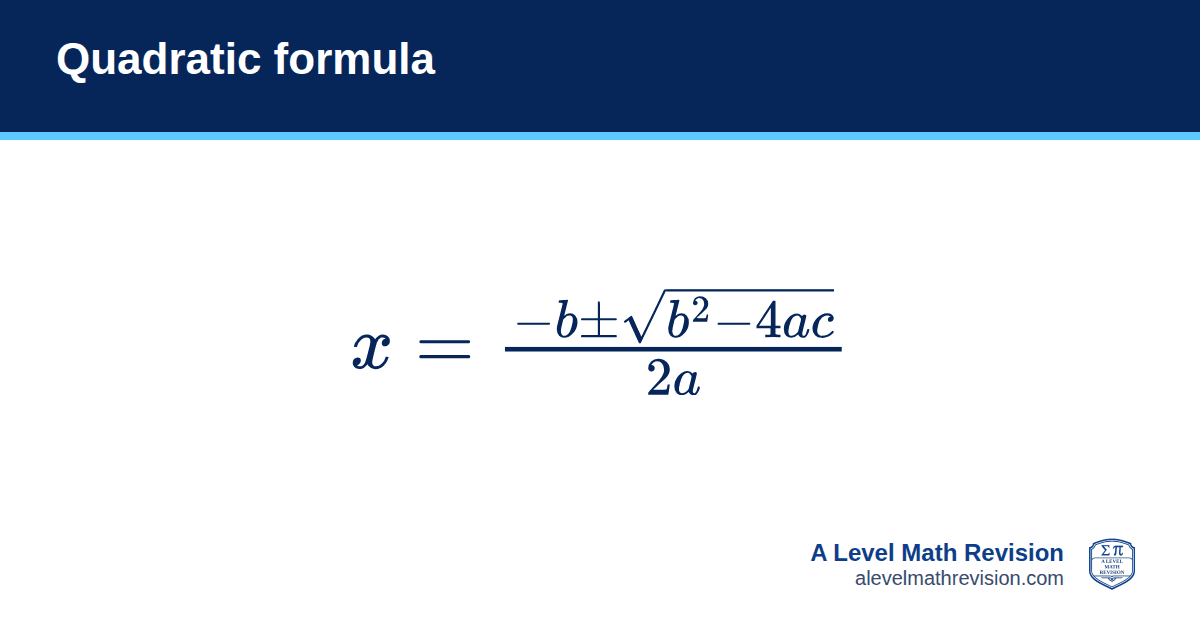
Quadratic formula: x = (−b ± √(b² − 4ac)) / 2a
The quadratic formula is x = (−b ± √(b² − 4ac)) / 2a.
What each letter means
- \(a,\ b,\ c\) the numbers in ax² + bx + c = 0 (a is not 0)
- \(x\) the solutions (roots) of the equation
- \(b^2-4ac\) the discriminant: it tells you how many real roots there are
When to use it
To solve any quadratic equation ax² + bx + c = 0, especially one that does not factorise. Rearrange so that one side is 0 before you read off a, b and c.
Worked example
Solve \(3x^2+5x-1=0\), giving your answers in exact form.
- \(a=3,\ b=5,\ c=-1\)
- \(x=\dfrac{-5\pm\sqrt{25+12}}{6}\)
Answer: \(x=\dfrac{-5+\sqrt{37}}{6}\) or \(x=\dfrac{-5-\sqrt{37}}{6}\)
Common mistake
Losing a minus sign. If b = −3, then −b = 3 and b² = 9, not −9. Put negative values in brackets when you substitute.
On your course
| Course | In the exam |
|---|---|
| Edexcel A Level (9MA0) | Not in the Edexcel booklet: learn it |
| Edexcel International A Level | Not in the booklet: learn it |
| AQA or OCR A Level | Check your board’s formula booklet: AQA formulae booklet (PDF) · OCR A Level Maths assessment page |
From our own A Level Maths formula sheets, in our words. Official: Pearson's formulae booklet (PDF) · Pearson's IAL formulae booklet (PDF).
Practise and revise
- Practise A Level Maths practice
- Revise Algebra and functions
- Revise IAL P1 algebra
- Print Edexcel A Level (9MA0) one-page formula sheet
Questions
What is the quadratic formula?
The quadratic formula is x = (−b ± √(b² − 4ac)) / 2a. a, b, c: the numbers in ax² + bx + c = 0 (a is not 0); x: the solutions (roots) of the equation; b²-4ac: the discriminant: it tells you how many real roots there are.
Is the quadratic formula given in the exam?
Edexcel A Level (9MA0): not in the Edexcel booklet: learn it. Edexcel International A Level: not in the booklet: learn it. AQA or OCR A Level: check your board’s formula booklet. This comes from our own A Level Maths formula sheets; your teacher has the official booklet.
What does the discriminant tell you?
If b² − 4ac is positive there are two different real roots, if it is 0 there is one repeated root, and if it is negative there are no real roots.
Our own wording, examples and card, checked by A Level Math Revision. Not produced or endorsed by Pearson Edexcel, AQA or OCR.