
Edexcel IAL M1 Maths Revision: Mechanics 1
Edexcel International A Level M1 (Mechanics 1): every topic with an exam-style question and its mark scheme, and 278 practice questions with mark schemes.
- 1h 30min written paper (75 marks), calculator permitted
- 7 topics
- 278 questions
Try one now
Free · no sign-inA particle moving with constant acceleration passes three points
Worked answer
- M1 for
- M1 for
- A1 for
- M1 for
- A1 for
M1 topics
- Kinematics9 easy · 15 medium · 13 hard
- Forces and Newton's Laws8 easy · 22 medium · 15 hard
- Moments10 easy · 21 medium · 12 hard
- Vectors (Mechanics context)13 easy · 31 medium · 19 hard
- Dynamics of a Particle5 easy · 17 medium · 8 hard
- Statics of a Particle9 easy · 14 medium · 7 hard
- Momentum and Impulse4 easy · 16 medium · 10 hard
5 more M1 practice questions on every topic, with instant feedback. Free account, no card. Join free
Try it now
1 of 5
- Question 1 of 5
- Question 2 of 5
- Question 3 of 5
- Question 4 of 5
- Question 5 of 5
5 quick questions from across IAL M1. No sign-in needed.
M1 past papers
Official Pearson M1 papers and mark schemes, with a timer: all IAL M1 past papers. Most recent: June 2025 · January 2025 · October 2024 · June 2024.
Knowledge organiser: Mechanics 1 (M1) on one page (key facts, formulas and mistakes to avoid; printable PDF)
M1 Kinematics
Constant-acceleration (suvat) formulae; vertical motion under gravity; displacement-time and velocity-time graphs (variable acceleration and projectiles are M2).
Example question
A particle moving with constant acceleration passes three points
Show the mark scheme
- M1 for
- M1 for
- A1 for
- M1 for
- A1 for
M1 Forces and Newton's Laws
Newton's three laws, resolving forces on inclines, connected particles (pulleys), friction with coefficient μ.
Example question
Two particles
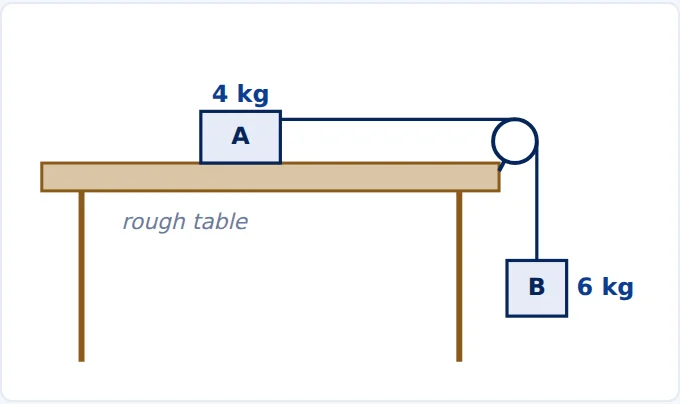
Show the mark scheme
For
M1 Moments
Moment of a force; equilibrium of a rod under parallel coplanar forces, including non-uniform rods and rods on the point of tilting.
Example question
A uniform plank of length
(a) Find, in terms of
(b) State the maximum value of
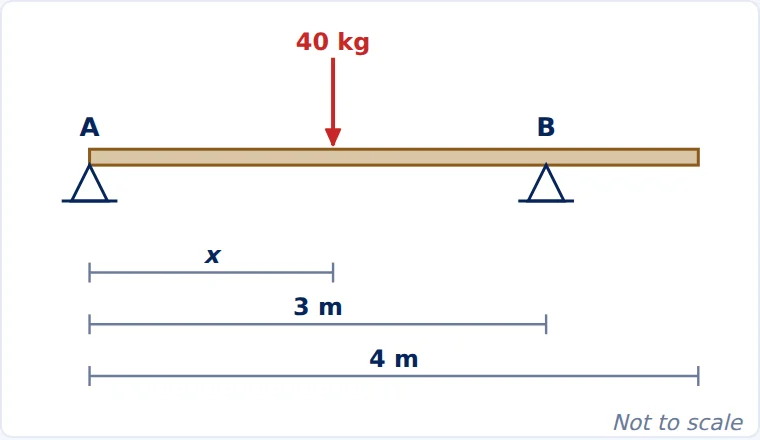
Show the mark scheme
(a) Moments about
(b) On point of tipping about
M1 Vectors (Mechanics context)
Position, velocity and force vectors in i, j form; magnitude and direction; r = r₀ + vt for constant velocity; resultant forces.
Example question
Ship A starts at position
- Write down the position vectors of Ship A and Ship B at time
- Find an expression for the square of the distance between the ships at time
- Find the exact time
Show the mark scheme
- M1 for writing the vector equations of motion.
A1 for - M1 for finding the relative displacement vector
M1 for setting up the square of the magnitude:
A1 for expanding and simplifying to a quadratic: - M1 for recognizing that minimum distance occurs when the derivative of
M1 for solving
A1 for finding exactly
M1 Dynamics of a Particle
F = ma in a straight line; connected particles over pulleys; tow-bars; lifts.
Example question
Two particles A and B of masses
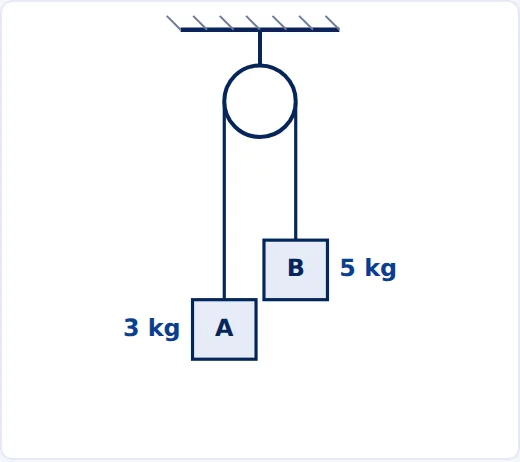
Show the mark scheme
- M1 for forming the equation for B (moving downwards):
- M1 for forming the equation for A (moving upwards):
- M1 for adding the equations to eliminate
- A1 for calculating
M1 Statics of a Particle
Resolving forces; equilibrium of a particle; friction and limiting equilibrium (F ≤ μR).
Example question
A particle of mass
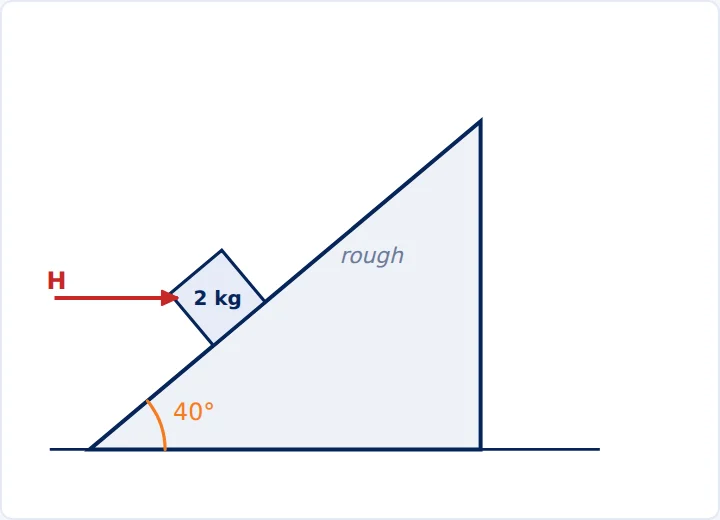
Show the mark scheme
- M1 for resolving perpendicular to the plane:
- M1 for resolving parallel to the plane (friction acts down):
- M1 for substituting
- M1 for rearranging to isolate
- A1 for calculating
M1 Momentum and Impulse
Momentum, impulse = change in momentum, conservation of momentum in direct collisions.
Example question
A ball of mass
Show the mark scheme
- M1 for finding the velocity just before impact using
- M1 for finding the velocity just after impact using
- M1 for calculating the impulse:
- A1 for evaluating
Your M1 revision kit
- IAL revision notesPlain-English topic notes for P1 to P4, S1 and M1, with key formulas and worked examples.
- M1 formulas (free PDF)The IAL formulas on one page, with the ones the Pearson booklet leaves out marked.
- M1 past papersPearson's own papers and mark schemes by series, with an exam timer.
- Calculator guideKeystrokes for the exam calculator skills. A calculator is allowed in every IAL unit, M1 included.
Save your M1 answers and track your progressA free account remembers the questions you have done and brings you back to this page.
Join freeAlready have an account? Sign in
FAQ
What is on the Edexcel IAL M1 exam?
M1 Mechanics 1 is assessed by a 1h 30min written paper (75 marks), calculator permitted. It covers Kinematics, Forces and Newton's Laws, Moments, Vectors (Mechanics context), Dynamics of a Particle, Statics of a Particle, Momentum and Impulse.
Can I use a calculator in M1?
Yes, a calculator is permitted in M1, as in every IAL maths unit. You still need to show full method to earn the M marks.
How many M1 practice questions are there?
278 exam-style M1 questions across 7 topics, each with an Edexcel-style mark scheme (M, A and B marks).
Which M1 topics come up most?
In our mapping of the 4 Pearson M1 papers from June 2024 to June 2025, Vectors (Mechanics context) (6 questions), Kinematics (5 questions), Dynamics of a Particle (5 questions) were tested most. Every topic can be examined in any series.
Where can I find M1 past papers?
Pearson publishes them. Our IAL M1 past papers page links to each official paper and mark scheme by series, with an exam timer.
How should I revise for M1?
Read the note for a topic, study the worked example and its mark scheme, practise that topic's questions, then sit a timed M1 past paper and check the common mistakes examiners report.
What is free on this page?
Everything here, with no sign-in: one example question with its mark scheme for every M1 topic, the worked examples on the topic pages and a quick quiz.
What does a free account add?
A free account (no card) adds 5 more practice questions on every topic with instant feedback, answers and mark schemes on free questions, 3 AI-marked answers a week, free, and your streak and progress on any device. The rest of the M1 bank with its mark schemes is part of the paid plans.