M1 forces is Newton's second law, , applied to particles on horizontal surfaces, on slopes, in lifts and joined by strings over pulleys, with friction . Draw a force diagram first, resolve in two directions, and write one equation of motion for each particle.
Start with one question on forces and Newton's second law. Stuck? Take a hint. No sign-in needed.
A particle slides down a smooth plane inclined at to the horizontal. Taking m s, find its acceleration.
A box of mass kg is pulled across rough horizontal ground by a horizontal force of N. The coefficient of friction is . Taking m s, find the acceleration of the box.
A particle of mass kg rests on a rough horizontal table. The coefficient of friction is . Taking m s, find the greatest possible friction force.
A puck of mass kg slides across a rough horizontal surface with no other horizontal force acting. The coefficient of friction is . Taking m s, find the deceleration of the puck.
A person of mass kg stands in a lift that is accelerating upwards at m s. Taking m s, find the normal reaction of the floor on the person.
Particles of mass kg and kg hang at the ends of a light inextensible string over a smooth fixed pulley. The system is released from rest. Taking m s, find the acceleration of the particles.
Resultant force mass acceleration, in the direction of the acceleration. Weight is with m s. In a lift accelerating upwards, the floor pushes harder than the weight: .
Resolving on a slope
On a slope at angle , split the weight into down the slope and into it. With no other force across the slope, . On a smooth slope at , a particle slides down with acceleration m s.
Friction
Friction opposes motion (or the tendency to move) and , with when the particle is moving or about to move (limiting). A kg box pulled by a horizontal N force on rough ground with : N, friction N, so m s.
Connected particles and pulleys
Particles joined by a light inextensible string share the same acceleration, and over a smooth pulley the tension is the same on both sides. A kg particle on a smooth table joined to a hanging kg particle: and , so m s and N.
Key formulas
Newton's 2nd law; weightLearn it
FrictionLearn it
Slope at : weight component down the slope; if nothing else acts perpendicular to itLearn it
In the formula booklet = printed in Pearson's IAL formulae booklet, so know where to find it. Learn it = not printed there, so learn it by heart. All M1 formulas on one page (free PDF) →
M1 Forces and Newton's Laws worked examples
Each mark scheme is checked line by line before it is published here. M marks are for method, A marks for accurate answers that follow from them, B marks for independent results.
Worked example 1 · 7 marks · hard
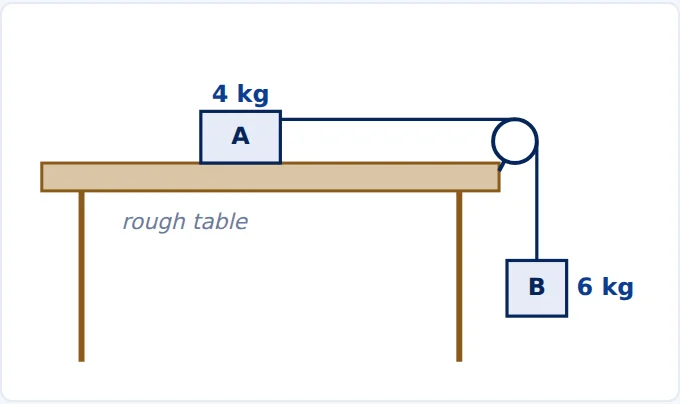
Two particles () and () are connected by a light inextensible string that passes over a smooth pulley at the edge of a rough horizontal table. rests on the table (coefficient of friction ); hangs freely. The system is released from rest. Find the acceleration and the tension in the string. Take .
Mark scheme
For :; friction M1 A1. Newton II on :M1. Newton II on :, i.e. M1. Add: A1. Then A1 A1.
Worked example 2 · 7 marks · hard
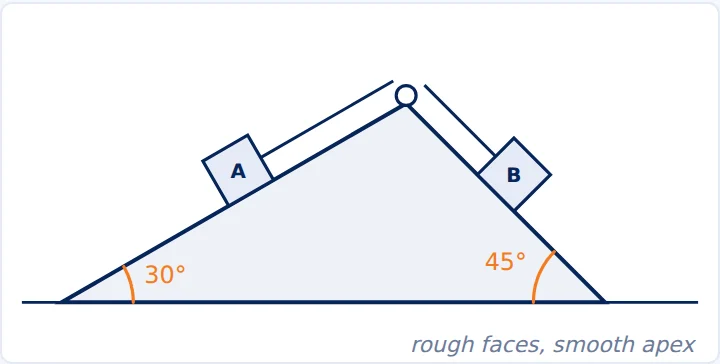
A wedge has two rough inclined faces, one at and the other at to the horizontal. A particle A of mass lies on the face and is connected by a light string passing over the smooth apex of the wedge to a particle B of mass on the face. The coefficient of friction on both faces is . Determine the acceleration of the particles.
Mark scheme
M1 for identifying the likely direction of motion: B () is heavier and on a steeper slope than A (), so B will move down its plane and A up its plane.
M1 for calculating friction on A (opposing motion, acting down): .
M1 for calculating friction on B (opposing motion, acting up): .
M1 for setting up equation of motion for A: .
M1 for setting up equation of motion for B: .
M1 for adding equations to eliminate T: .
A1 for finding (to 3 s.f.).
7 steps
Worked example 3 · 5 marks · medium
A puck of mass is projected across a rough horizontal ice rink with an initial speed of . It comes to rest after travelling . Find the coefficient of friction between the puck and the ice.
Mark scheme
M1 for selecting a SUVAT equation to find acceleration: .
M1 for substituting known values: .
A1 for calculating .
M1 for relating deceleration to friction: .
A1 for finding (to 3 s.f.).
5 steps
Free account: +5 more practice questions on forces and Newton's laws with instant feedback, and full worked answers on the free questions. Free, no card. Join free →
Common M1 forces and Newton's laws mistakes
Friction in the wrong direction. Friction acts against the motion. If the particle could move either way (on a slope, say), decide the direction of motion first.
Assuming R = mg. On a slope, or when a pulling force acts at an angle, resolve perpendicular to the surface: is usually not .
One equation for two particles. Write F = ma for each particle separately, each in its own direction of motion, then solve them together.
Over-precise answers. is given to 2 significant figures, so give final answers to 2 or 3 significant figures.
Take g = 9.8 m s⁻² unless a question says otherwise, and round answers that use it sensibly (2 or 3 significant figures).
When is friction equal to μR?
When the particle is moving, or on the point of moving (limiting equilibrium). Otherwise friction is only as large as it needs to be to stop motion, so F ≤ μR.
Is a calculator allowed in IAL M1?
Yes. A calculator is allowed in every Edexcel IAL maths unit, M1 included. Method marks are for the working you write down, so show it.
How long is the IAL M1 exam?
Each IAL maths unit, M1 included, is one written paper of 1 hour 30 minutes worth 75 marks.
How often does forces and Newton's laws come up in M1?
In our mapping of the 4 Pearson M1 papers from June 2024 to June 2025, forces and Newton's laws was tested in 3 of them (3 questions in all). Any topic can be examined in any series.
 A Level Math Revision