IAL M1 forces and newton's laws: exam questions with mark schemes
Newton's three laws, resolving forces on inclines, connected particles (pulleys), friction with coefficient μ.
Each question carries its marks, and its mark scheme sits under it: M marks for method, A marks for accuracy, B marks for a correct result on its own. Try the question on paper first, then open the solution and mark yourself the way an examiner would.
Edexcel IAL M1 Mechanics 1 · 10 questions · 44 marks · Resolving Forces at an Angle, Friction on a Horizontal Plane, SUVAT and Friction, newton-second-law, Connected Particles with Friction
A force of acts horizontally on a block of mass on a smooth surface. Find the acceleration.
Show solution
Newton II: M1. A1 A1.
Answer:
Question 2
3 marks · warm-up
A box of mass is pushed along a rough horizontal floor by a constant horizontal force of . The box moves at a constant velocity. Find the coefficient of friction between the box and the floor.
Show solution
M1 for identifying that constant velocity implies zero acceleration, so the driving force equals the frictional force: .
M1 for resolving vertically to find .
A1 for applying to find (to 3 s.f.).
Question 3
3 marks · standard
A rough horizontal floor has a coefficient of friction of . A block of mass is pulled by a horizontal force of and accelerates at . Find the value of .
Show solution
M1 for formulating the friction: .
M1 for setting up Newton's Second Law: .
A1 for solving for : (to 3 s.f.).
Question 4
4 marks · standard
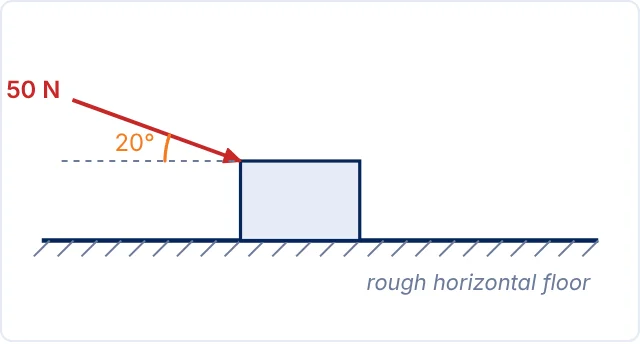
A block of mass is pushed along a rough horizontal floor by a force of acting at an angle of below the horizontal. The coefficient of friction is . Find the acceleration of the block.
Show solution
M1 for resolving vertically: .
M1 for calculating and hence .
M1 for resolving horizontally and applying :.
A1 for calculating (to 3 s.f.).
Question 5
5 marks · standard
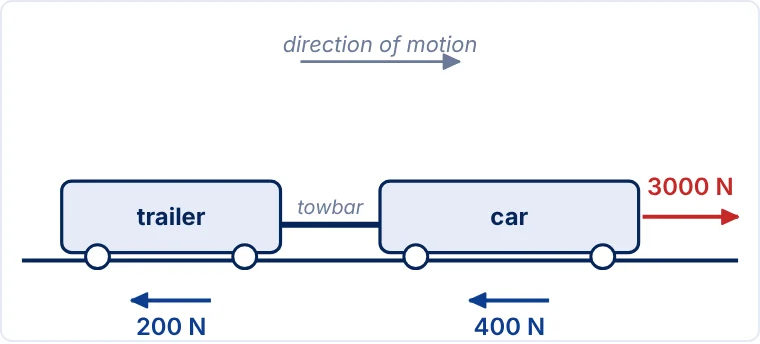
A car of mass tows a trailer of mass along a horizontal road. The tow-bar is horizontal and light. Total resistance to motion is (on the car) plus (on the trailer). The engine provides . Find the acceleration of the car and the tension in the tow-bar.
Show solution
Whole system: net force ; total mass ;M1 A1. Trailer alone (Newton II): M1 A1 A1.
Answer:;
Question 6
5 marks · standard
A sled of mass starts from rest and slides down a rough hill inclined at . After seconds, its velocity is . Find the coefficient of friction between the sled and the hill.
Show solution
M1 for finding the acceleration using SUVAT: .
M1 for setting up Newton's Second Law parallel to the plane: .
A1 for calculating .
M1 for resolving perpendicularly to find .
A1 for finding (to 3 s.f.).
Question 7
5 marks · harder
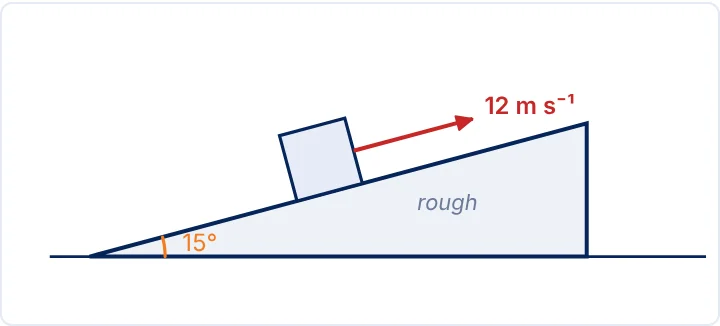
A particle is projected up a line of greatest slope of a rough plane inclined at an angle of to the horizontal. The initial speed is and the coefficient of friction is . Find the distance the particle travels up the plane before coming to instantaneous rest.
Show solution
M1 for determining the forces acting down the plane while moving up: weight component and friction.
M1 for calculating acceleration :.
A1 for evaluating .
M1 for applying SUVAT with :.
A1 for calculating distance (to 3 s.f.).
Question 8
5 marks · harder
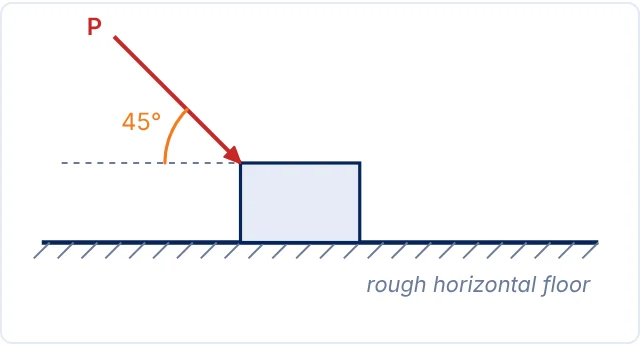
A wooden crate of mass sits on a rough horizontal floor. A worker pushes the crate with a force downwards at an angle of to the horizontal. The coefficient of friction is . Find the maximum value of that can be applied without the crate moving.
Show solution
M1 for resolving vertically to find the normal reaction: .
M1 for setting up the limiting friction condition: .
M1 for resolving horizontally in limiting equilibrium: .
M1 for substituting and gathering terms in :.
A1 for calculating (to 3 s.f.).
Question 9
5 marks · harder
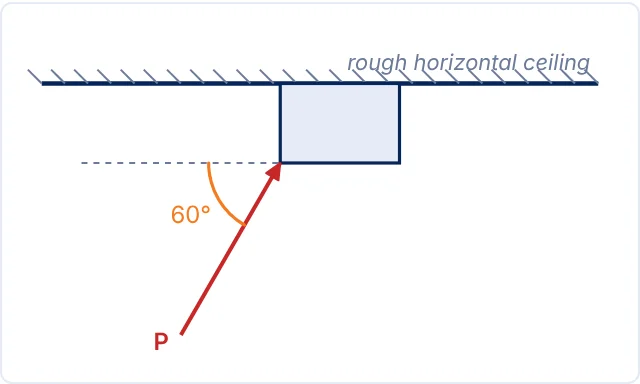
A box of mass is pushed at a constant speed along a rough horizontal ceiling (the box is underneath the ceiling) by a force acting upwards at an angle of to the horizontal. The coefficient of friction between the box and the ceiling is . Find the magnitude of .
Show solution
resolving vertically, the ceiling pushes down on the box: M1 A1 resolving horizontally at constant speed, with :M1 A1 N (3 s.f.) A1
Answer: N
Answer: N
Question 10
6 marks · harder
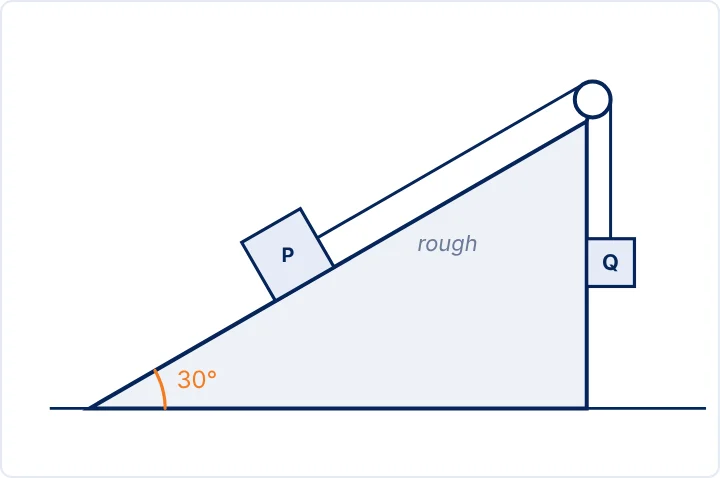
Particle P of mass lies on a rough plane inclined at to the horizontal. It is connected by a light inextensible string passing over a smooth pulley at the top of the plane to a particle Q of mass which hangs freely. The coefficient of friction between P and the plane is . The system is released from rest. Find the acceleration of the system.
Show solution
M1 for resolving perpendicular to the plane for P to find :.
M1 for calculating friction: .
M1 for setting up the equation of motion for Q: .
M1 for setting up the equation of motion for P (assuming it moves up the plane): .