IAL M1 statics of a particle: exam questions with mark schemes
Resolving forces; equilibrium of a particle; friction and limiting equilibrium (F ≤ μR).
Each question carries its marks, and its mark scheme sits under it: M marks for method, A marks for accuracy, B marks for a correct result on its own. Try the question on paper first, then open the solution and mark yourself the way an examiner would.
Edexcel IAL M1 Mechanics 1 · 10 questions · 36 marks · Rough Inclined Planes, Resolving Forces, Friction on a Horizontal Plane, Friction on a Vertical Wall, Lami's Theorem / Resolving
A block of mass rests in limiting equilibrium on a rough horizontal surface under the action of a horizontal pull of . Find the coefficient of friction, , between the block and the surface.
Show solution
M1 for identifying and using with :.
A1 for finding .
Question 2
2 marks · warm-up
A particle rests in limiting equilibrium on a rough plane inclined at an angle to the horizontal. No other forces act on the particle. Show that the coefficient of friction .
Show solution
M1 for resolving parallel () and perpendicular () and using .
A1 for substituting to get .
Question 3
3 marks · standard
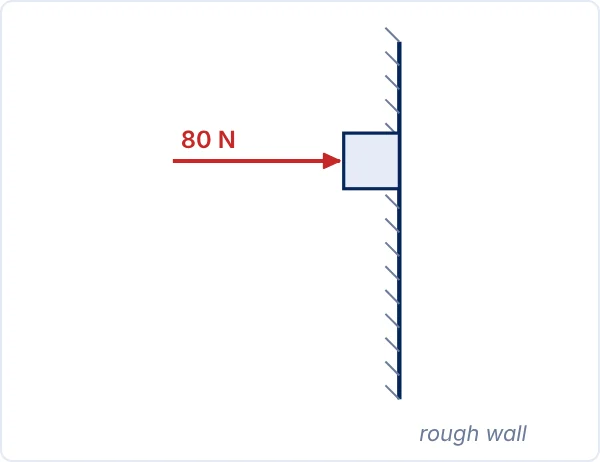
A particle of mass is held stationary against a rough vertical wall by a horizontal force of . Find the minimum coefficient of friction required between the particle and the wall to prevent sliding.
Show solution
M1 for identifying the normal reaction is provided by the horizontal force: .
M1 for resolving vertically, where friction must balance weight: .
A1 for applying , so minimum (to 3 s.f.).
Question 4
4 marks · standard
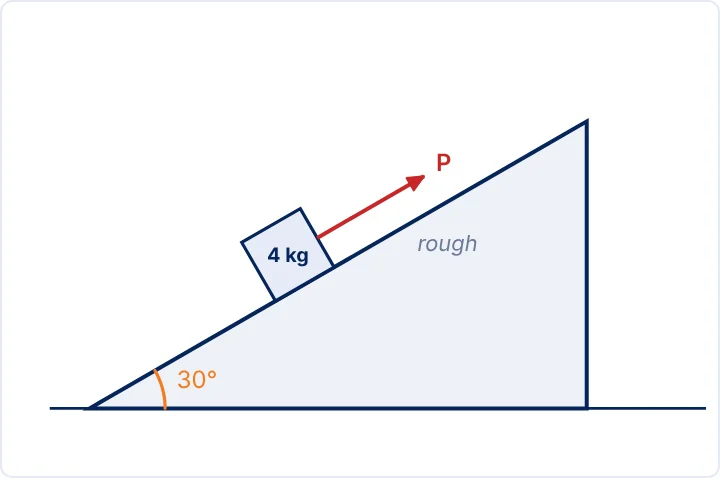
A particle of mass rests on a rough plane inclined at to the horizontal. The coefficient of friction is . A force acts parallel to the plane, directed up the plane, to prevent the particle from sliding down. Find the minimum value of .
Show solution
M1 for finding normal reaction .
M1 for finding limiting friction acting up the plane.
M1 for resolving parallel to the plane: .
A1 for calculating .
Question 5
4 marks · standard
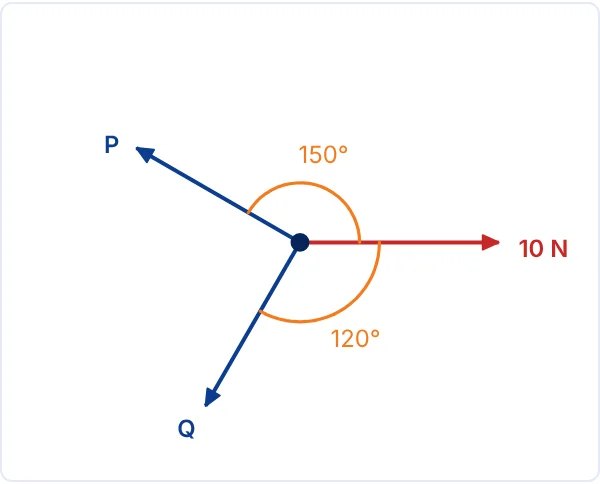
Three coplanar forces ,, and act at a point and are in equilibrium. The angle between and the force is , and the angle between and the force is . Find the magnitudes of and .
Show solution
M1 for finding the angle between and :.
M1 for applying Lami's theorem or resolving: .
A1 for finding .
A1 for finding .
Question 6
4 marks · standard
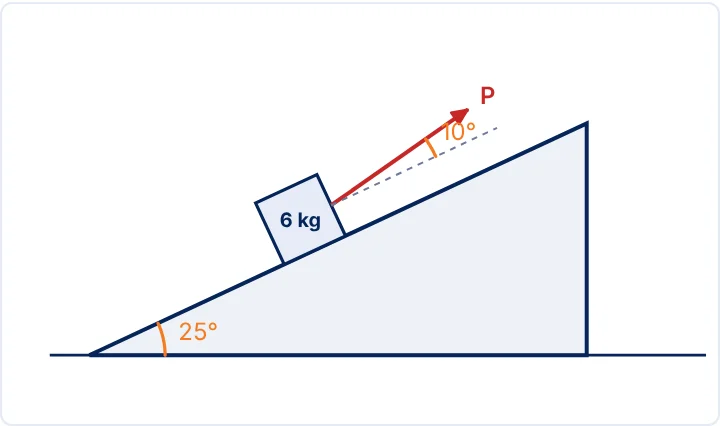
A particle of mass is kept in equilibrium on a smooth plane inclined at to the horizontal by a force acting at an angle of above the line of greatest slope of the plane. Find the magnitude of .
Show solution
M1 for identifying the component of weight down the plane: .
M1 for identifying the component of parallel to the plane: .
M1 for equating the parallel components (equilibrium): .
A1 for calculating (to 3 s.f.).
Question 7
4 marks · harder
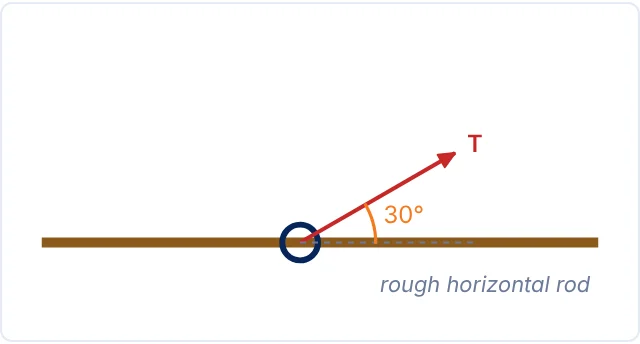
A small ring of mass is threaded on a rough horizontal rod. The coefficient of friction is . A light string is attached to the ring and pulled with a force at an angle of above the rod. Find the maximum value of for which the ring remains in equilibrium.
Show solution
M1 for resolving vertically to find the normal reaction: .
M1 for resolving horizontally in limiting equilibrium: .
M1 for setting :.
A1 for solving for : (to 3 s.f.).
Question 8
4 marks · harder
Two forces of magnitudes and act on a particle in equilibrium with a third force . The angle between the force and the force is . Given that can vary, find the minimum possible magnitude of .
Show solution
M1 for using the cosine rule (or components) for the resultant of the and forces, which is equal and opposite to :.
A1 for the correct quadratic .
M1 for completing the square or differentiating: , least when .
A1 for the minimum .
Question 9
4 marks · harder
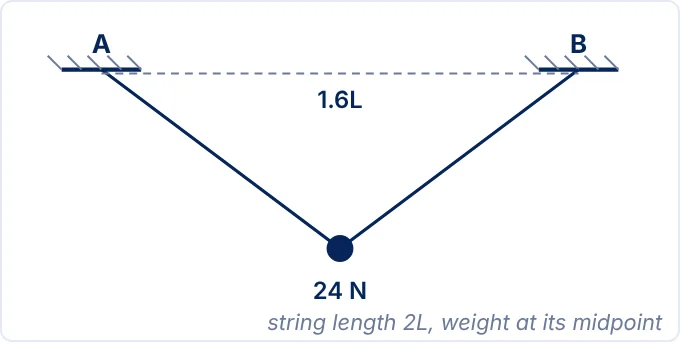
A light inextensible string of length has its ends attached to two fixed points and on the same horizontal level, distance apart. A weight of is attached to the midpoint of the string. Find the tension in the string.
Show solution
M1 for forming a right-angled triangle with hypotenuse and horizontal side .
M1 for finding the angle to the horizontal: , so .
M1 for resolving vertically: .
A1 for calculating .
Question 10
5 marks · harder
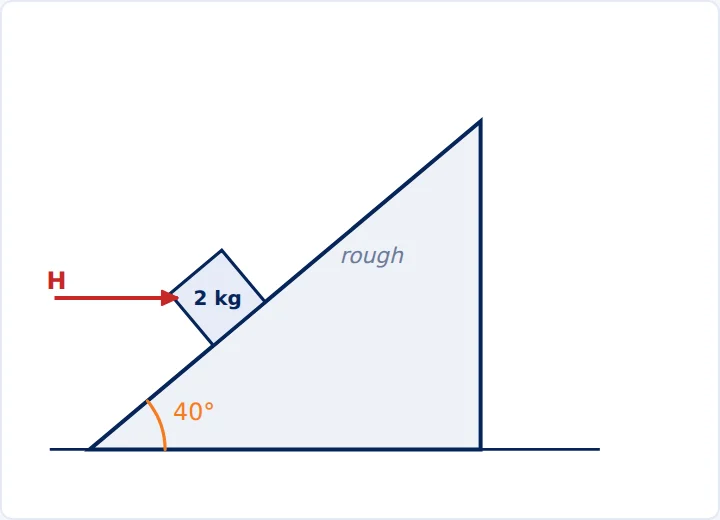
A particle of mass is held in limiting equilibrium on a rough plane inclined at to the horizontal by a horizontal force . The particle is on the point of sliding down the plane. The coefficient of friction is . Taking , find the value of .
Show solution
M1 for resolving perpendicular to the plane: .
M1 for resolving parallel to the plane (friction acts up): .