A Level Maths Year 2 starter questions: weeks 27–40
42 short questions to open a lesson for A Level Maths Year 2, weeks 27–40 of the teaching year, three or four a week. Each question is shown as an image with its text underneath; answers and mark schemes stay with teachers.
Week 27
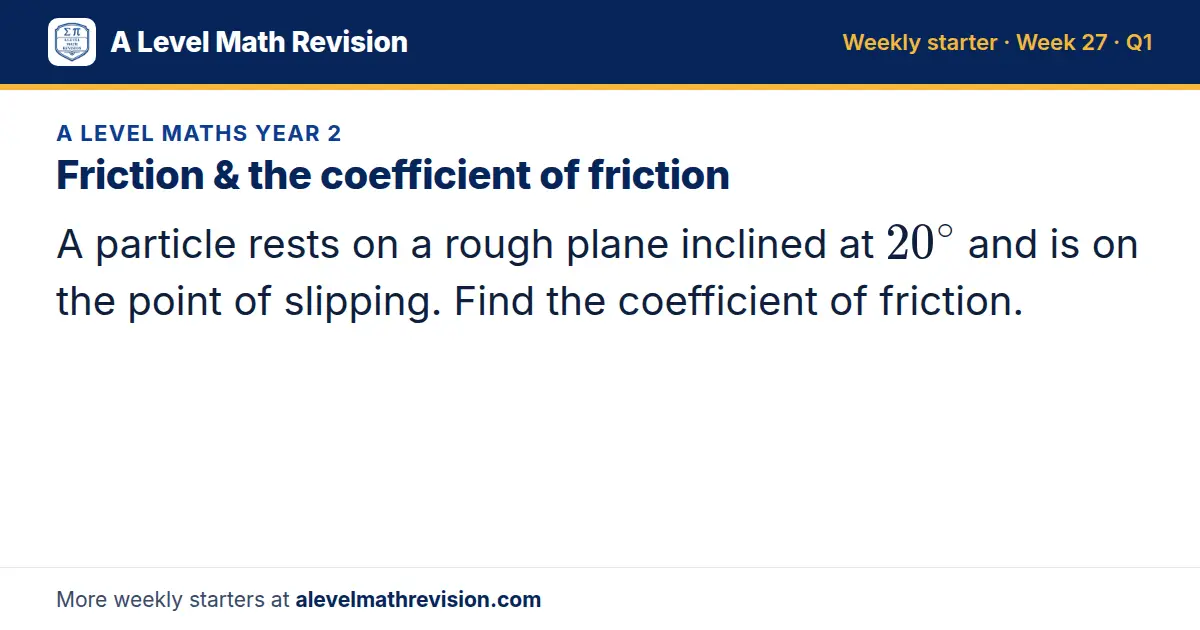
Question 1: Friction & the coefficient of friction
A particle rests on a rough plane inclined at 20^∘ and is on the point of slipping. Find the coefficient of friction.
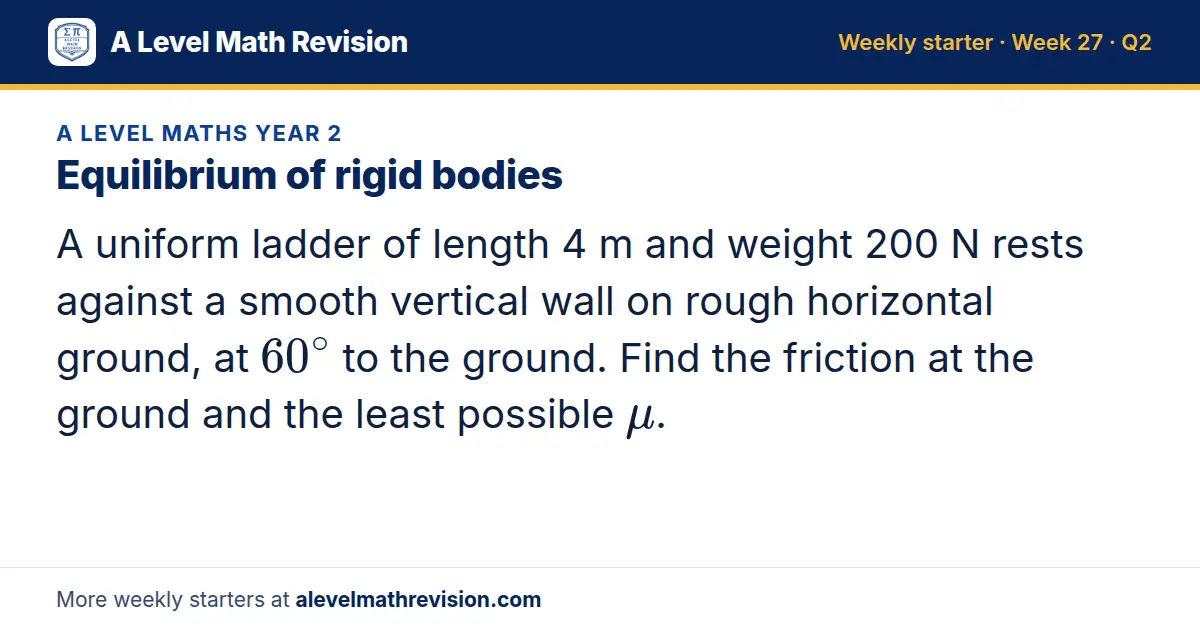
Question 2: Equilibrium of rigid bodies
A uniform ladder of length 4 m and weight 200 N rests against a smooth vertical wall on rough horizontal ground, at 60^∘ to the ground. Find the friction at the ground and the least possible μ.
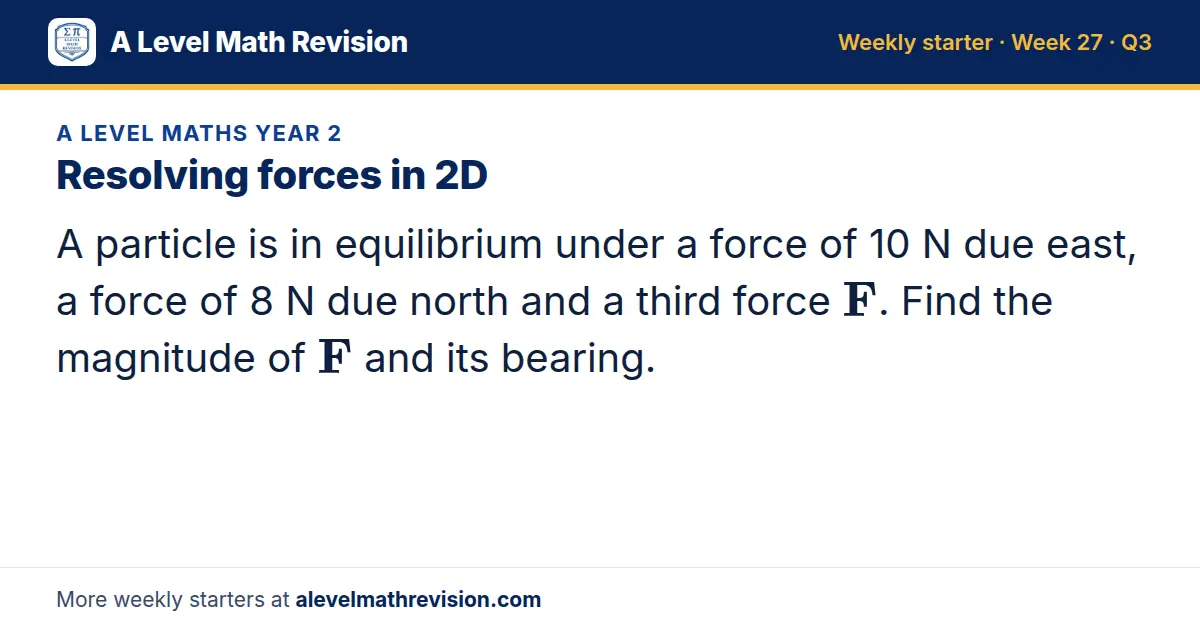
Question 3: Resolving forces in 2D
A particle is in equilibrium under a force of 10 N due east, a force of 8 N due north and a third force F. Find the magnitude of F and its bearing.
Week 28
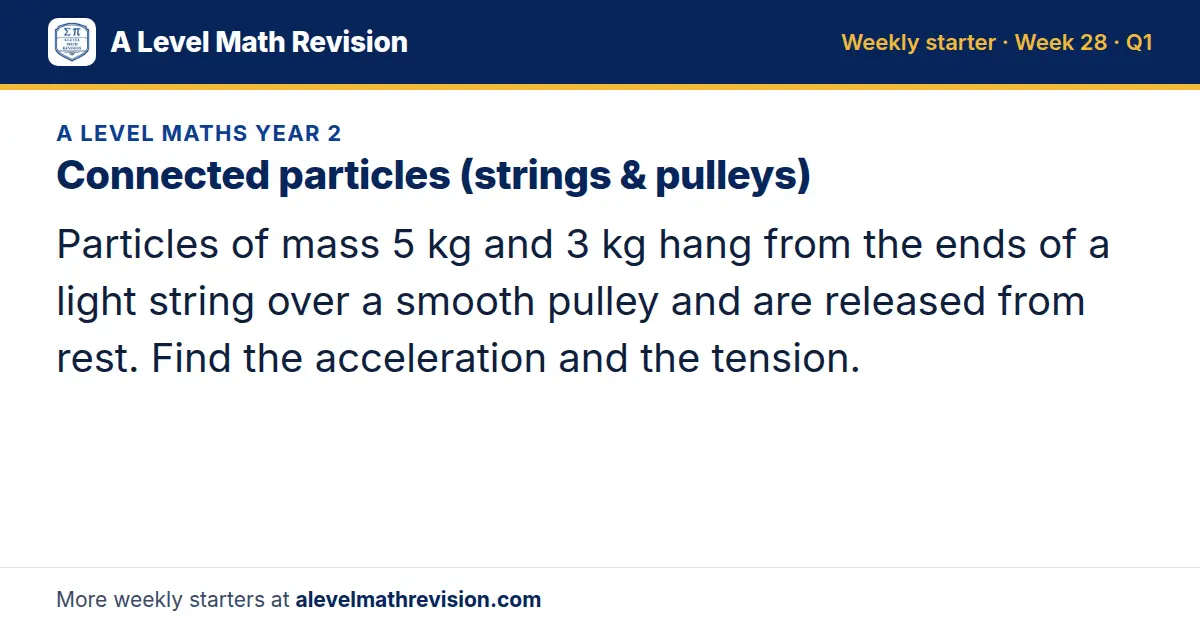
Question 1: Connected particles (strings & pulleys)
Particles of mass 5 kg and 3 kg hang from the ends of a light string over a smooth pulley and are released from rest. Find the acceleration and the tension.
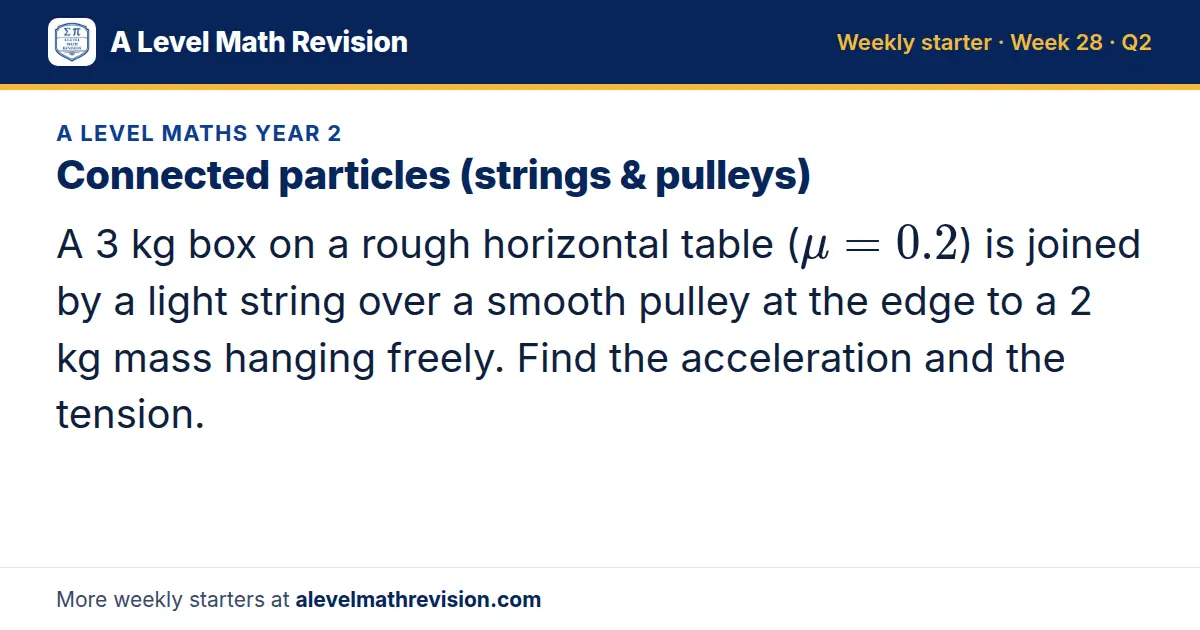
Question 2: Connected particles (strings & pulleys)
A 3 kg box on a rough horizontal table (μ = 0.2) is joined by a light string over a smooth pulley at the edge to a 2 kg mass hanging freely. Find the acceleration and the tension.
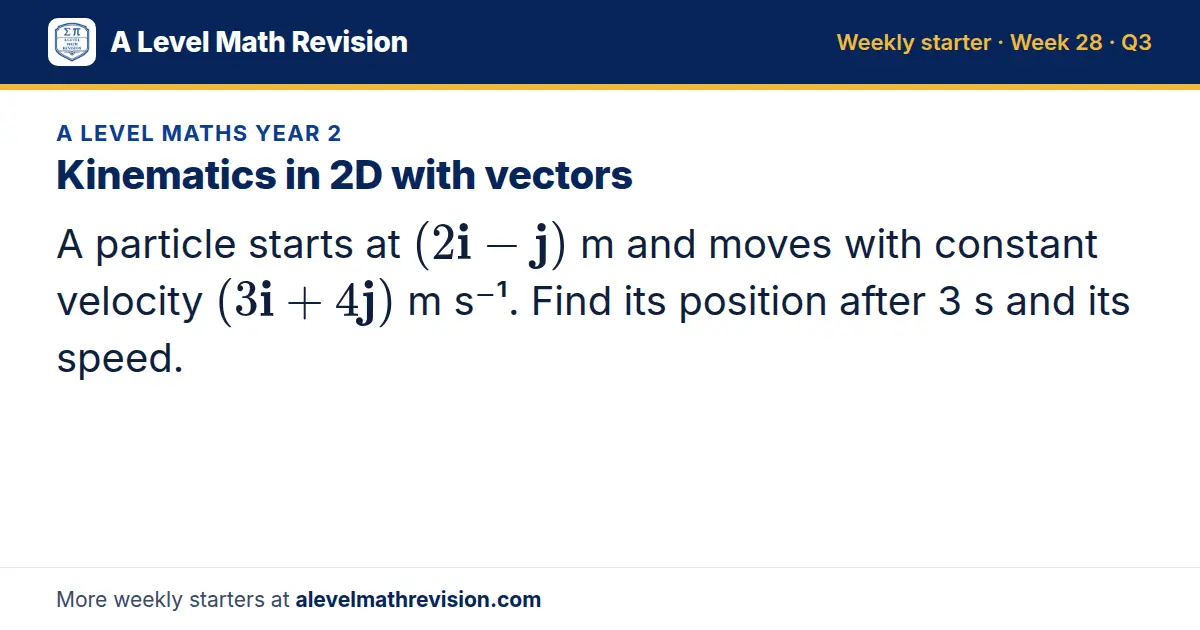
Question 3: Kinematics in 2D with vectors
A particle starts at (2i - j) m and moves with constant velocity (3i + 4j) m s⁻¹. Find its position after 3 s and its speed.
Week 29
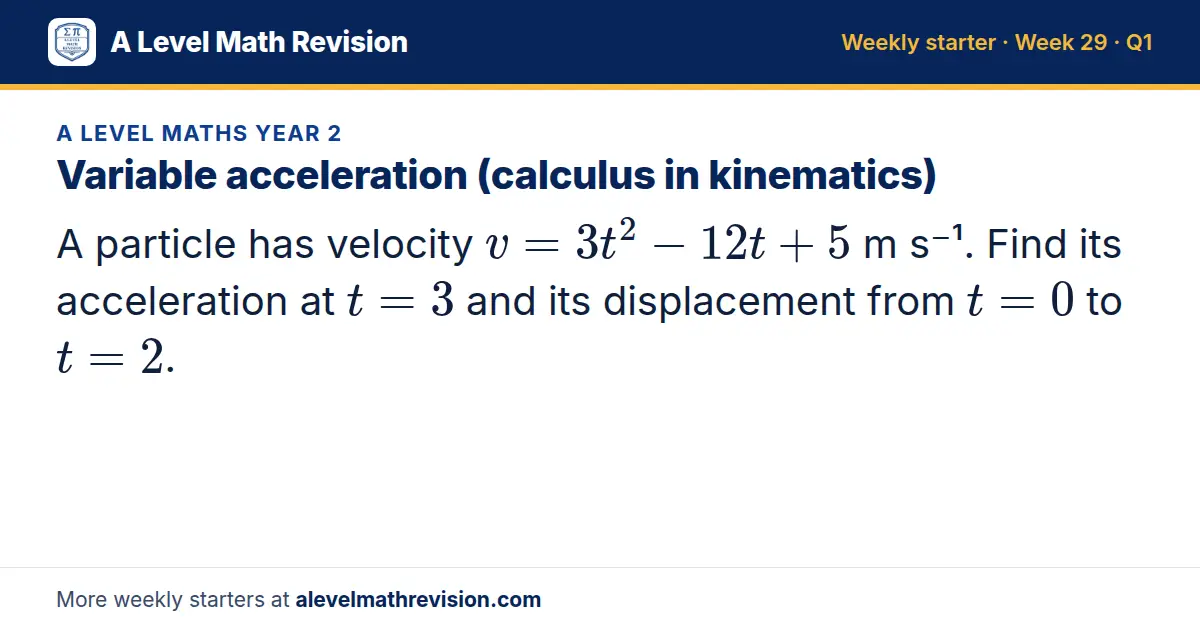
Question 1: Variable acceleration (calculus in kinematics)
A particle has velocity v = 3t² - 12t + 5 m s⁻¹. Find its acceleration at t = 3 and its displacement from t = 0 to t = 2.
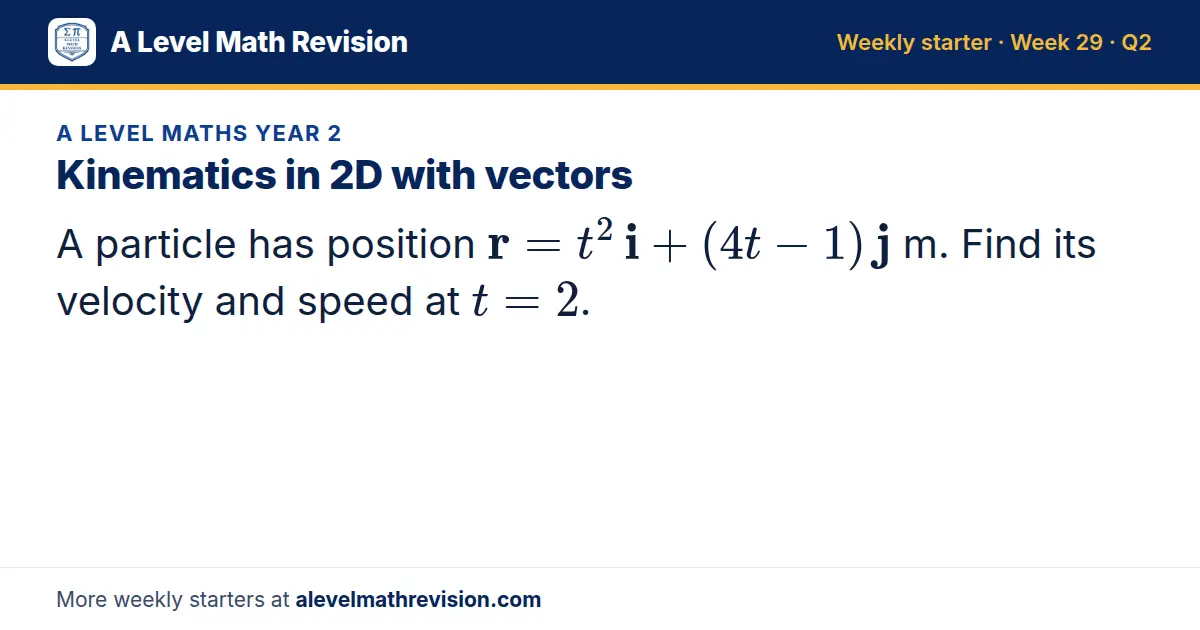
Question 2: Kinematics in 2D with vectors
A particle has position r = t² i + (4t - 1) j m. Find its velocity and speed at t = 2.
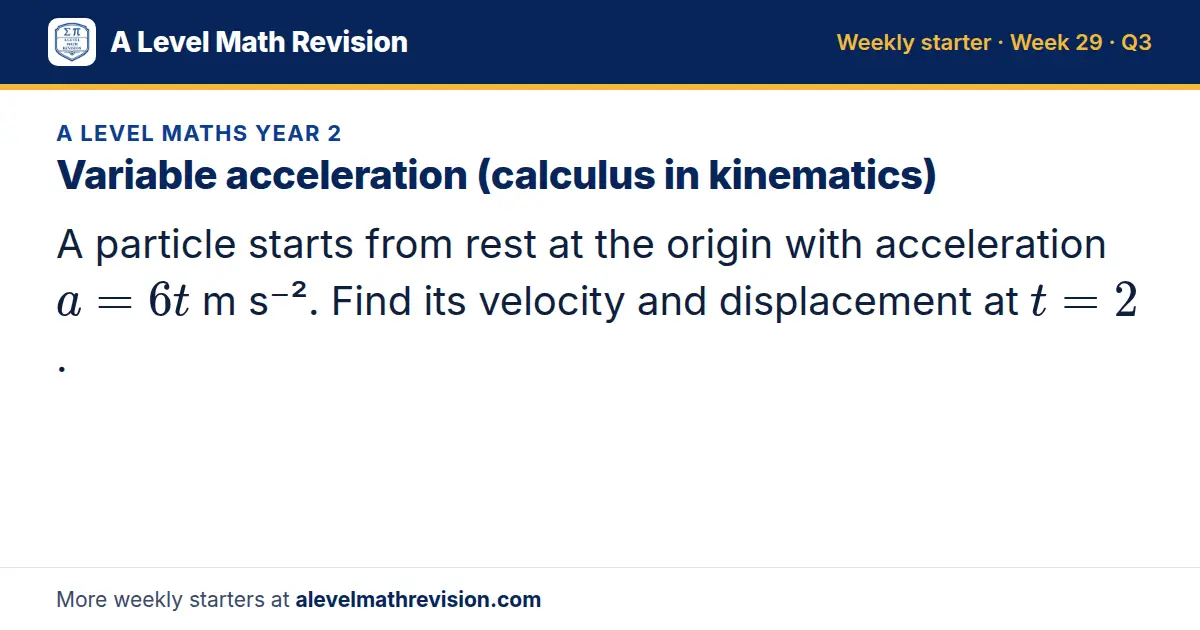
Question 3: Variable acceleration (calculus in kinematics)
A particle starts from rest at the origin with acceleration a = 6t m s⁻². Find its velocity and displacement at t = 2.
Week 30

Question 1: Integration by parts
Find ∫ xcos x dx.
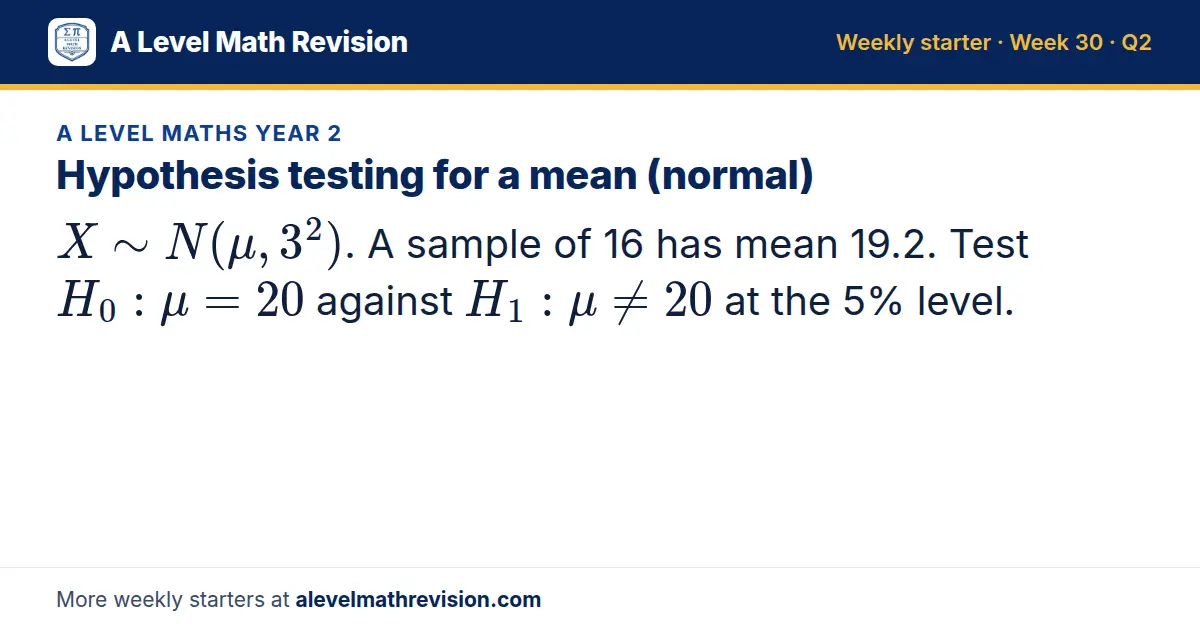
Question 2: Hypothesis testing for a mean (normal)
X N(μ, 3²). A sample of 16 has mean 19.2. Test H_0: μ = 20 against H_1: μ ≠ 20 at the 5% level.
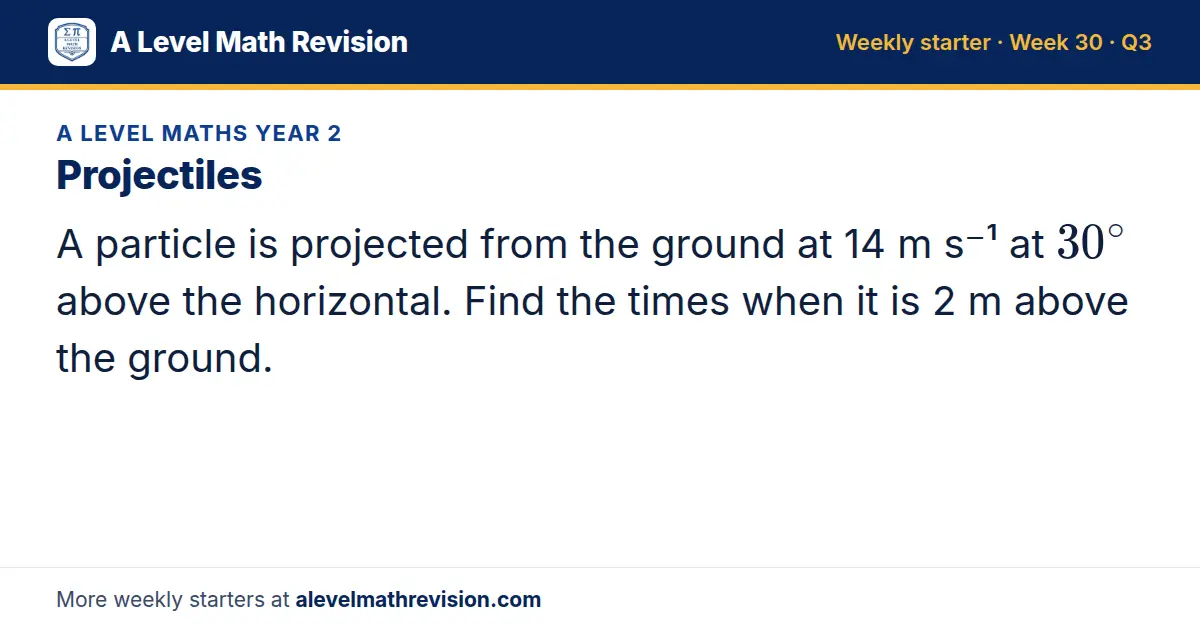
Question 3: Projectiles
A particle is projected from the ground at 14 m s⁻¹ at 30^∘ above the horizontal. Find the times when it is 2 m above the ground.
Week 31
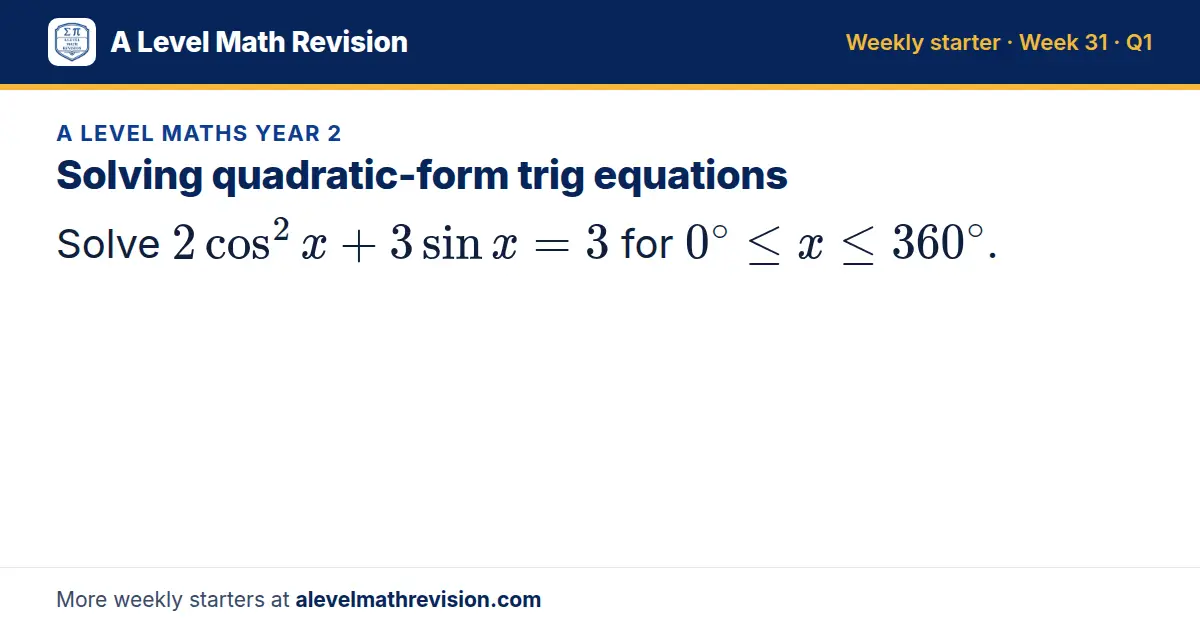
Question 1: Solving quadratic-form trig equations
Solve 2cos² x + 3sin x = 3 for 0^∘ ≤ x ≤ 360^∘.
Question 2: Critical regions (binomial)
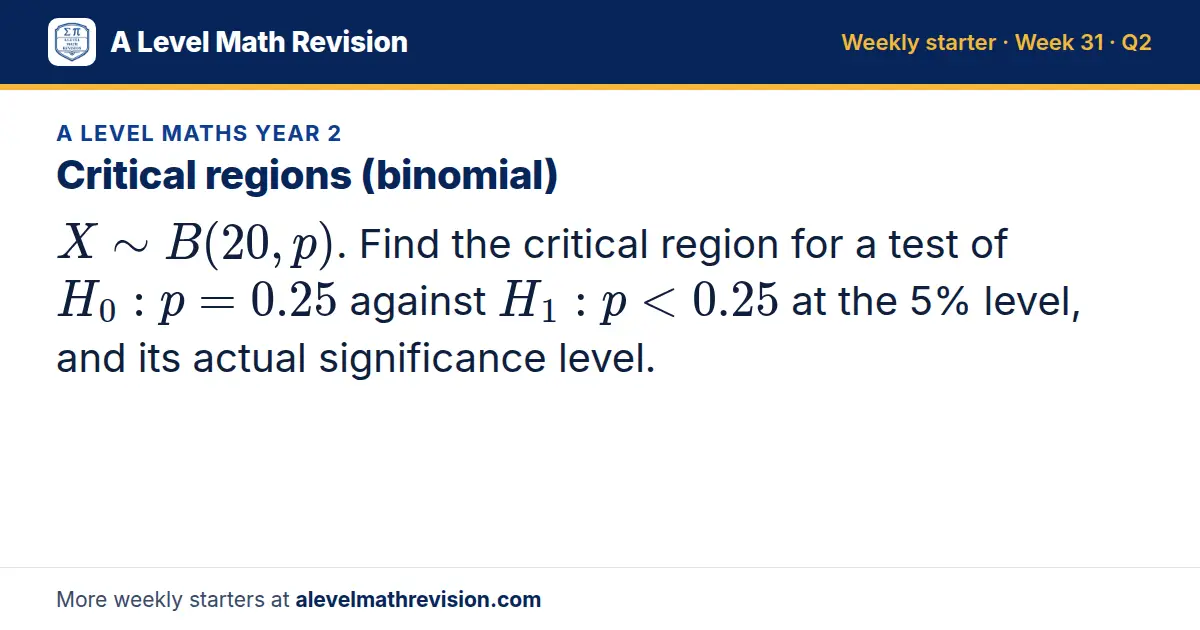
X B(20, p). Find the critical region for a test of H_0: p = 0.25 against H_1: p < 0.25 at the 5% level, and its actual significance level.
Question 3: Sine & cosine rules
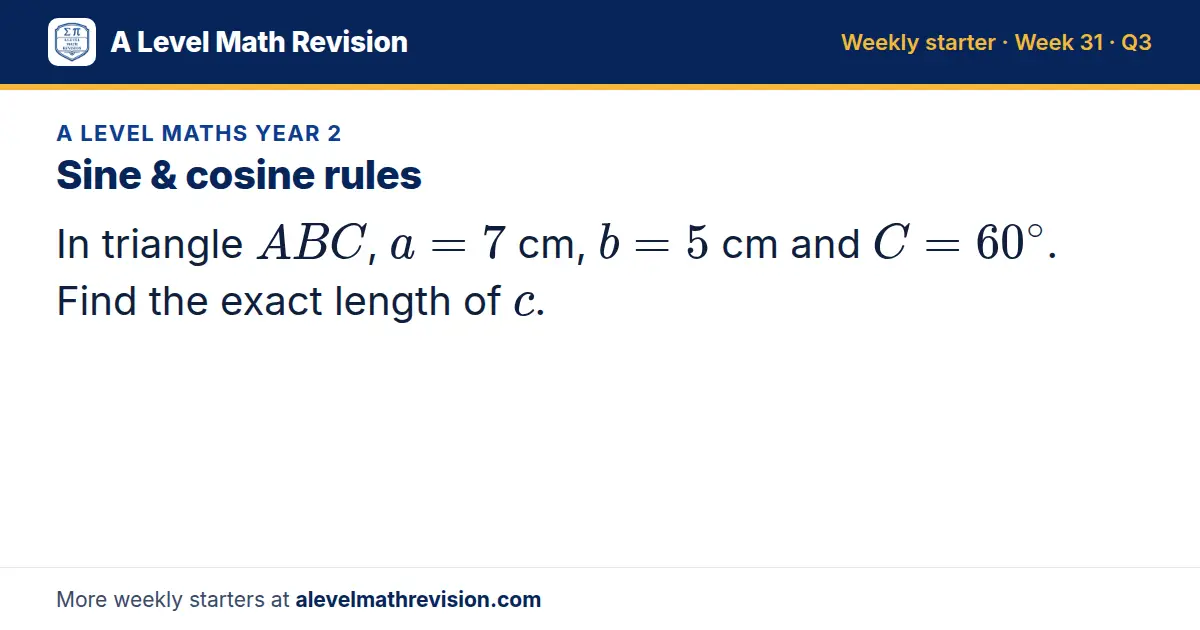
In triangle ABC, a = 7 cm, b = 5 cm and C = 60^∘. Find the exact length of c.
Week 32
Question 1: Exponential growth & decay models
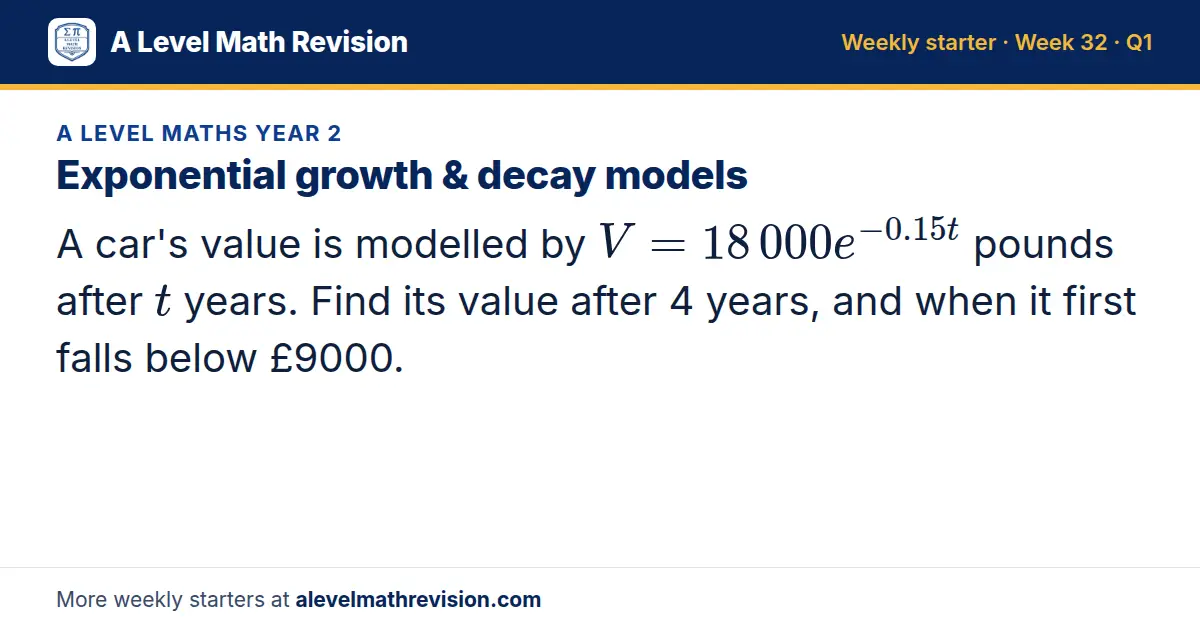
A car's value is modelled by V = 18 000e^(-0.15t) pounds after t years. Find its value after 4 years, and when it first falls below £9000.
Question 2: Recurrence relations
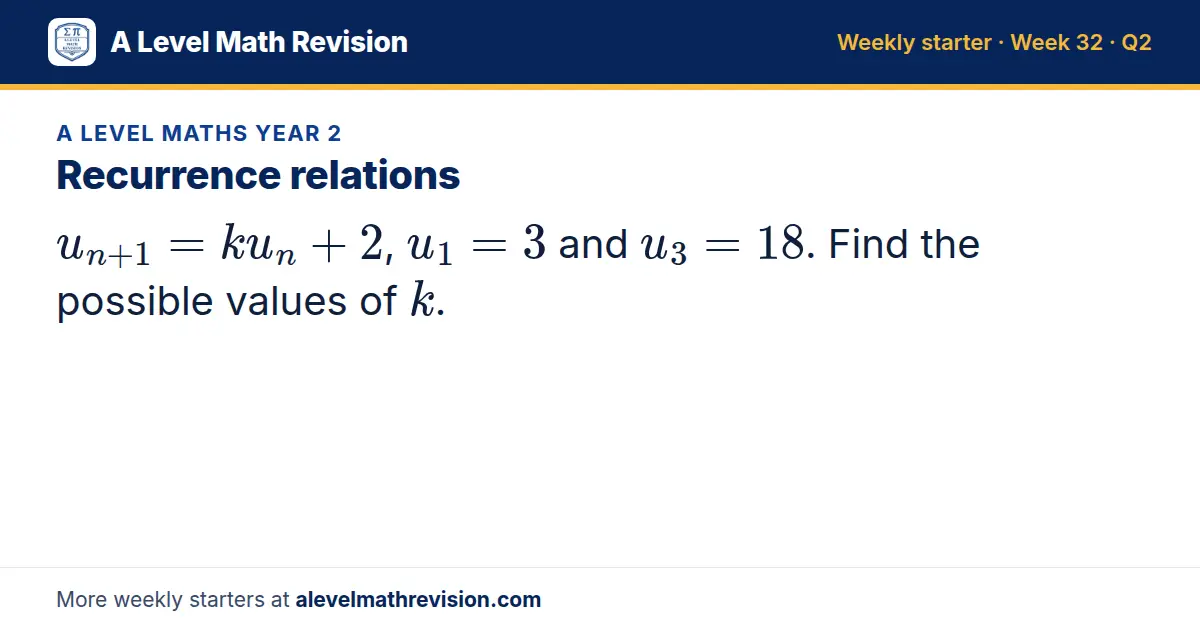
u_n+1 = k u_n + 2, u_1 = 3 and u_3 = 18. Find the possible values of k.
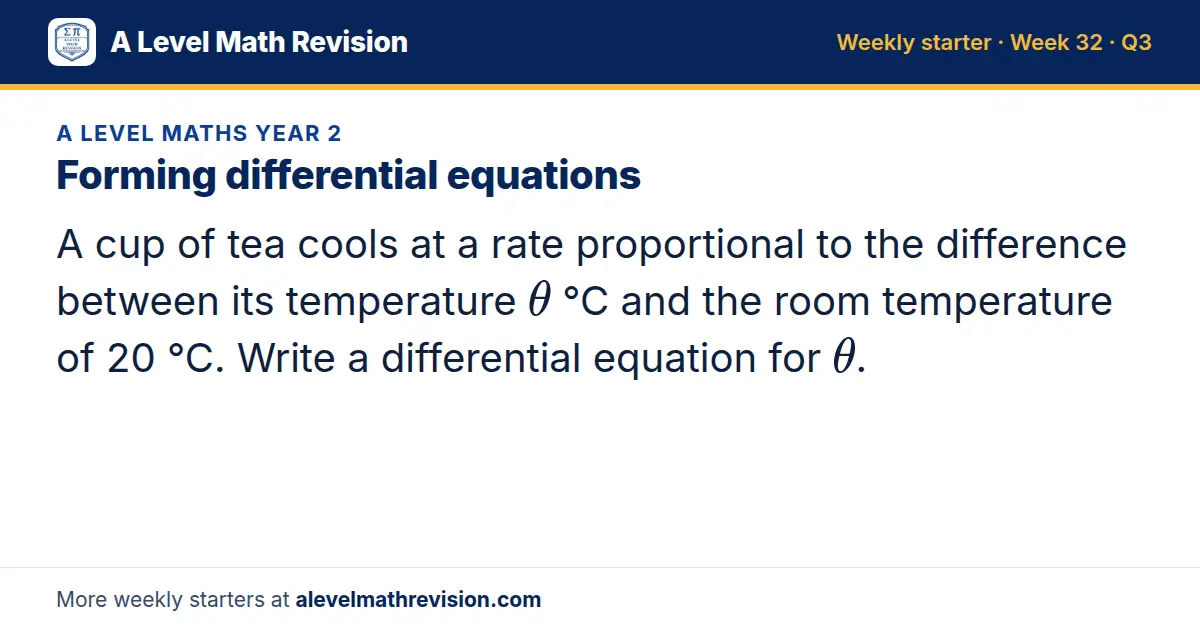
Question 3: Forming differential equations
A cup of tea cools at a rate proportional to the difference between its temperature θ °C and the room temperature of 20 °C. Write a differential equation for θ.
Week 33
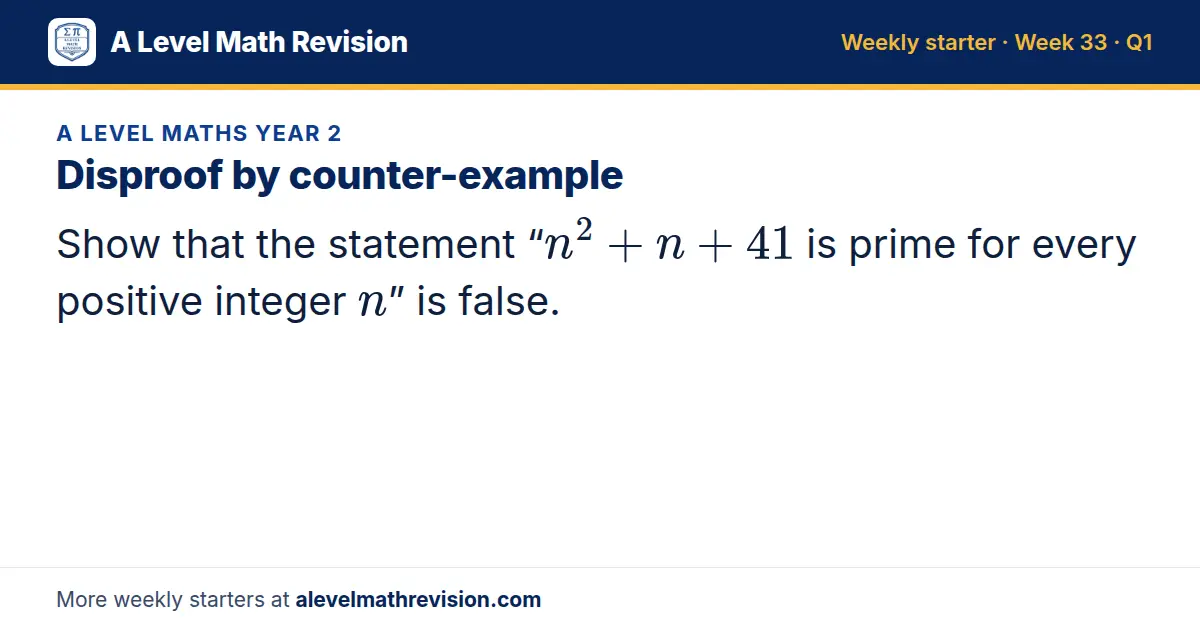
Question 1: Disproof by counter-example
Show that the statement “n² + n + 41 is prime for every positive integer n” is false.
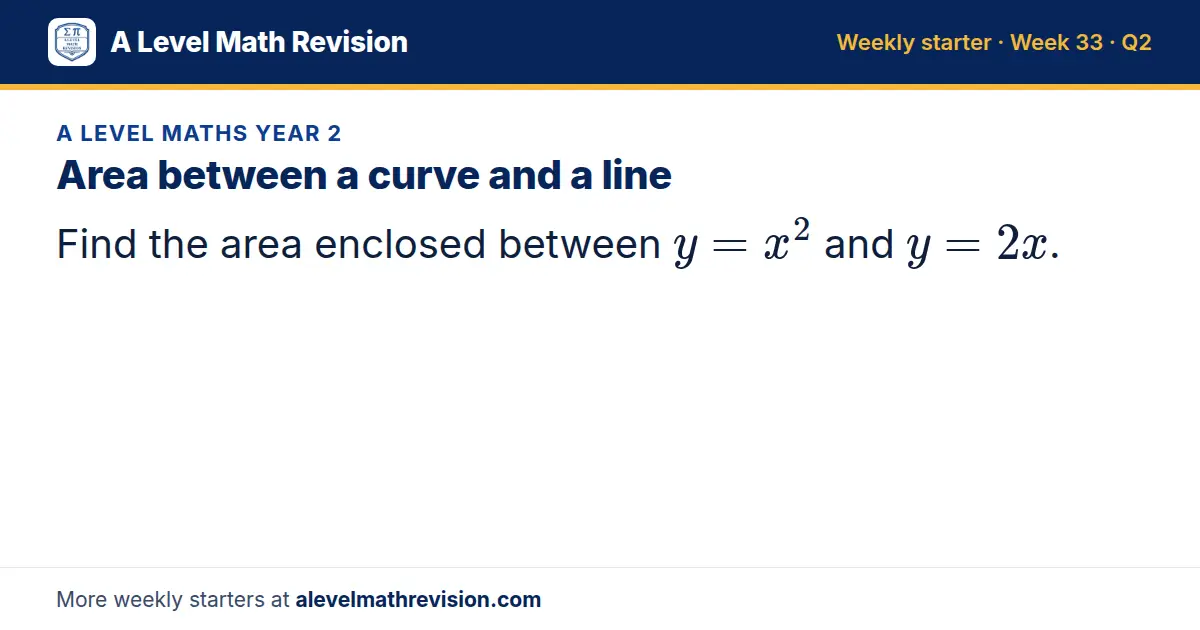
Question 2: Area between a curve and a line
Find the area enclosed between y = x² and y = 2x.
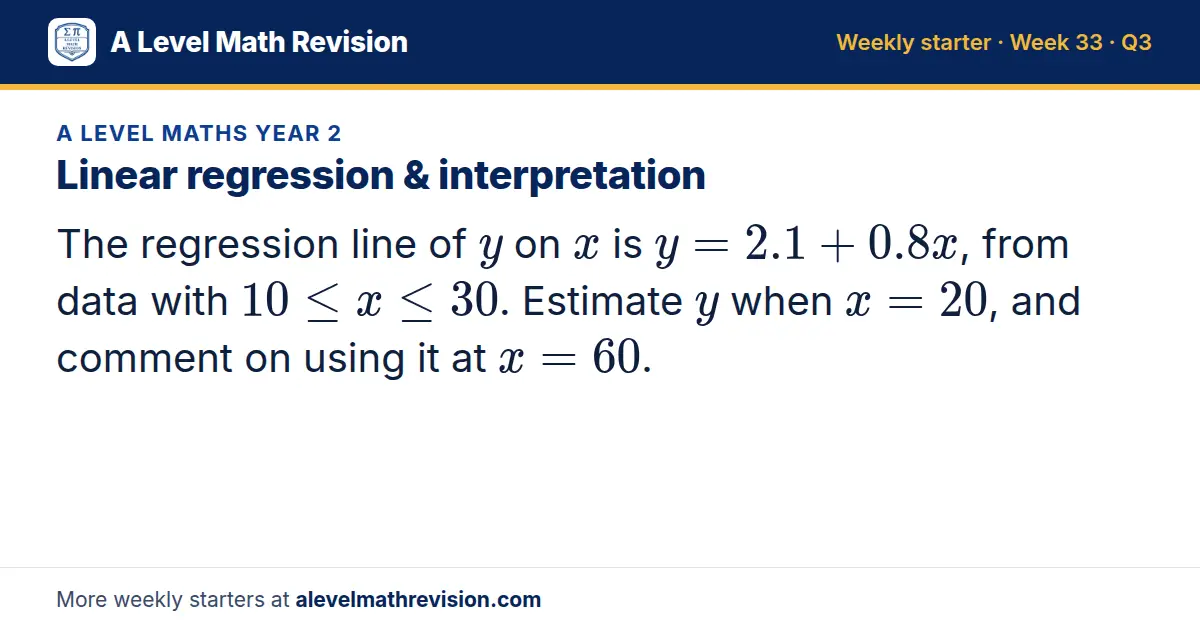
Question 3: Linear regression & interpretation
The regression line of y on x is y = 2.1 + 0.8x, from data with 10 ≤ x ≤ 30. Estimate y when x = 20, and comment on using it at x = 60.
Week 34
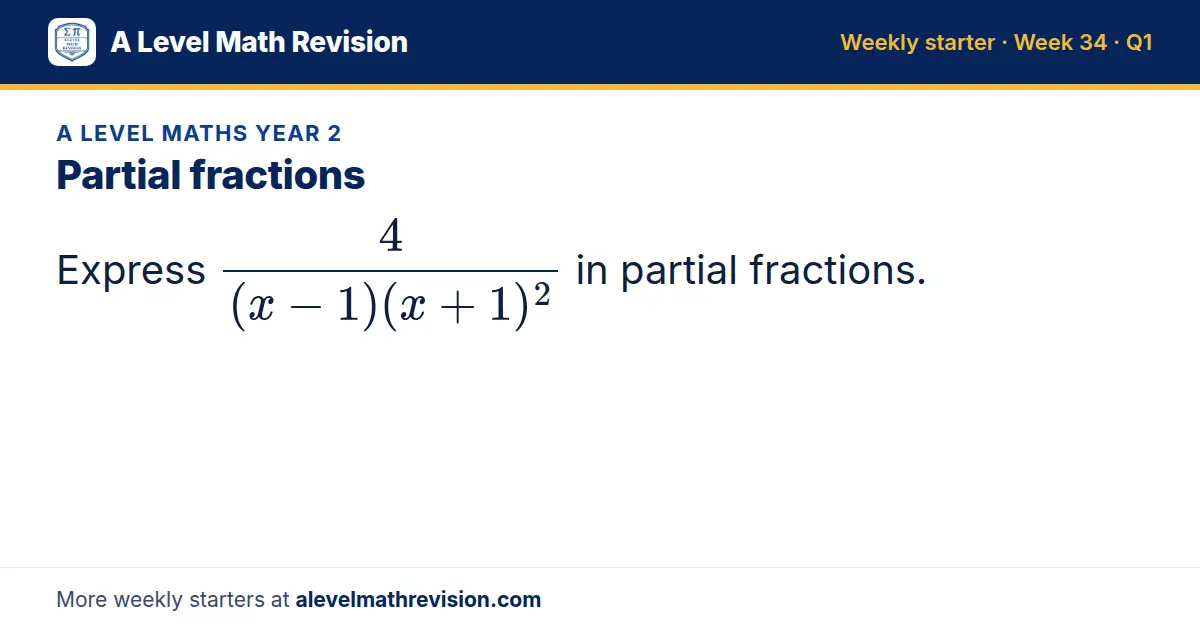
Question 1: Partial fractions
Express 4/((x - 1)(x + 1)²) in partial fractions.
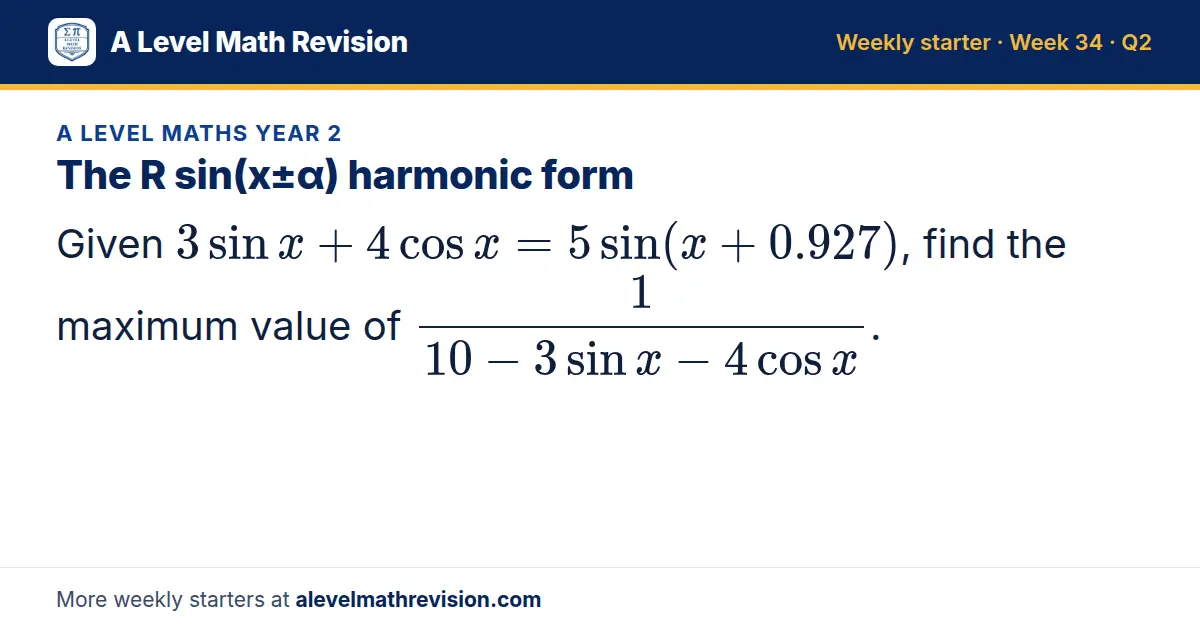
Question 2: The R sin(x±α) harmonic form
Given 3sin x + 4cos x = 5sin(x + 0.927), find the maximum value of 1/(10 - 3sin x - 4cos x).
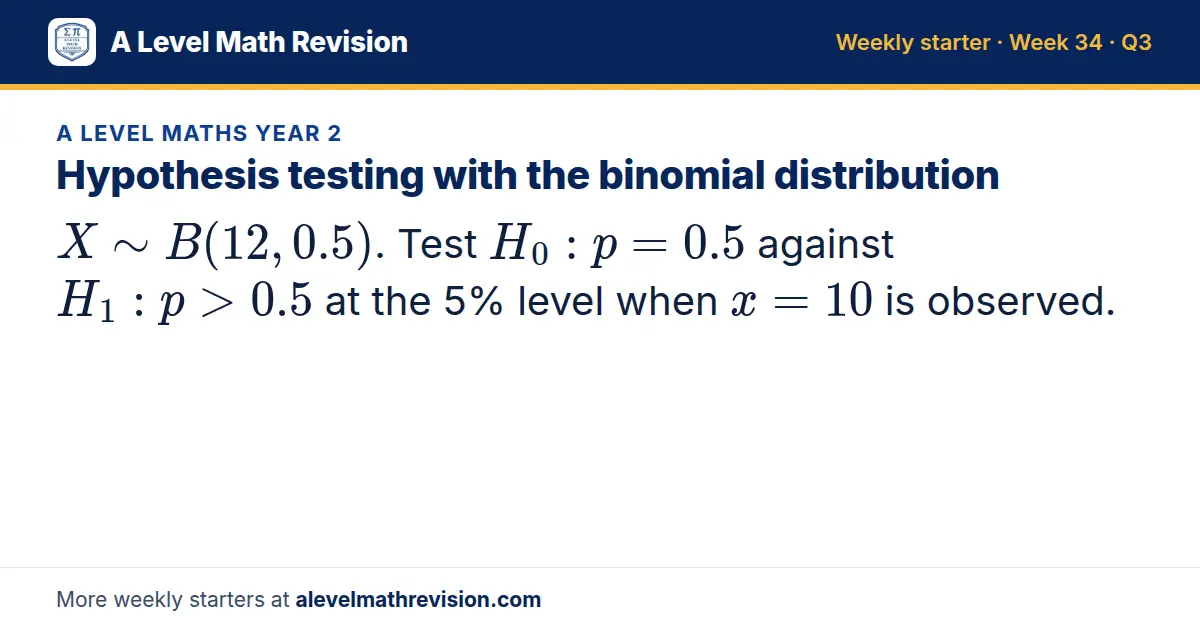
Question 3: Hypothesis testing with the binomial distribution
X B(12, 0.5). Test H_0: p = 0.5 against H_1: p > 0.5 at the 5% level when x = 10 is observed.
Week 35
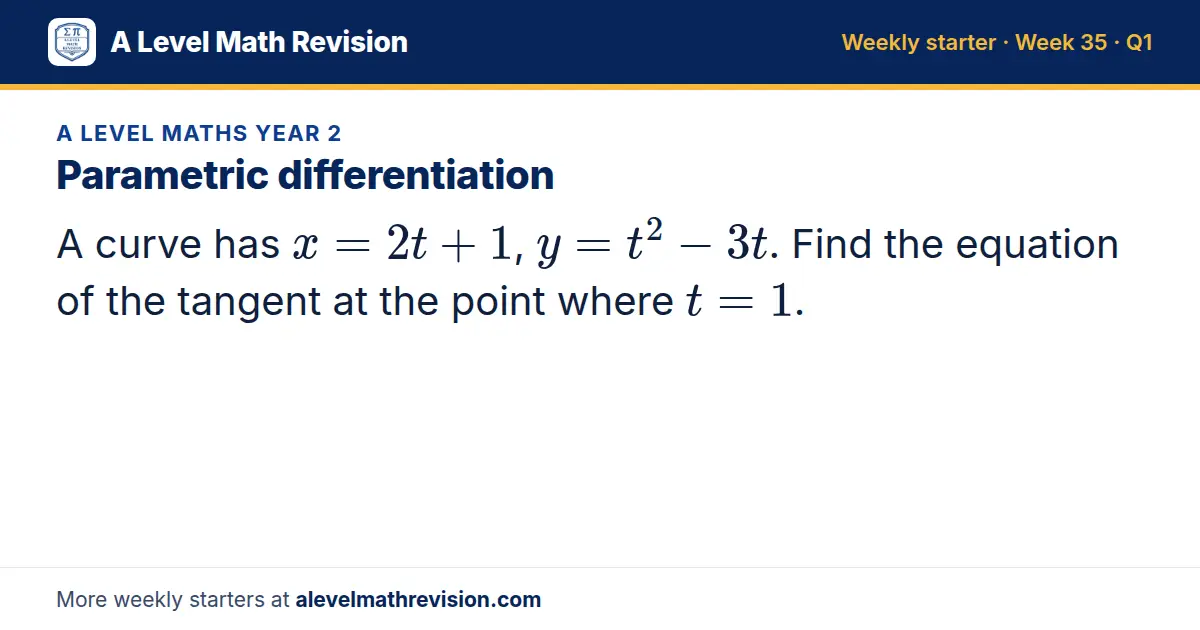
Question 1: Parametric differentiation
A curve has x = 2t + 1, y = t² - 3t. Find the equation of the tangent at the point where t = 1.
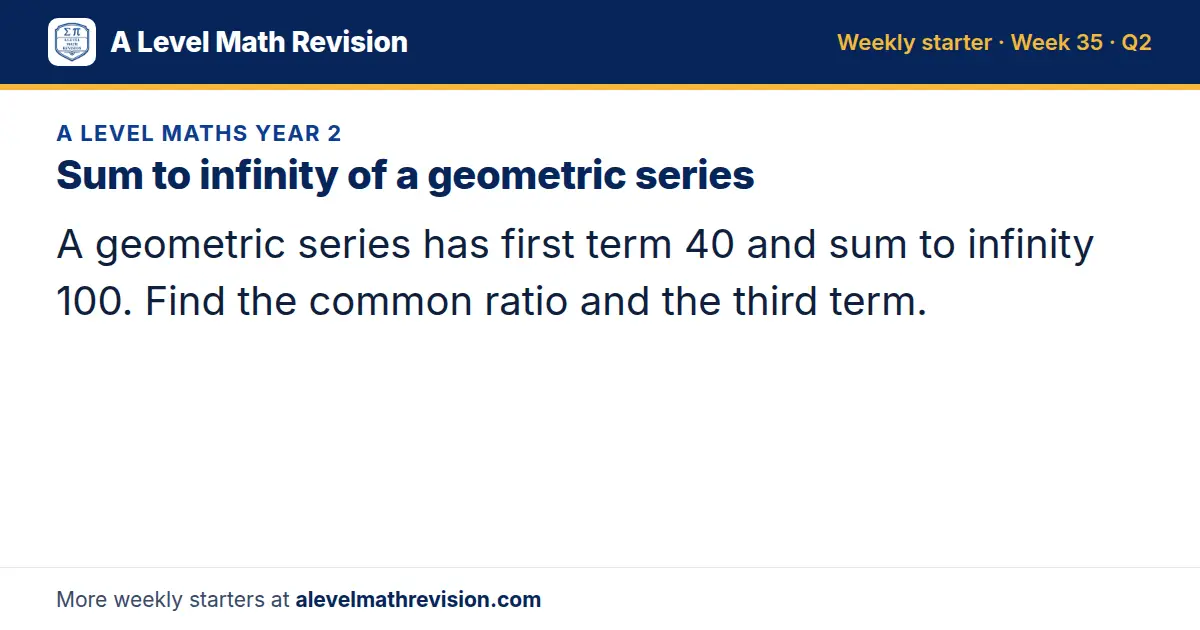
Question 2: Sum to infinity of a geometric series
A geometric series has first term 40 and sum to infinity 100. Find the common ratio and the third term.
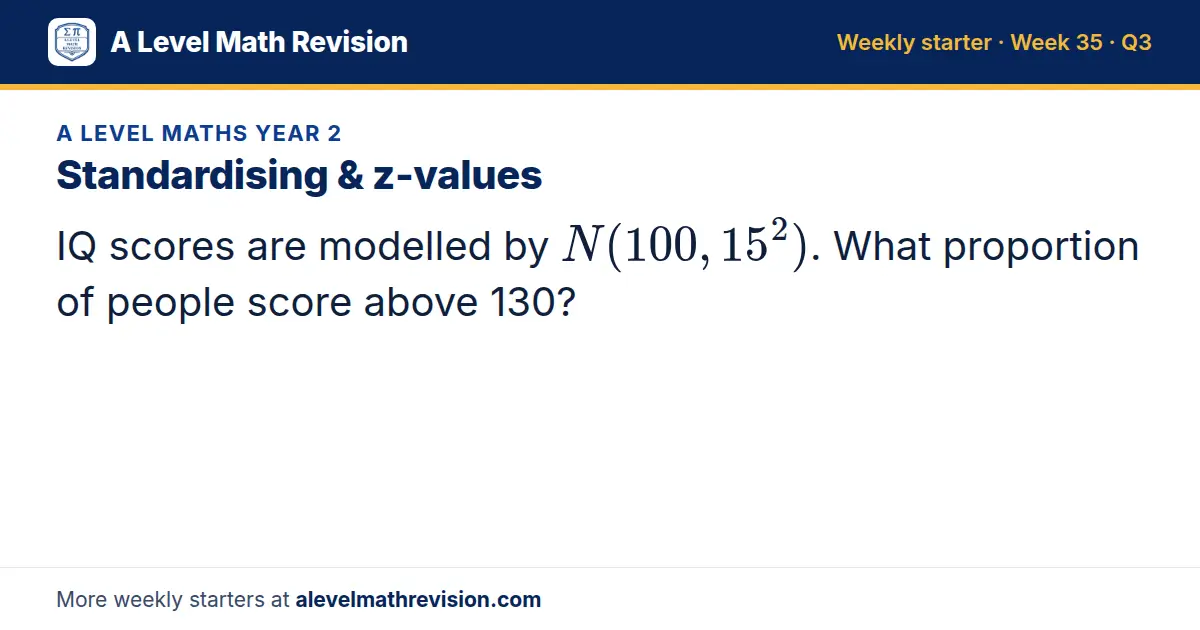
Question 3: Standardising & z-values
IQ scores are modelled by N(100, 15²). What proportion of people score above 130?
Week 36
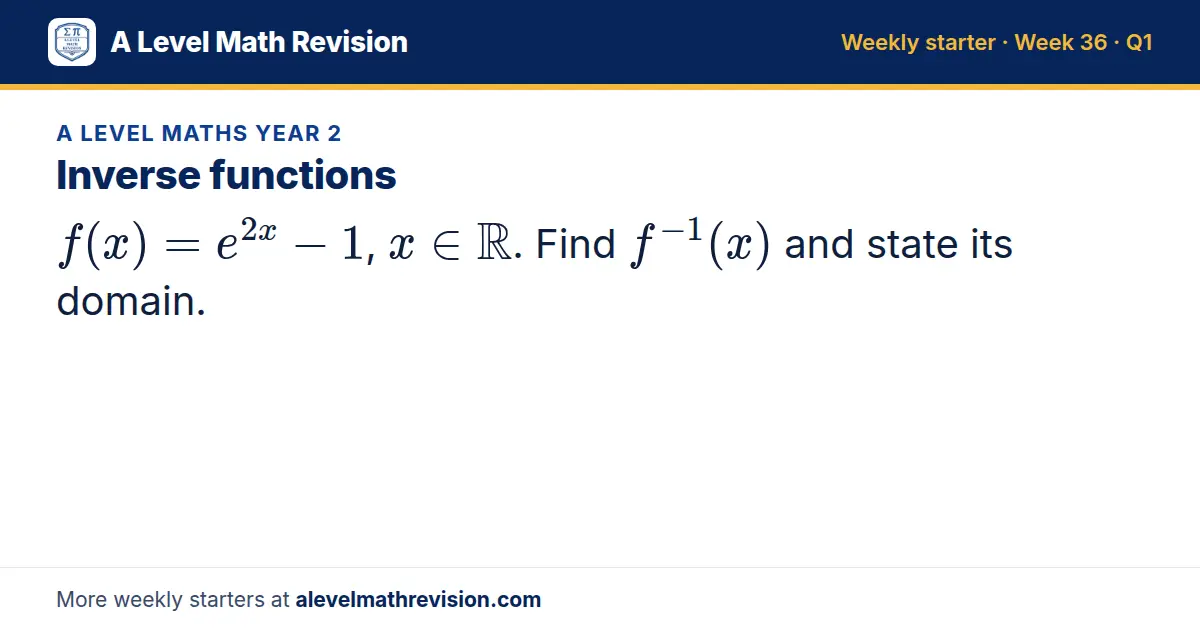
Question 1: Inverse functions
f(x) = e^(2x) - 1, x ∈ ℝ. Find f⁻¹(x) and state its domain.
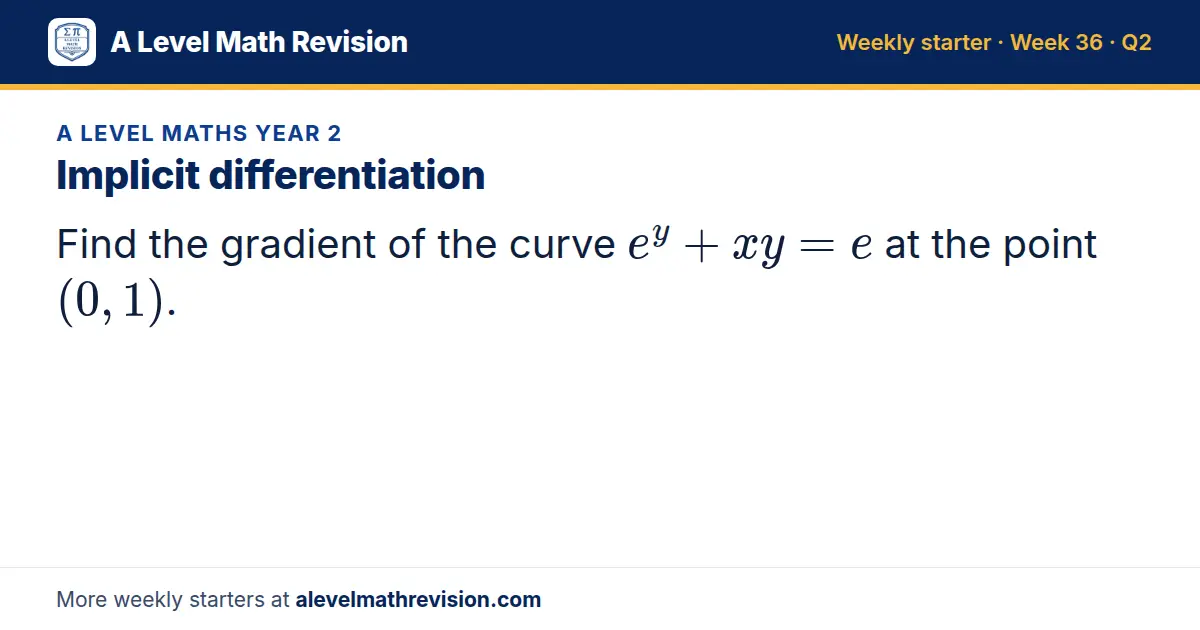
Question 2: Implicit differentiation
Find the gradient of the curve e^y + xy = e at the point (0, 1).
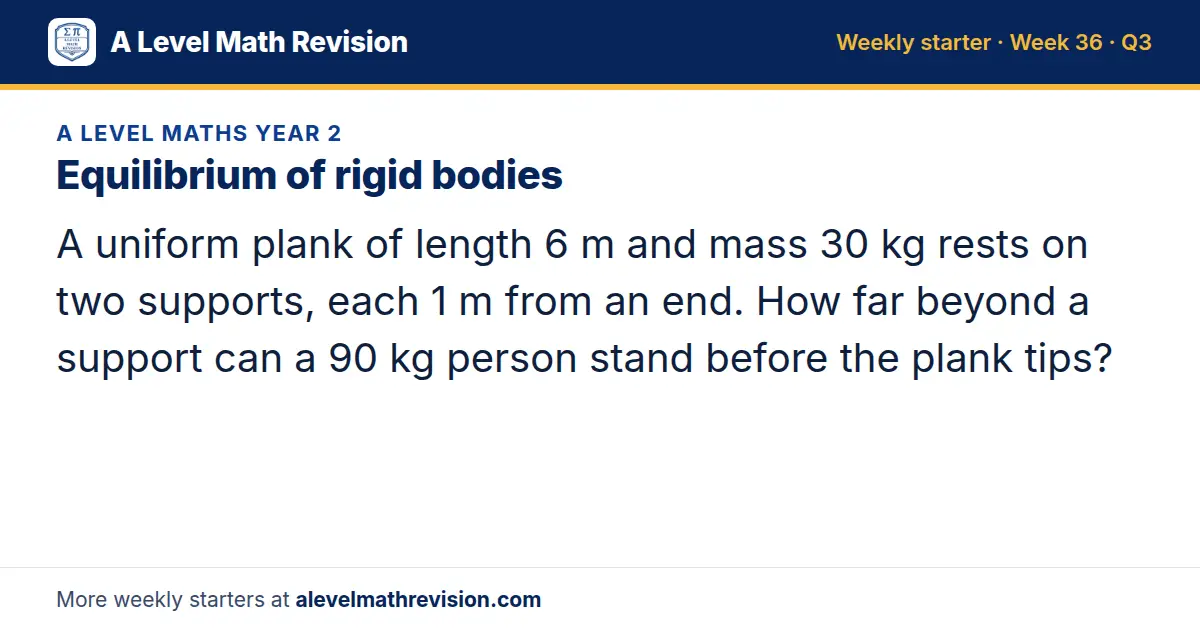
Question 3: Equilibrium of rigid bodies
A uniform plank of length 6 m and mass 30 kg rests on two supports, each 1 m from an end. How far beyond a support can a 90 kg person stand before the plank tips?
Week 37
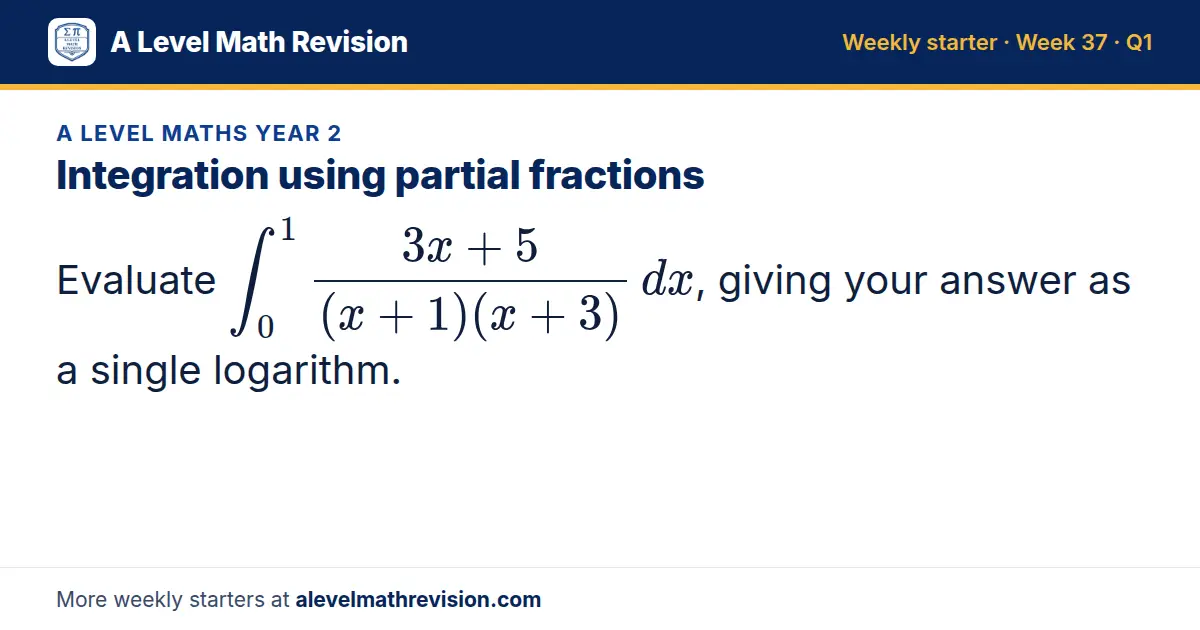
Question 1: Integration using partial fractions
Evaluate ∫_0¹ (3x + 5)/((x + 1)(x + 3)) dx, giving your answer as a single logarithm.
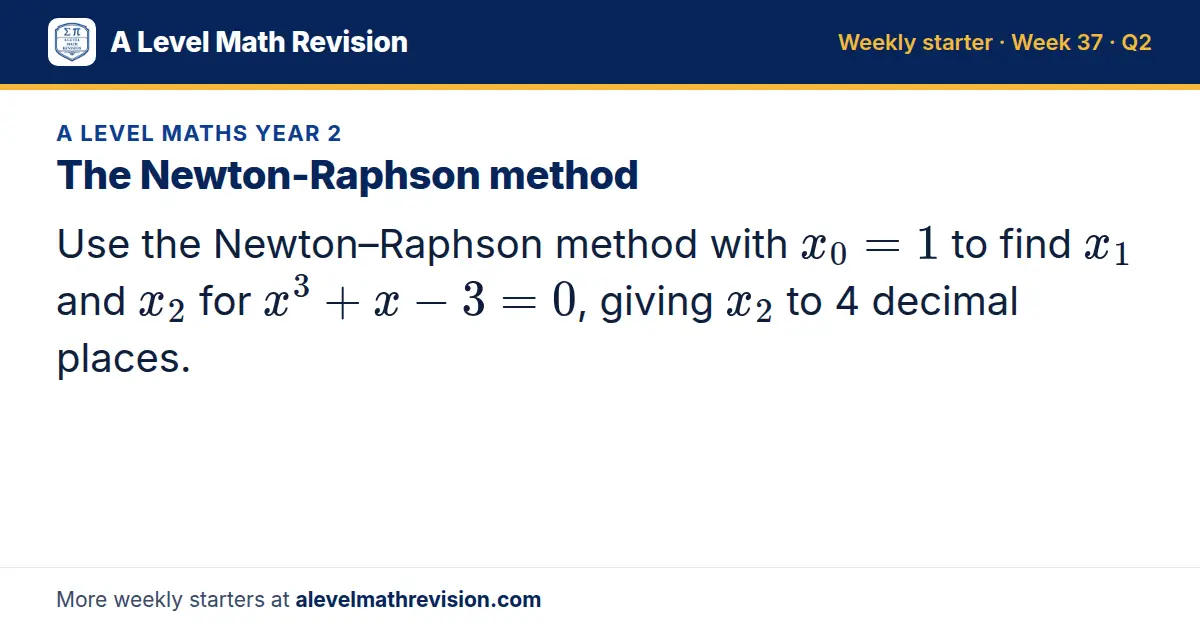
Question 2: The Newton-Raphson method
Use the Newton–Raphson method with x_0 = 1 to find x_1 and x_2 for x³ + x - 3 = 0, giving x_2 to 4 decimal places.
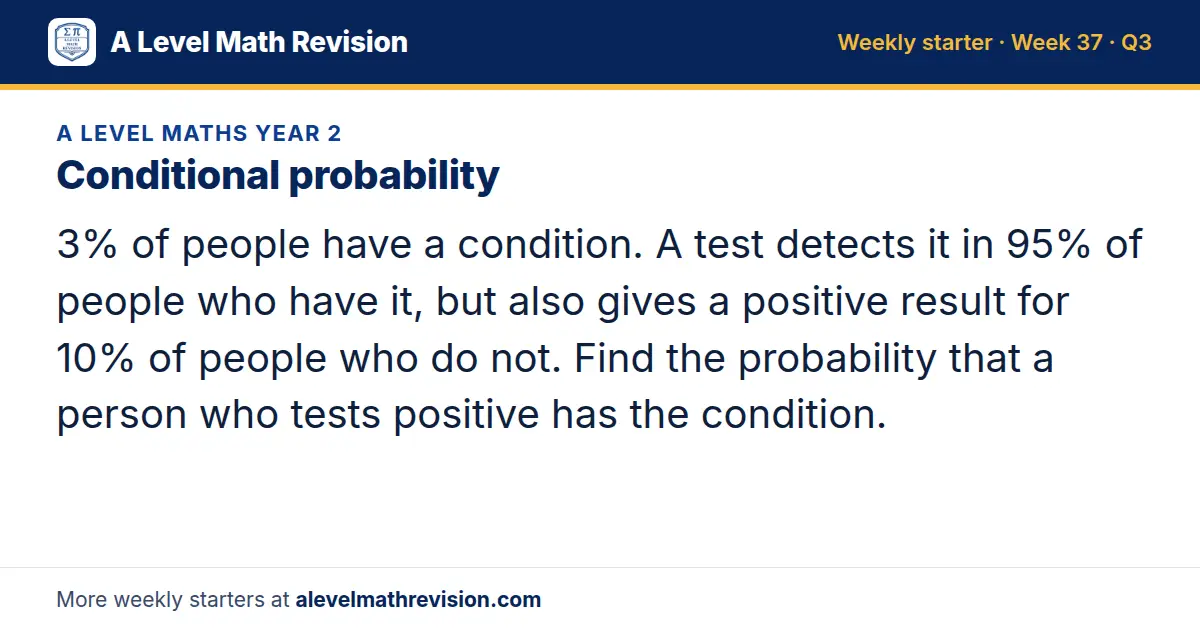
Question 3: Conditional probability
3% of people have a condition. A test detects it in 95% of people who have it, but also gives a positive result for 10% of people who do not. Find the probability that a person who tests positive has the condition.
Week 38
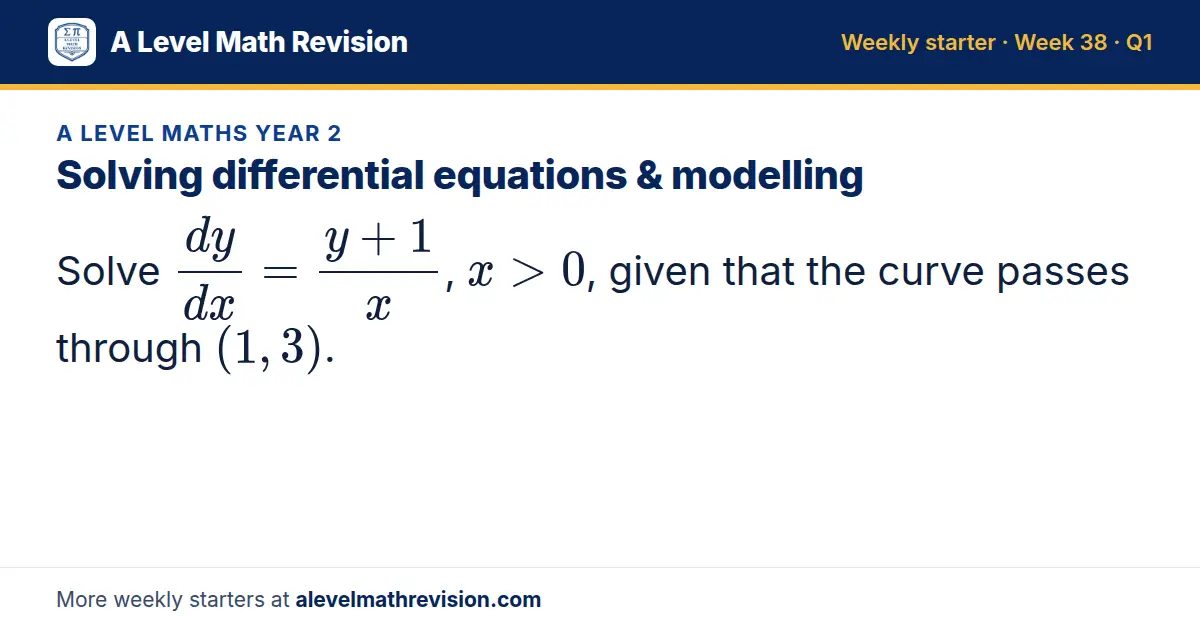
Question 1: Solving differential equations & modelling
Solve dy/dx = (y + 1)/x, x > 0, given that the curve passes through (1, 3).
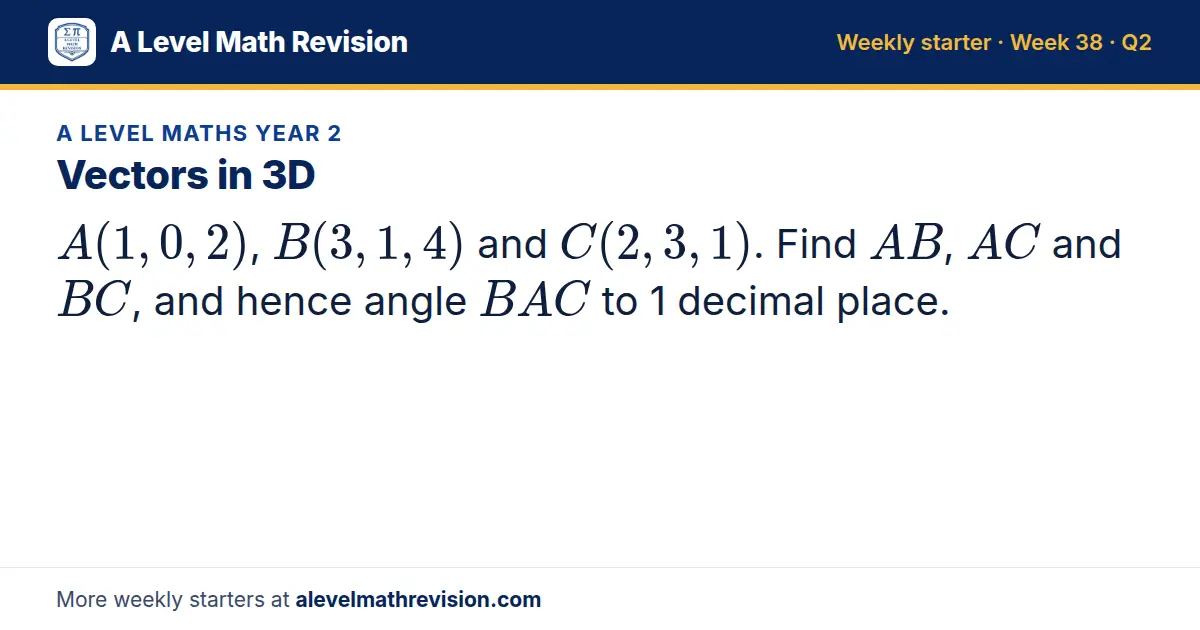
Question 2: Vectors in 3D
A(1, 0, 2), B(3, 1, 4) and C(2, 3, 1). Find AB, AC and BC, and hence angle BAC to 1 decimal place.
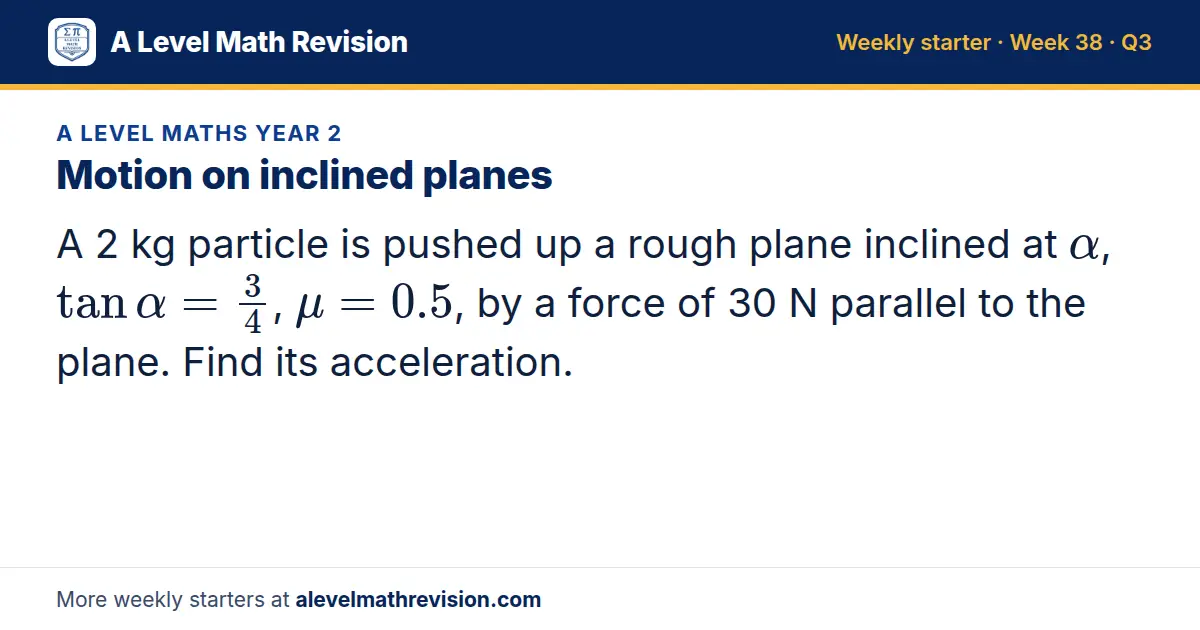
Question 3: Motion on inclined planes
A 2 kg particle is pushed up a rough plane inclined at α, tanα = 3/4, μ = 0.5, by a force of 30 N parallel to the plane. Find its acceleration.
Week 39
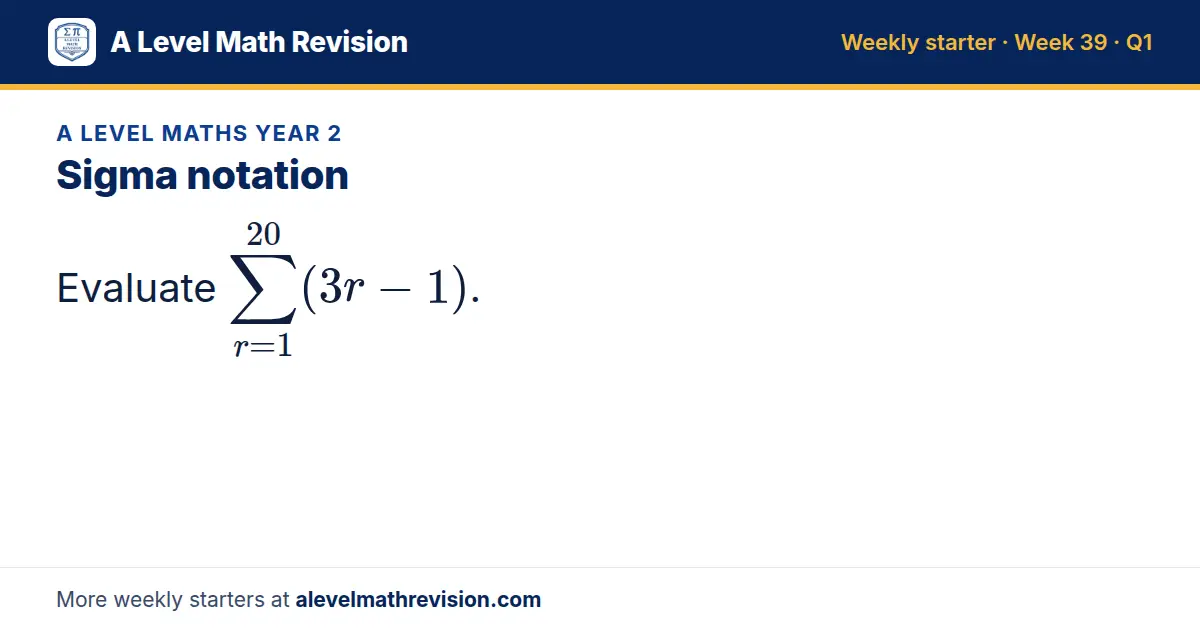
Question 1: Sigma notation
Evaluate Σ_r=1²⁰ (3r - 1).
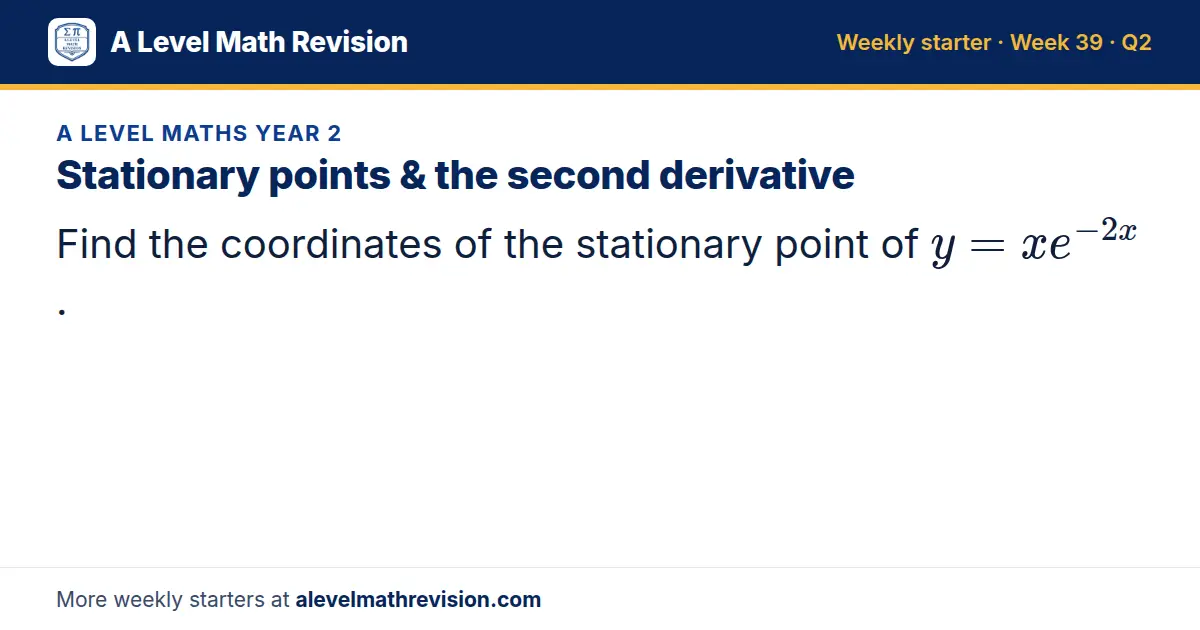
Question 2: Stationary points & the second derivative
Find the coordinates of the stationary point of y = xe^(-2x).
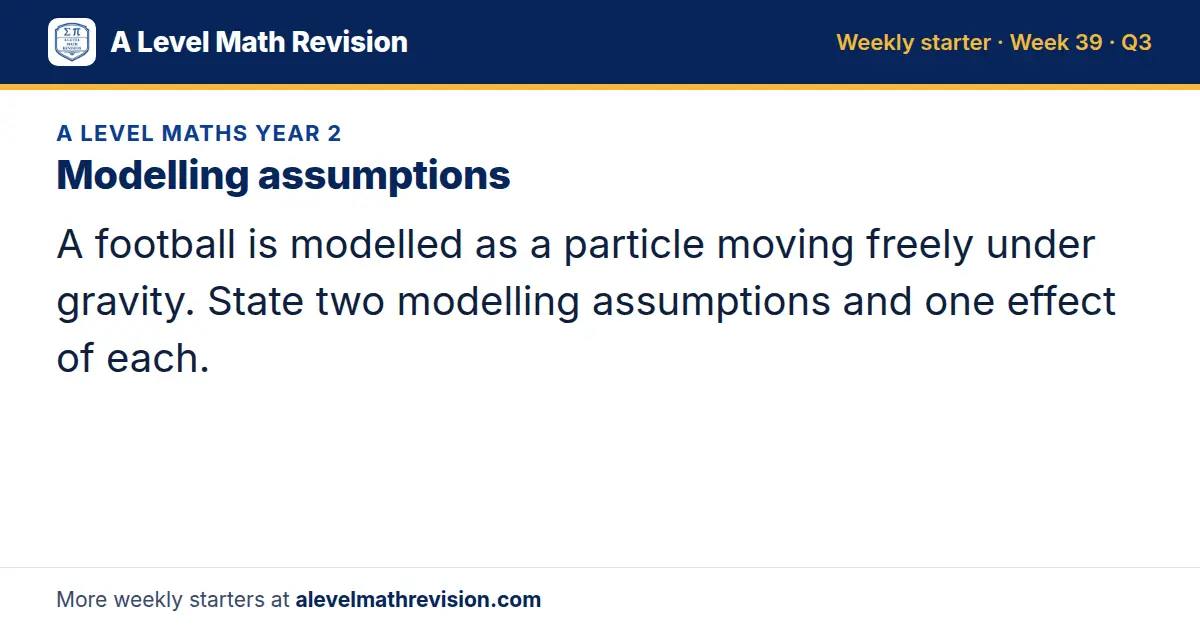
Question 3: Modelling assumptions
A football is modelled as a particle moving freely under gravity. State two modelling assumptions and one effect of each.
Week 40
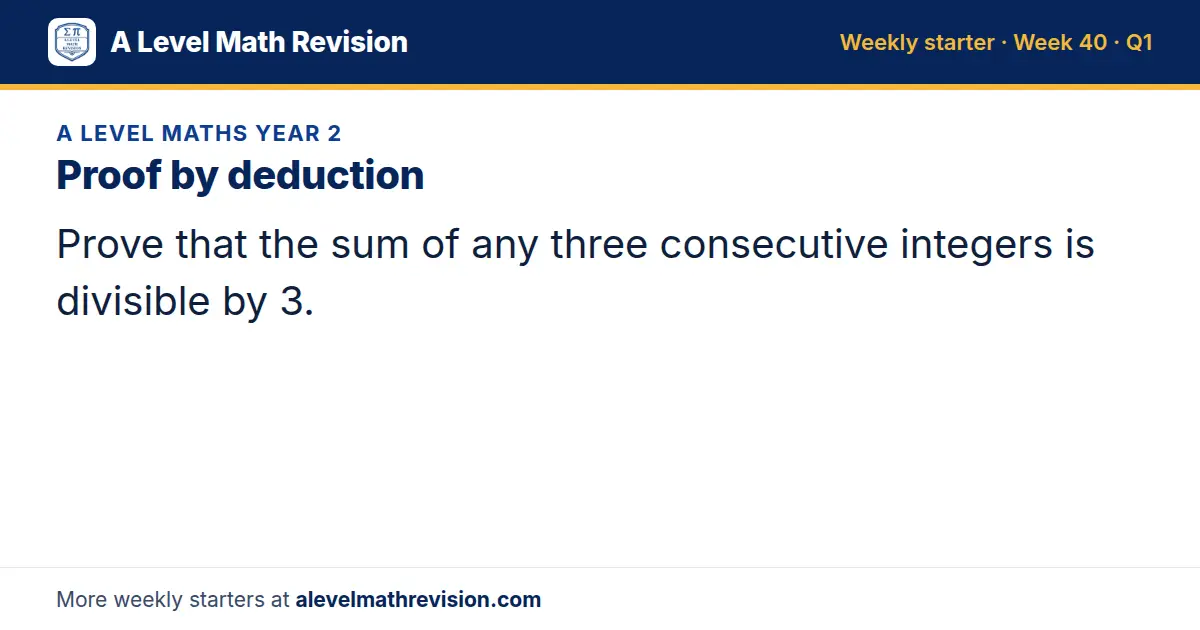
Question 1: Proof by deduction
Prove that the sum of any three consecutive integers is divisible by 3.
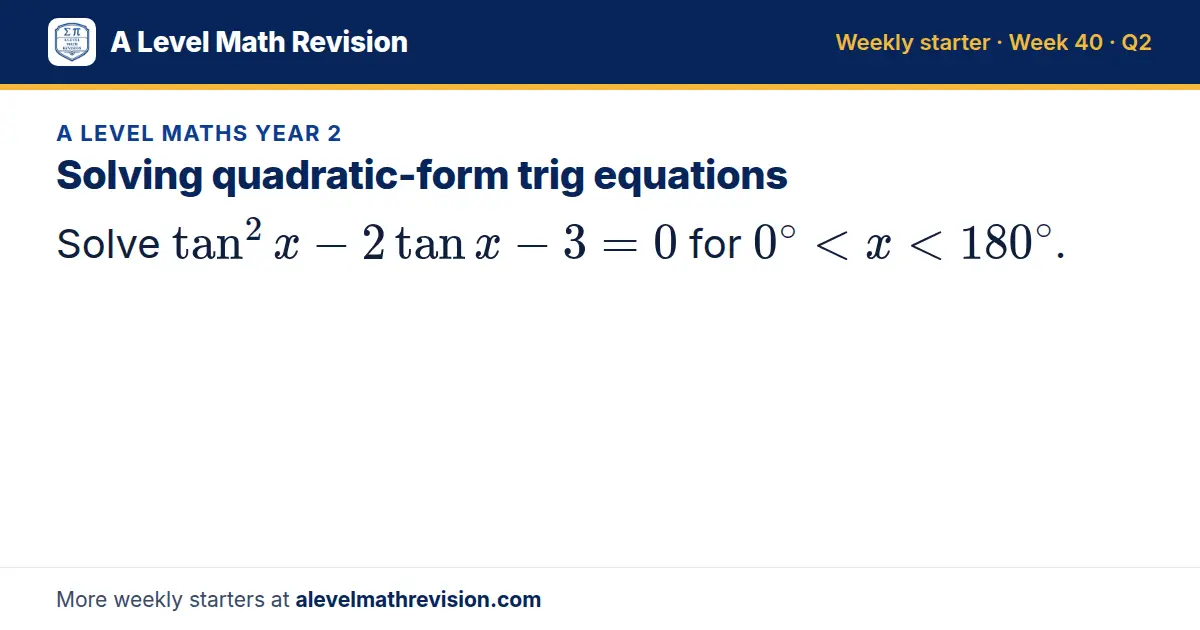
Question 2: Solving quadratic-form trig equations
Solve tan² x - 2tan x - 3 = 0 for 0^∘ < x < 180^∘.
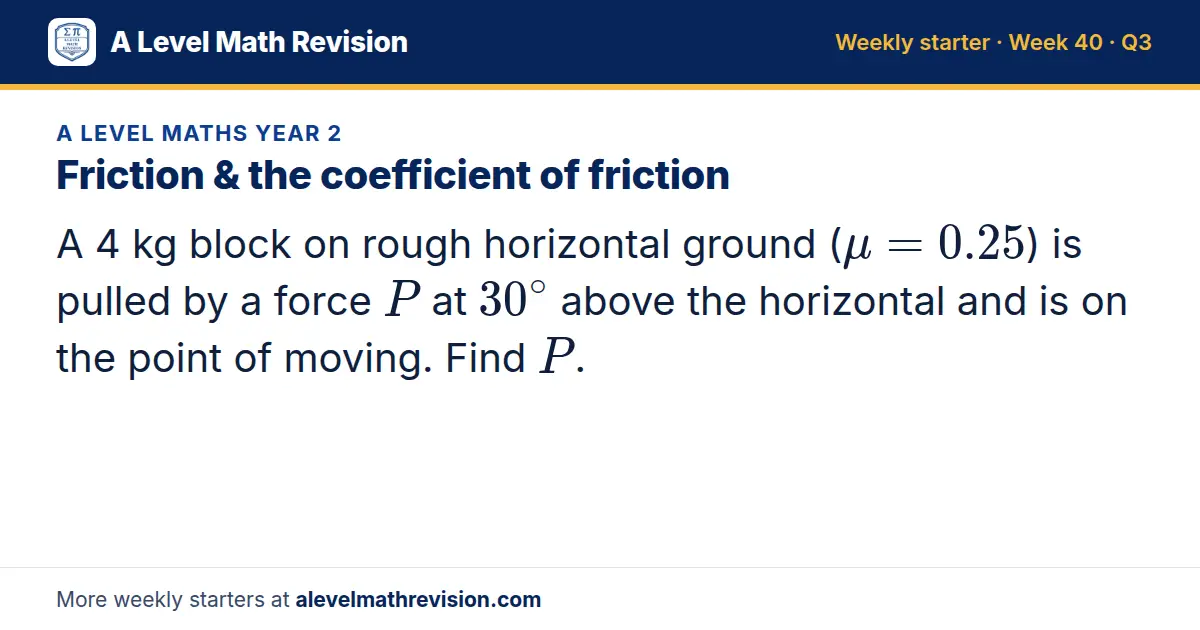
Question 3: Friction & the coefficient of friction
A 4 kg block on rough horizontal ground (μ = 0.25) is pulled by a force P at 30^∘ above the horizontal and is on the point of moving. Find P.
More starter questions
Other weeks: Weeks 1–13 · Weeks 14–26 · Weeks 27–40. Answers and mark schemes are in the starter tasks for teachers.