A Level Maths Year 2 starter questions: weeks 1–13
39 short questions to open a lesson for A Level Maths Year 2, weeks 1–13 of the teaching year, three or four a week. Each question is shown as an image with its text underneath; answers and mark schemes stay with teachers.
Week 1
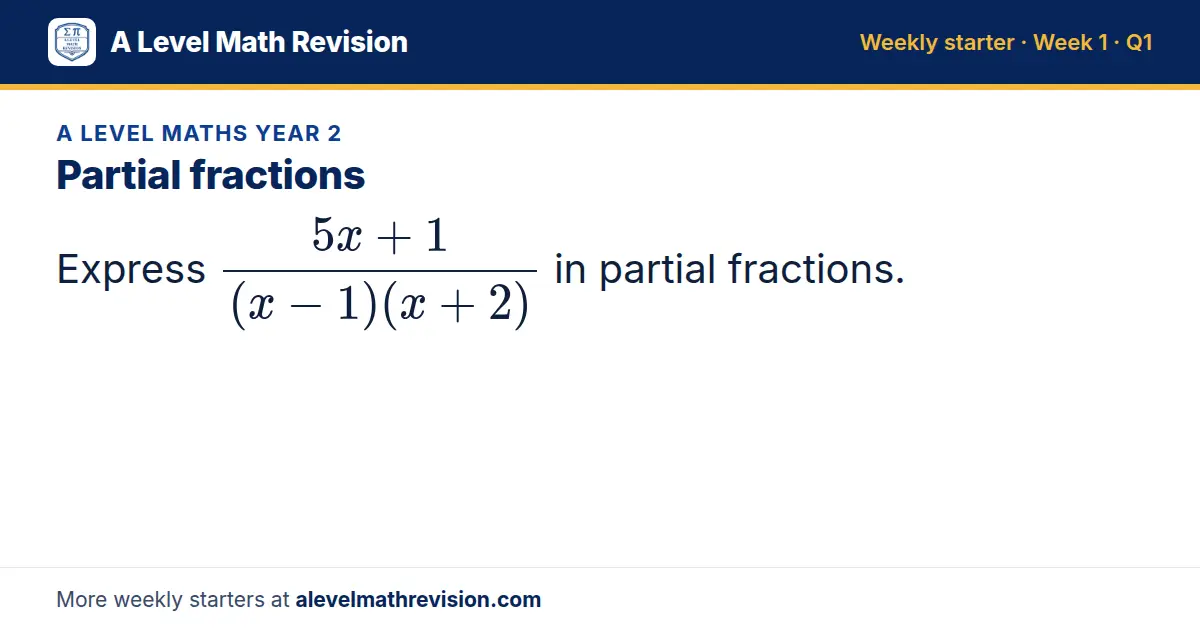
Question 1: Partial fractions
Express (5x + 1)/((x - 1)(x + 2)) in partial fractions.
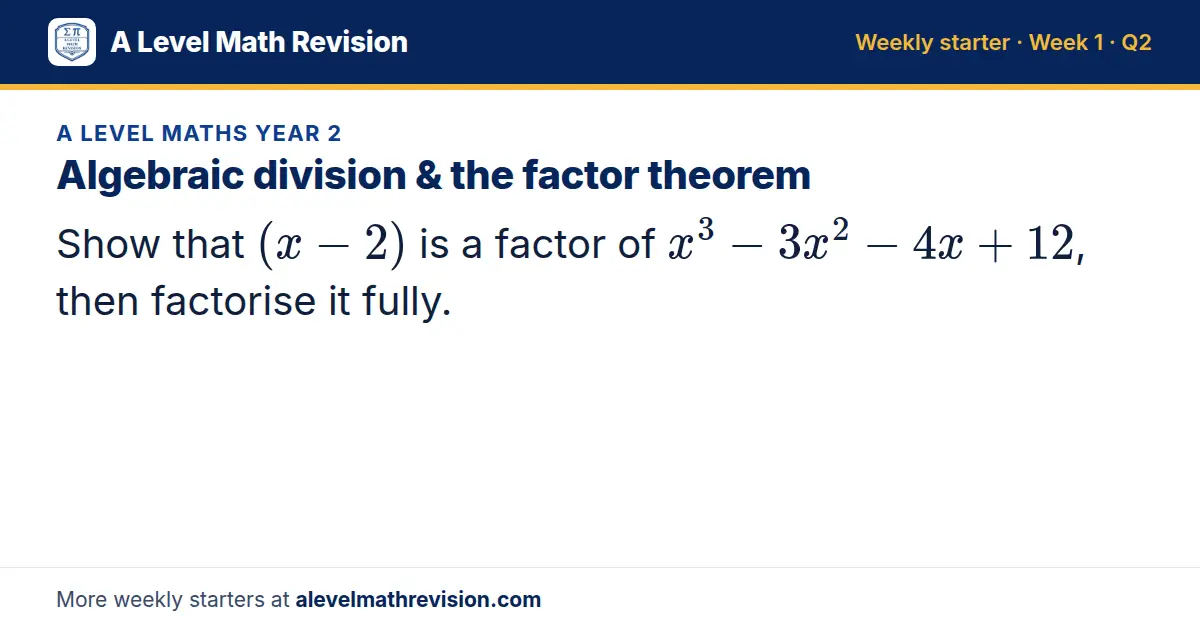
Question 2: Algebraic division & the factor theorem
Show that (x - 2) is a factor of x³ - 3x² - 4x + 12, then factorise it fully.
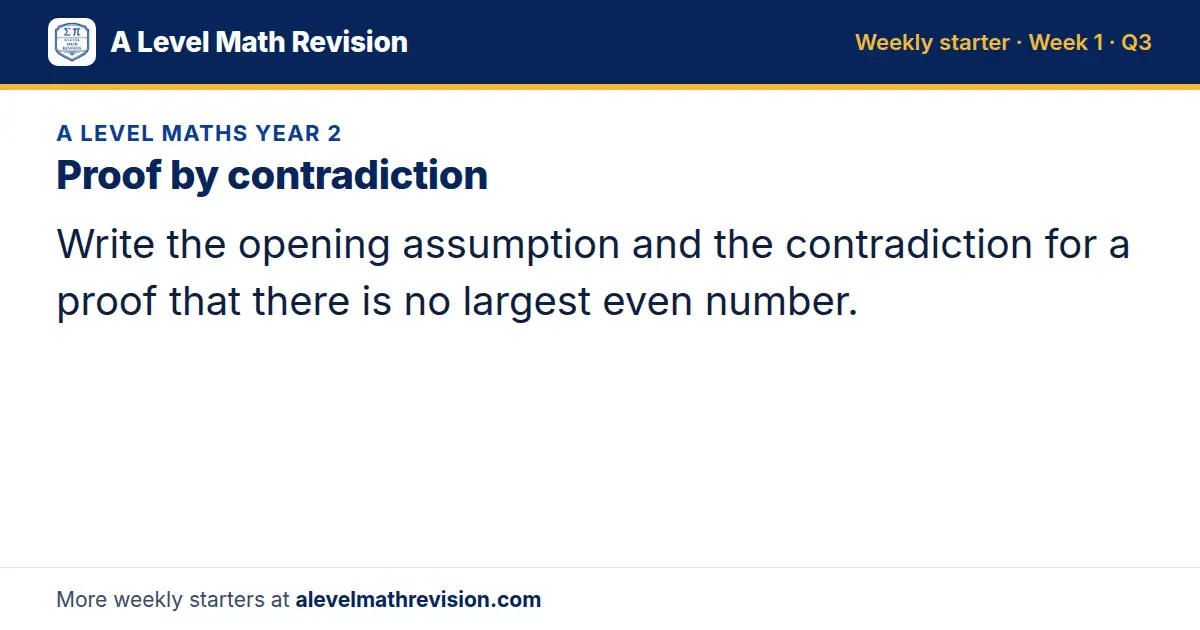
Question 3: Proof by contradiction
Write the opening assumption and the contradiction for a proof that there is no largest even number.
Week 2
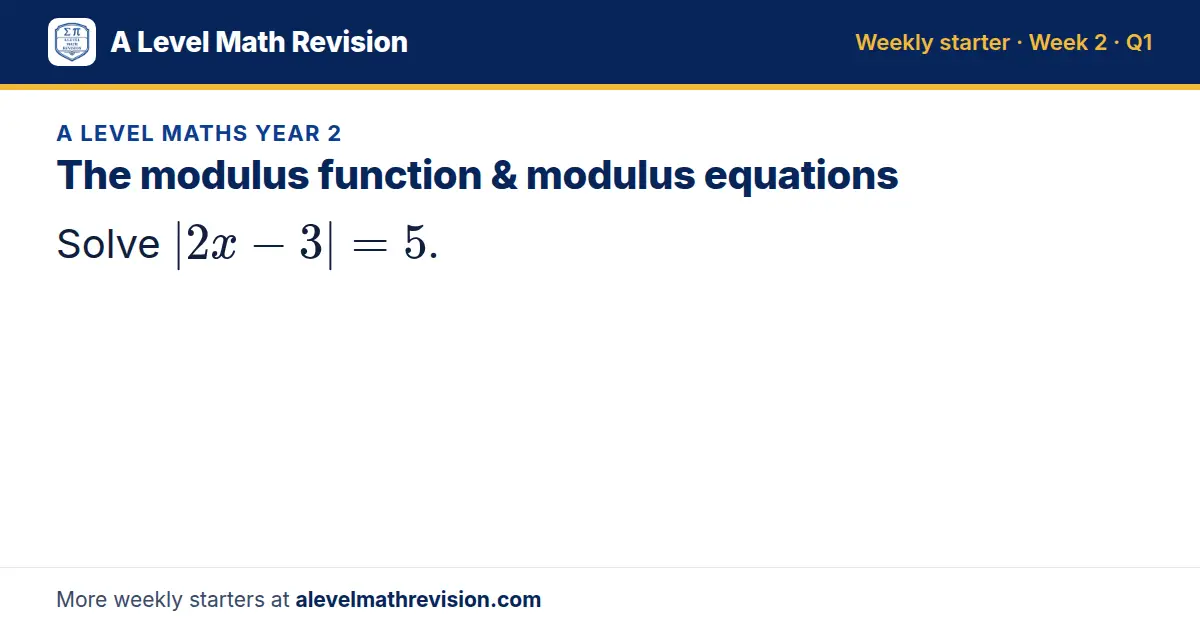
Question 1: The modulus function & modulus equations
Solve |2x - 3| = 5.
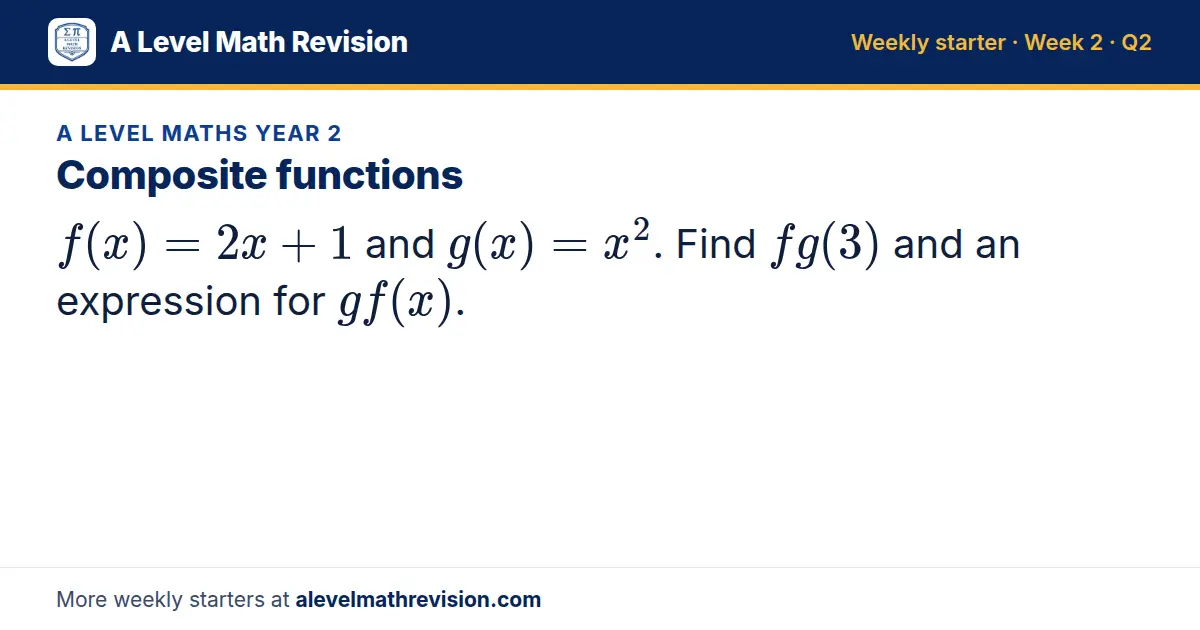
Question 2: Composite functions
f(x) = 2x + 1 and g(x) = x^2. Find fg(3) and an expression for gf(x).
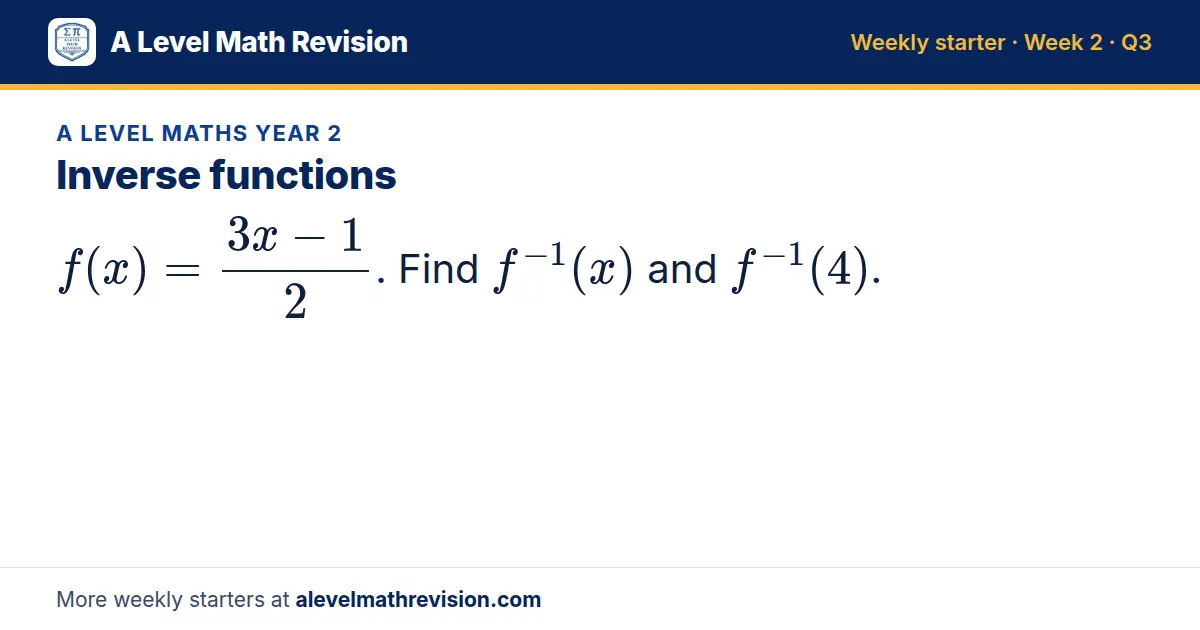
Question 3: Inverse functions
f(x) = (3x - 1)/2. Find f⁻¹(x) and f⁻¹(4).
Week 3
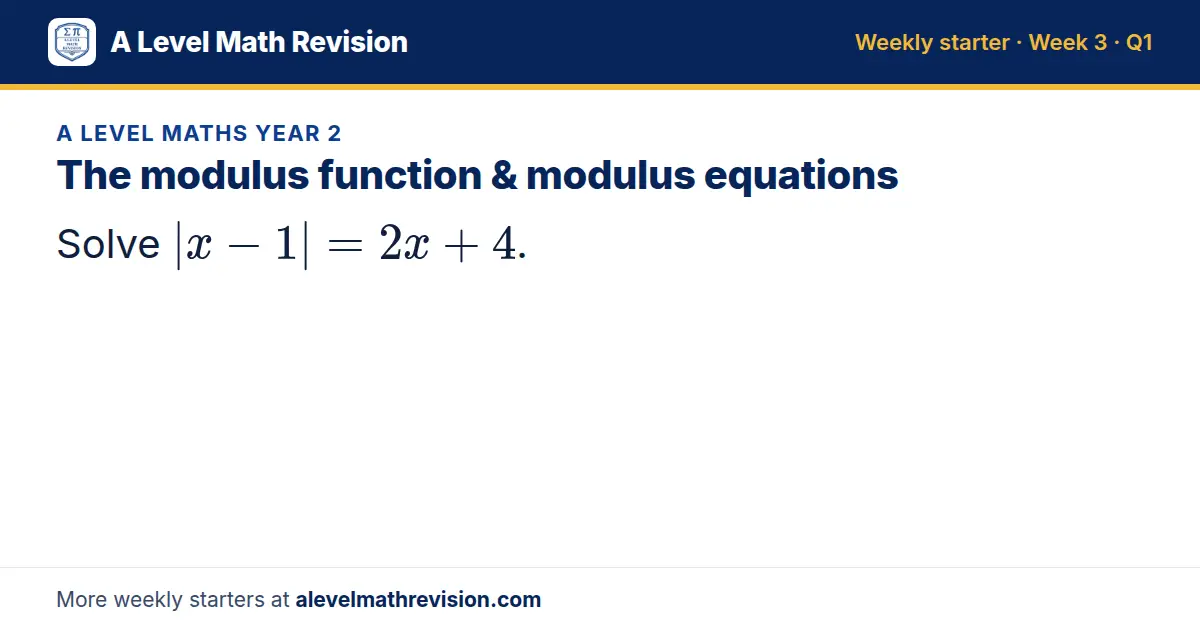
Question 1: The modulus function & modulus equations
Solve |x - 1| = 2x + 4.
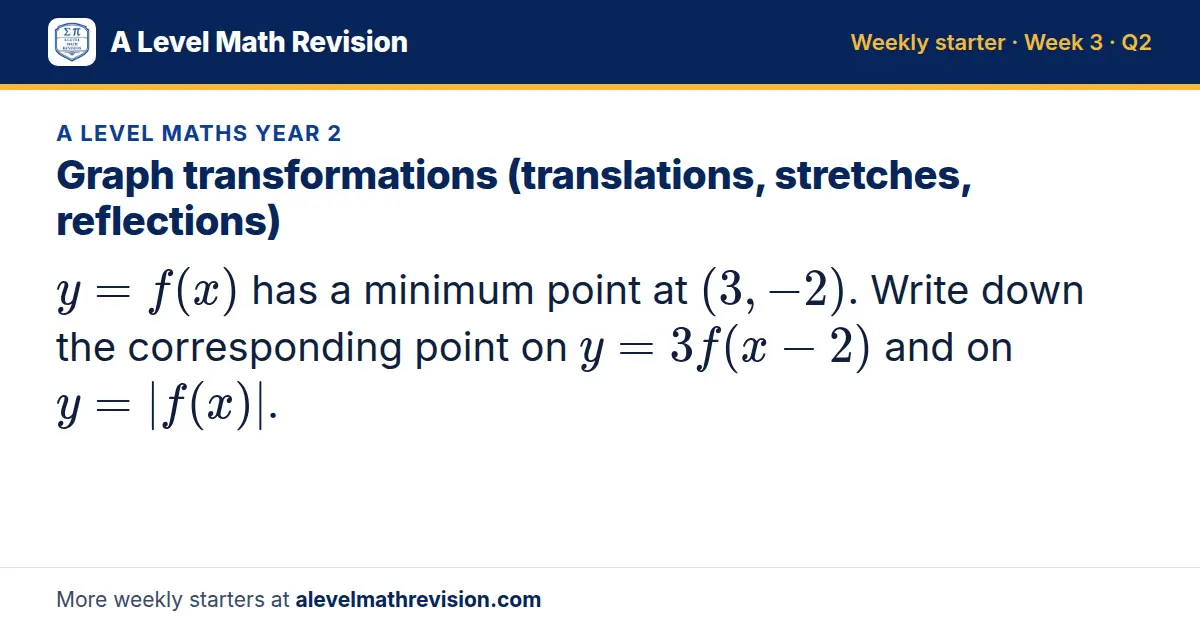
Question 2: Graph transformations (translations, stretches, reflections)
y = f(x) has a minimum point at (3, -2). Write down the corresponding point on y = 3f(x - 2) and on y = |f(x)|.
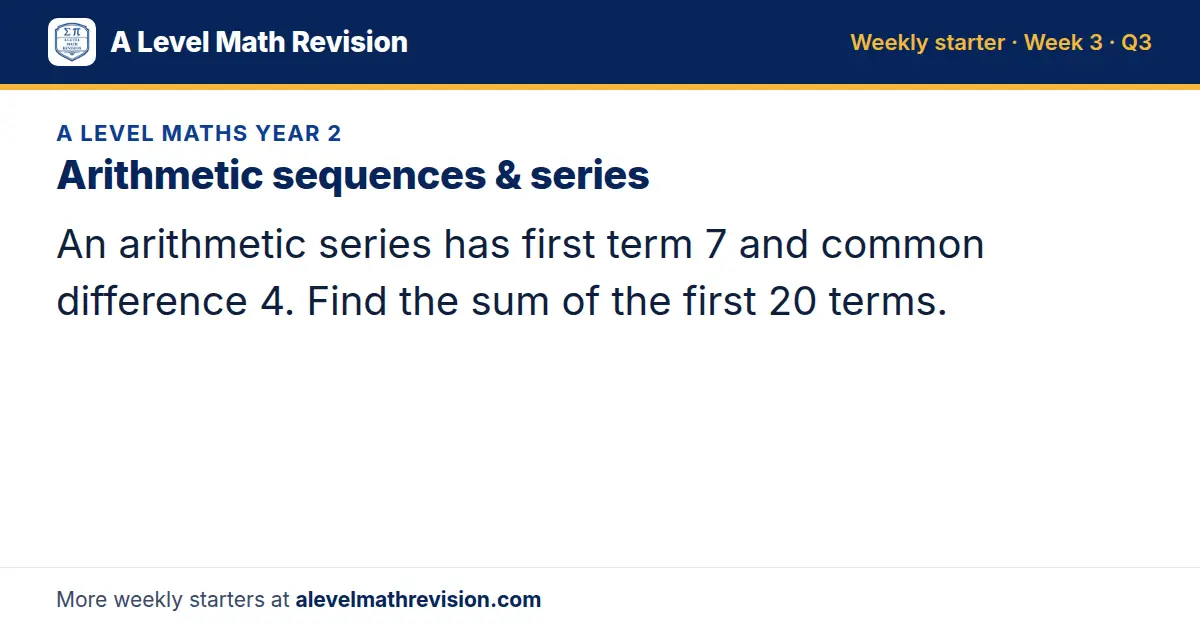
Question 3: Arithmetic sequences & series
An arithmetic series has first term 7 and common difference 4. Find the sum of the first 20 terms.
Week 4
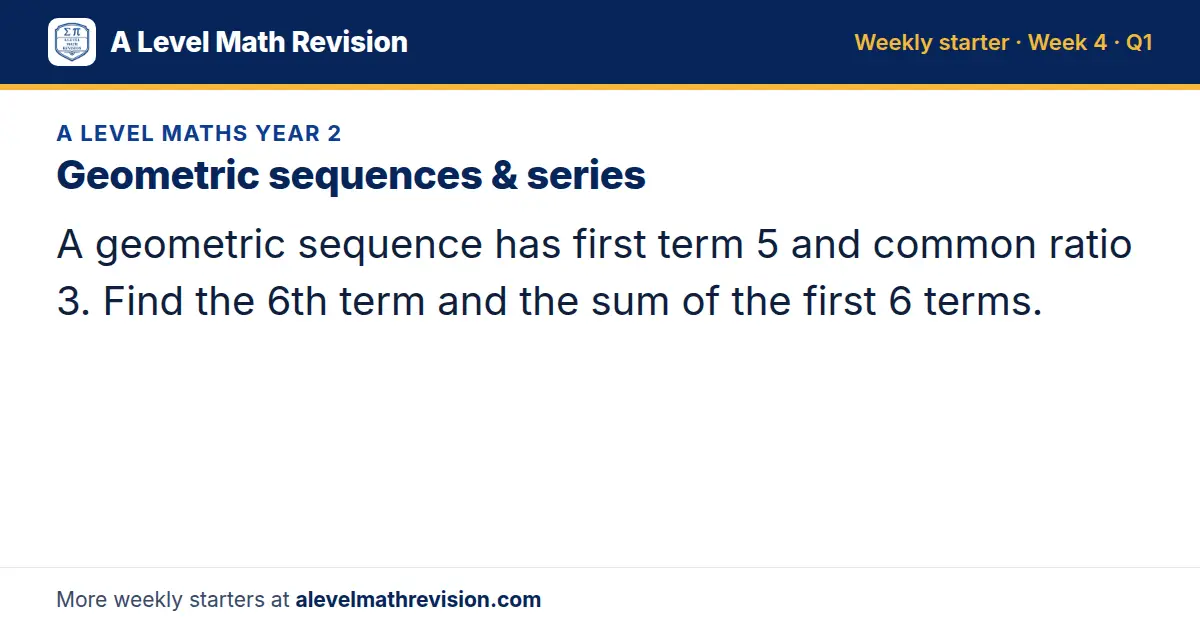
Question 1: Geometric sequences & series
A geometric sequence has first term 5 and common ratio 3. Find the 6th term and the sum of the first 6 terms.
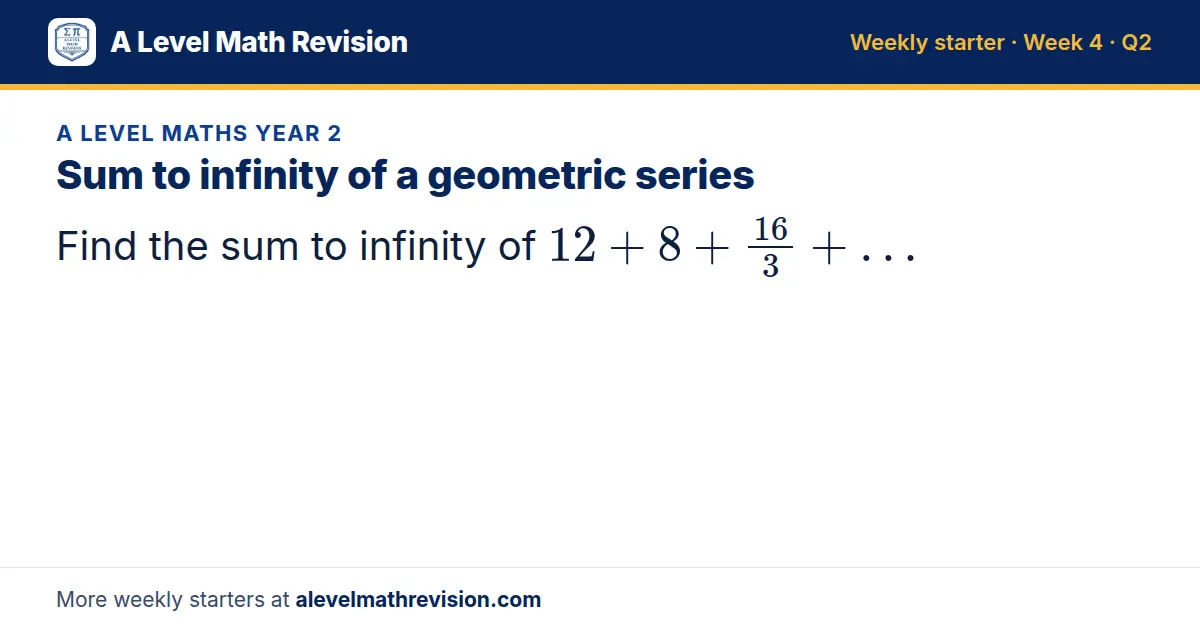
Question 2: Sum to infinity of a geometric series
Find the sum to infinity of 12 + 8 + 16/3 + …
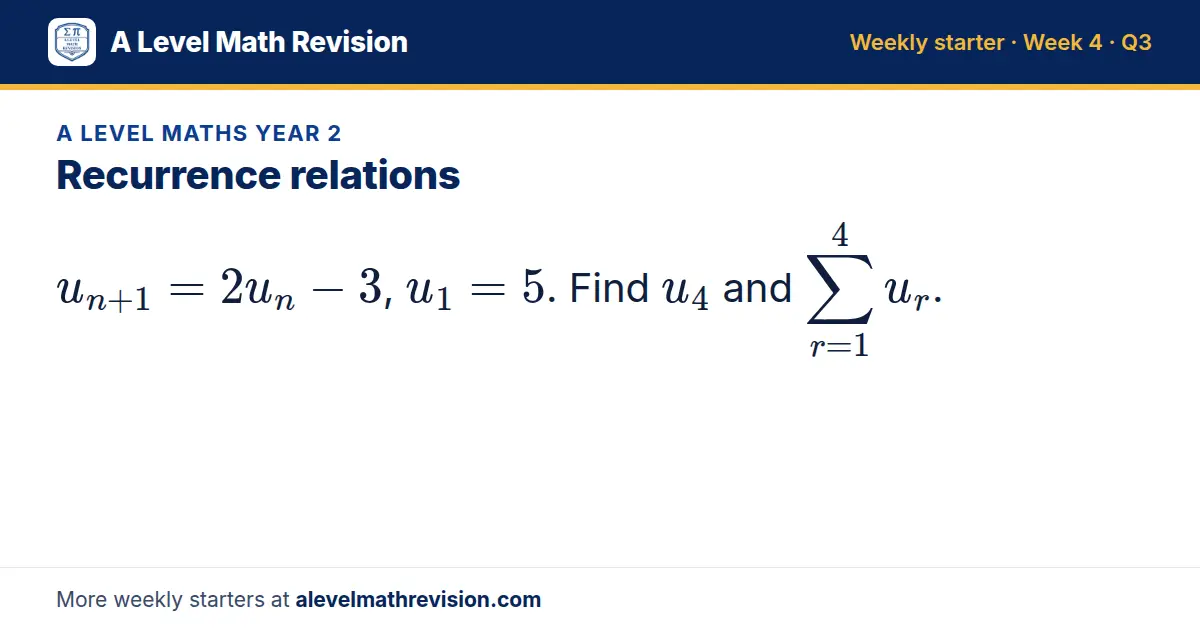
Question 3: Recurrence relations
u_n+1 = 2u_n - 3, u_1 = 5. Find u_4 and Σ_r=1⁴ u_r.
Week 5
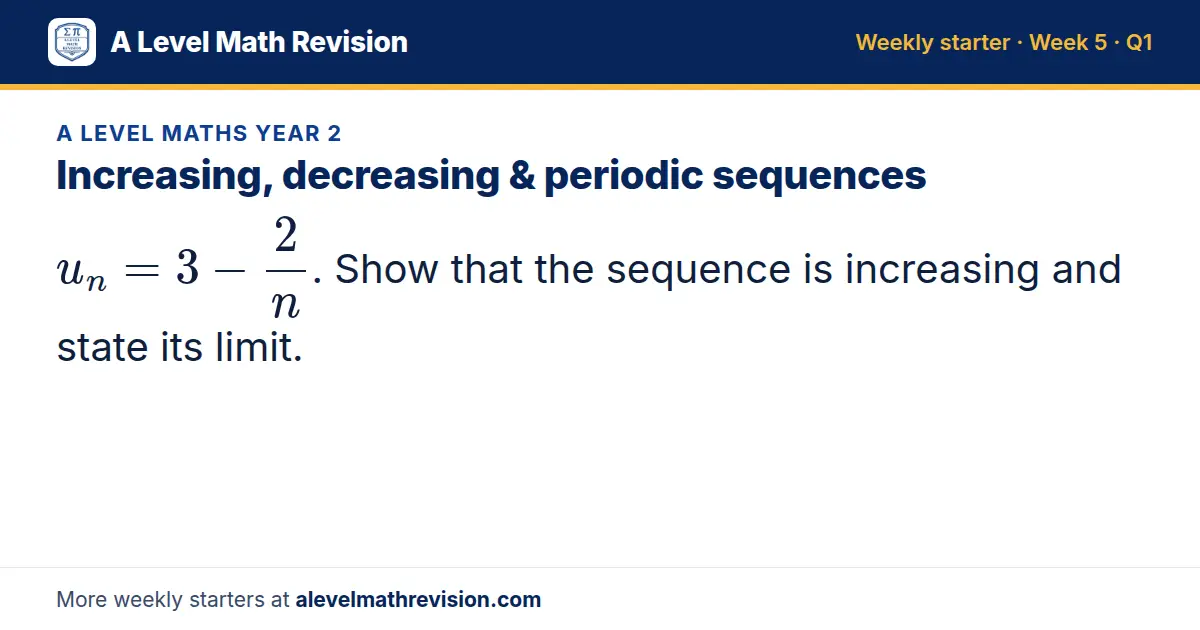
Question 1: Increasing, decreasing & periodic sequences
u_n = 3 - 2/n. Show that the sequence is increasing and state its limit.
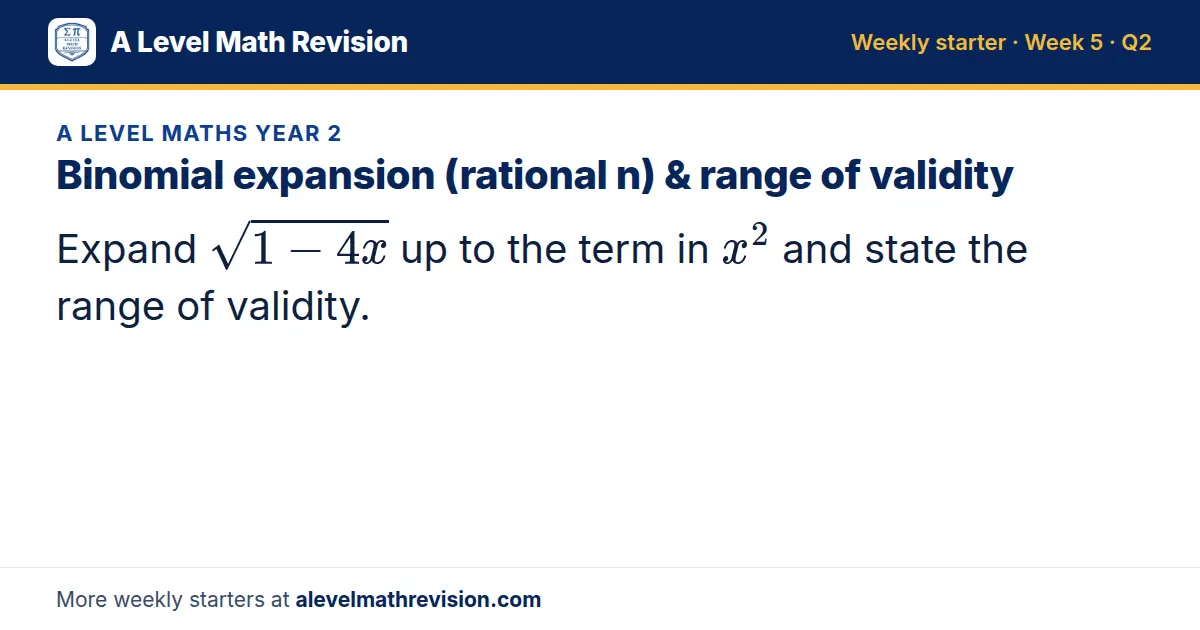
Question 2: Binomial expansion (rational n) & range of validity
Expand √(1 - 4x) up to the term in x² and state the range of validity.
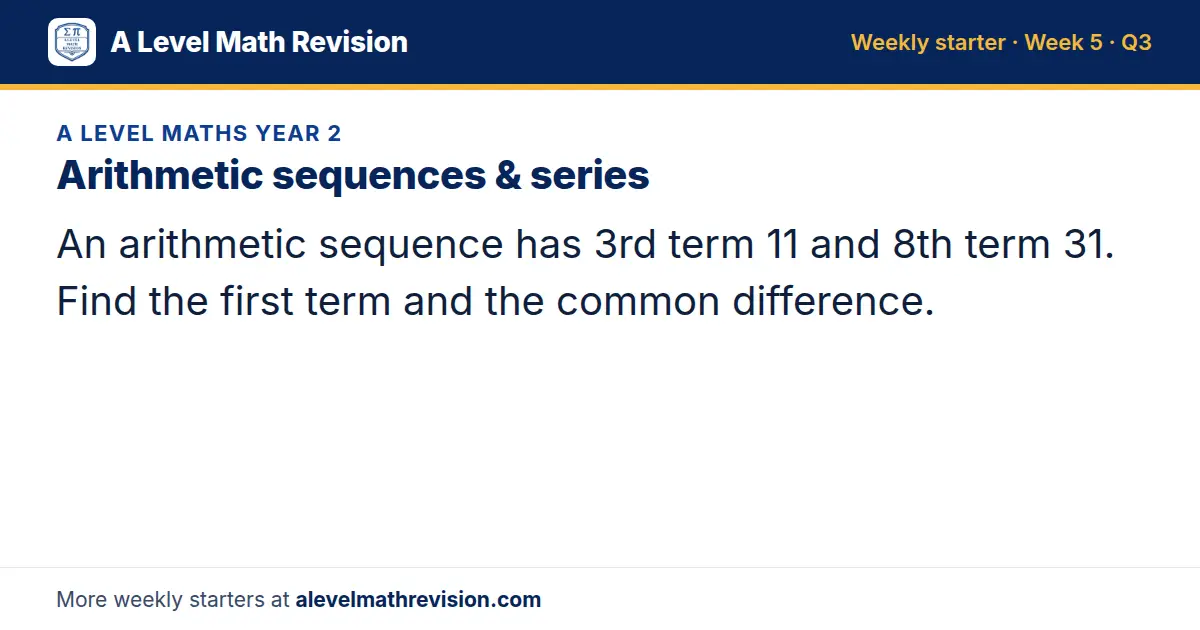
Question 3: Arithmetic sequences & series
An arithmetic sequence has 3rd term 11 and 8th term 31. Find the first term and the common difference.
Week 6
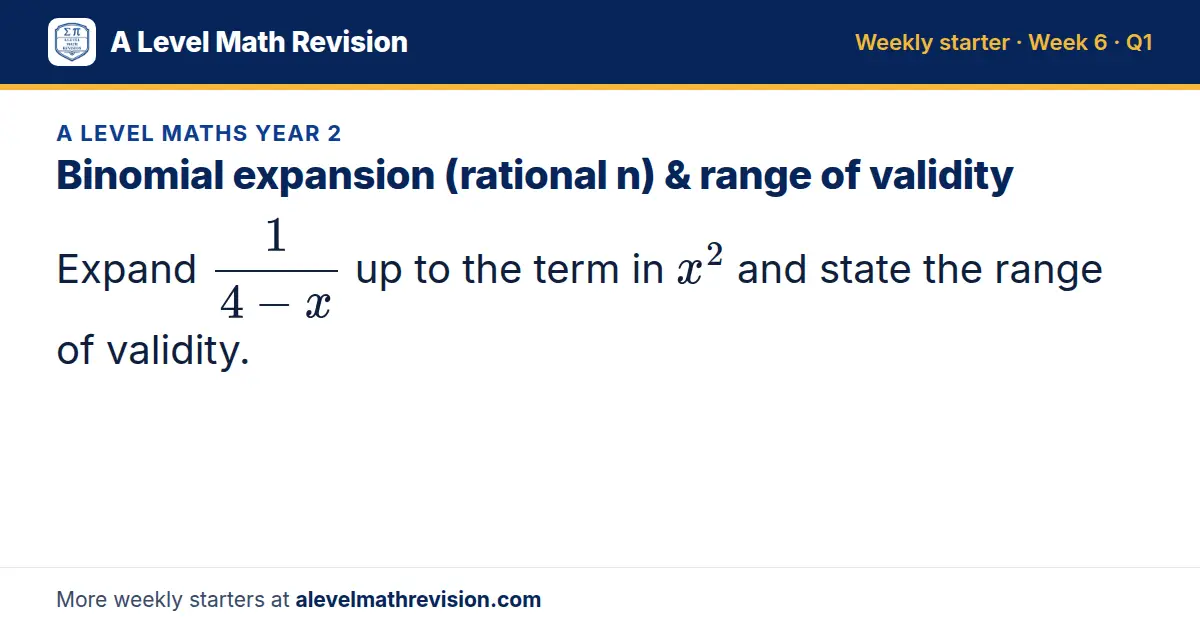
Question 1: Binomial expansion (rational n) & range of validity
Expand 1/(4 - x) up to the term in x² and state the range of validity.
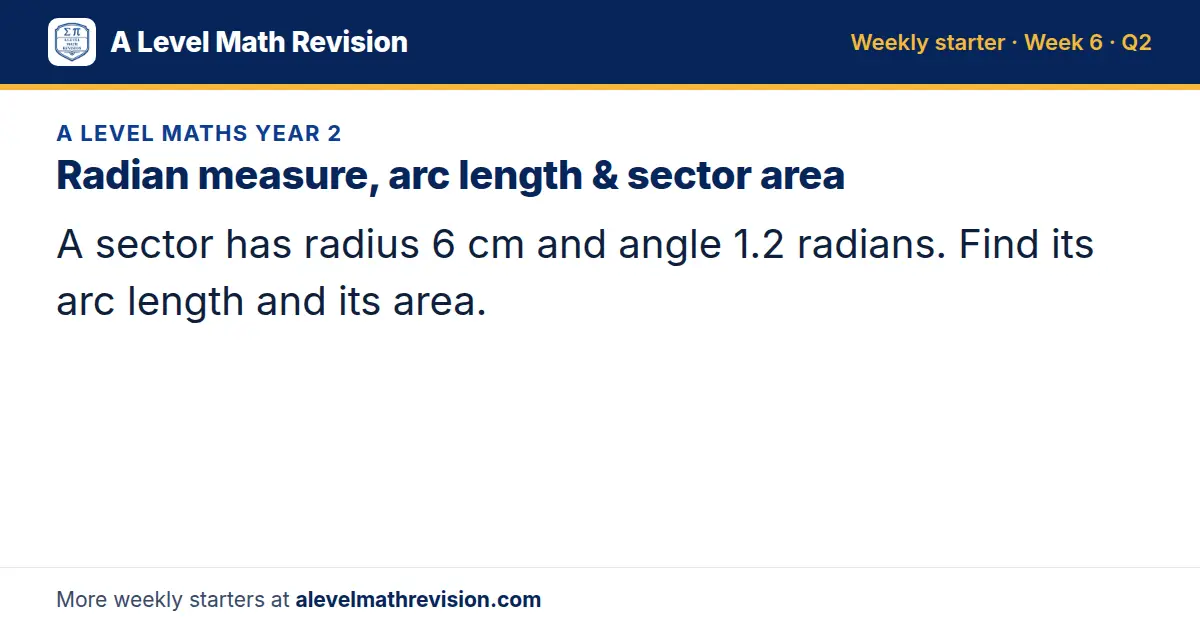
Question 2: Radian measure, arc length & sector area
A sector has radius 6 cm and angle 1.2 radians. Find its arc length and its area.
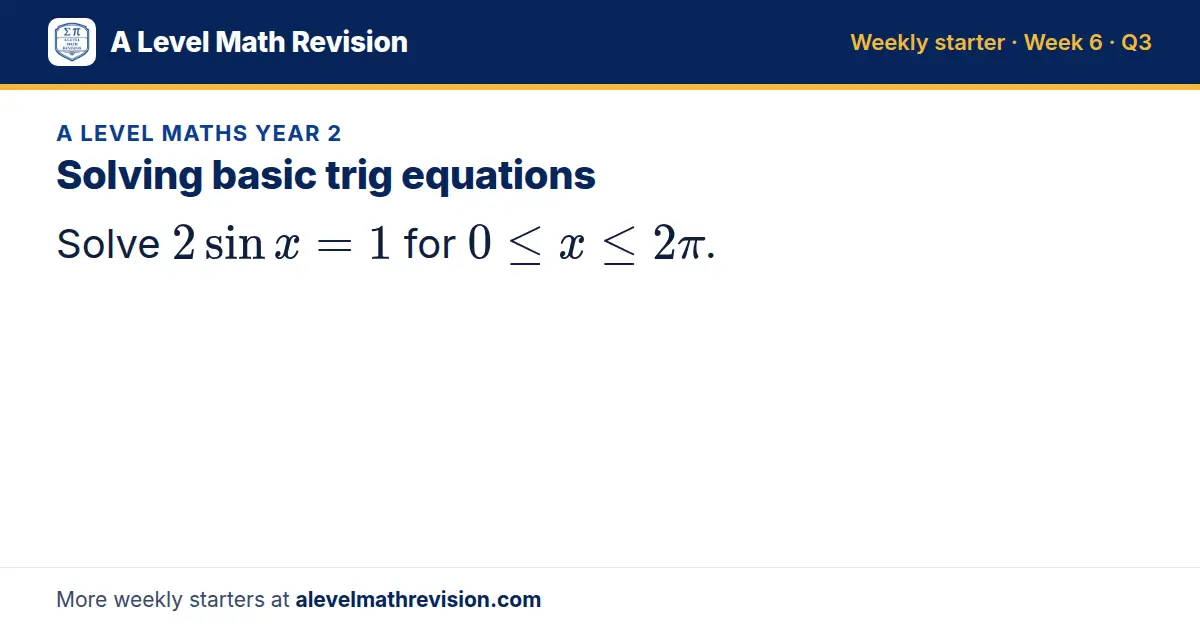
Question 3: Solving basic trig equations
Solve 2sin x = 1 for 0 ≤ x ≤ 2π.
Week 7
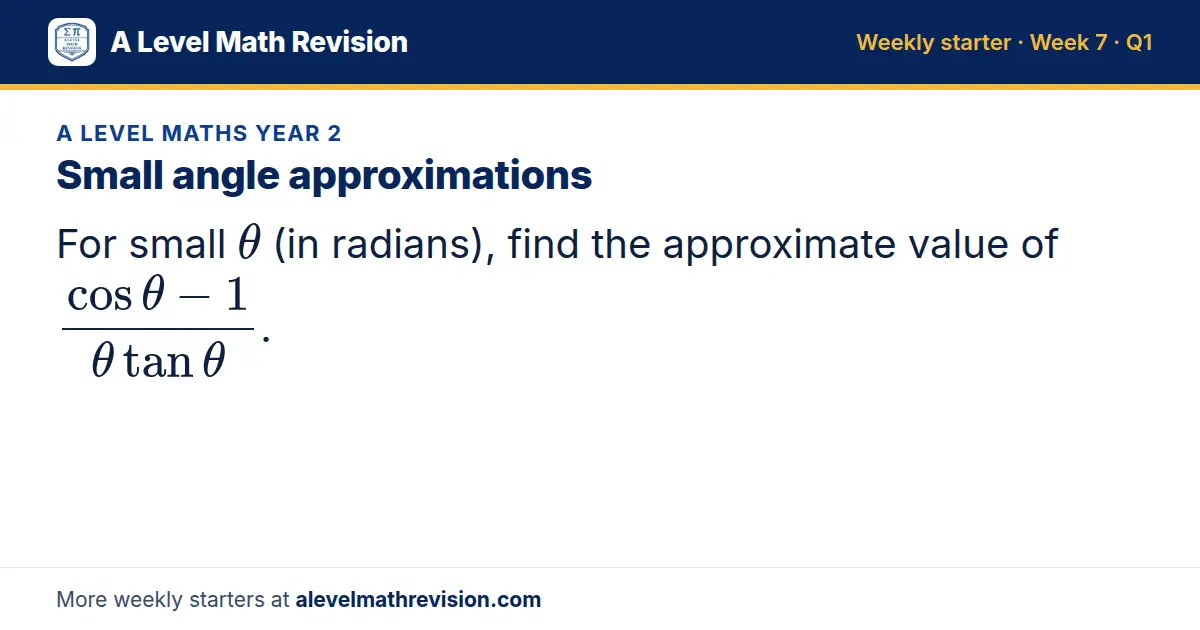
Question 1: Small angle approximations
For small θ (in radians), find the approximate value of (cosθ - 1)/(θtanθ).
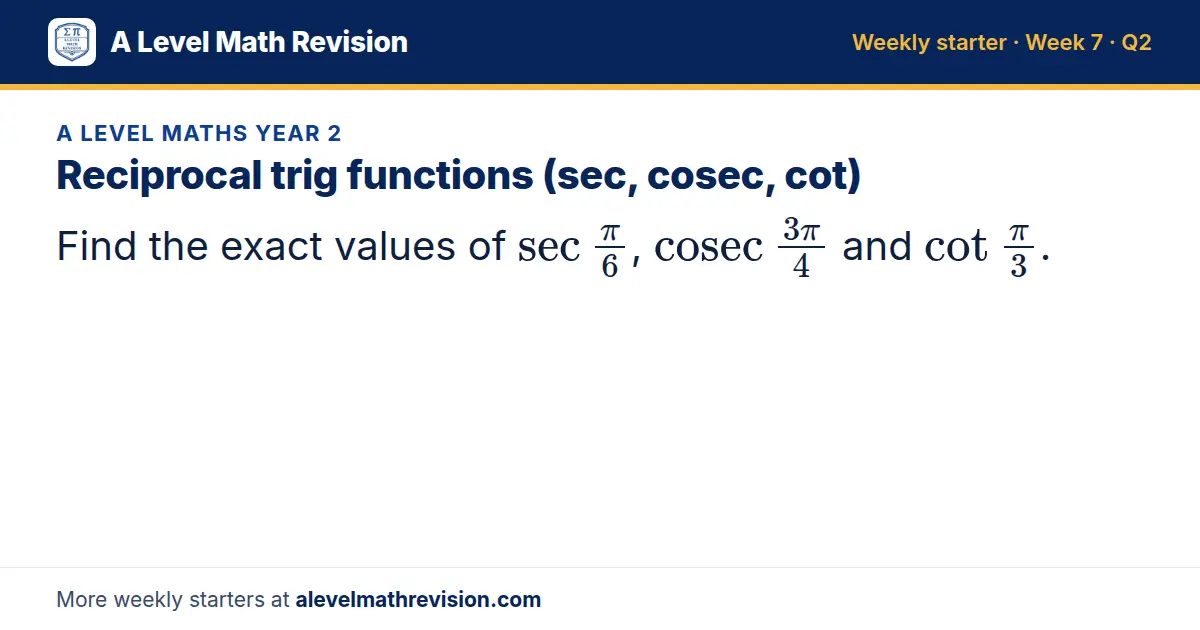
Question 2: Reciprocal trig functions (sec, cosec, cot)
Find the exact values of sec(π)/6, cosec(3π)/4 and cot(π)/3.
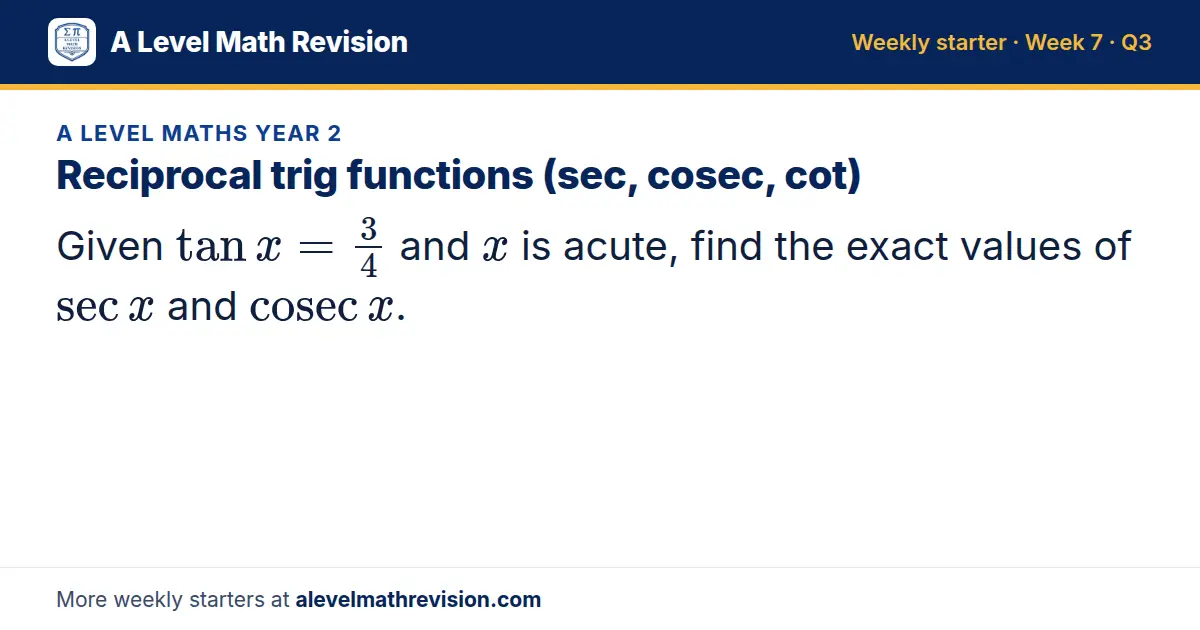
Question 3: Reciprocal trig functions (sec, cosec, cot)
Given tan x = 3/4 and x is acute, find the exact values of sec x and cosec x.
Week 8
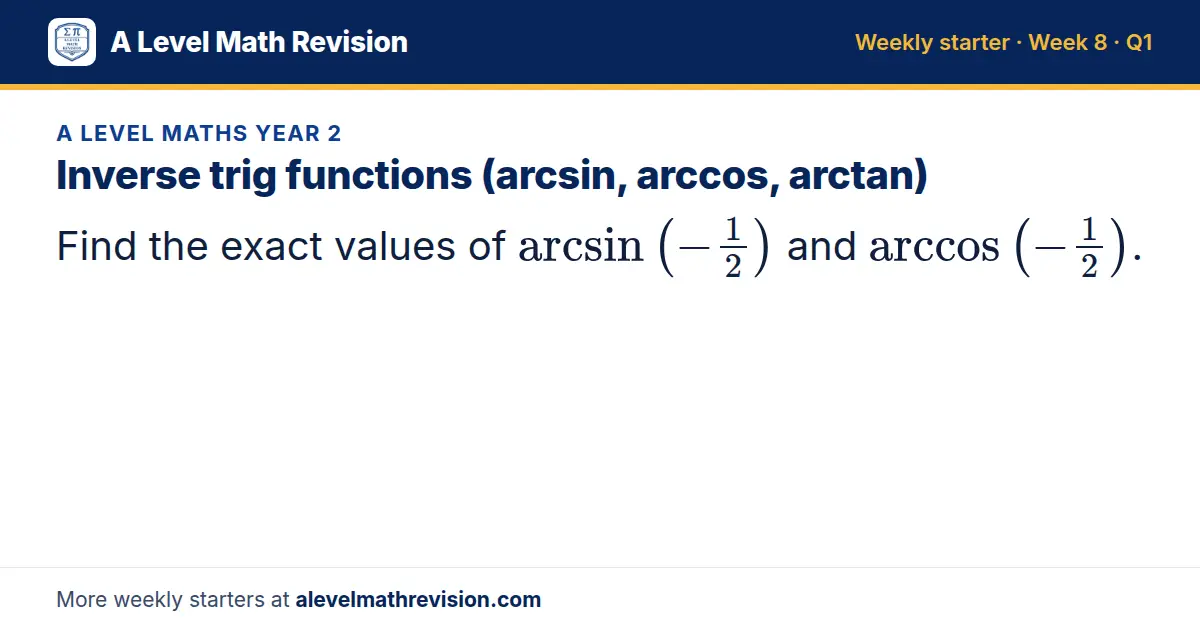
Question 1: Inverse trig functions (arcsin, arccos, arctan)
Find the exact values of arcsin(-1/2) and arccos(-1/2).
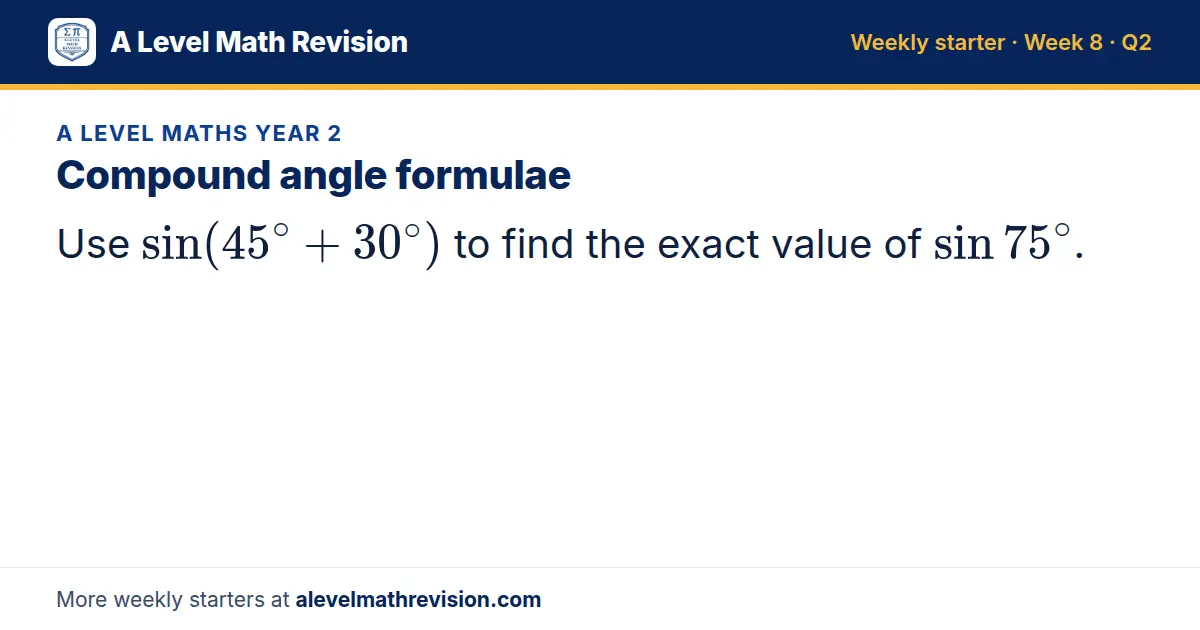
Question 2: Compound angle formulae
Use sin(45^∘ + 30^∘) to find the exact value of sin 75^∘.
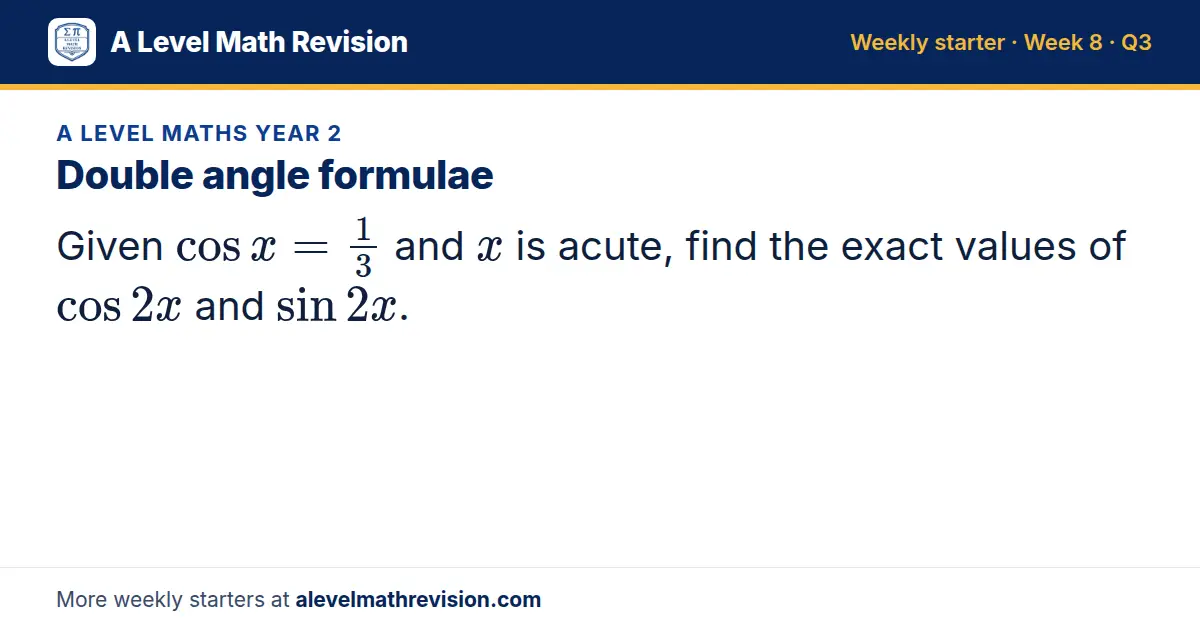
Question 3: Double angle formulae
Given cos x = 1/3 and x is acute, find the exact values of cos 2x and sin 2x.
Week 9
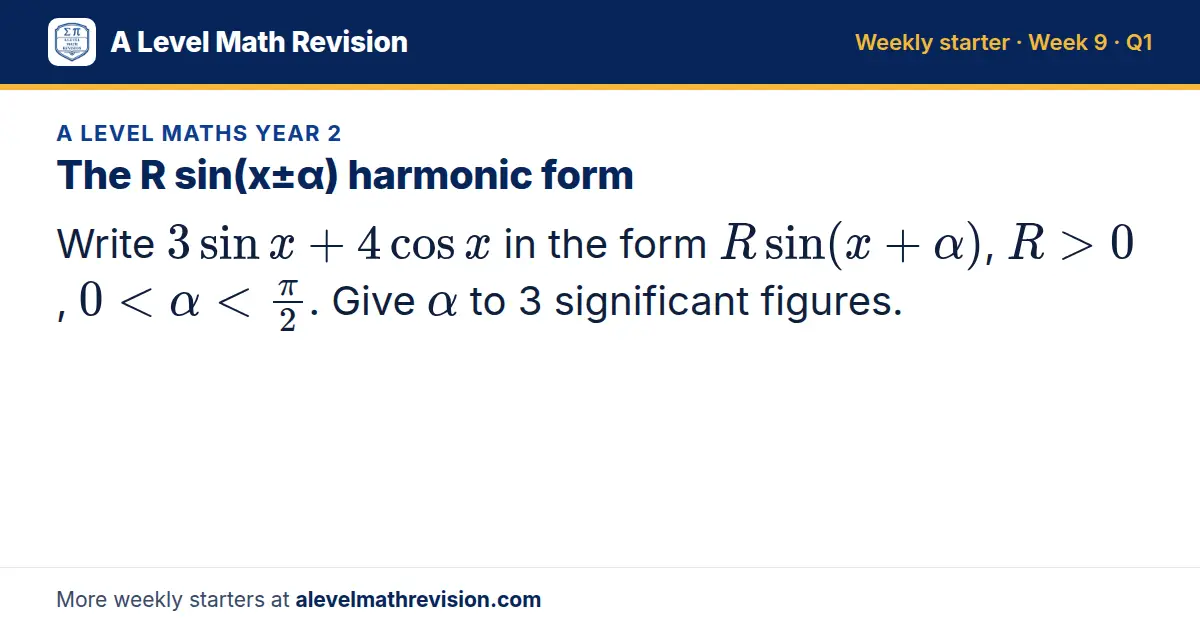
Question 1: The R sin(x±α) harmonic form
Write 3sin x + 4cos x in the form Rsin(x + α), R > 0, 0 < α < (π)/2. Give α to 3 significant figures.
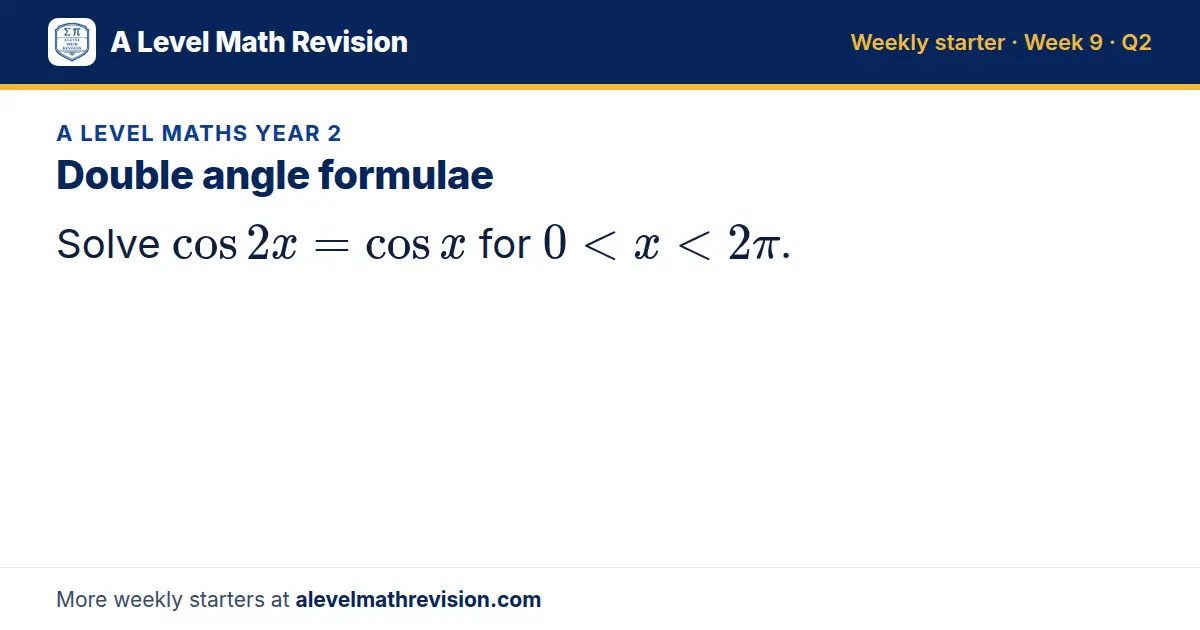
Question 2: Double angle formulae
Solve cos 2x = cos x for 0 < x < 2π.
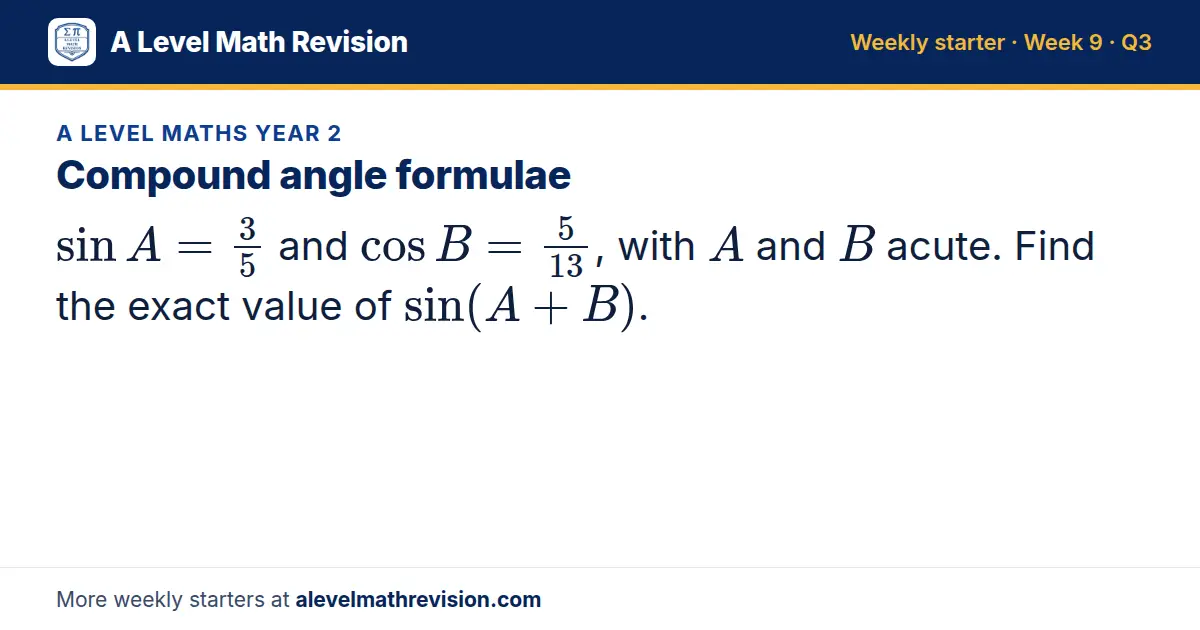
Question 3: Compound angle formulae
sin A = 3/5 and cos B = 5/13, with A and B acute. Find the exact value of sin(A + B).
Week 10
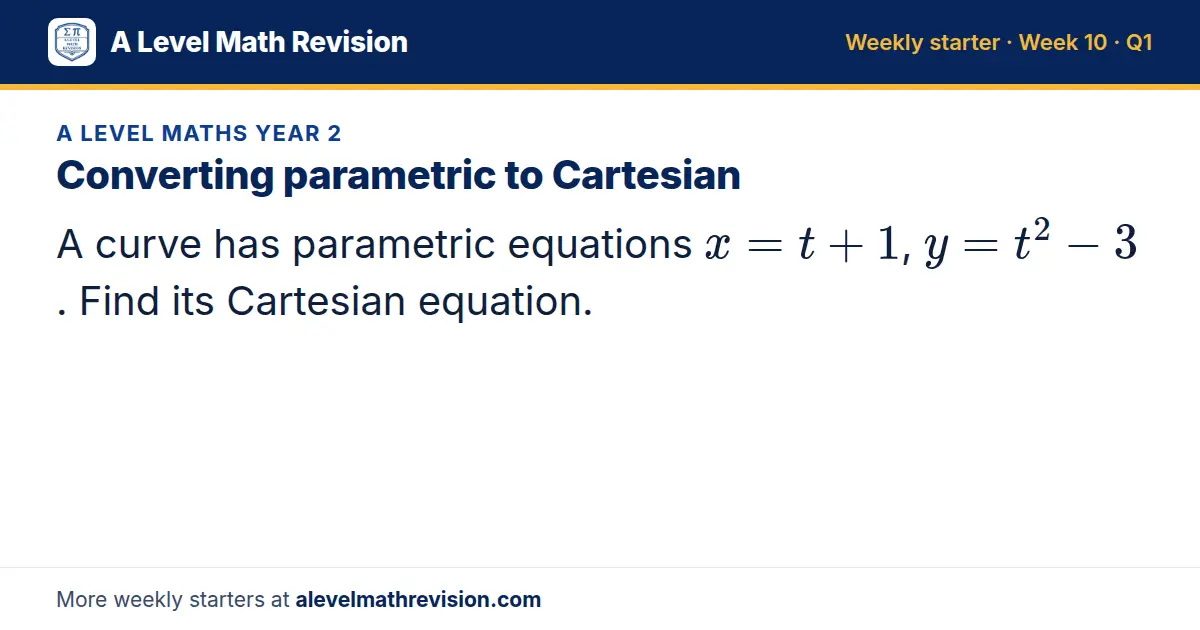
Question 1: Converting parametric to Cartesian
A curve has parametric equations x = t + 1, y = t² - 3. Find its Cartesian equation.
Question 2: Converting parametric to Cartesian
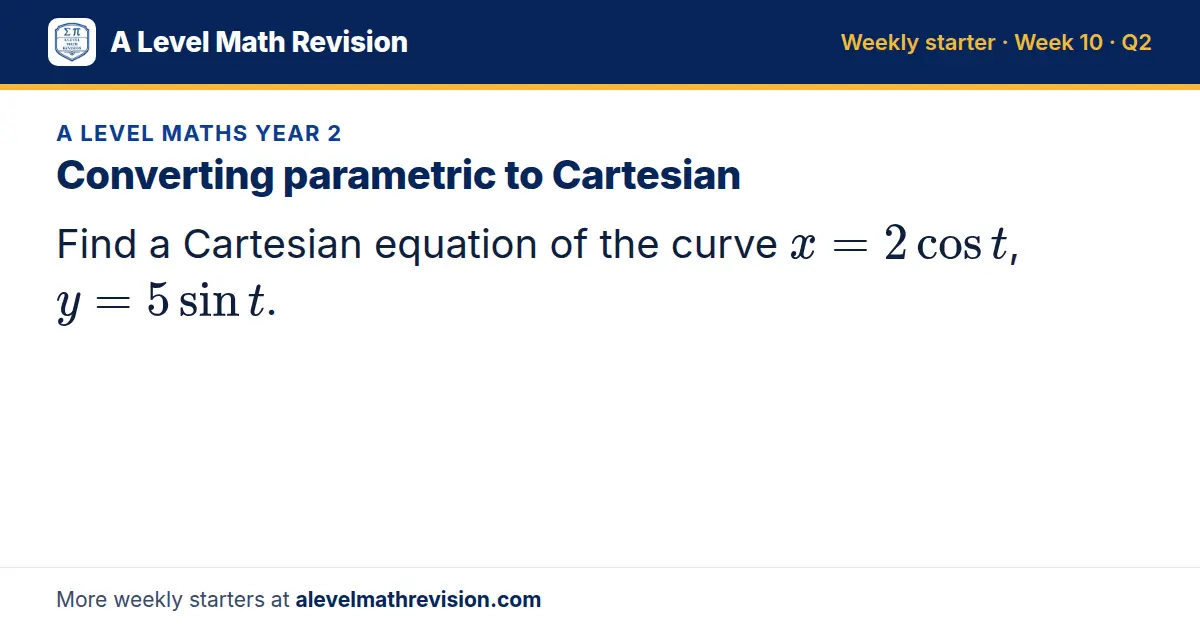
Find a Cartesian equation of the curve x = 2cos t, y = 5sin t.
Question 3: Parametric equations
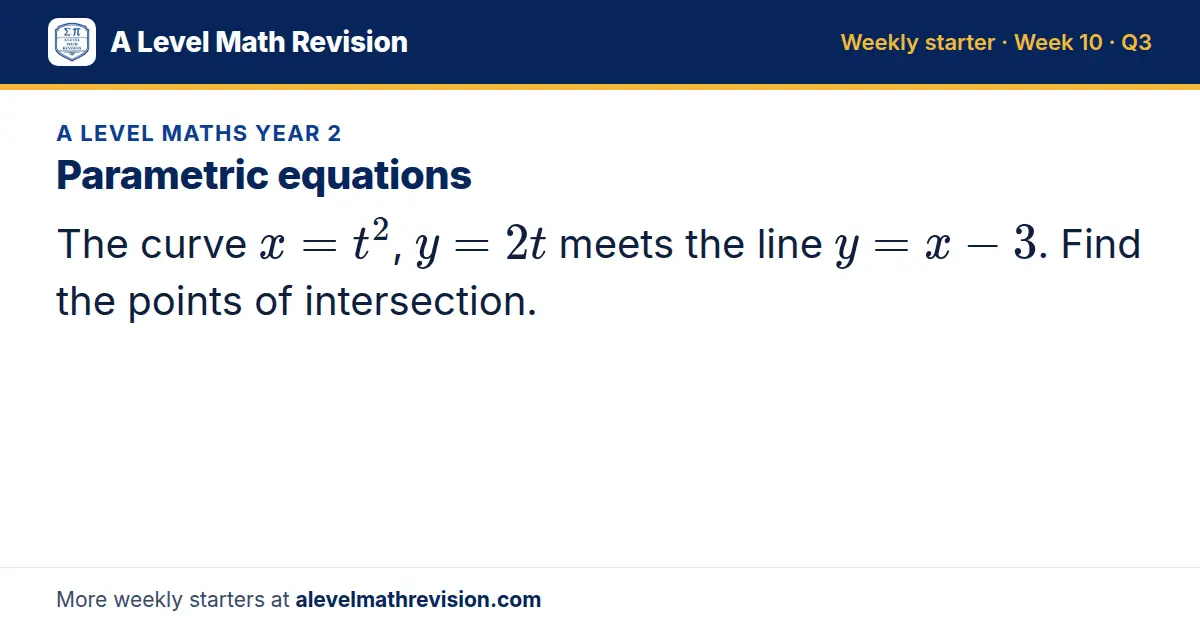
The curve x = t², y = 2t meets the line y = x - 3. Find the points of intersection.
Week 11
Question 1: The chain rule
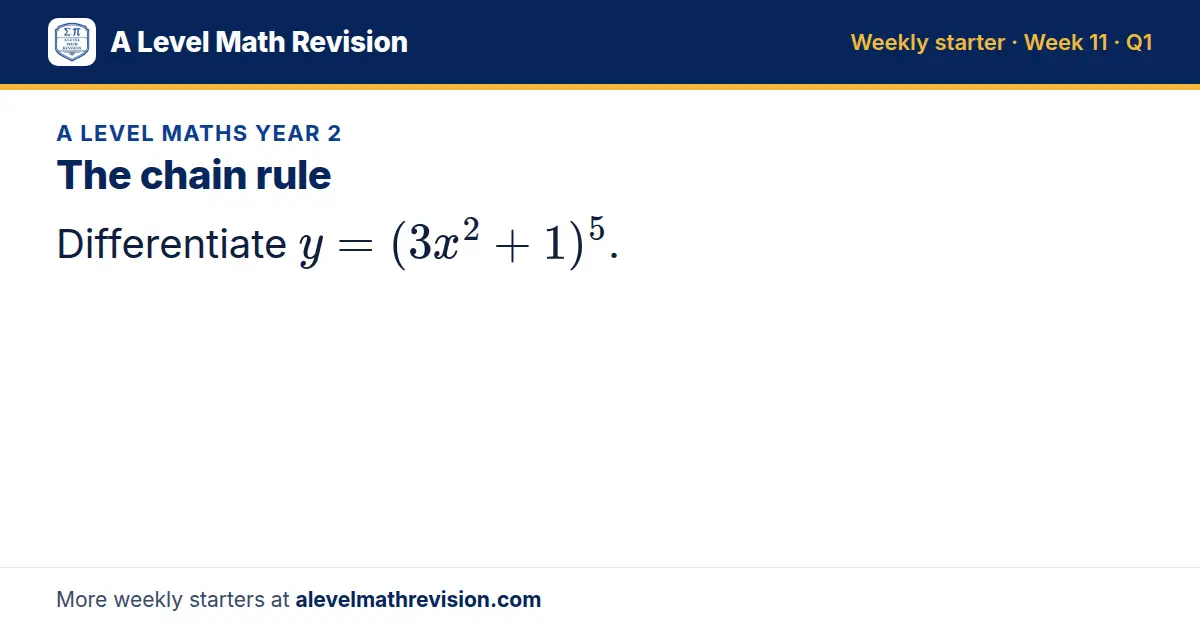
Differentiate y = (3x² + 1)^5.
Question 2: The product rule
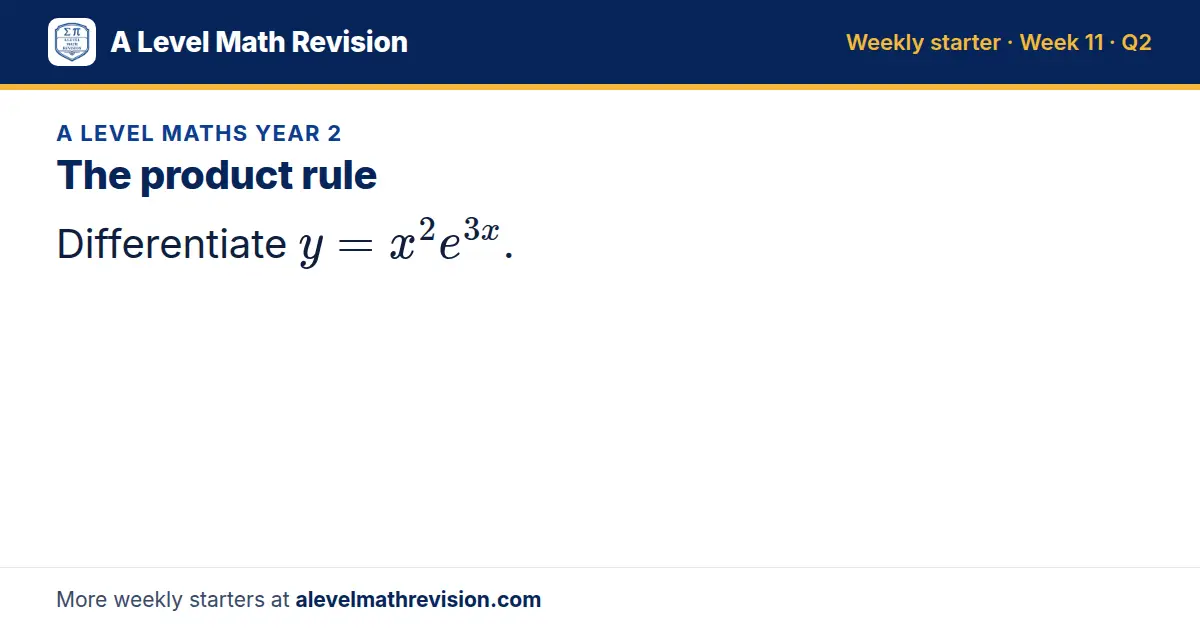
Differentiate y = x² e^(3x).
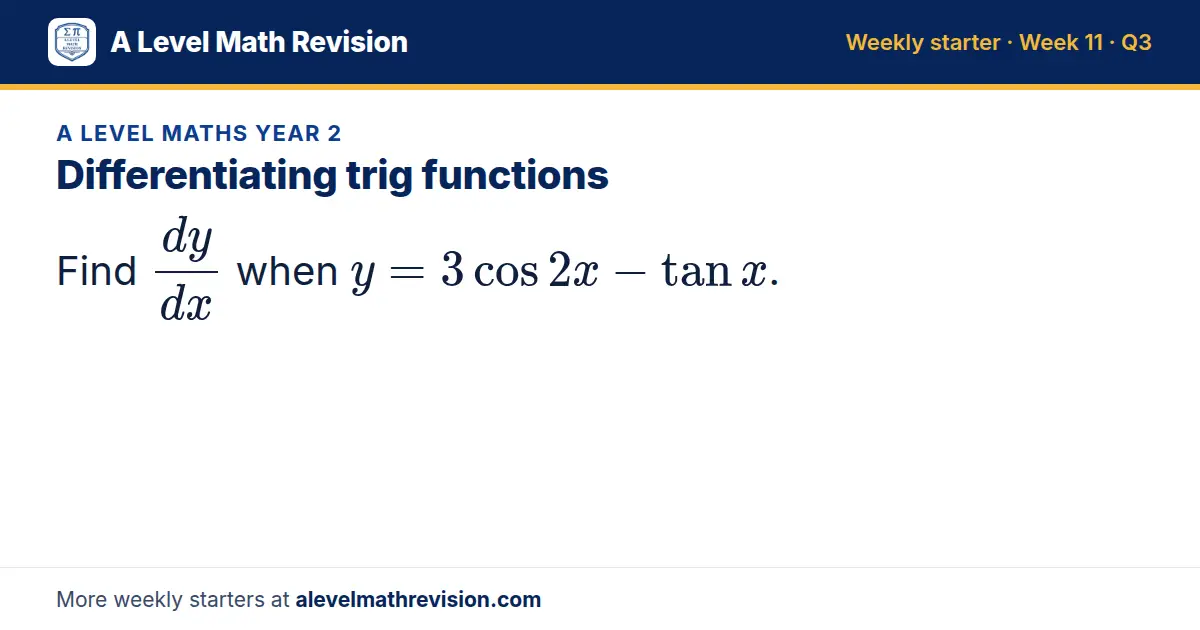
Question 3: Differentiating trig functions
Find dy/dx when y = 3cos 2x - tan x.
Week 12
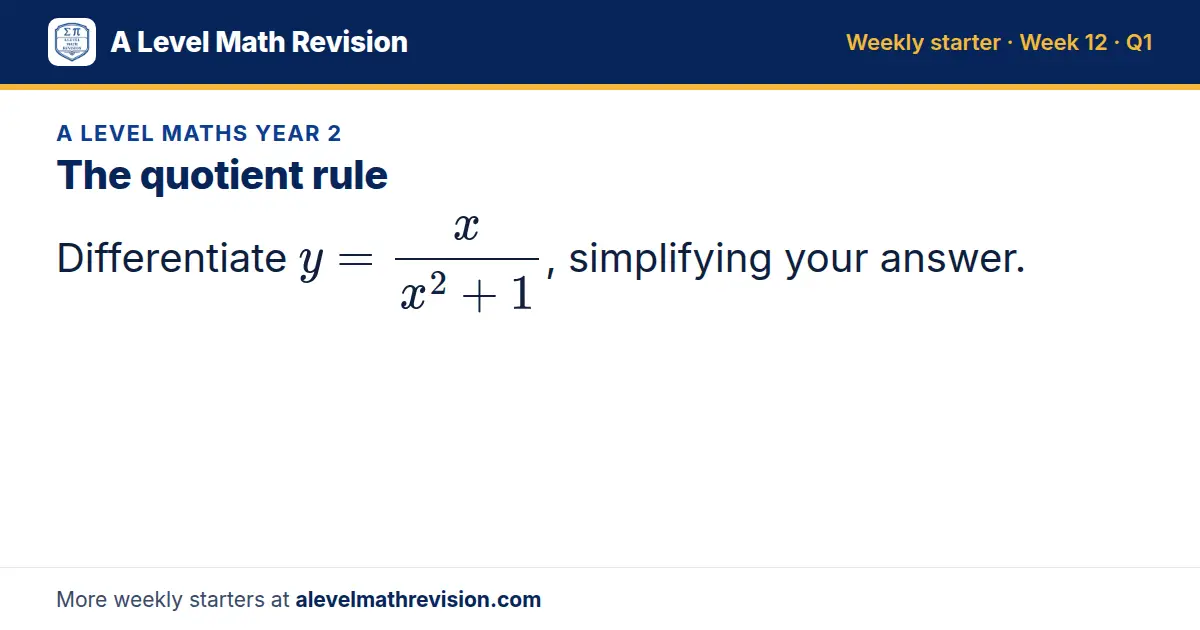
Question 1: The quotient rule
Differentiate y = x/(x² + 1), simplifying your answer.
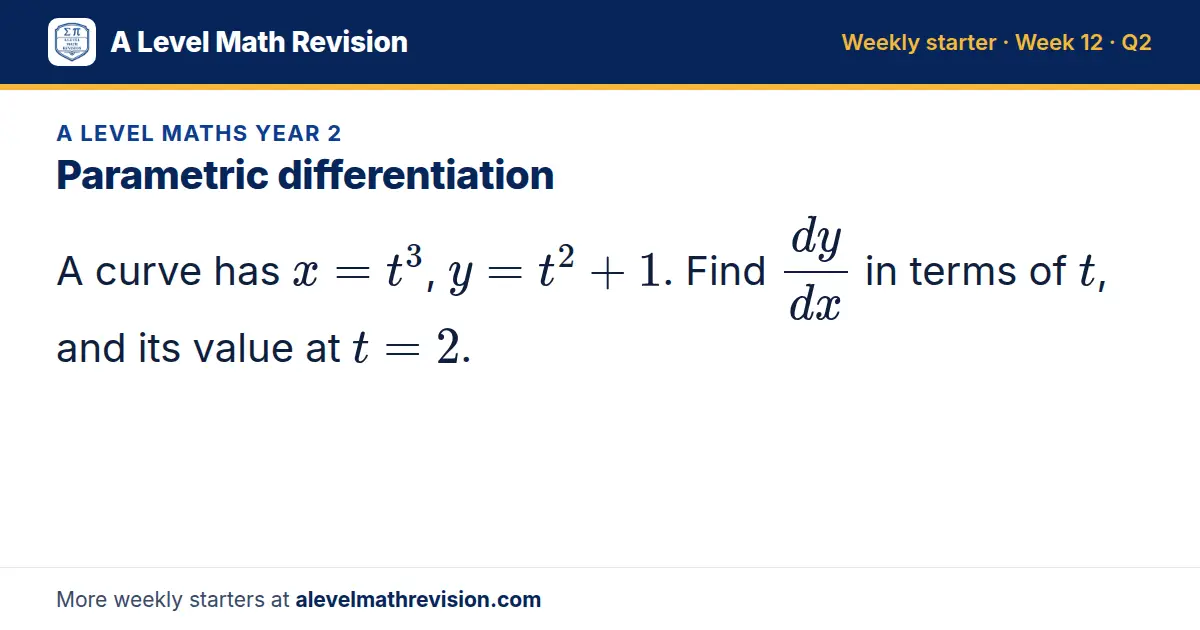
Question 2: Parametric differentiation
A curve has x = t³, y = t² + 1. Find dy/dx in terms of t, and its value at t = 2.
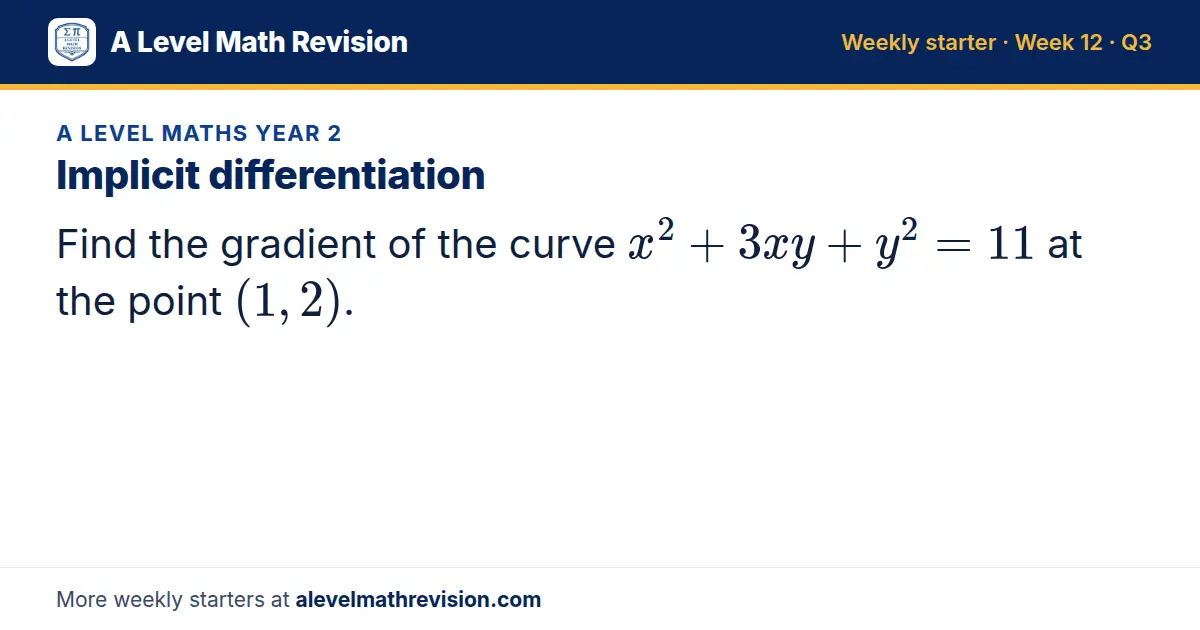
Question 3: Implicit differentiation
Find the gradient of the curve x² + 3xy + y² = 11 at the point (1, 2).
Week 13
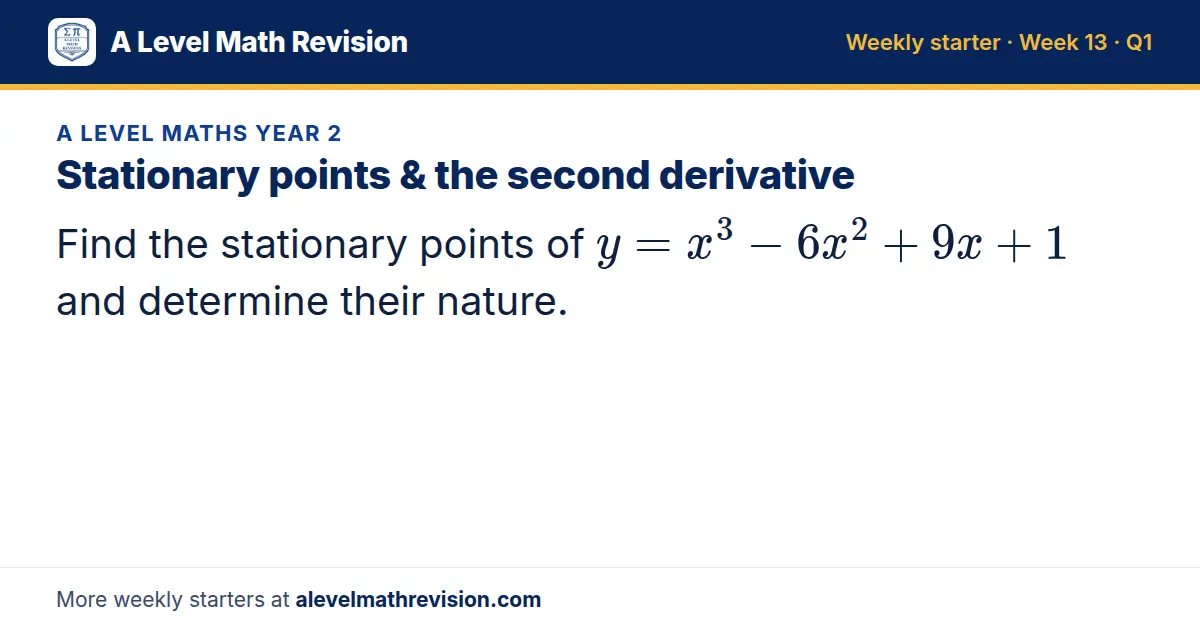
Question 1: Stationary points & the second derivative
Find the stationary points of y = x³ - 6x² + 9x + 1 and determine their nature.
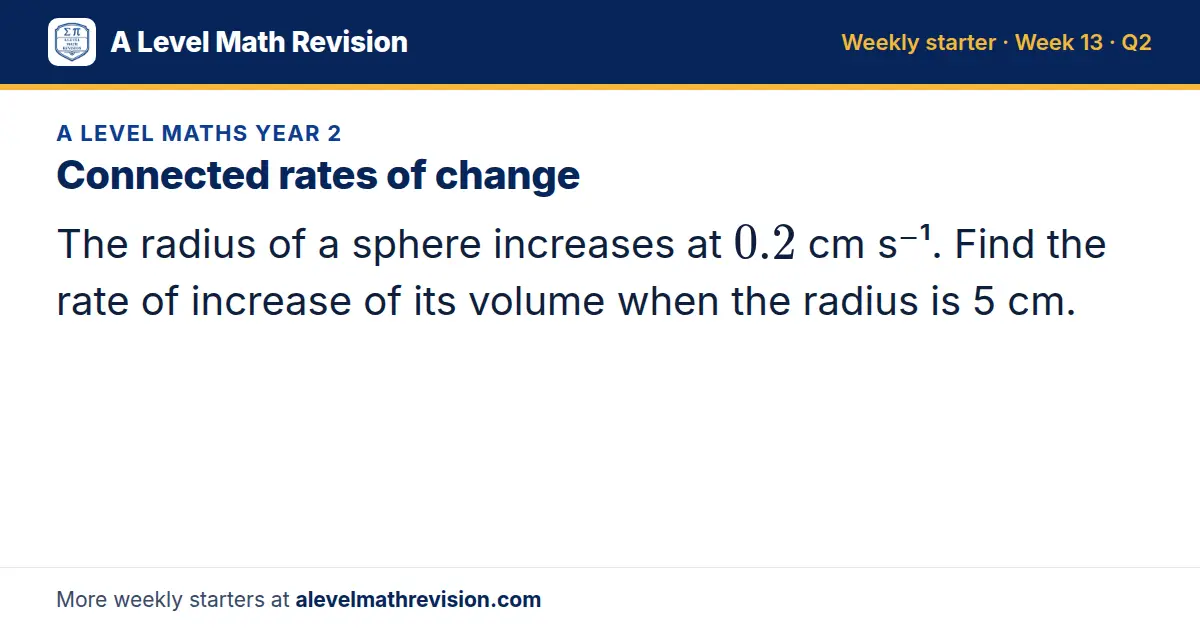
Question 2: Connected rates of change
The radius of a sphere increases at 0.2 cm s⁻¹. Find the rate of increase of its volume when the radius is 5 cm.
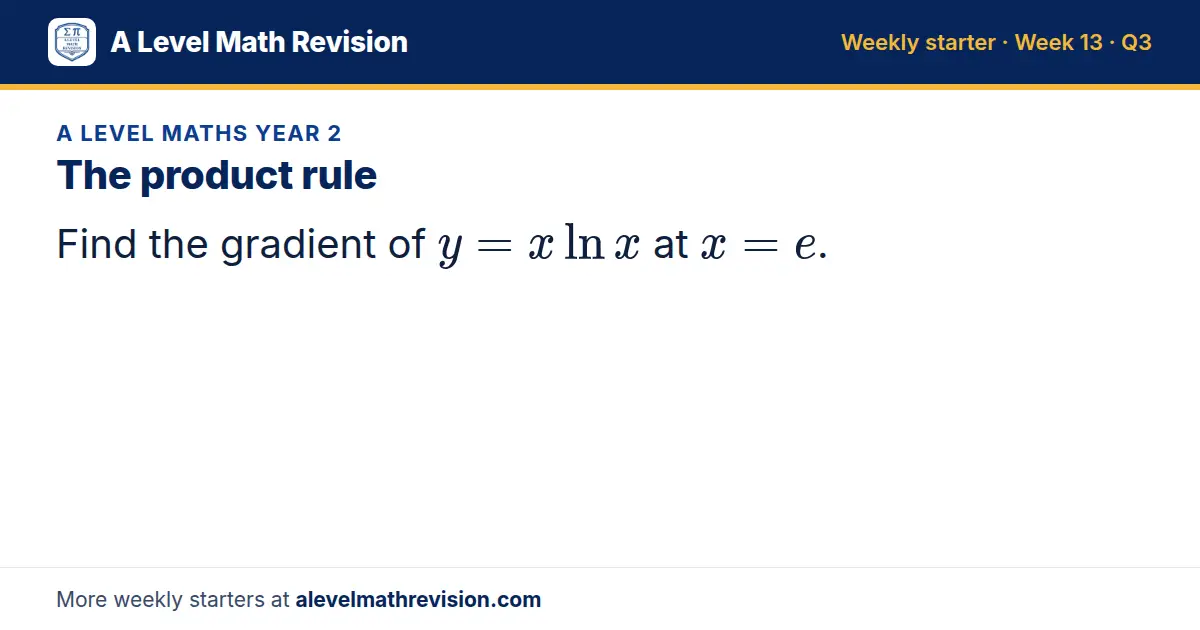
Question 3: The product rule
Find the gradient of y = xln x at x = e.
More starter questions
Other weeks: Weeks 1–13 · Weeks 14–26 · Weeks 27–40. Answers and mark schemes are in the starter tasks for teachers.