A Level Maths Year 2 starter questions: weeks 14–26
39 short questions to open a lesson for A Level Maths Year 2, weeks 14–26 of the teaching year, three or four a week. Each question is shown as an image with its text underneath; answers and mark schemes stay with teachers.
- ← A Level Maths Year 2, weeks 1–13
- A Level Maths Year 2, weeks 27–40 →
- All A Level Maths daily and weekly questions
Week 14
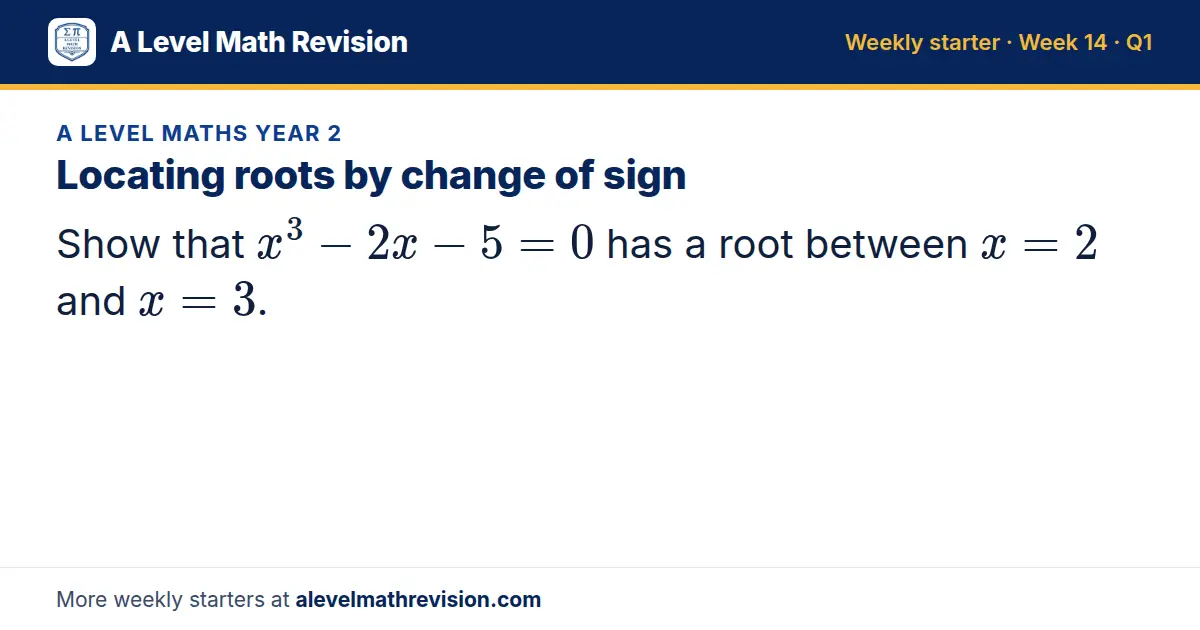
Question 1: Locating roots by change of sign
Show that x³ - 2x - 5 = 0 has a root between x = 2 and x = 3.
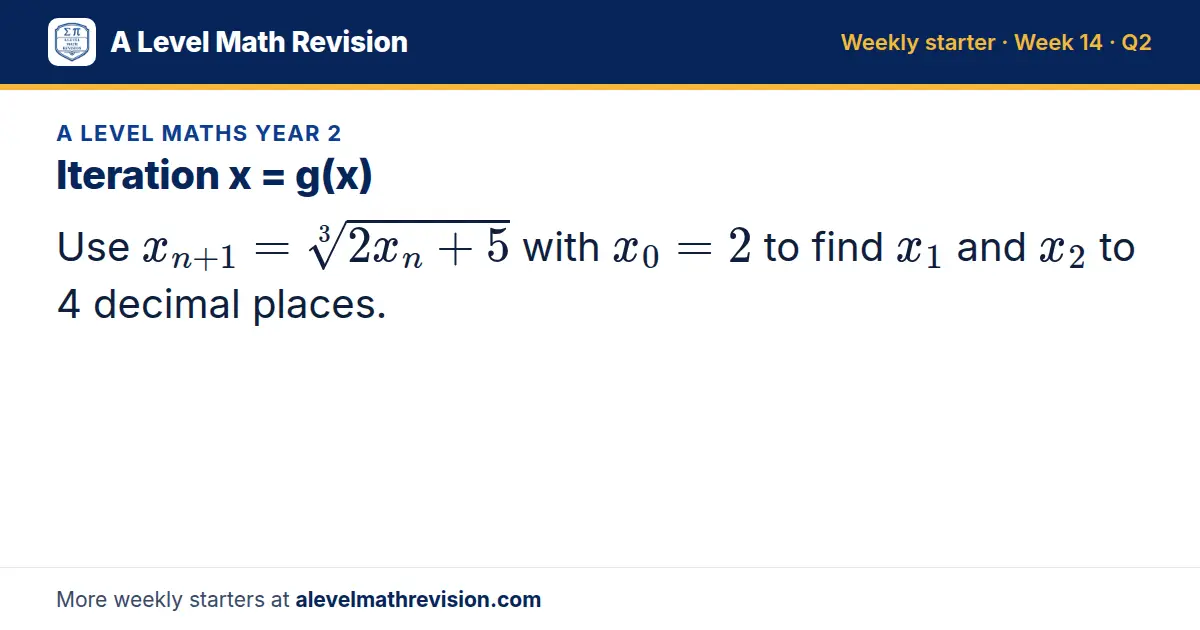
Question 2: Iteration x = g(x)
Use x_n+1 = 3√(2x_n + 5) with x_0 = 2 to find x_1 and x_2 to 4 decimal places.
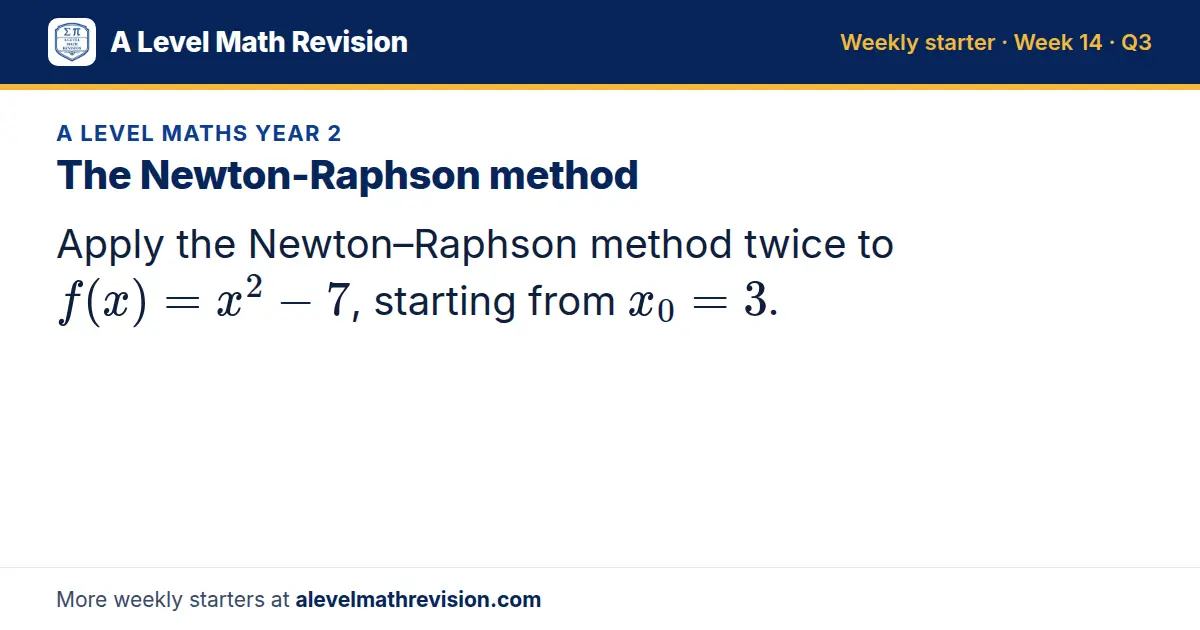
Question 3: The Newton-Raphson method
Apply the Newton–Raphson method twice to f(x) = x² - 7, starting from x_0 = 3.
Week 15
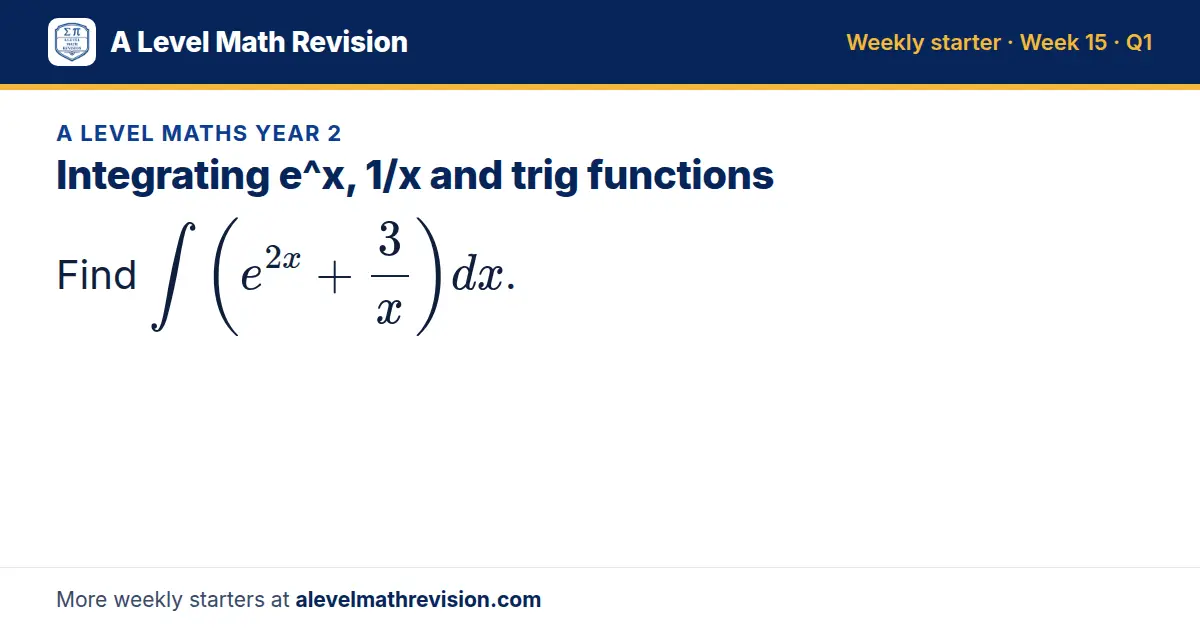
Question 1: Integrating e^x, 1/x and trig functions
Find ∫ (e^(2x) + 3/x) dx.
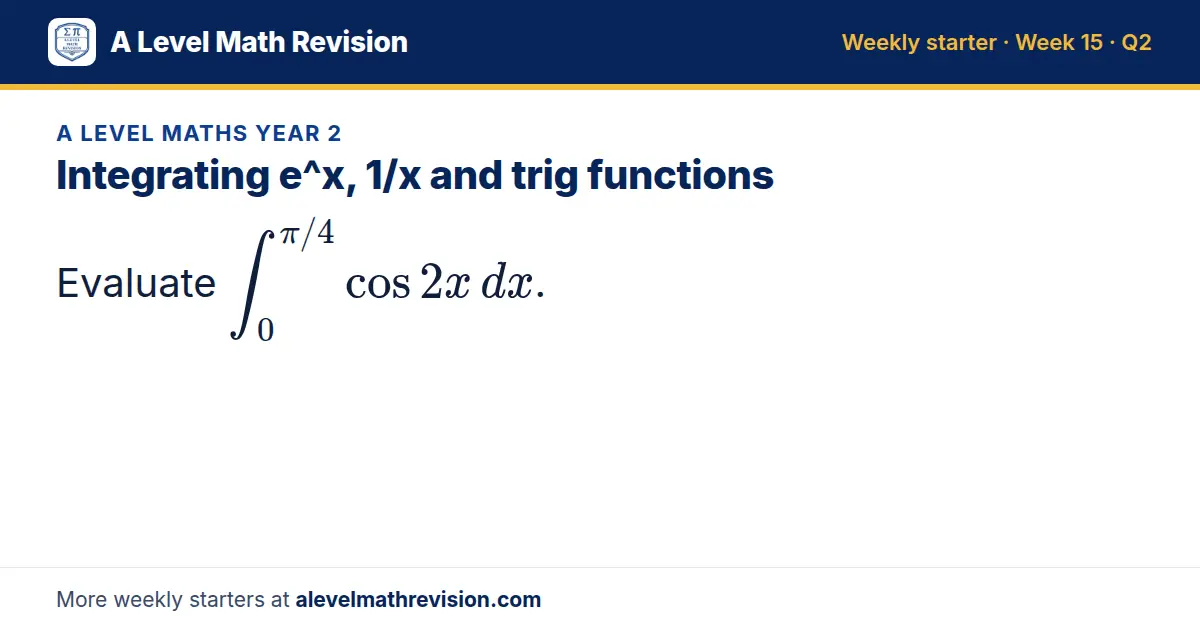
Question 2: Integrating e^x, 1/x and trig functions
Evaluate ∫_0^(π/4) cos 2x dx.
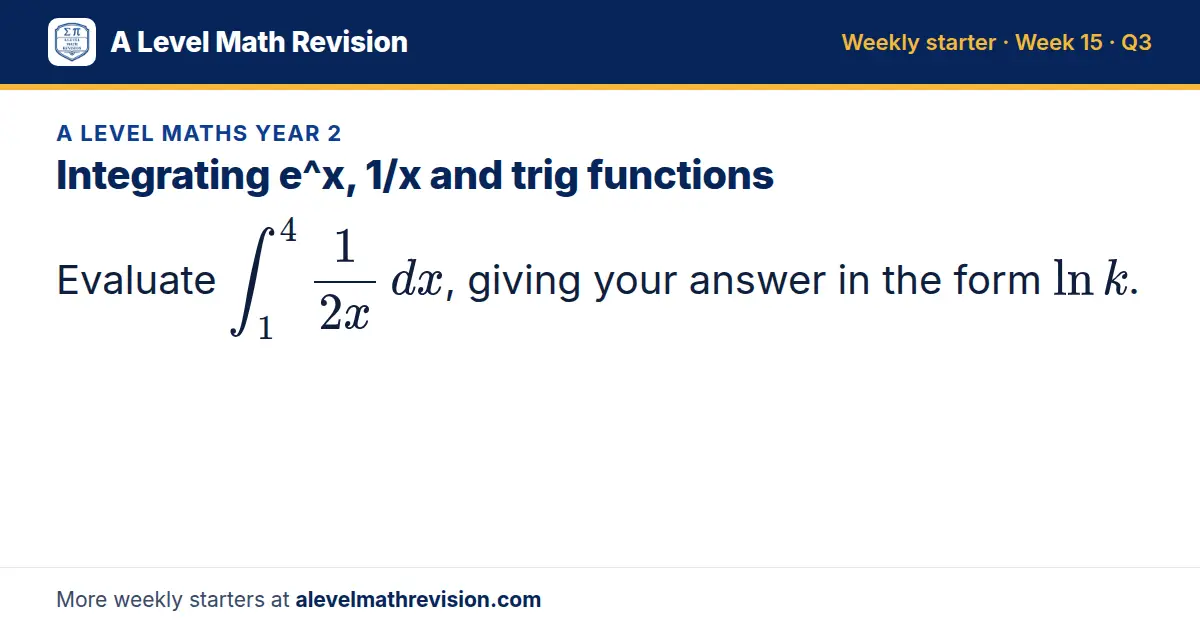
Question 3: Integrating e^x, 1/x and trig functions
Evaluate ∫_1⁴ 1/2x dx, giving your answer in the form ln k.
Week 16
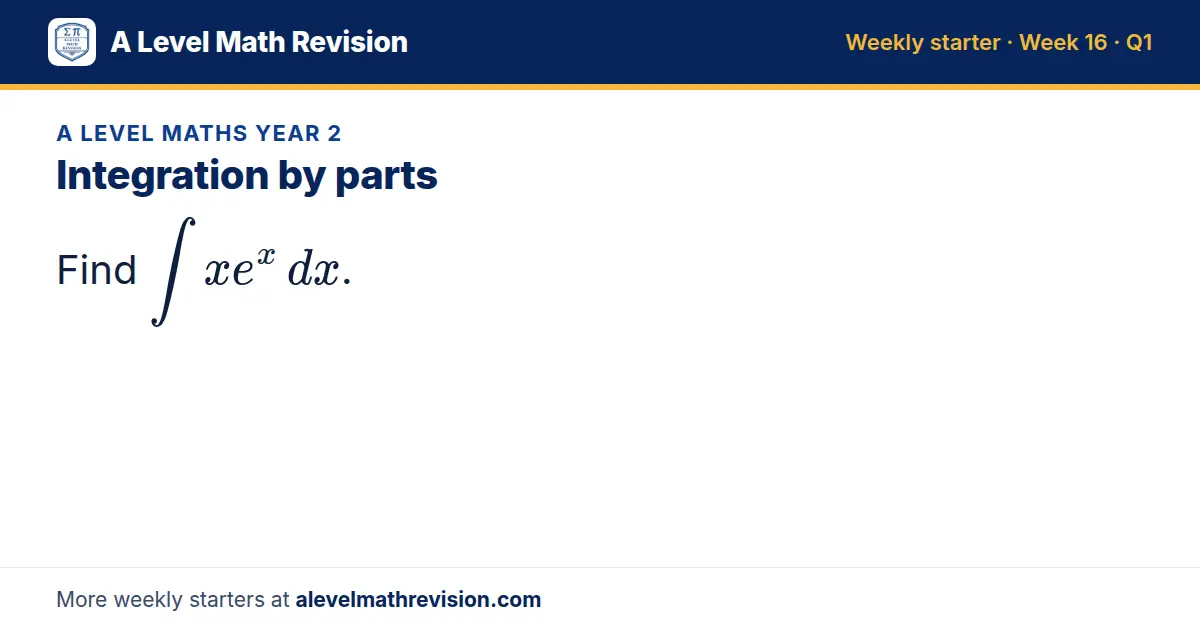
Question 1: Integration by parts
Find ∫ x e^x dx.
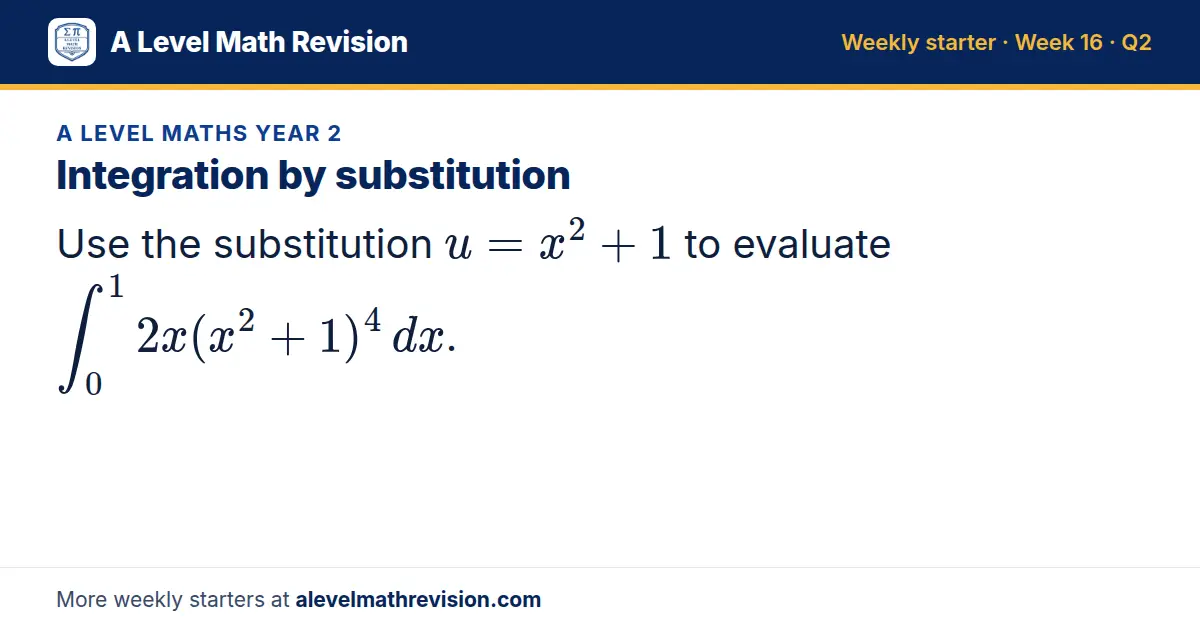
Question 2: Integration by substitution
Use the substitution u = x² + 1 to evaluate ∫_0¹ 2x(x² + 1)⁴ dx.
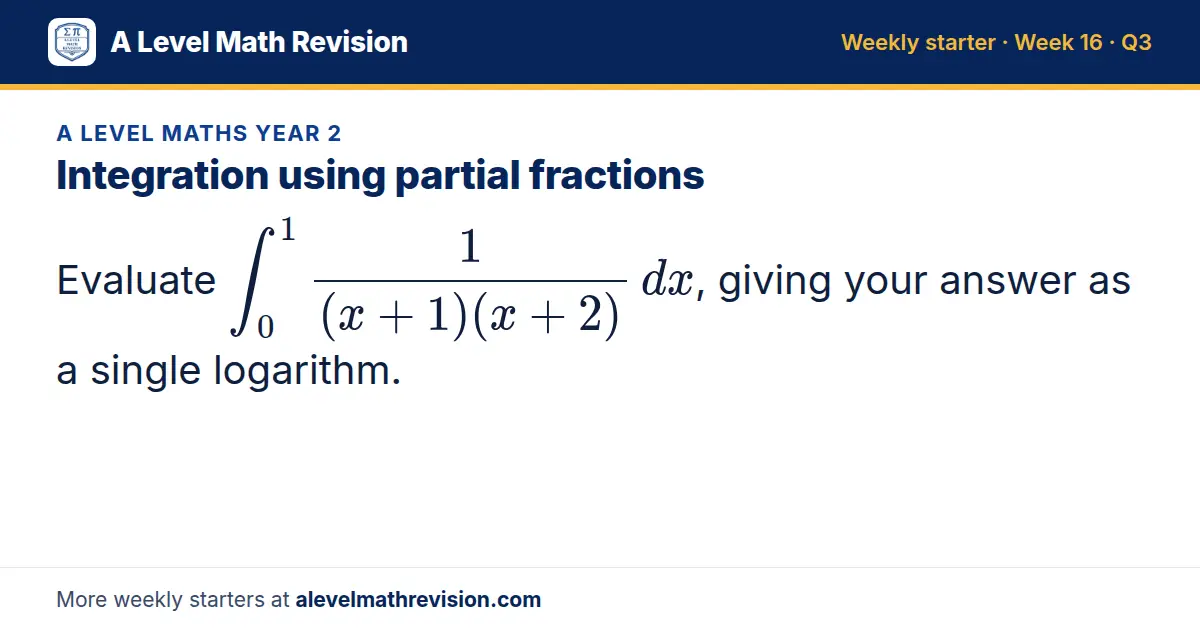
Question 3: Integration using partial fractions
Evaluate ∫_0¹ 1/((x + 1)(x + 2)) dx, giving your answer as a single logarithm.
Week 17
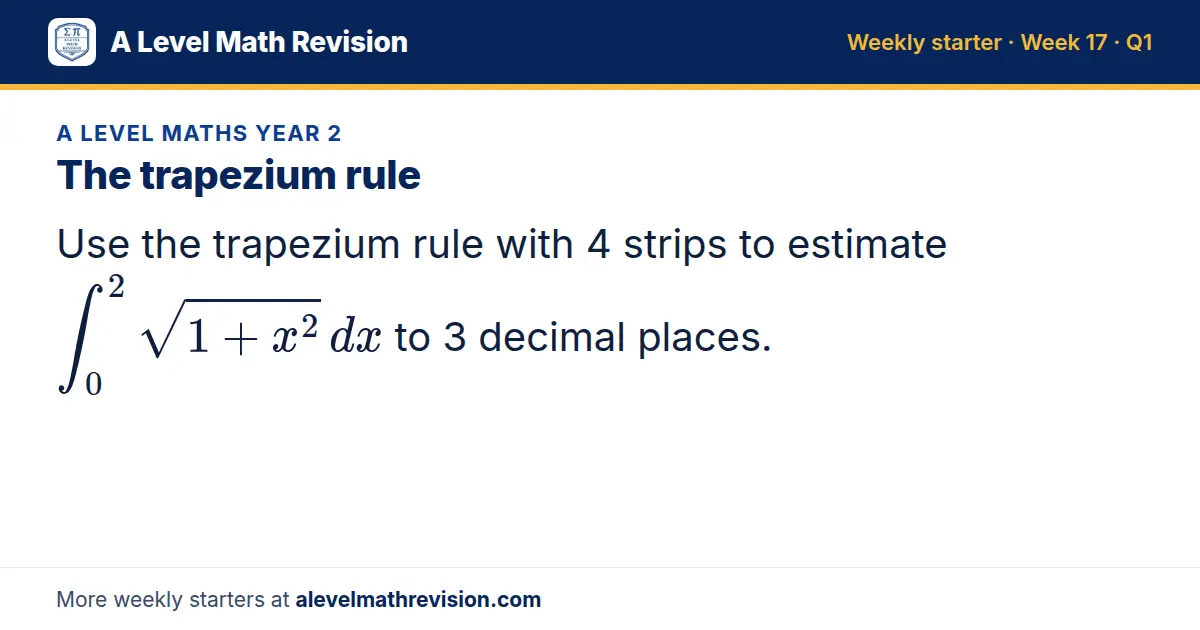
Question 1: The trapezium rule
Use the trapezium rule with 4 strips to estimate ∫_0² √(1 + x²) dx to 3 decimal places.
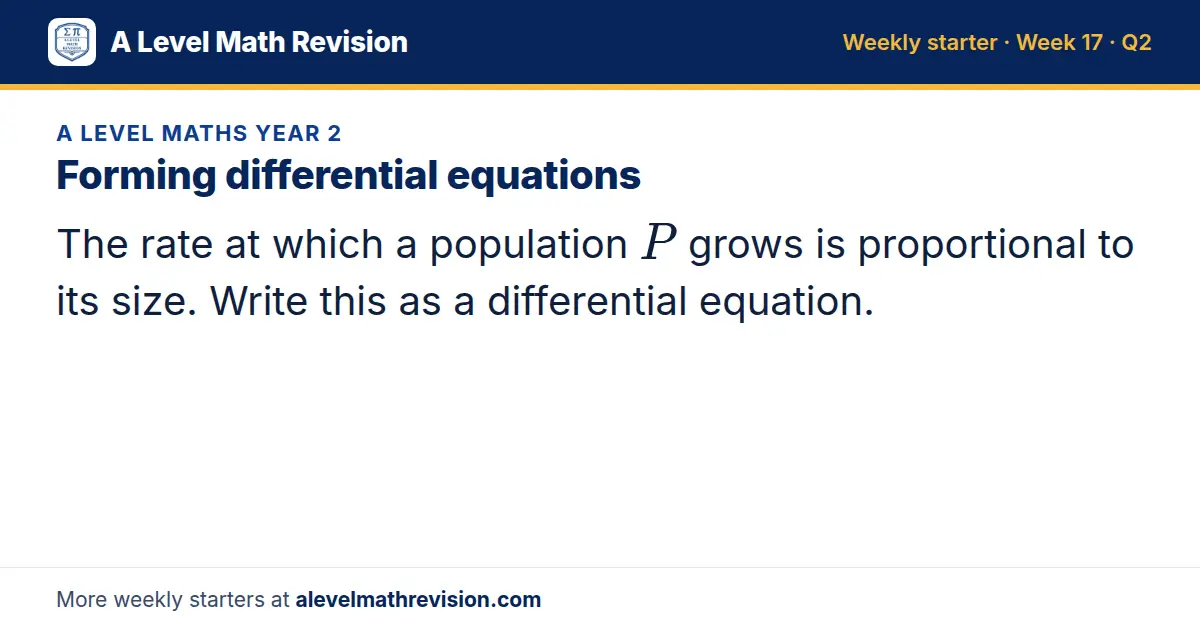
Question 2: Forming differential equations
The rate at which a population P grows is proportional to its size. Write this as a differential equation.
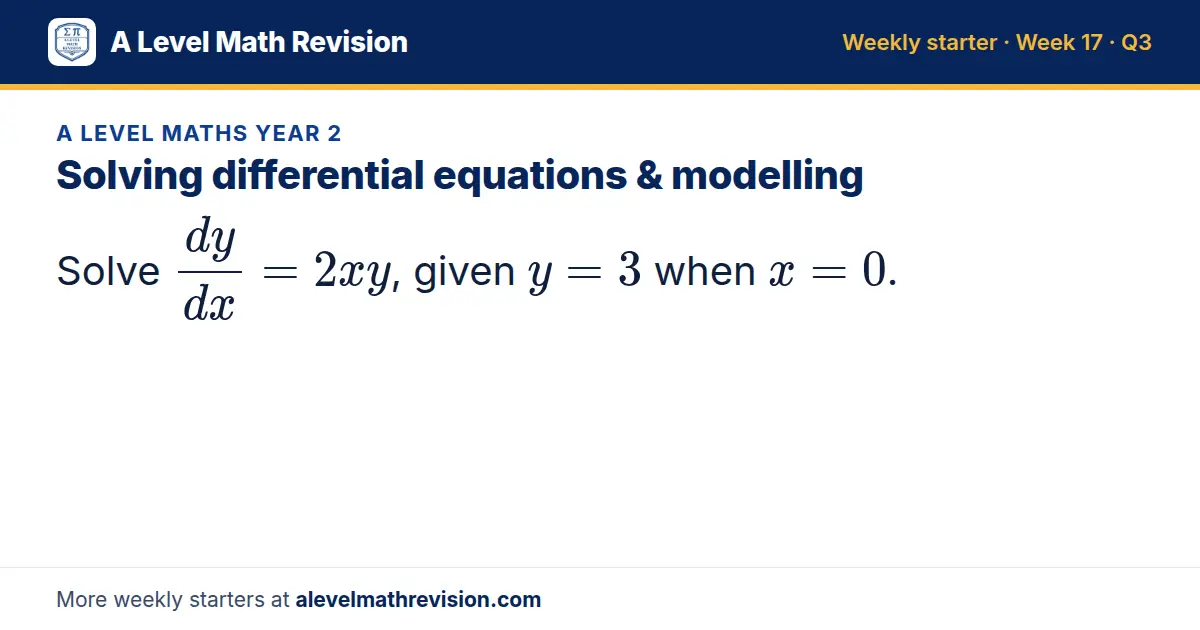
Question 3: Solving differential equations & modelling
Solve dy/dx = 2xy, given y = 3 when x = 0.
Week 18
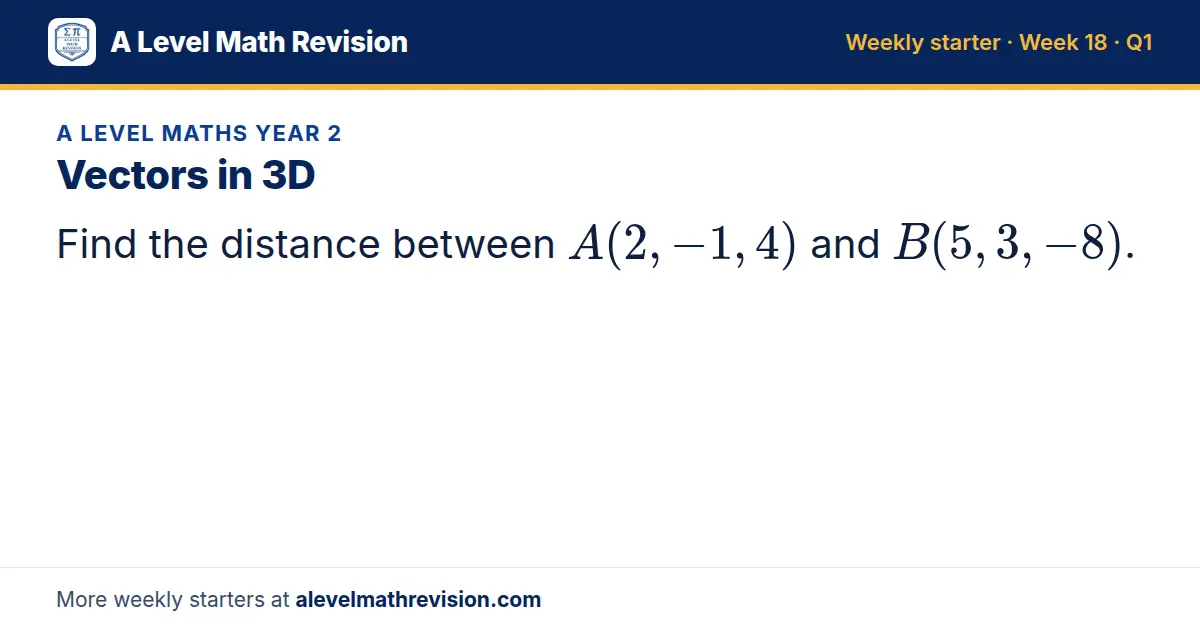
Question 1: Vectors in 3D
Find the distance between A(2, -1, 4) and B(5, 3, -8).
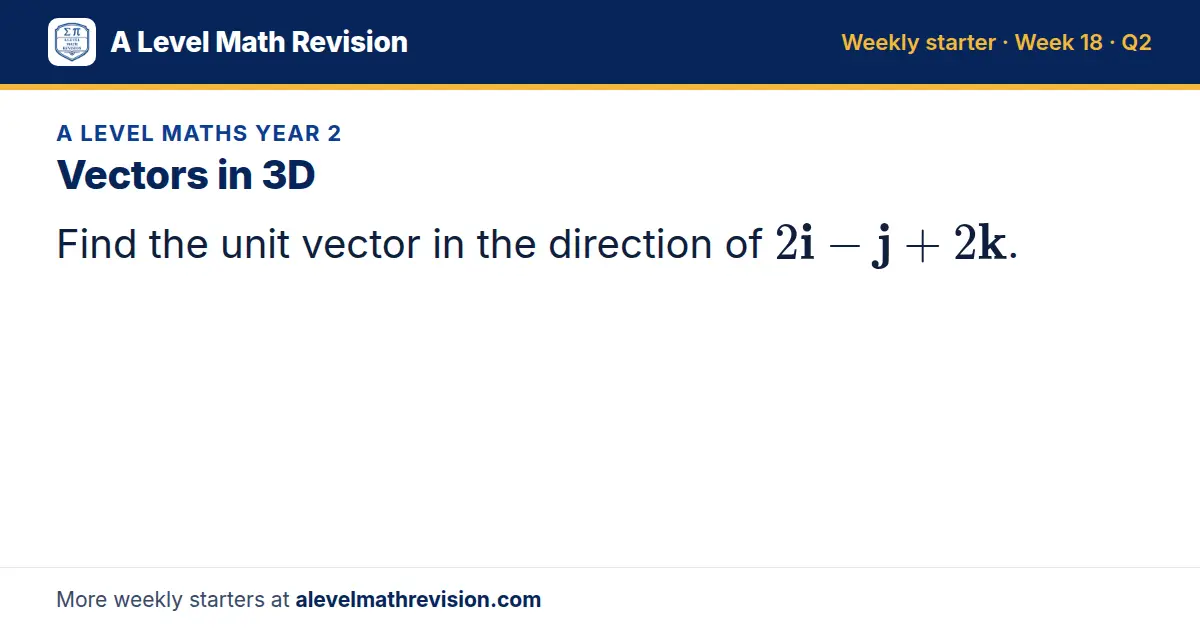
Question 2: Vectors in 3D
Find the unit vector in the direction of 2i - j + 2k.
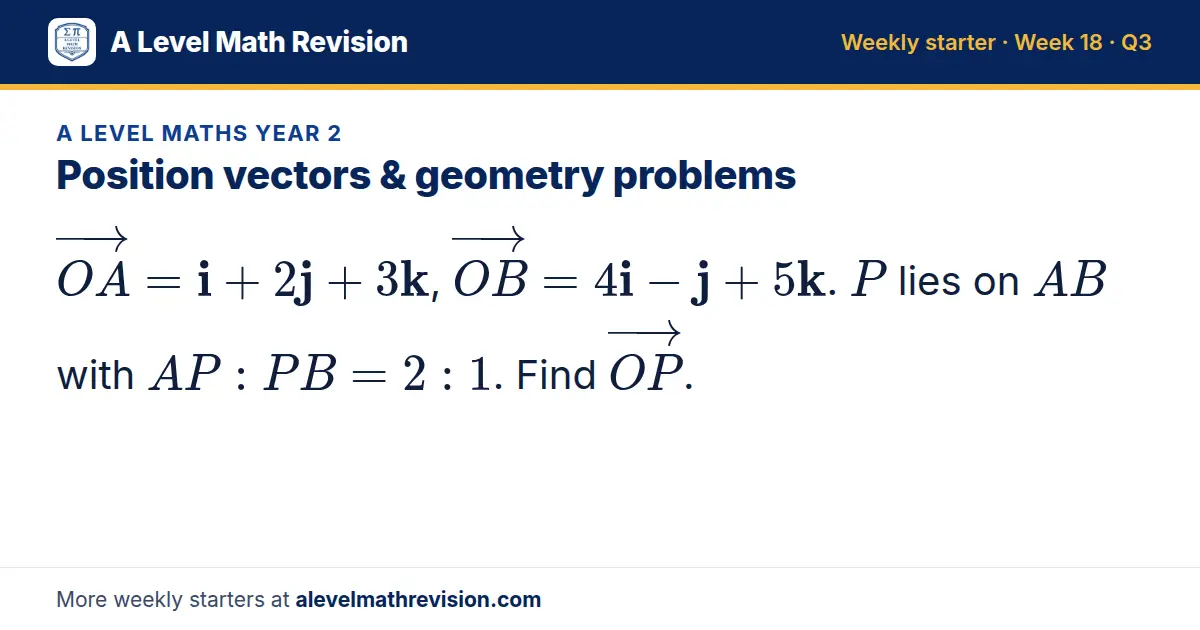
Question 3: Position vectors & geometry problems
OA = i + 2j + 3k, OB = 4i - j + 5k. P lies on AB with AP: PB = 2: 1. Find OP.
Week 19
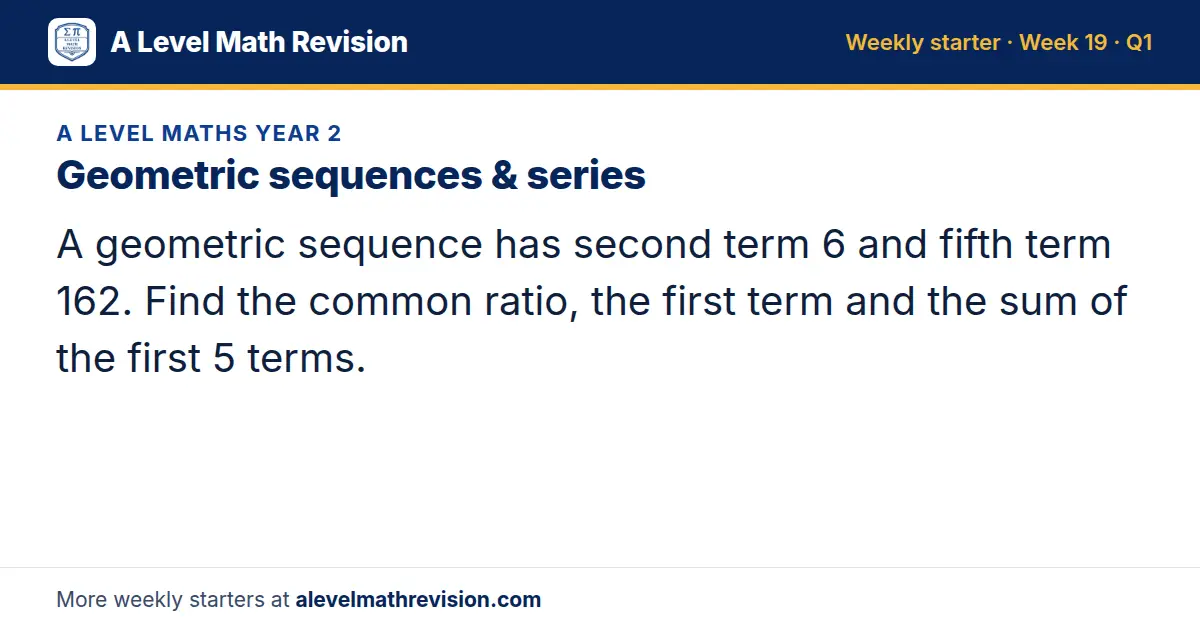
Question 1: Geometric sequences & series
A geometric sequence has second term 6 and fifth term 162. Find the common ratio, the first term and the sum of the first 5 terms.
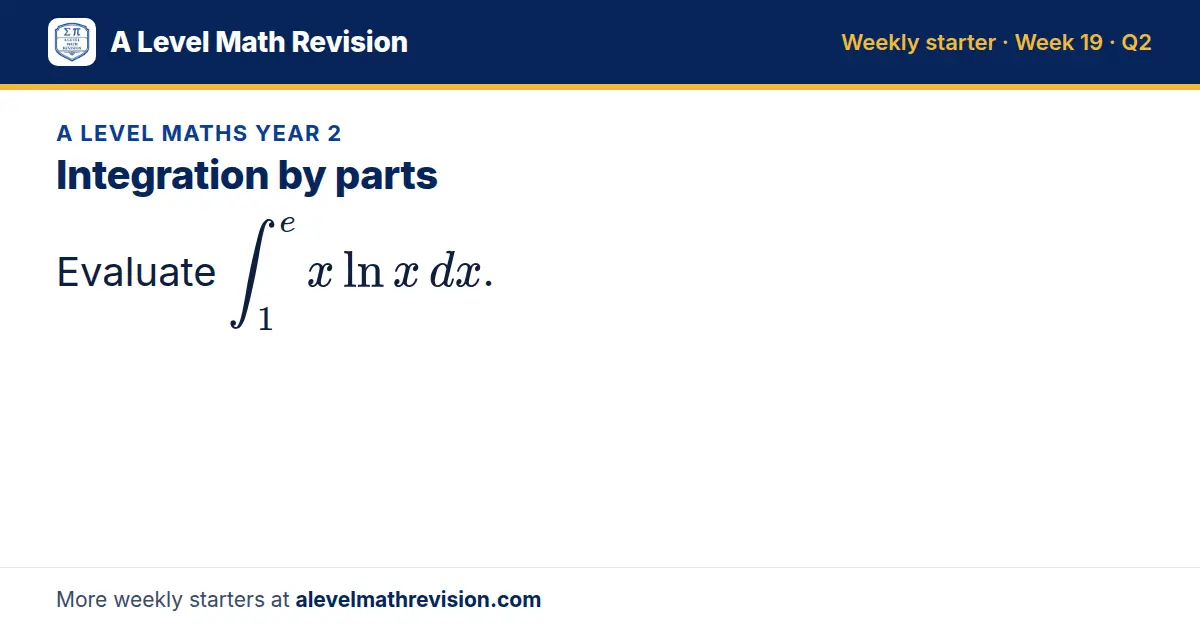
Question 2: Integration by parts
Evaluate ∫_1^e xln x dx.
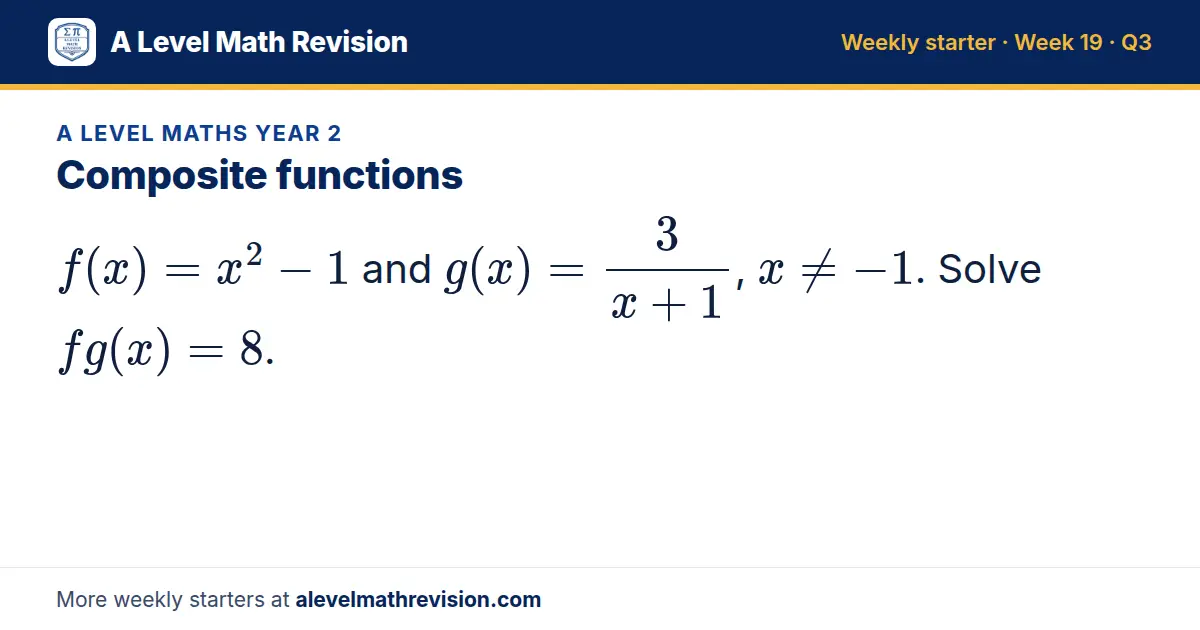
Question 3: Composite functions
f(x) = x² - 1 and g(x) = 3/(x + 1), x ≠ -1. Solve fg(x) = 8.
Week 20
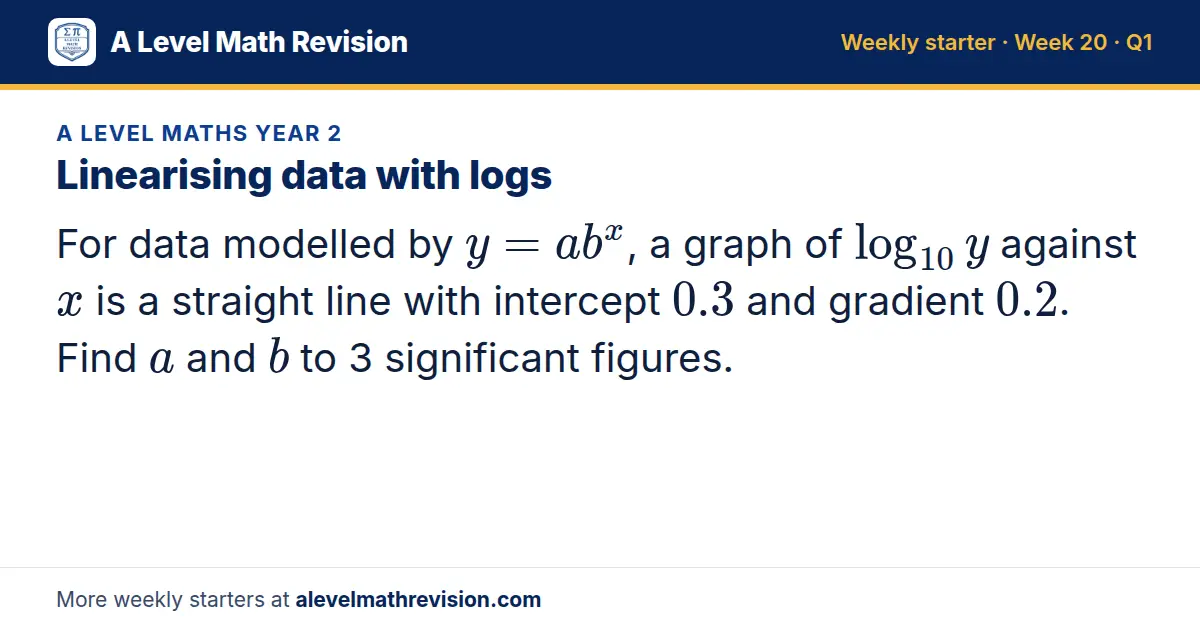
Question 1: Linearising data with logs
For data modelled by y = ab^x, a graph of log_10 y against x is a straight line with intercept 0.3 and gradient 0.2. Find a and b to 3 significant figures.
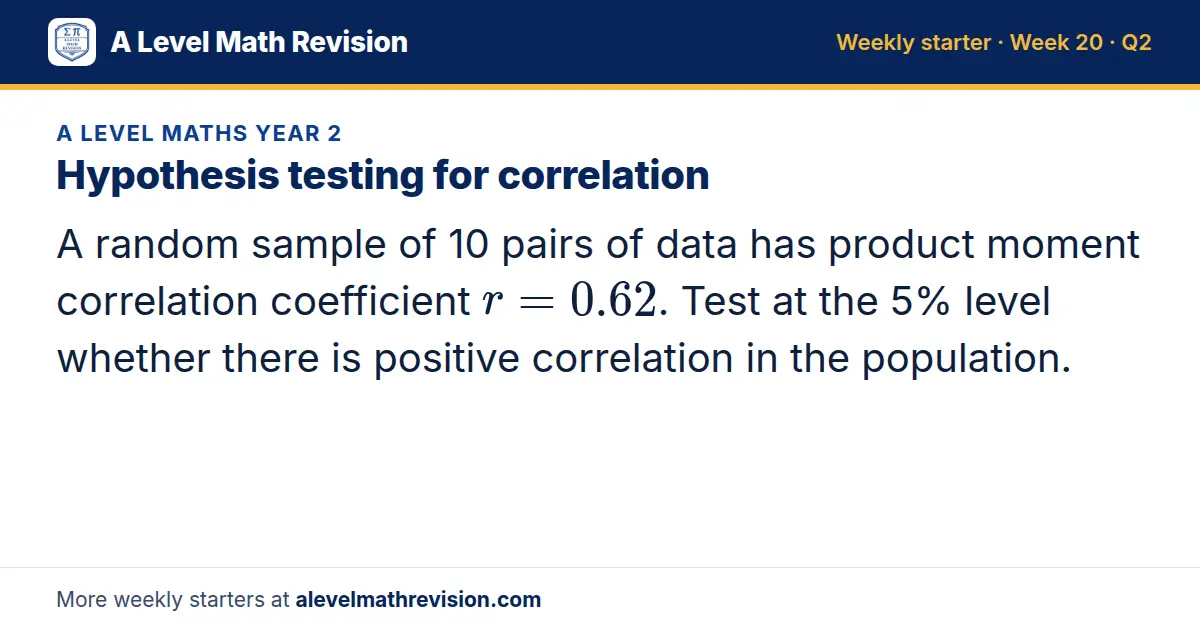
Question 2: Hypothesis testing for correlation
A random sample of 10 pairs of data has product moment correlation coefficient r = 0.62. Test at the 5% level whether there is positive correlation in the population.
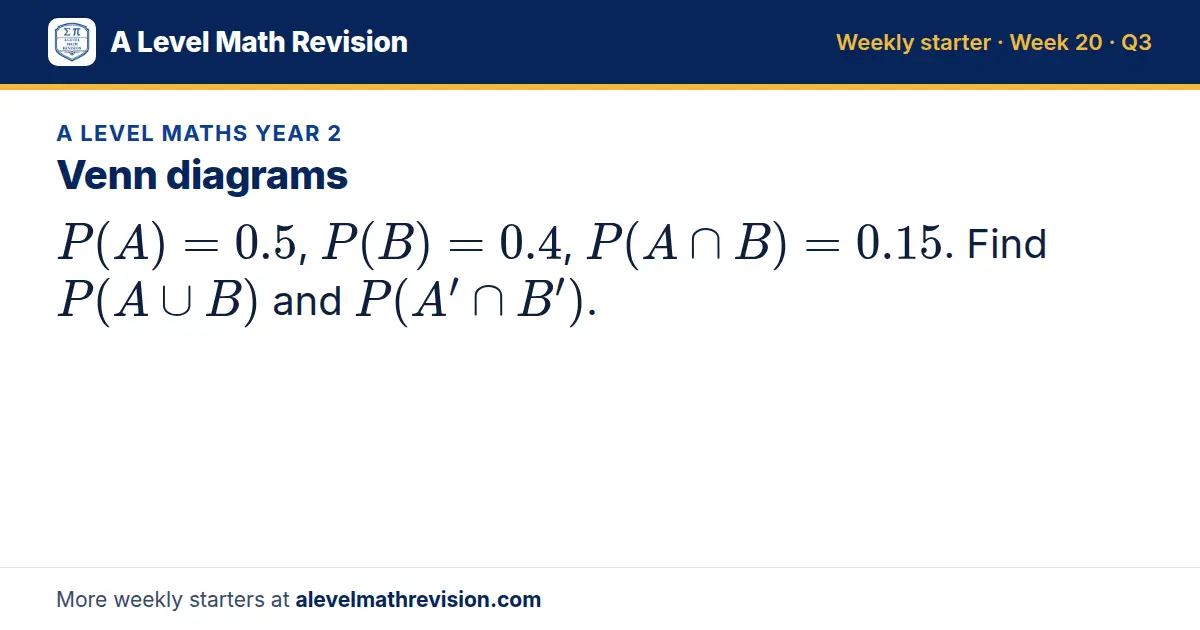
Question 3: Venn diagrams
P(A) = 0.5, P(B) = 0.4, P(A ∩ B) = 0.15. Find P(A ∪ B) and P(A' ∩ B').
Week 21
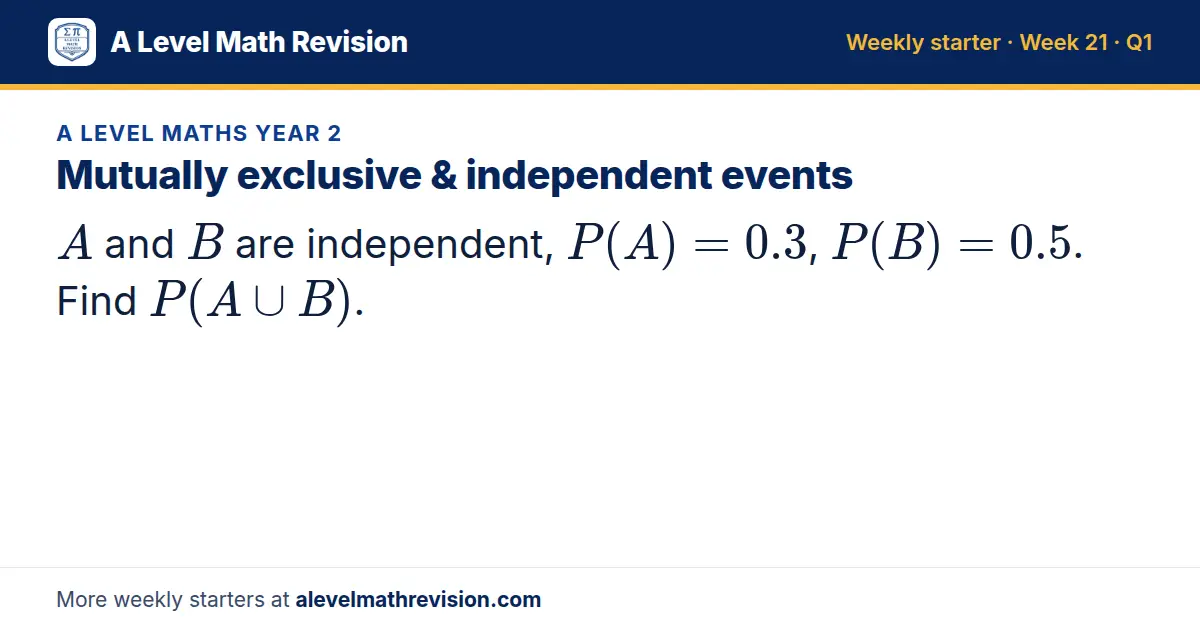
Question 1: Mutually exclusive & independent events
A and B are independent, P(A) = 0.3, P(B) = 0.5. Find P(A ∪ B).
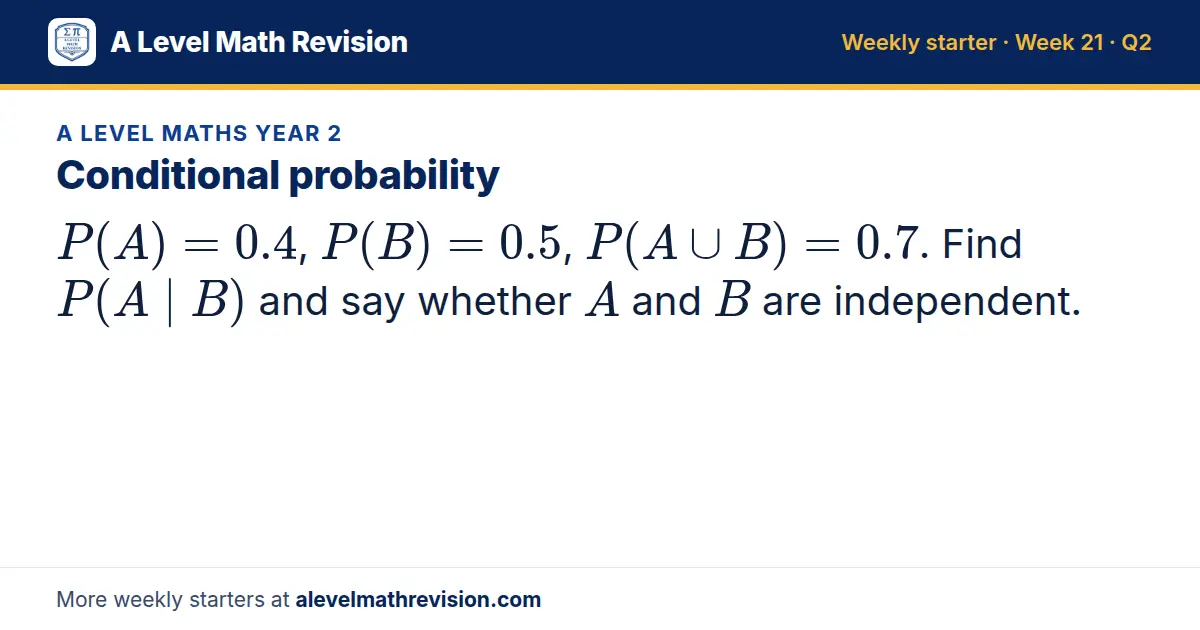
Question 2: Conditional probability
P(A) = 0.4, P(B) = 0.5, P(A ∪ B) = 0.7. Find P(A | B) and say whether A and B are independent.
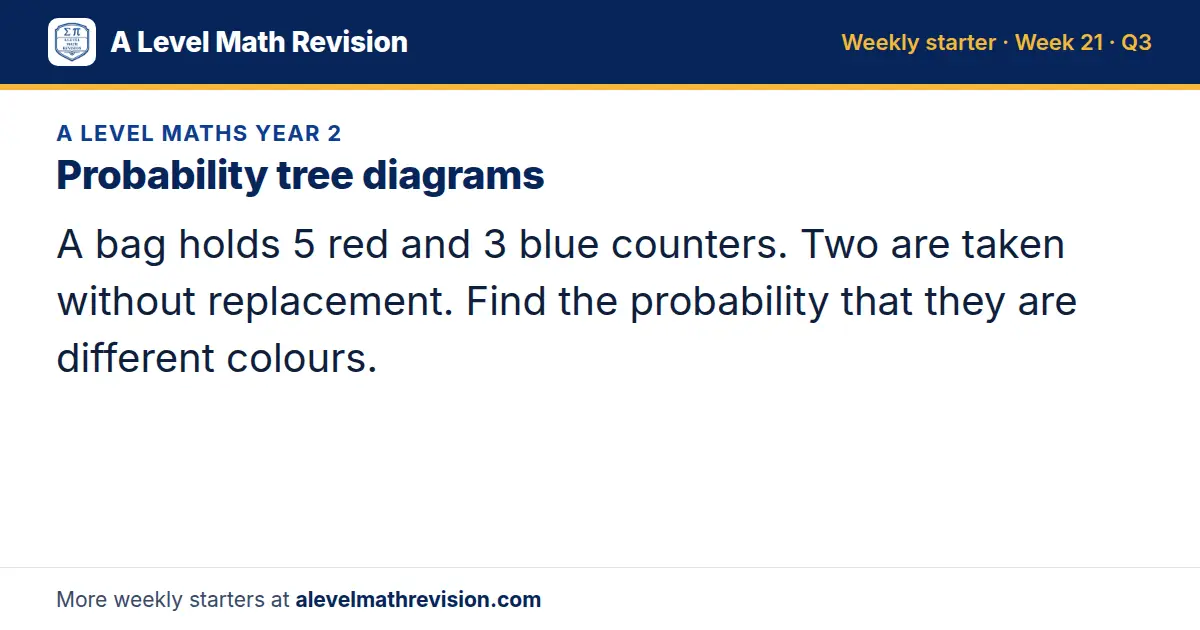
Question 3: Probability tree diagrams
A bag holds 5 red and 3 blue counters. Two are taken without replacement. Find the probability that they are different colours.
Week 22
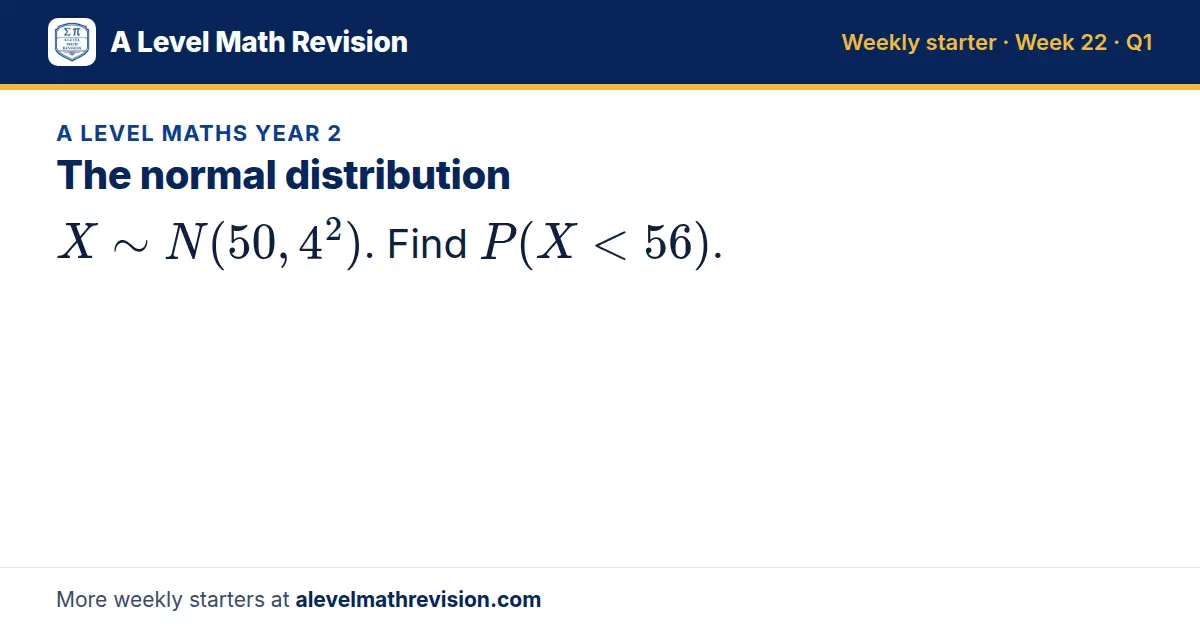
Question 1: The normal distribution
X N(50, 4²). Find P(X < 56).
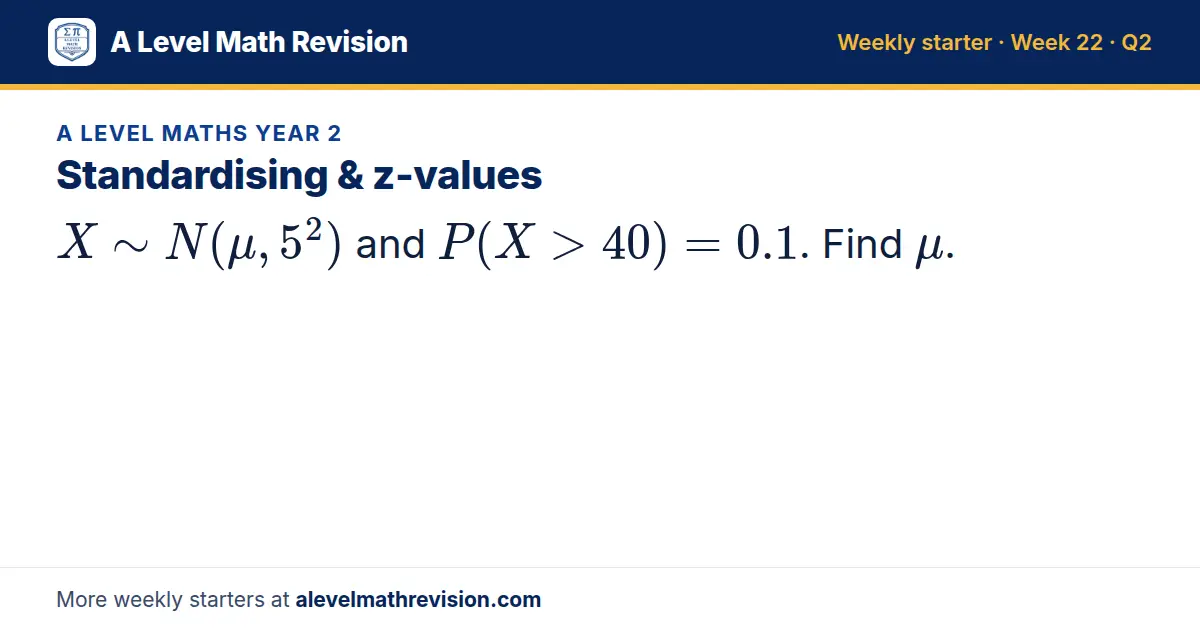
Question 2: Standardising & z-values
X N(μ, 5²) and P(X > 40) = 0.1. Find μ.
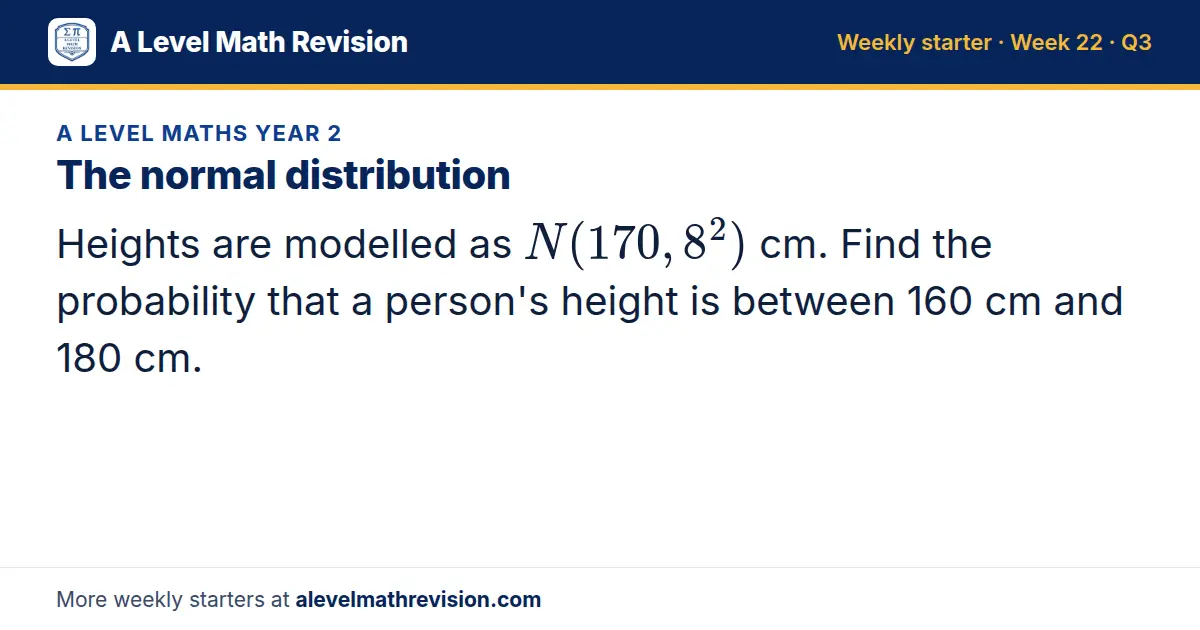
Question 3: The normal distribution
Heights are modelled as N(170, 8²) cm. Find the probability that a person's height is between 160 cm and 180 cm.
Week 23
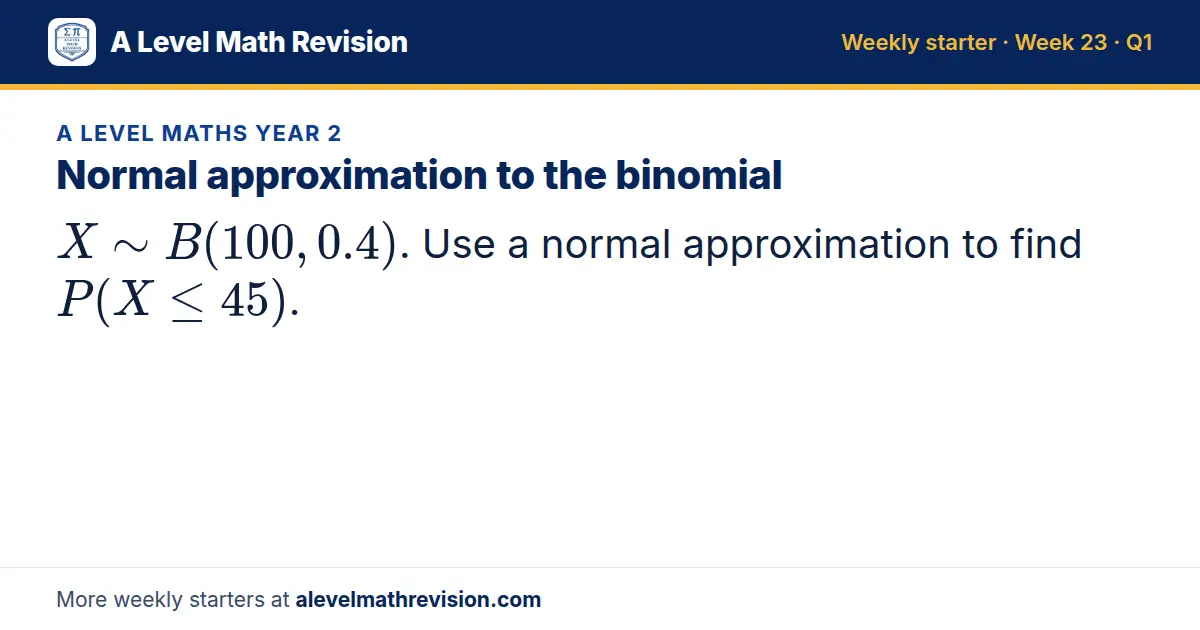
Question 1: Normal approximation to the binomial
X B(100, 0.4). Use a normal approximation to find P(X ≤ 45).
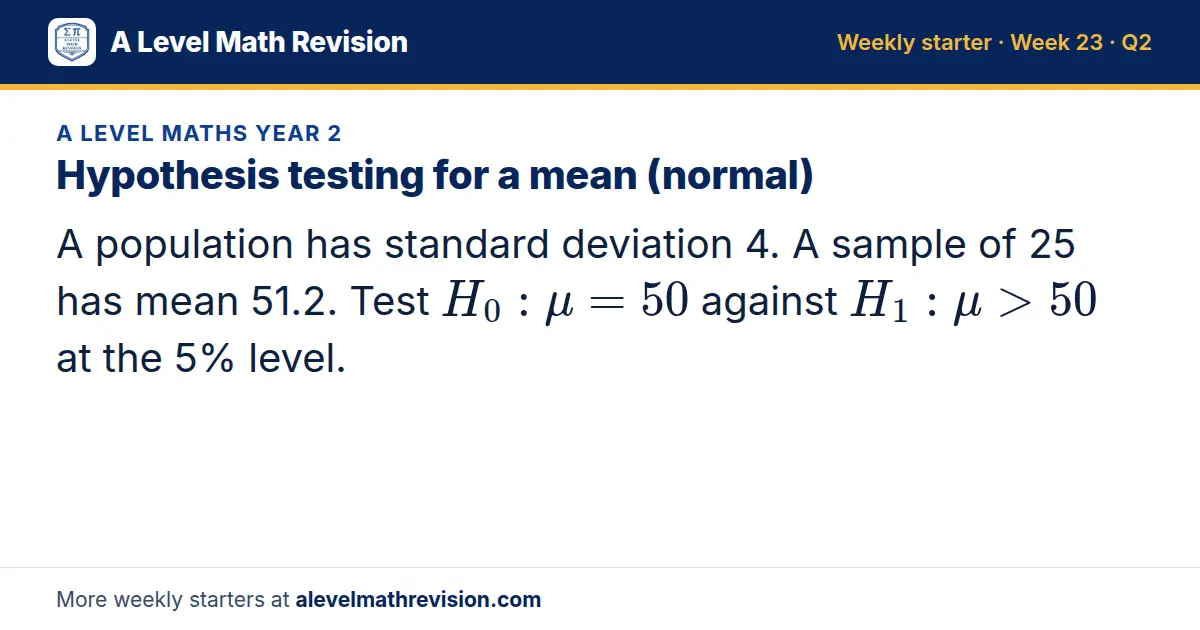
Question 2: Hypothesis testing for a mean (normal)
A population has standard deviation 4. A sample of 25 has mean 51.2. Test H_0: μ = 50 against H_1: μ > 50 at the 5% level.
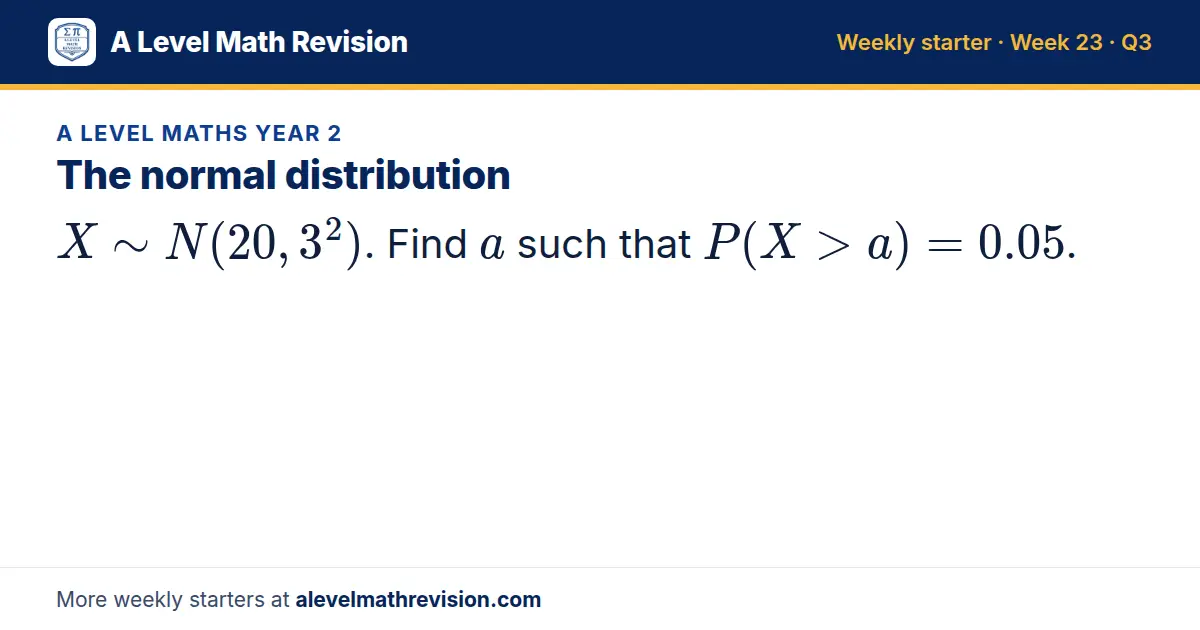
Question 3: The normal distribution
X N(20, 3²). Find a such that P(X > a) = 0.05.
Week 24
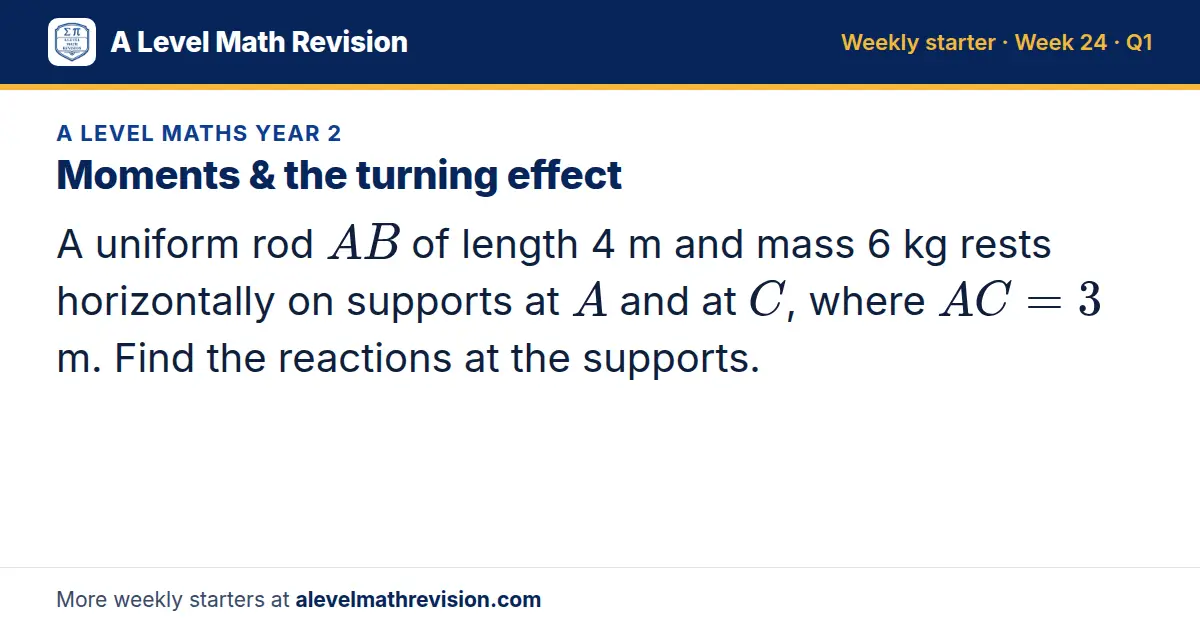
Question 1: Moments & the turning effect
A uniform rod AB of length 4 m and mass 6 kg rests horizontally on supports at A and at C, where AC = 3 m. Find the reactions at the supports.
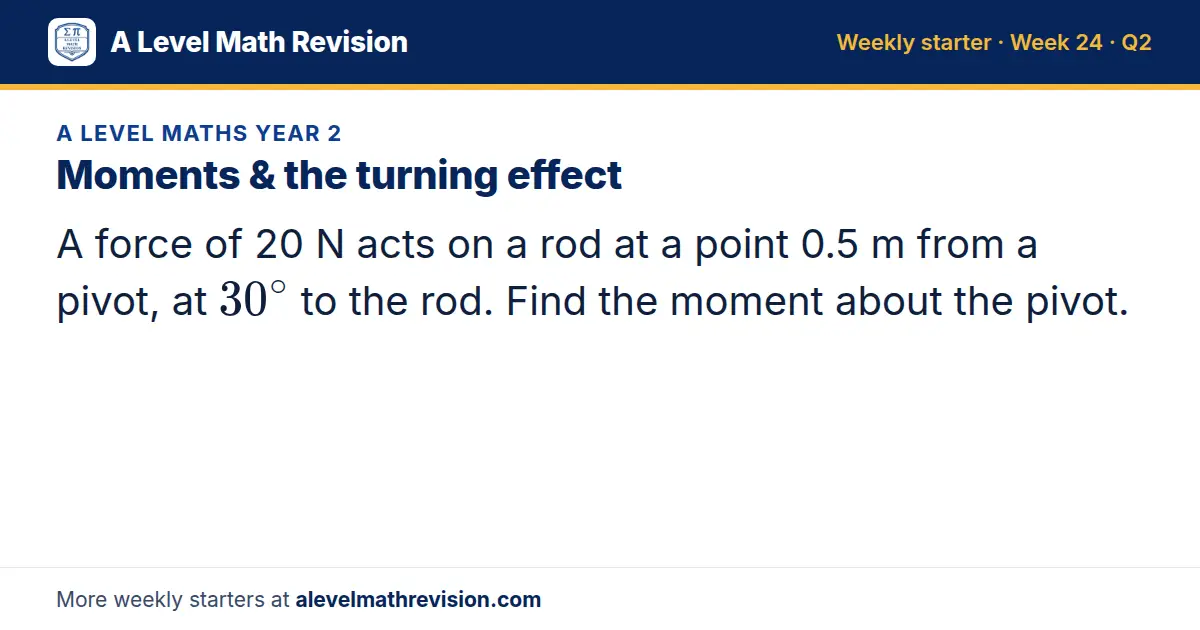
Question 2: Moments & the turning effect
A force of 20 N acts on a rod at a point 0.5 m from a pivot, at 30^∘ to the rod. Find the moment about the pivot.
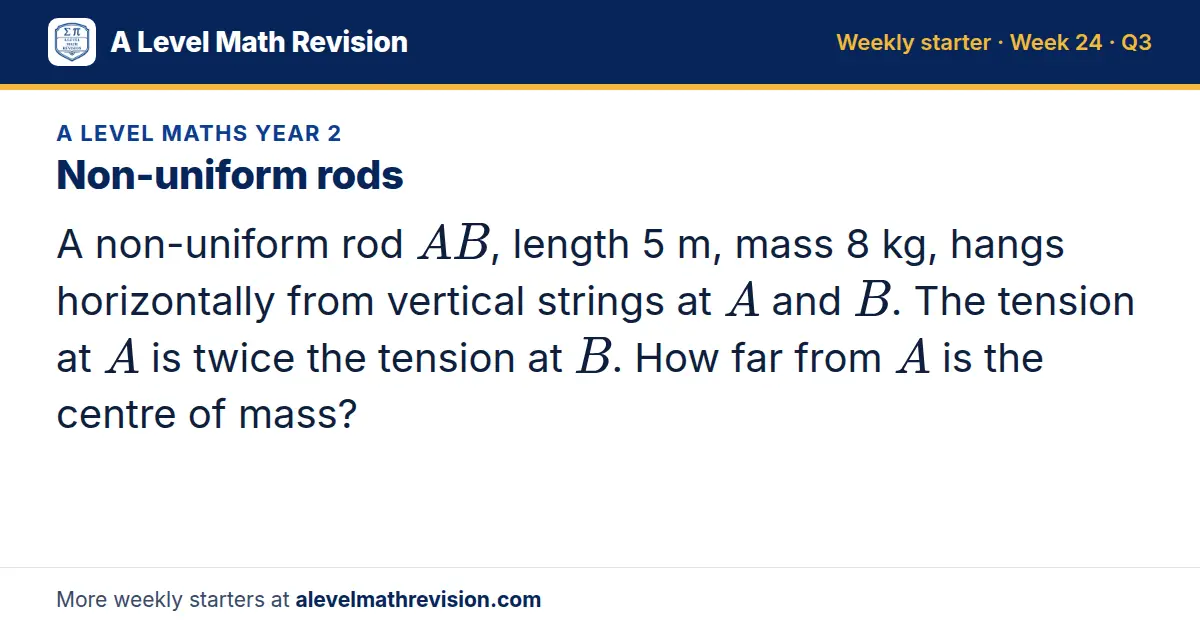
Question 3: Non-uniform rods
A non-uniform rod AB, length 5 m, mass 8 kg, hangs horizontally from vertical strings at A and B. The tension at A is twice the tension at B. How far from A is the centre of mass?
Week 25
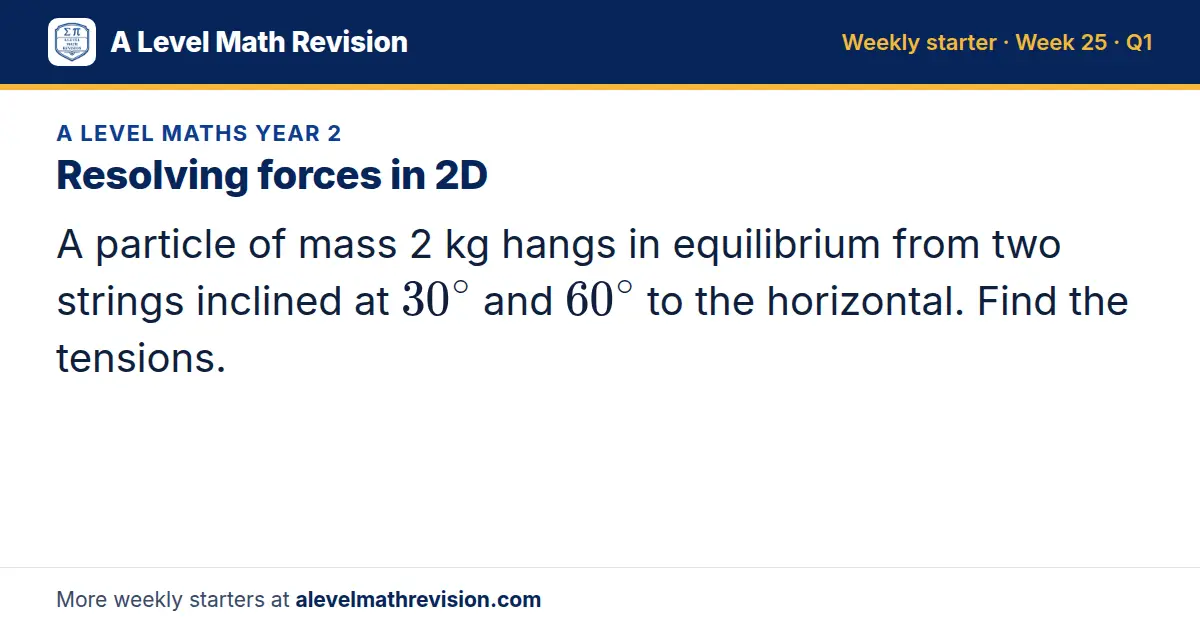
Question 1: Resolving forces in 2D
A particle of mass 2 kg hangs in equilibrium from two strings inclined at 30^∘ and 60^∘ to the horizontal. Find the tensions.
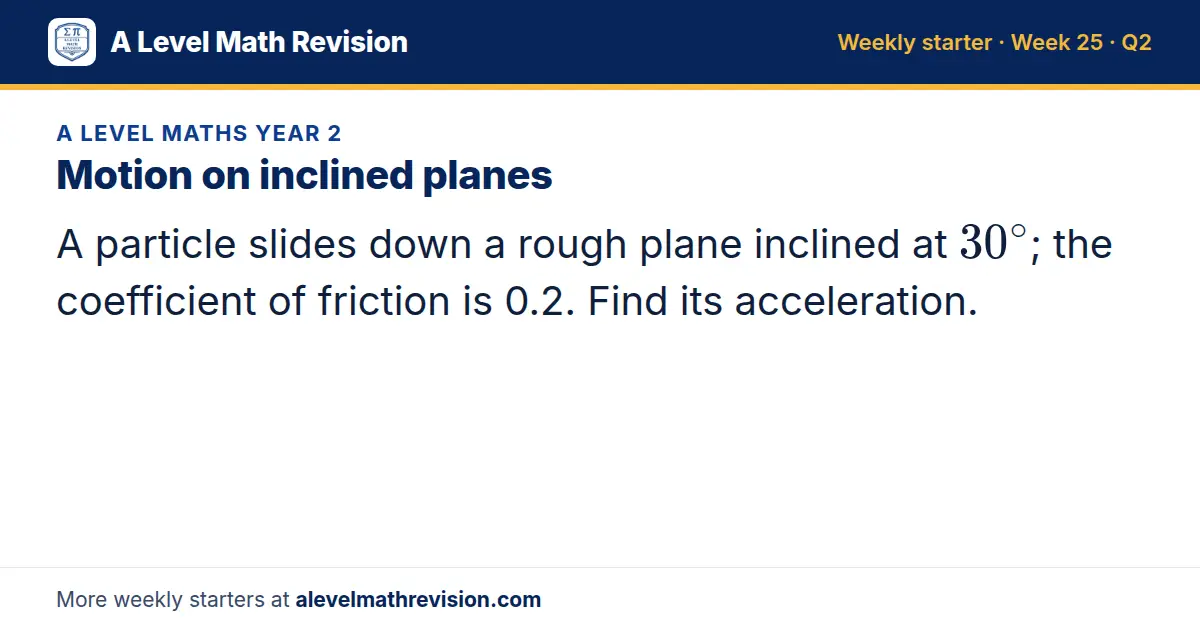
Question 2: Motion on inclined planes
A particle slides down a rough plane inclined at 30^∘; the coefficient of friction is 0.2. Find its acceleration.
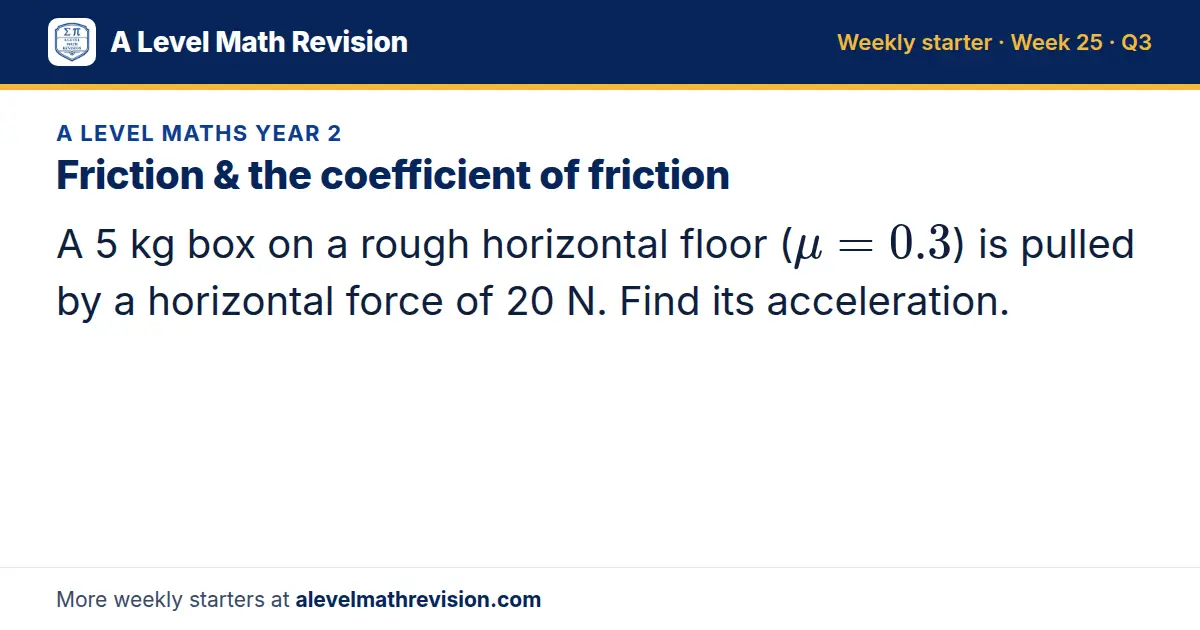
Question 3: Friction & the coefficient of friction
A 5 kg box on a rough horizontal floor (μ = 0.3) is pulled by a horizontal force of 20 N. Find its acceleration.
Week 26
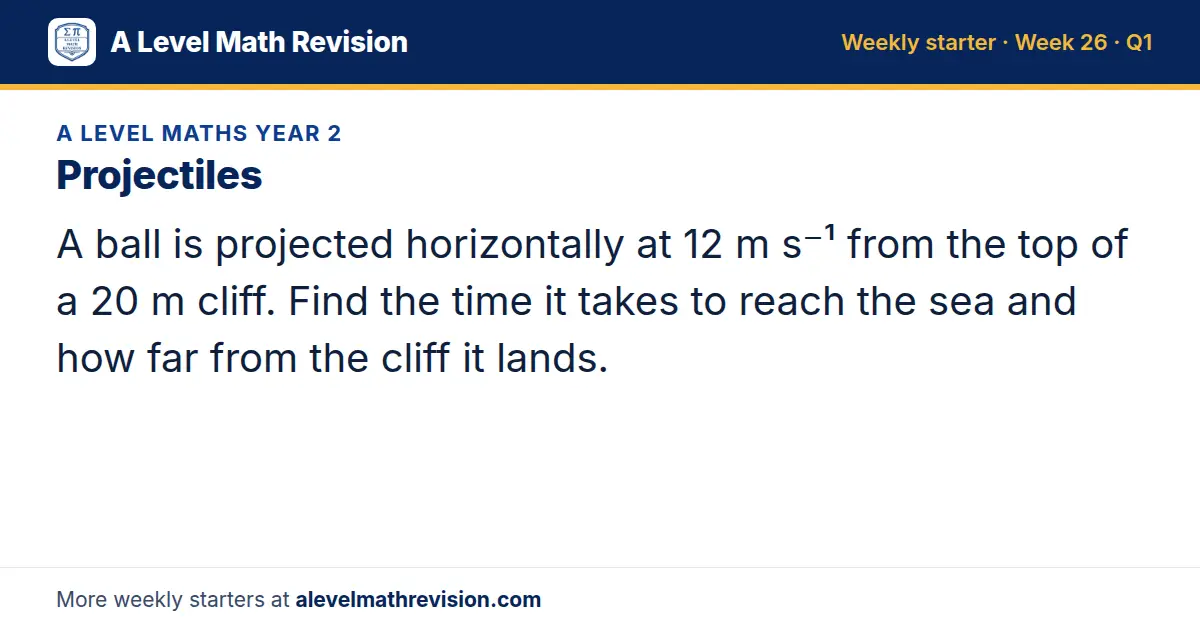
Question 1: Projectiles
A ball is projected horizontally at 12 m s⁻¹ from the top of a 20 m cliff. Find the time it takes to reach the sea and how far from the cliff it lands.
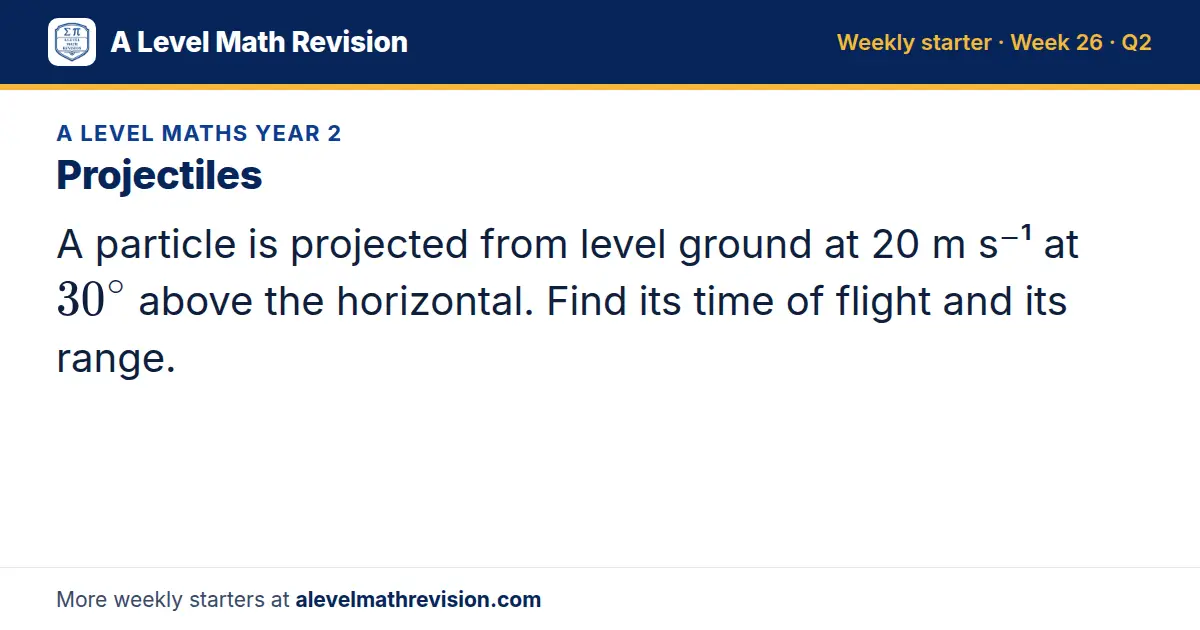
Question 2: Projectiles
A particle is projected from level ground at 20 m s⁻¹ at 30^∘ above the horizontal. Find its time of flight and its range.
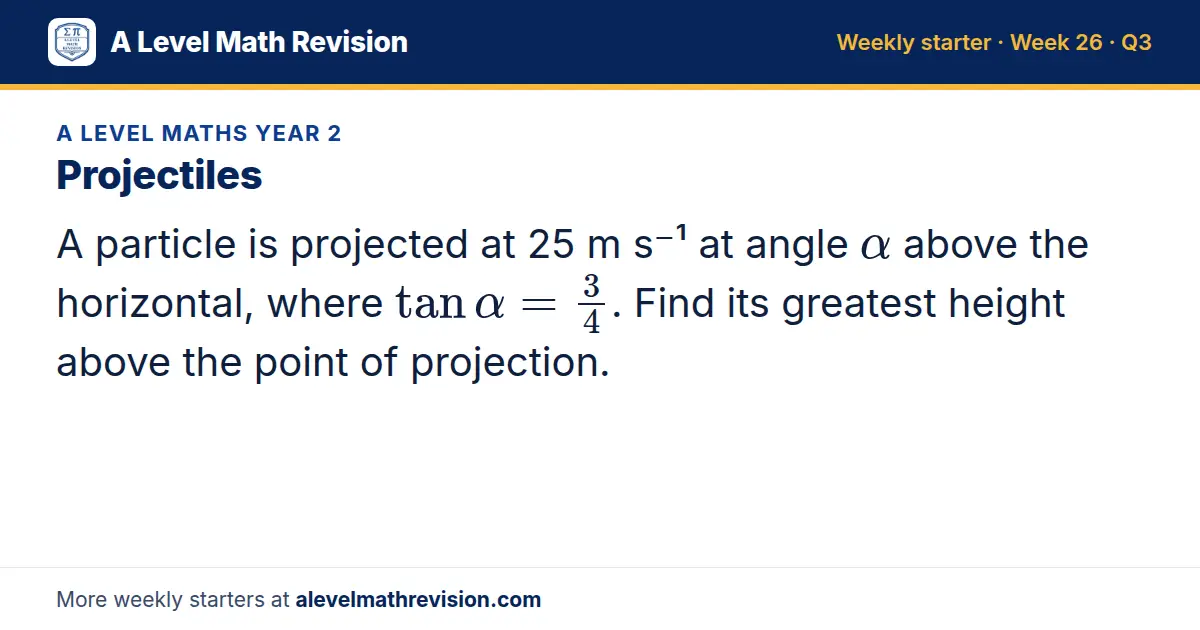
Question 3: Projectiles
A particle is projected at 25 m s⁻¹ at angle α above the horizontal, where tanα = 3/4. Find its greatest height above the point of projection.
More starter questions
Other weeks: Weeks 1–13 · Weeks 14–26 · Weeks 27–40. Answers and mark schemes are in the starter tasks for teachers.