Edexcel IAL Maths Year 2 starter questions: weeks 1–13
39 short questions to open a lesson for Edexcel International A Level Maths Year 2, weeks 1–13 of the teaching year, three or four a week. Each question is shown as an image with its text underneath; answers and mark schemes stay with teachers.
Week 1
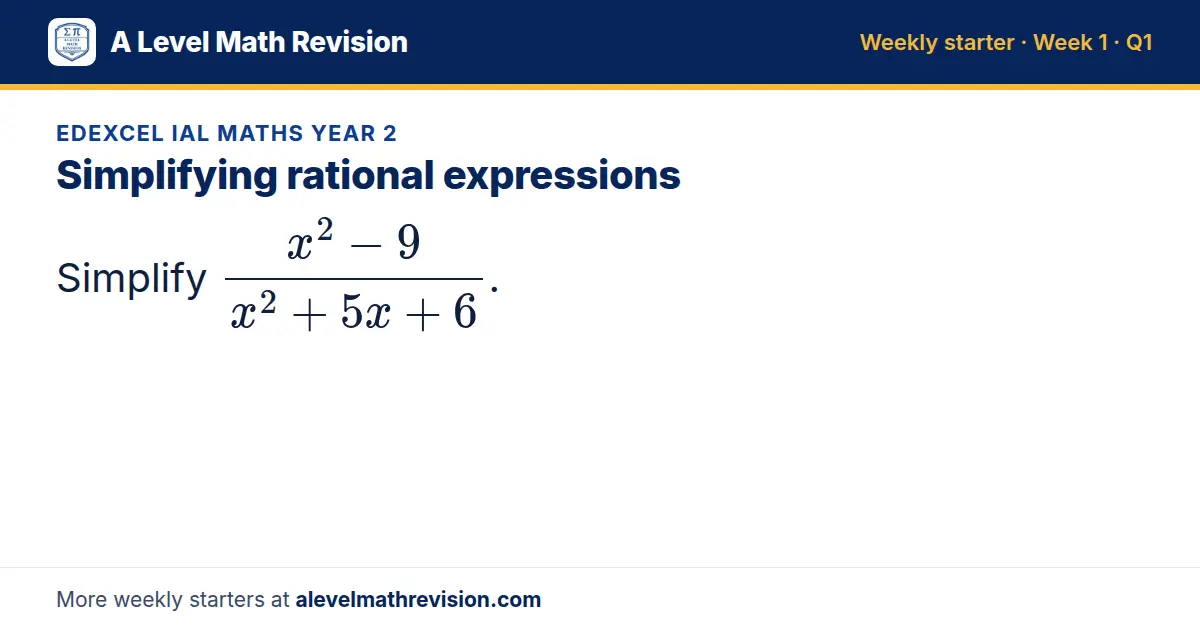
Question 1: Simplifying rational expressions
Simplify (x² - 9)/(x² + 5x + 6).
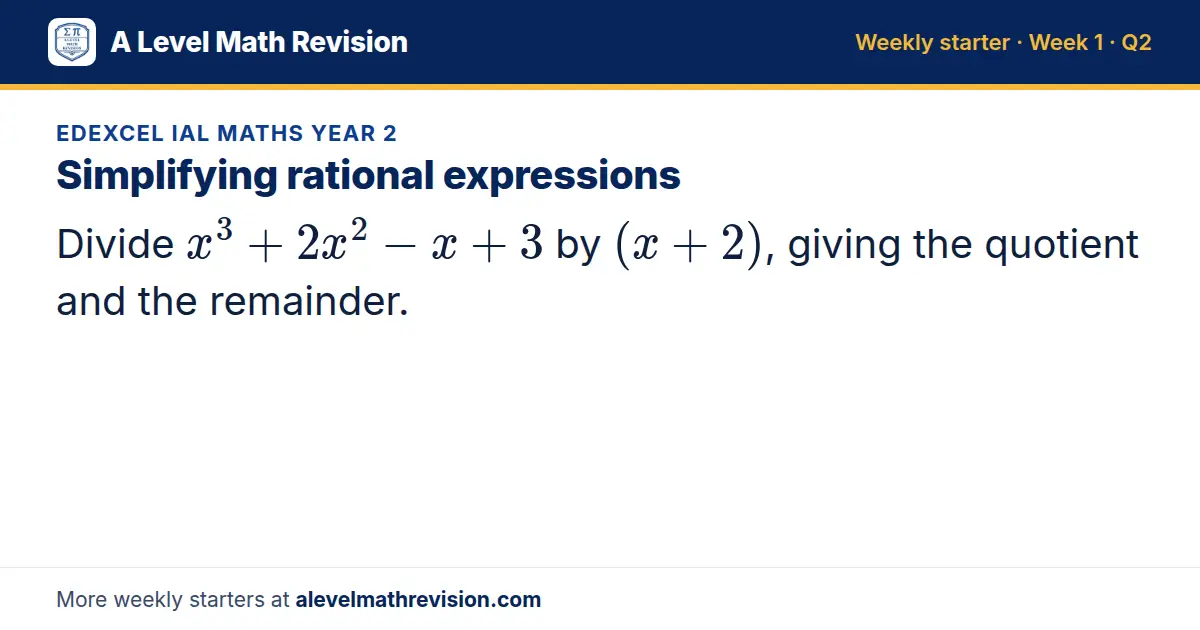
Question 2: Simplifying rational expressions
Divide x³ + 2x² - x + 3 by (x + 2), giving the quotient and the remainder.
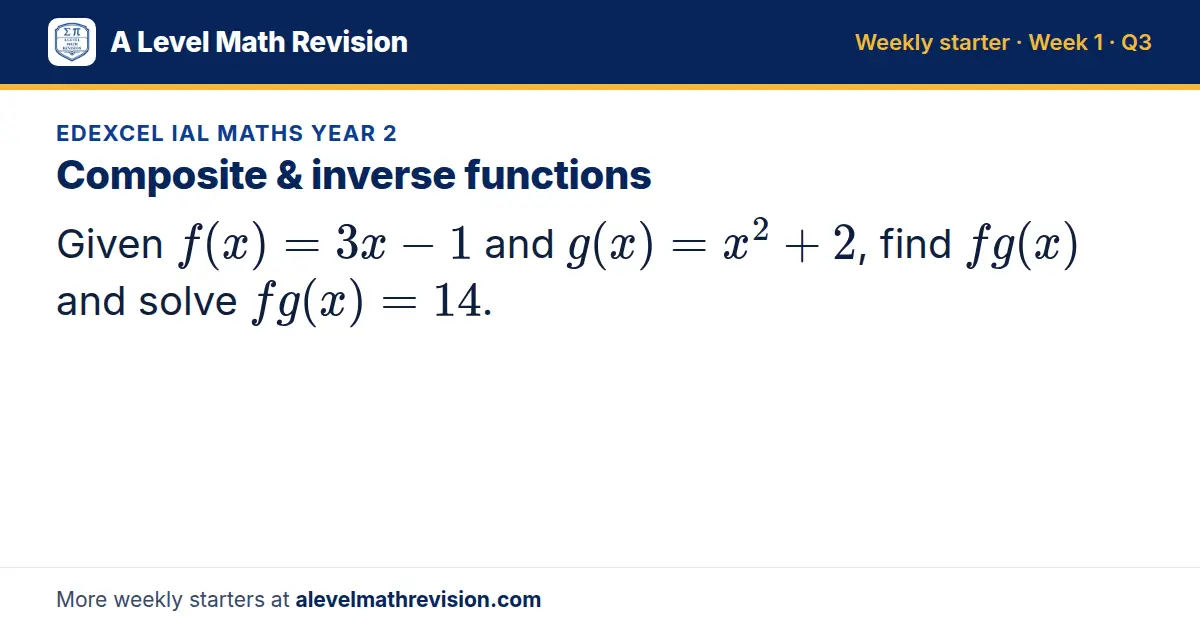
Question 3: Composite & inverse functions
Given f(x) = 3x - 1 and g(x) = x² + 2, find fg(x) and solve fg(x) = 14.
Week 2
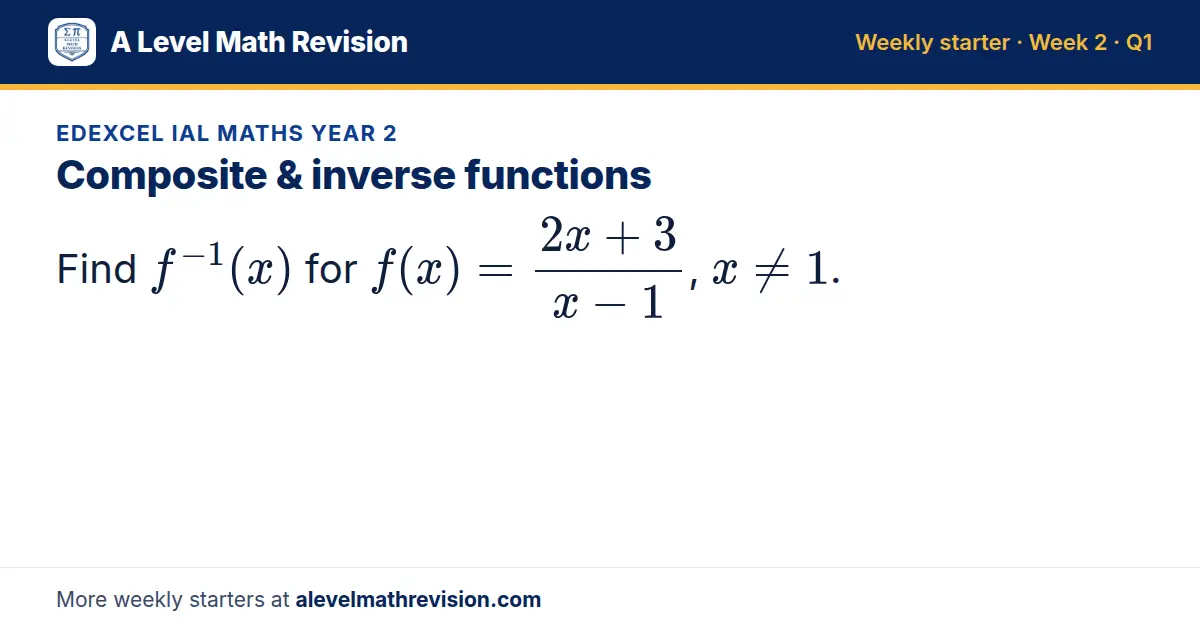
Question 1: Composite & inverse functions
Find f⁻¹(x) for f(x) = (2x + 3)/(x - 1), x ≠ 1.
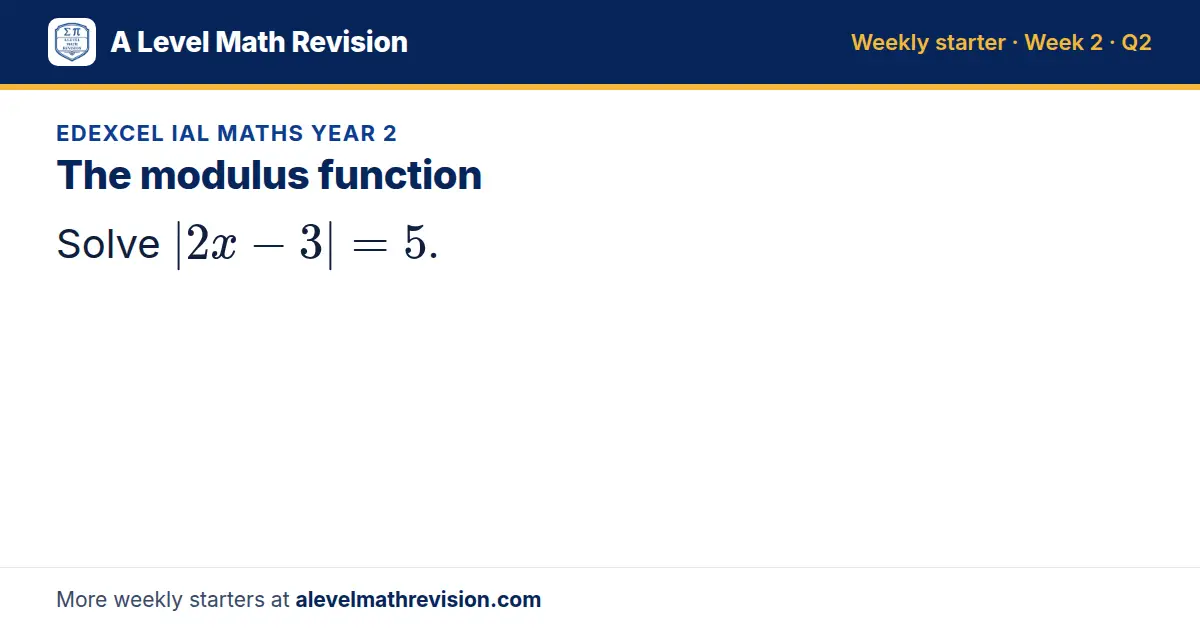
Question 2: The modulus function
Solve |2x - 3| = 5.
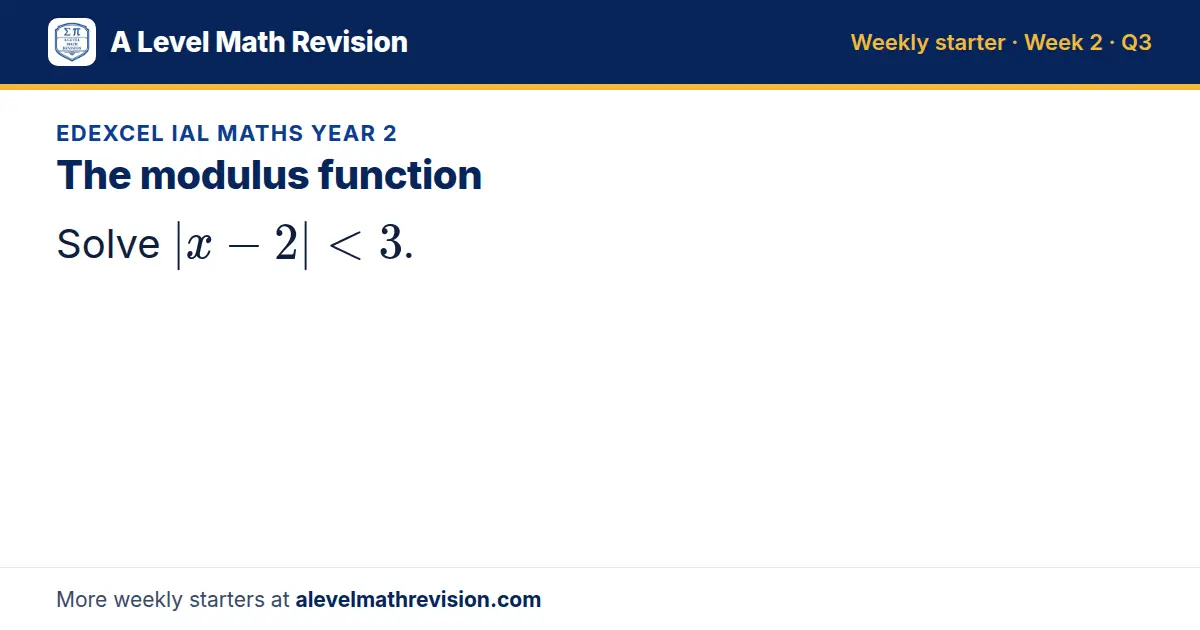
Question 3: The modulus function
Solve |x - 2| < 3.
Week 3
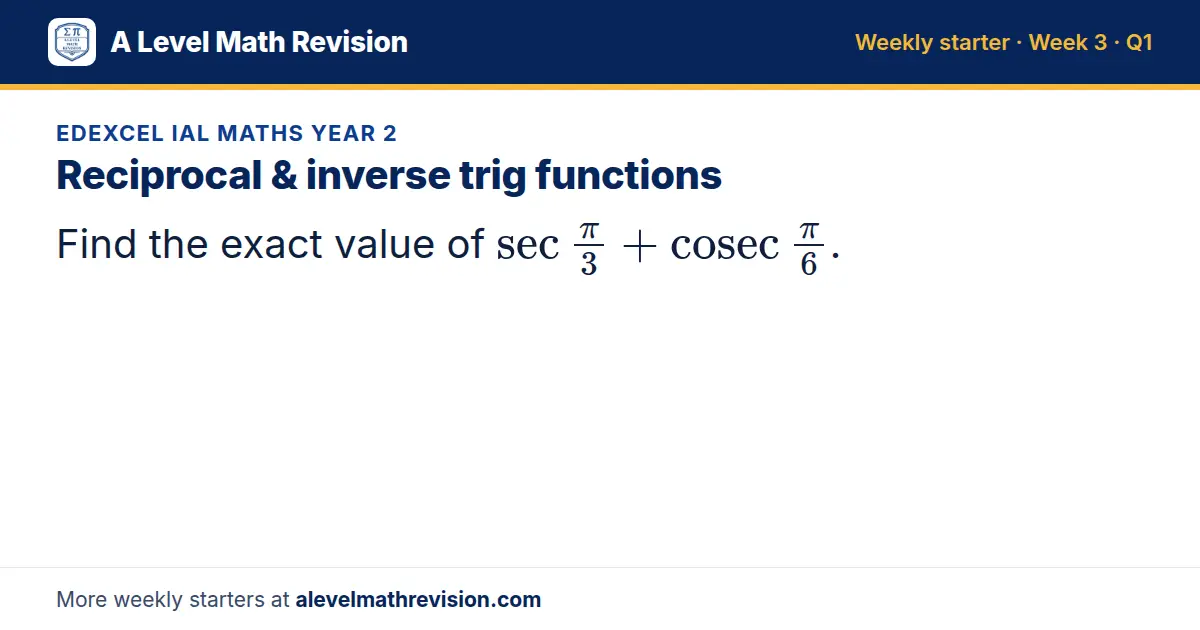
Question 1: Reciprocal & inverse trig functions
Find the exact value of sec(π)/3 + cosec(π)/6.
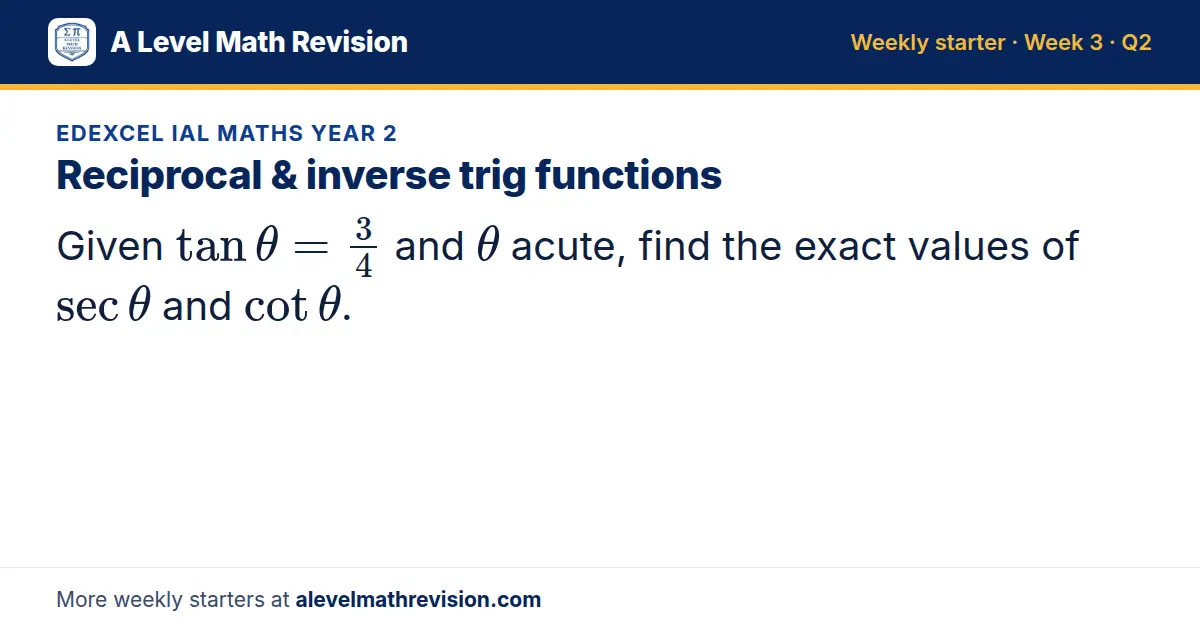
Question 2: Reciprocal & inverse trig functions
Given tanθ = 3/4 and θ acute, find the exact values of secθ and cotθ.
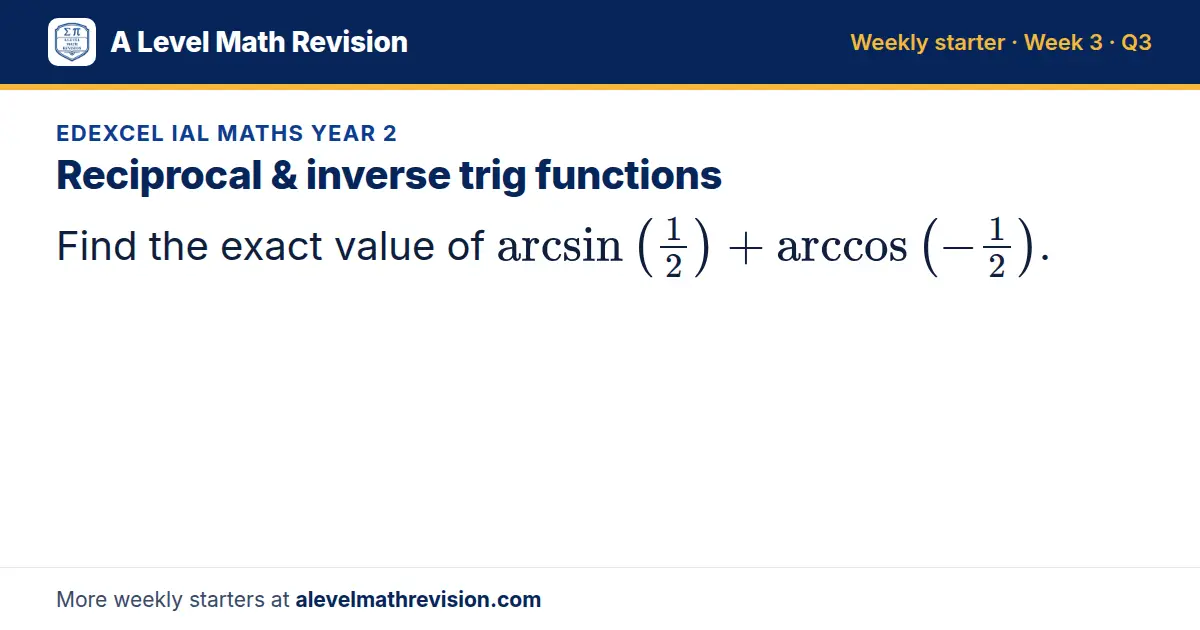
Question 3: Reciprocal & inverse trig functions
Find the exact value of arcsin(1/2) + arccos(-1/2).
Week 4
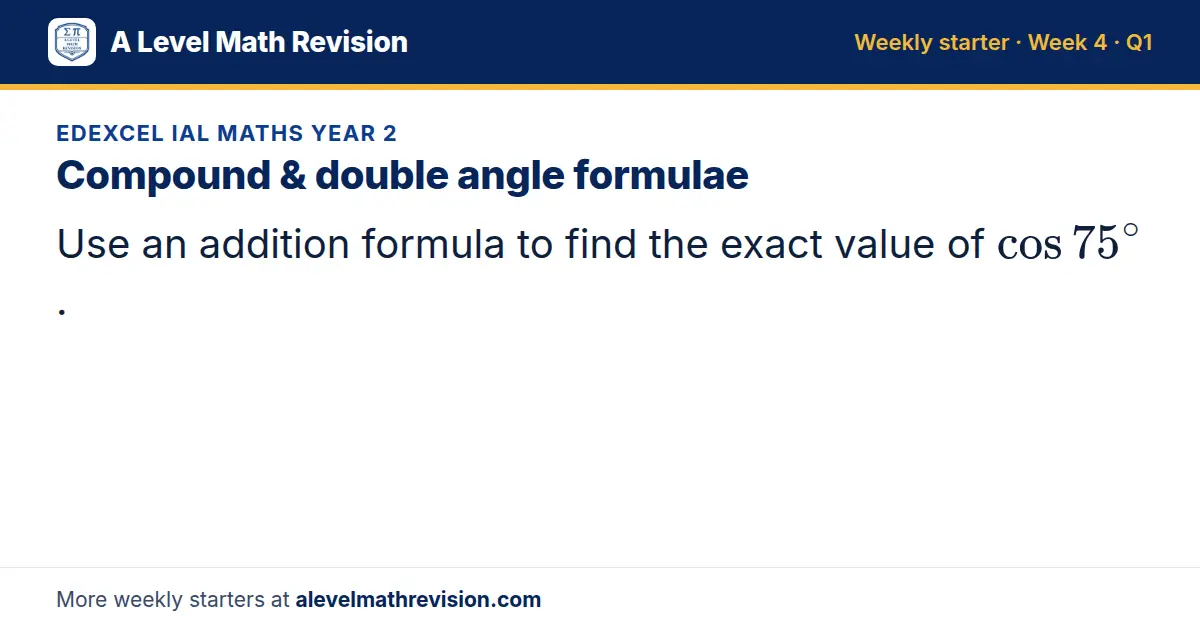
Question 1: Compound & double angle formulae
Use an addition formula to find the exact value of cos 75^∘.
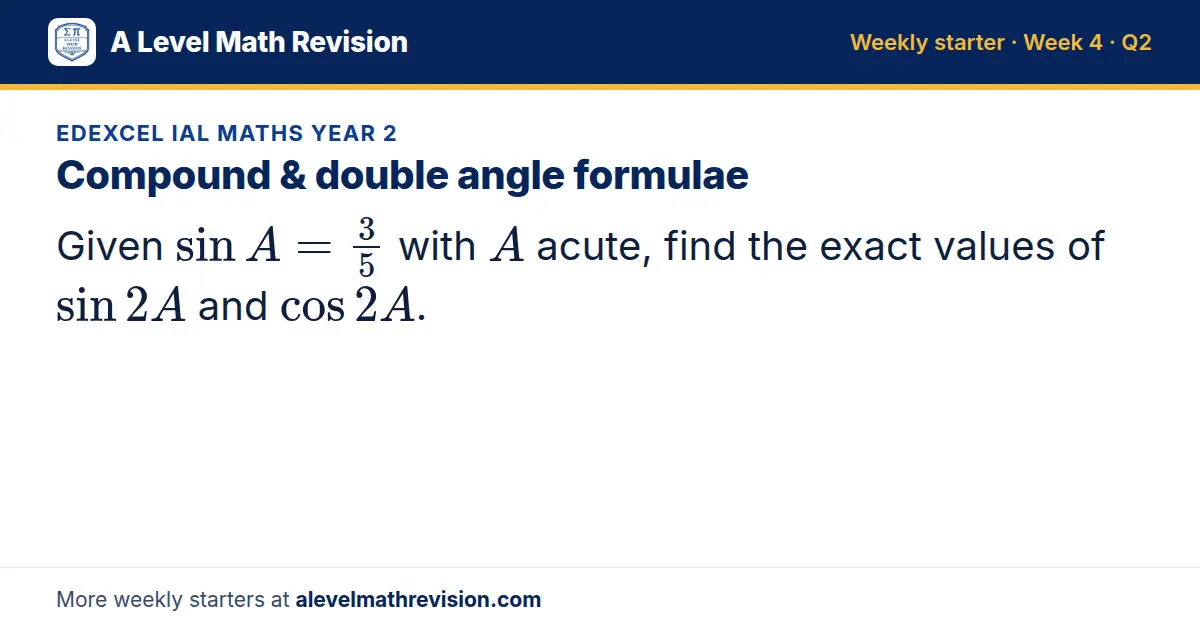
Question 2: Compound & double angle formulae
Given sin A = 3/5 with A acute, find the exact values of sin 2A and cos 2A.
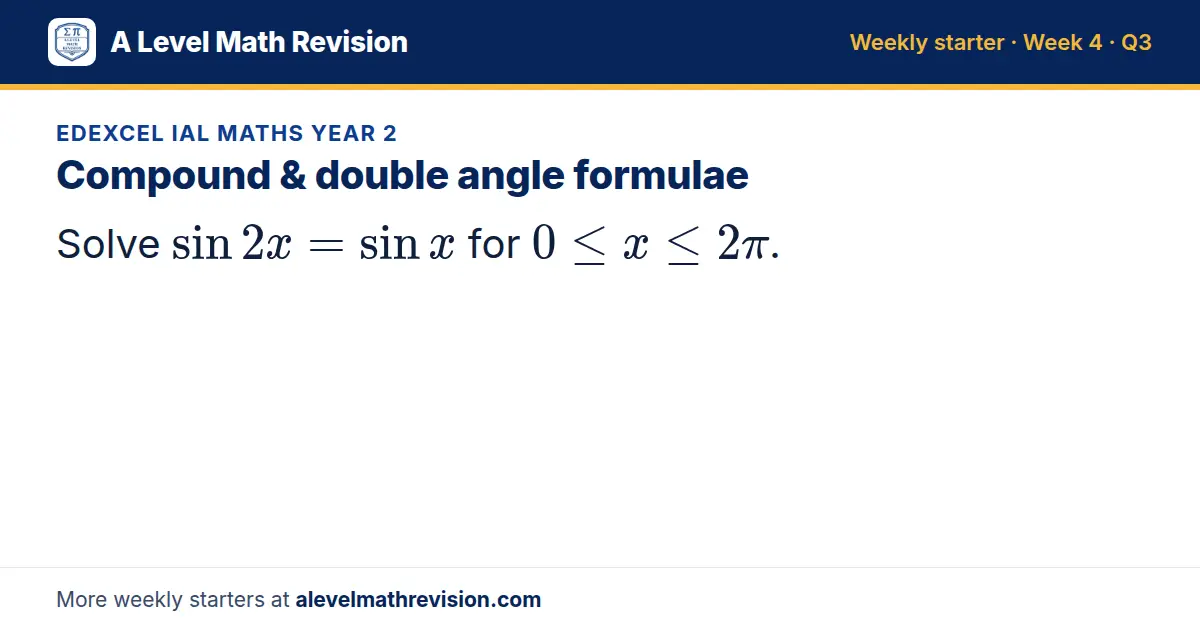
Question 3: Compound & double angle formulae
Solve sin 2x = sin x for 0 ≤ x ≤ 2π.
Week 5
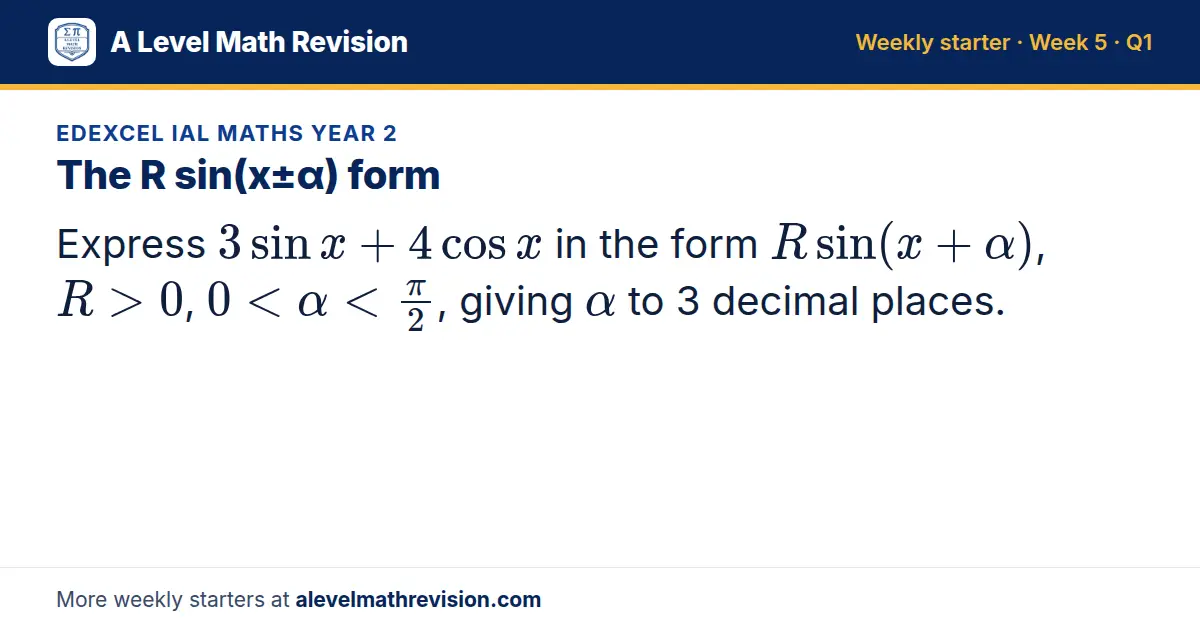
Question 1: The R sin(x±α) form
Express 3sin x + 4cos x in the form Rsin(x + α), R > 0, 0 < α < (π)/2, giving α to 3 decimal places.
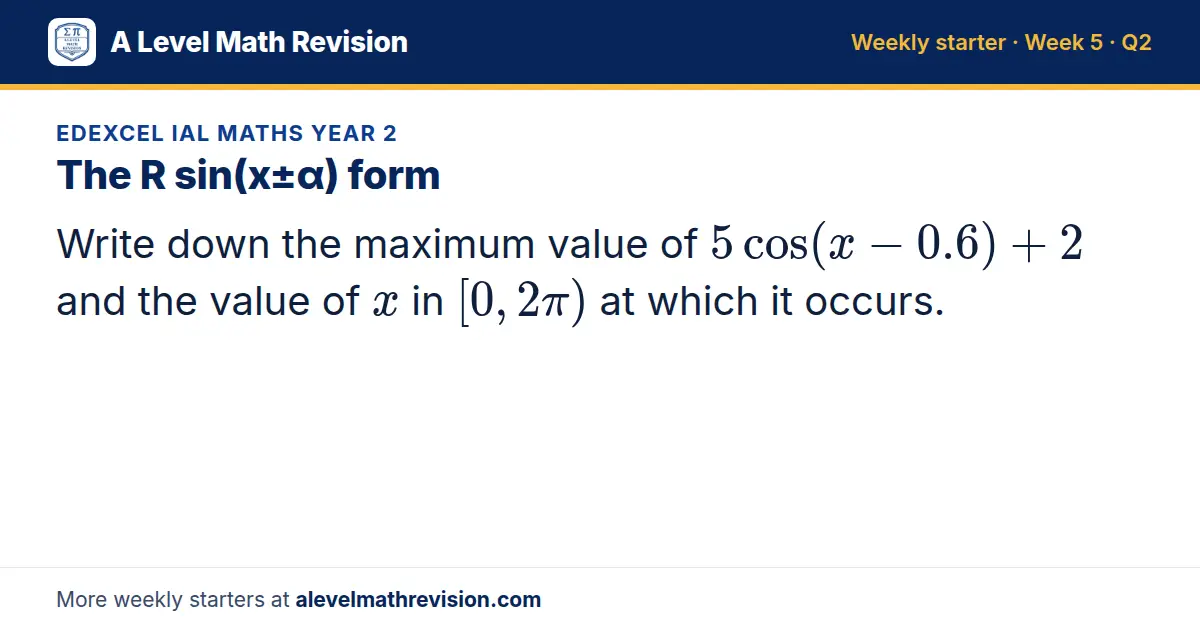
Question 2: The R sin(x±α) form
Write down the maximum value of 5cos(x - 0.6) + 2 and the value of x in [0, 2π) at which it occurs.
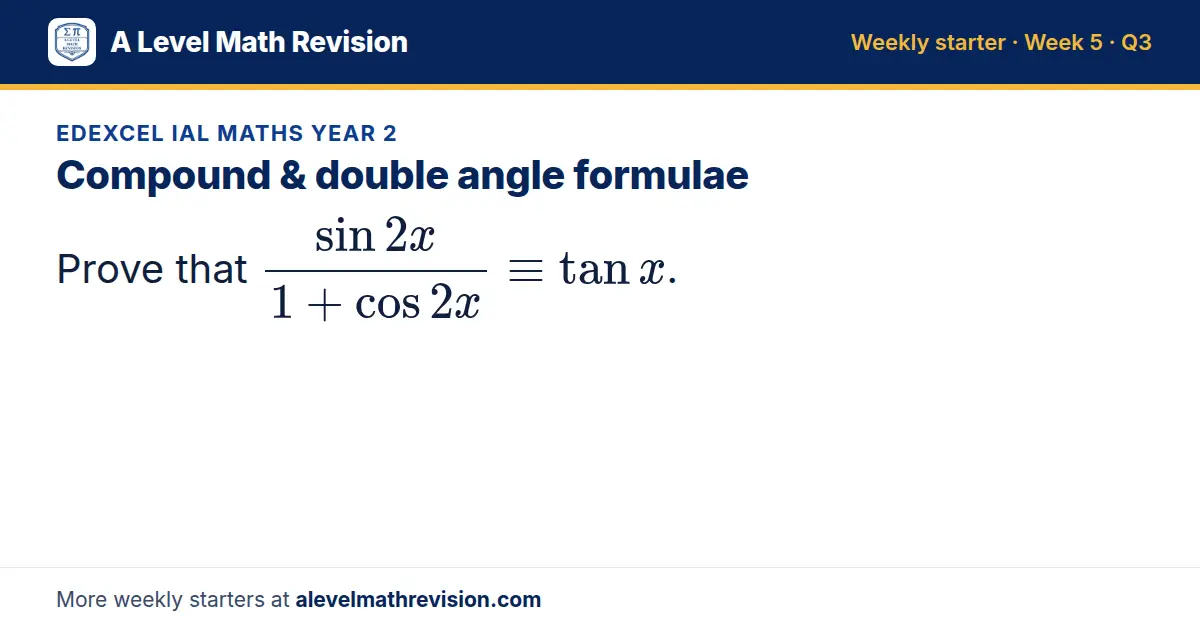
Question 3: Compound & double angle formulae
Prove that (sin 2x)/(1 + cos 2x) ≡ tan x.
Week 6
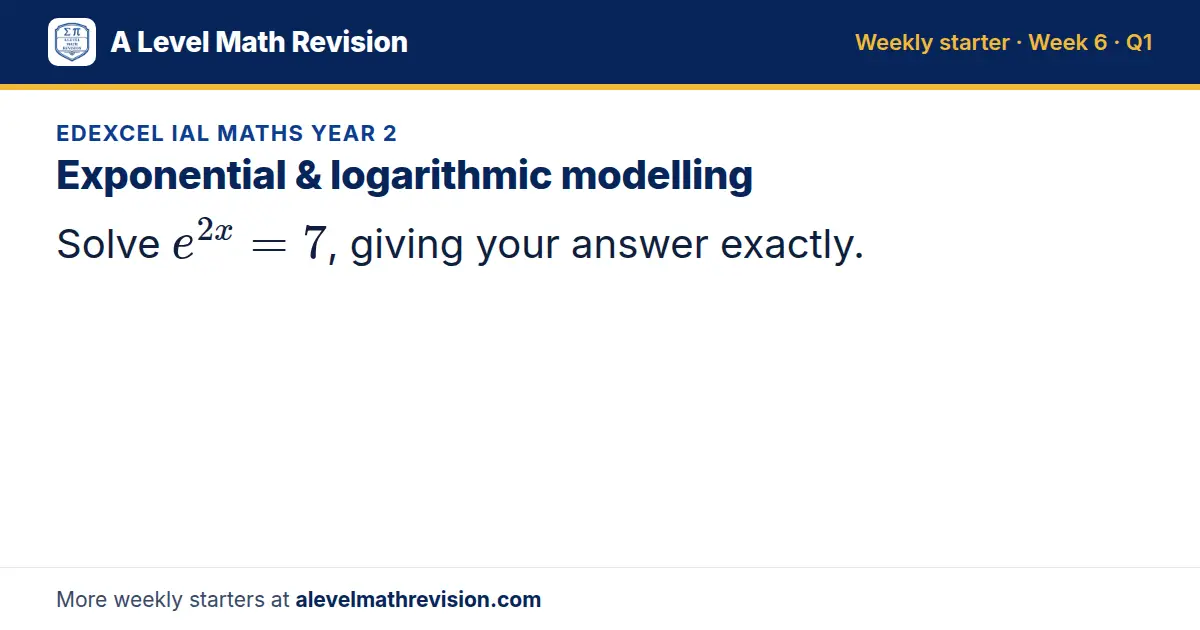
Question 1: Exponential & logarithmic modelling
Solve e^(2x) = 7, giving your answer exactly.
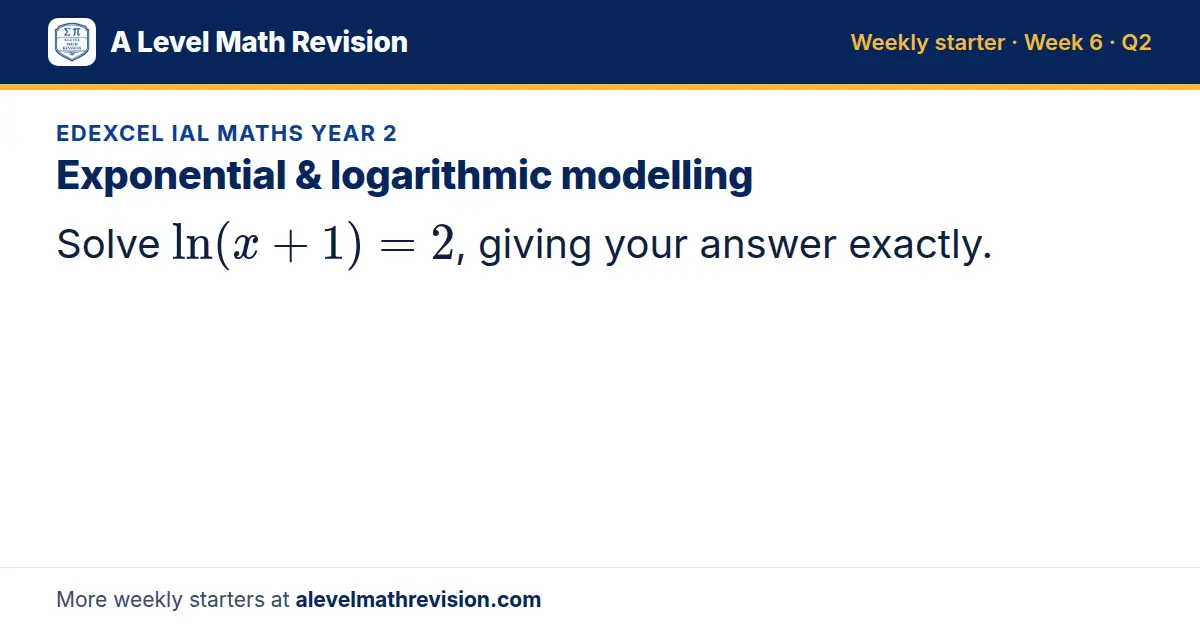
Question 2: Exponential & logarithmic modelling
Solve ln(x + 1) = 2, giving your answer exactly.
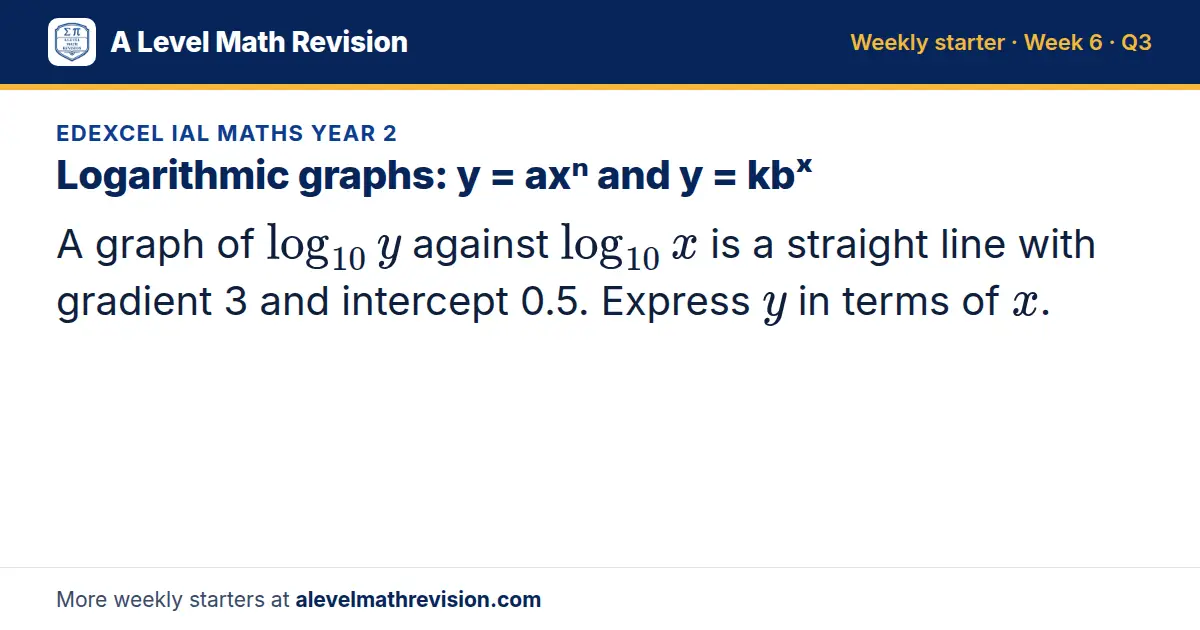
Question 3: Logarithmic graphs: y = axⁿ and y = kbˣ
A graph of log_10 y against log_10 x is a straight line with gradient 3 and intercept 0.5. Express y in terms of x.
Week 7
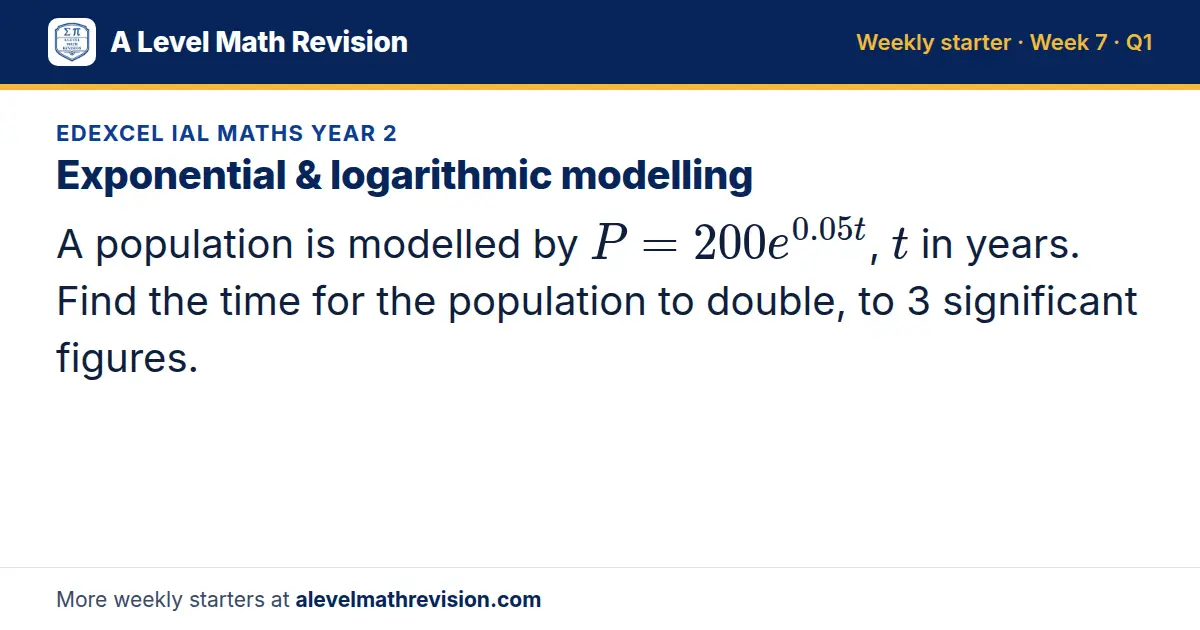
Question 1: Exponential & logarithmic modelling
A population is modelled by P = 200e^(0.05t), t in years. Find the time for the population to double, to 3 significant figures.
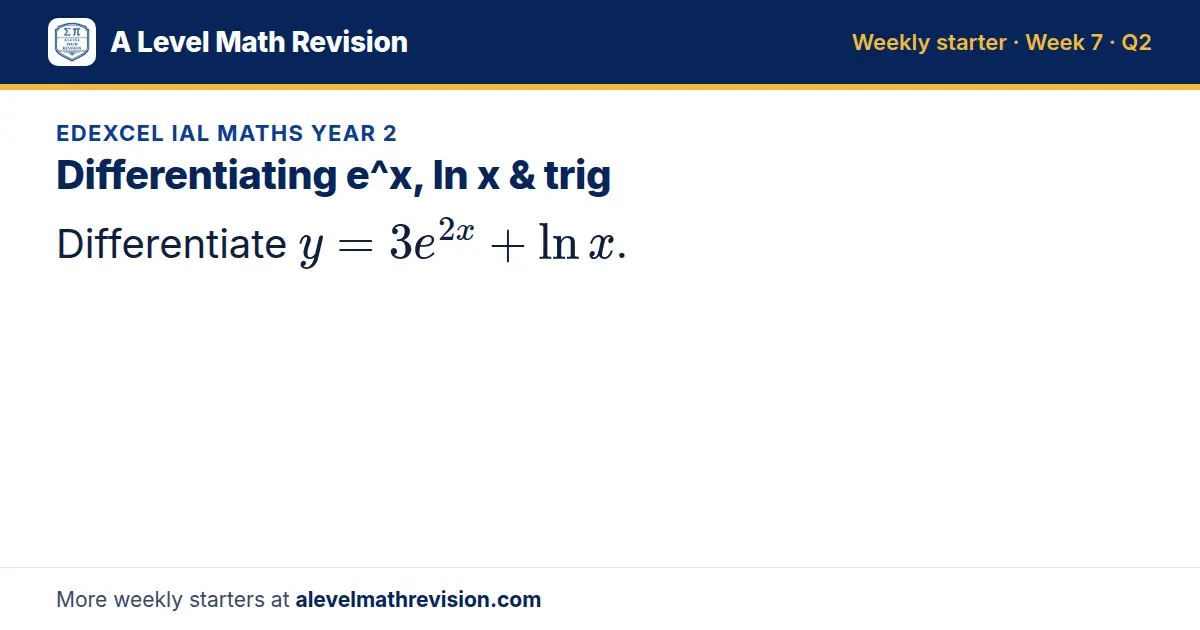
Question 2: Differentiating e^x, ln x & trig
Differentiate y = 3e^(2x) + ln x.
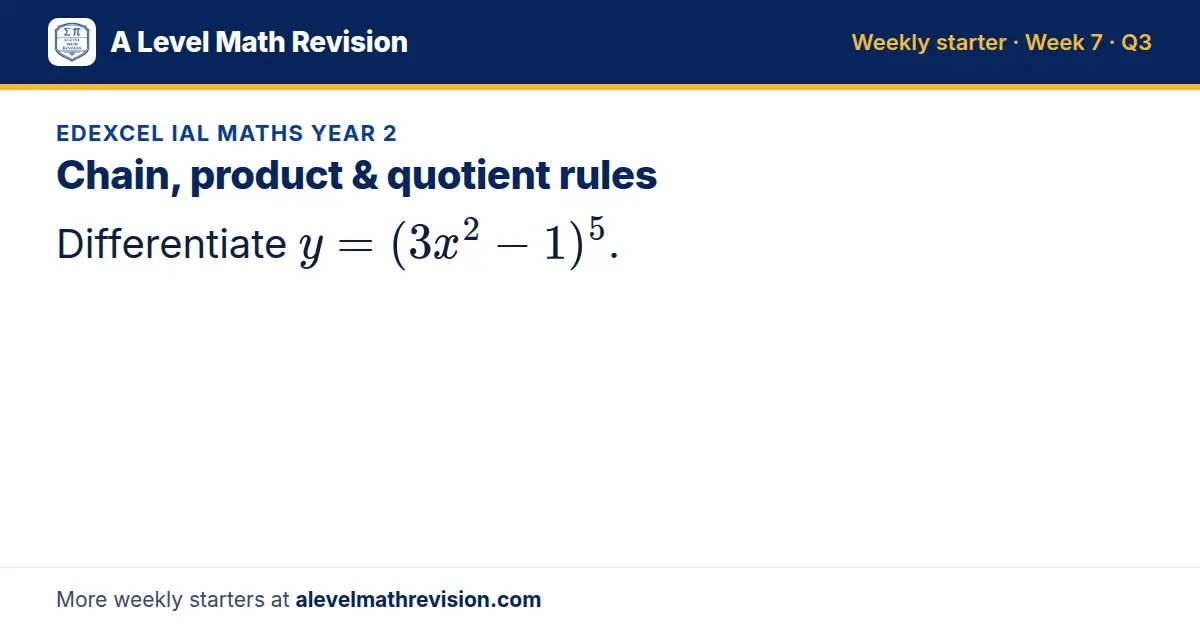
Question 3: Chain, product & quotient rules
Differentiate y = (3x² - 1)^5.
Week 8
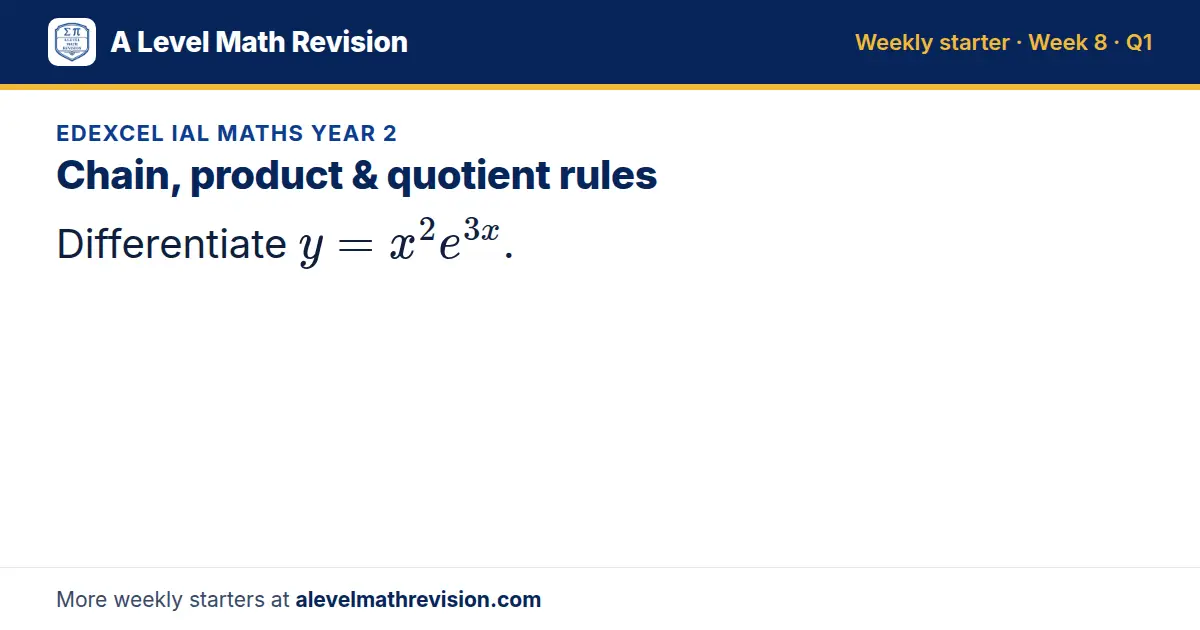
Question 1: Chain, product & quotient rules
Differentiate y = x² e^(3x).
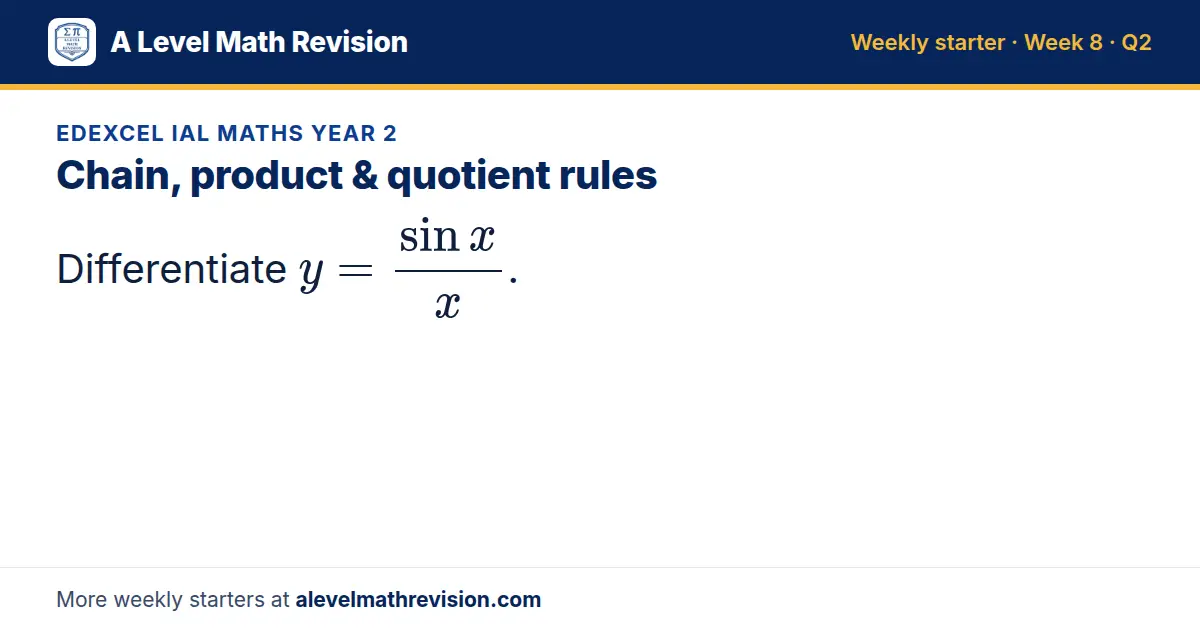
Question 2: Chain, product & quotient rules
Differentiate y = (sin x)/x.
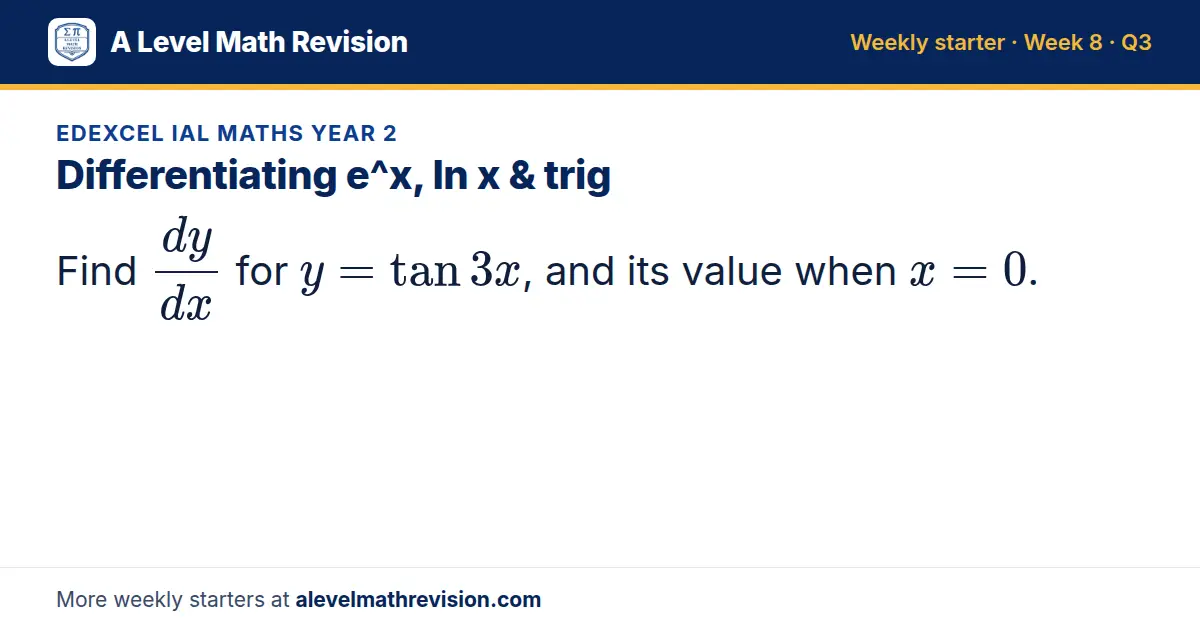
Question 3: Differentiating e^x, ln x & trig
Find dy/dx for y = tan 3x, and its value when x = 0.
Week 9
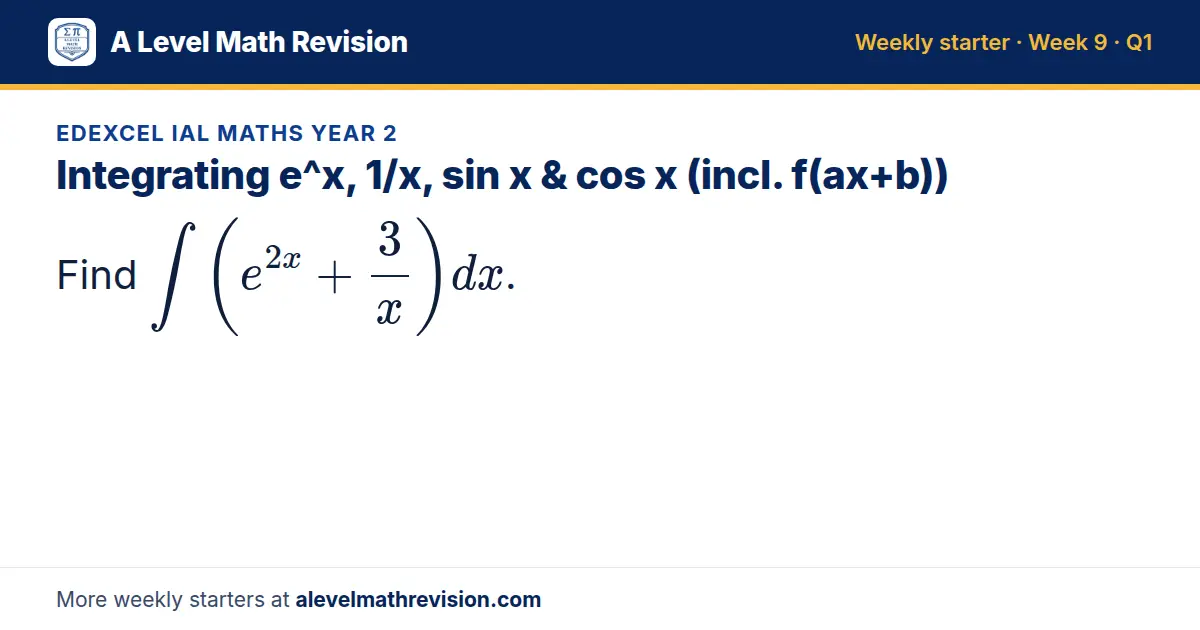
Question 1: Integrating e^x, 1/x, sin x & cos x (incl. f(ax+b))
Find ∫ (e^(2x) + 3/x)dx.
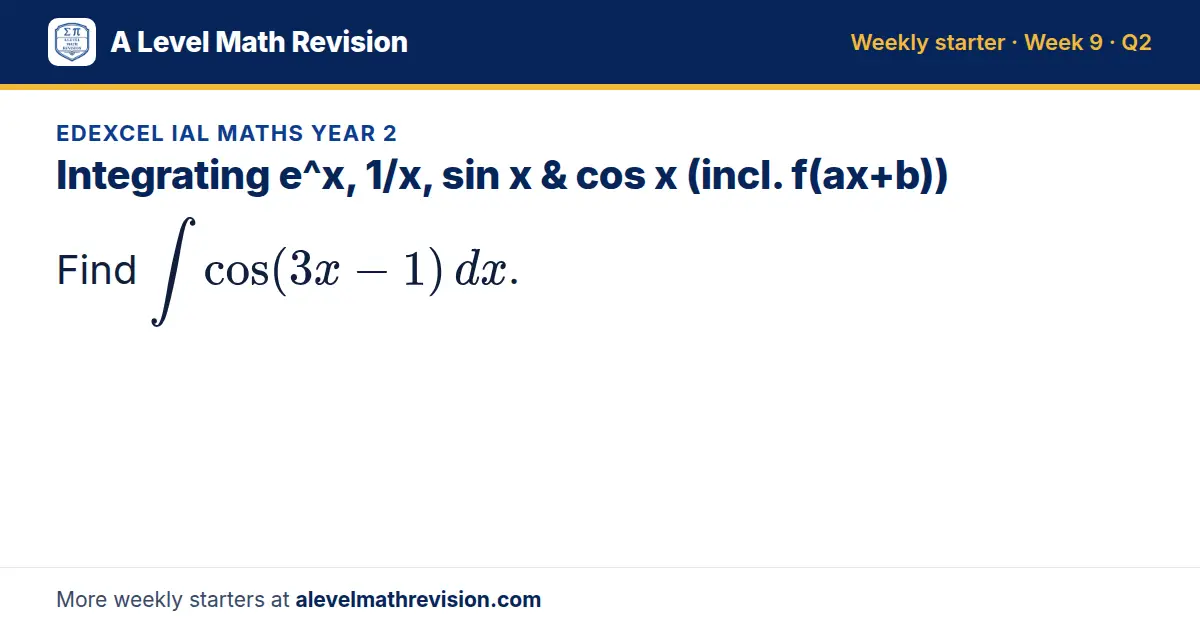
Question 2: Integrating e^x, 1/x, sin x & cos x (incl. f(ax+b))
Find ∫ cos(3x - 1) dx.
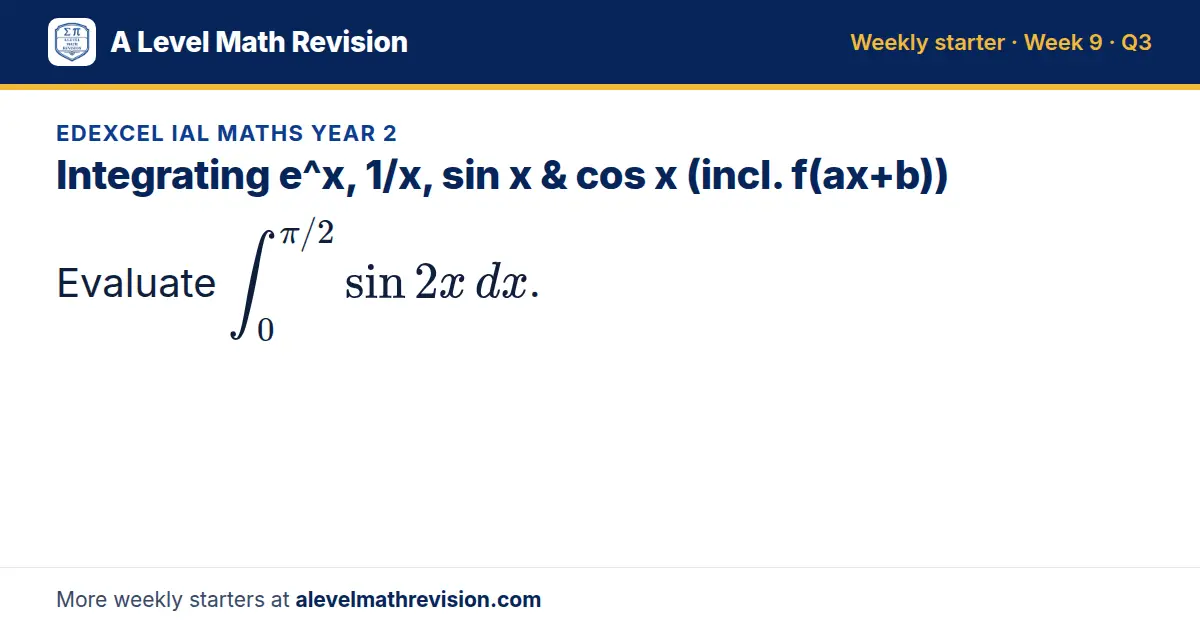
Question 3: Integrating e^x, 1/x, sin x & cos x (incl. f(ax+b))
Evaluate ∫_0^(π/2) sin 2x dx.
Week 10
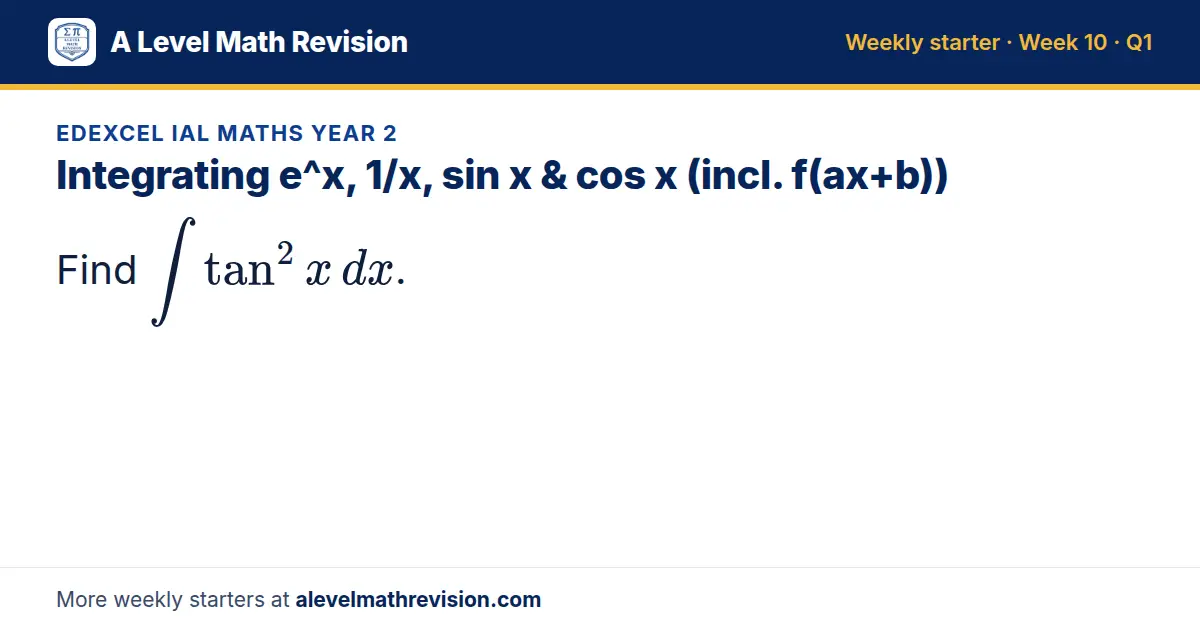
Question 1: Integrating e^x, 1/x, sin x & cos x (incl. f(ax+b))
Find ∫ tan² x dx.
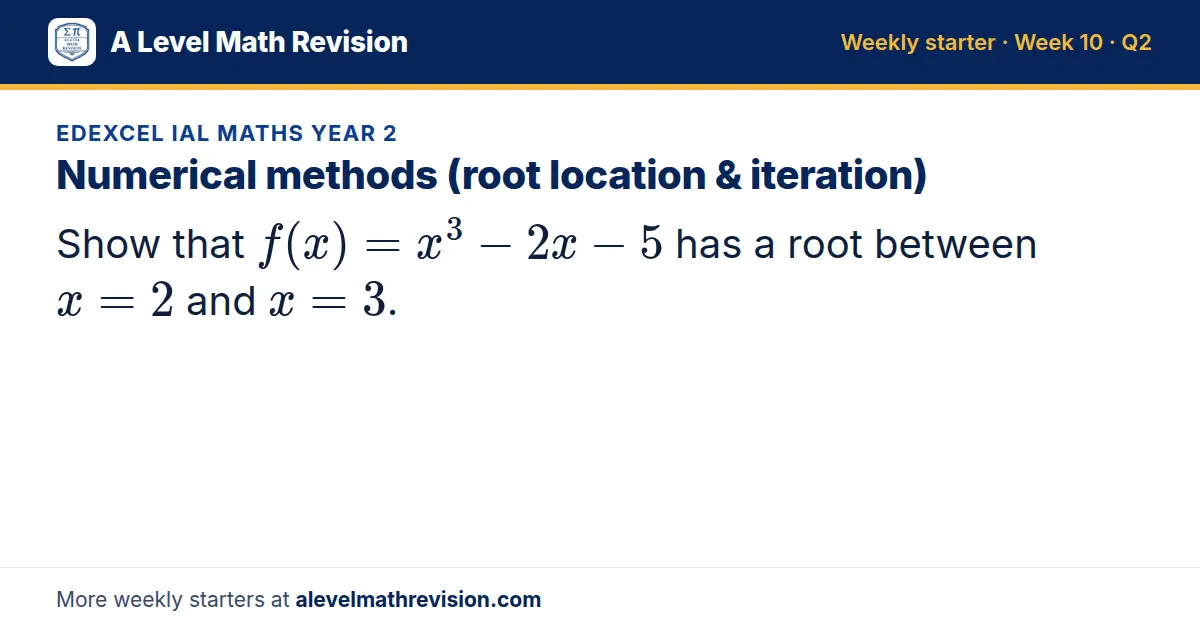
Question 2: Numerical methods (root location & iteration)
Show that f(x) = x³ - 2x - 5 has a root between x = 2 and x = 3.
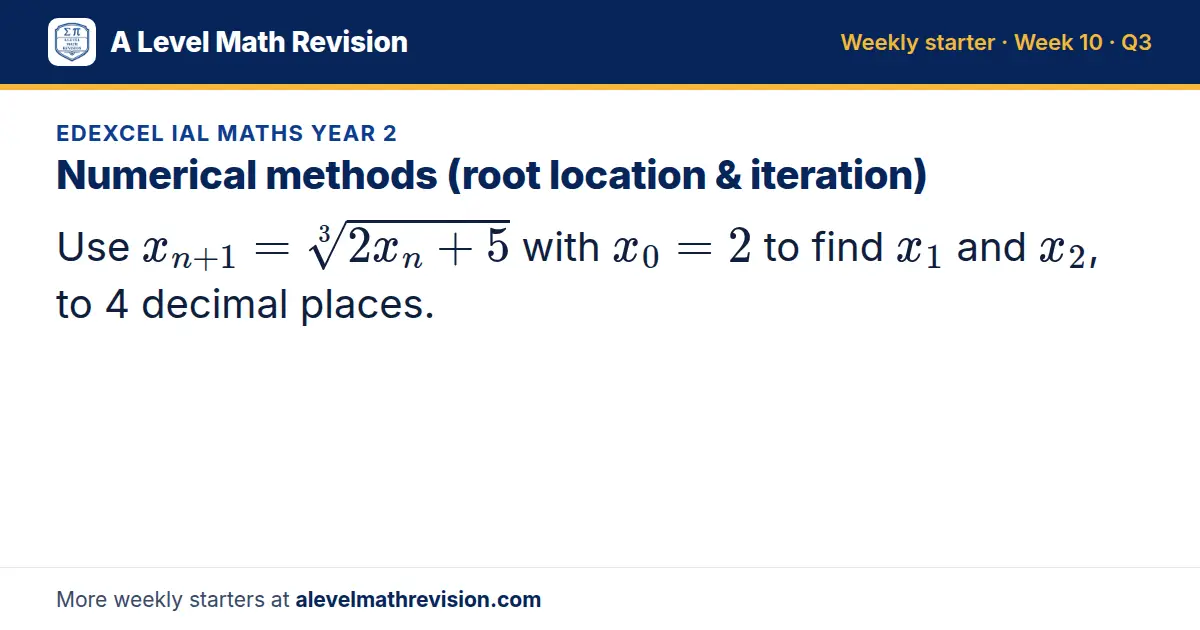
Question 3: Numerical methods (root location & iteration)
Use x_n+1 = 3√(2x_n + 5) with x_0 = 2 to find x_1 and x_2, to 4 decimal places.
Week 11
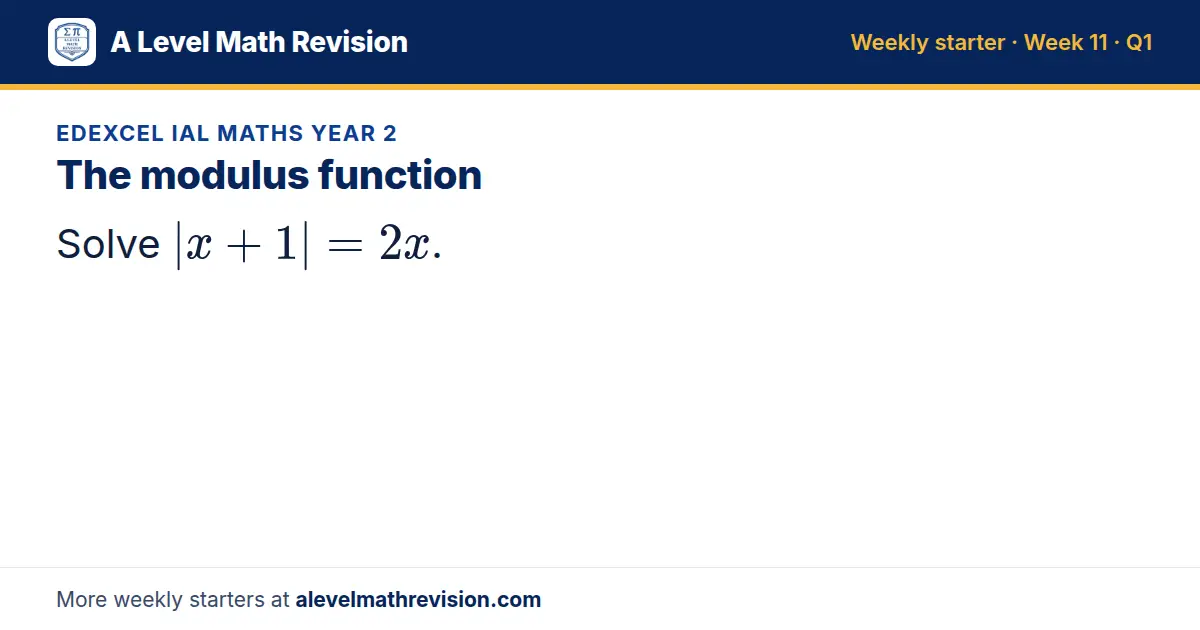
Question 1: The modulus function
Solve |x + 1| = 2x.
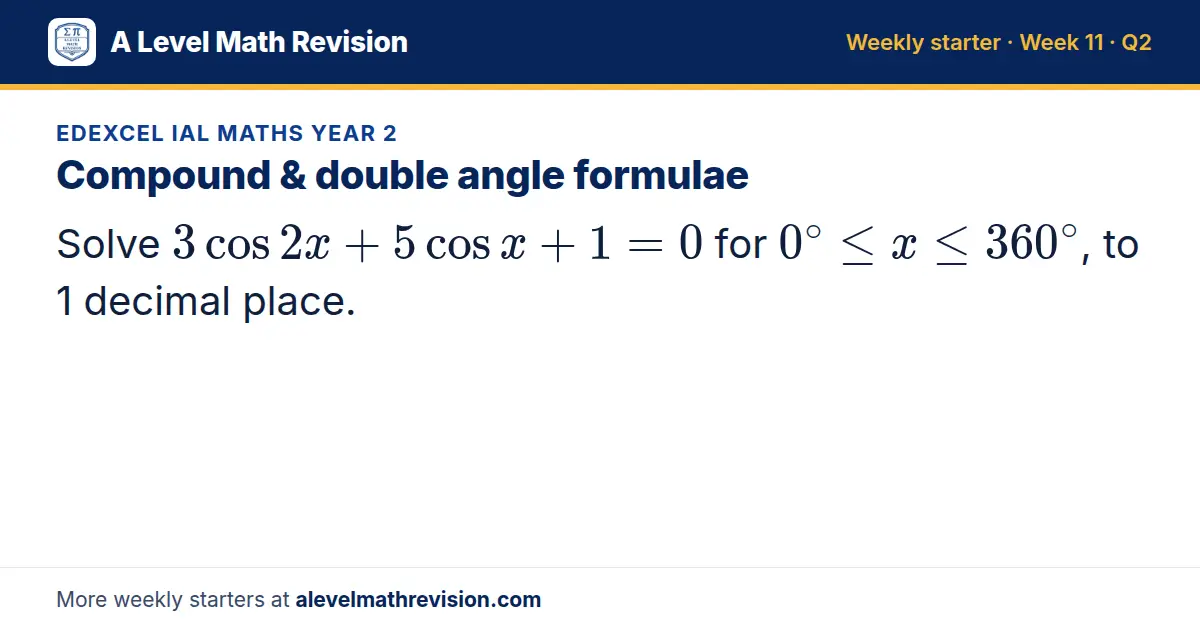
Question 2: Compound & double angle formulae
Solve 3cos 2x + 5cos x + 1 = 0 for 0^∘ ≤ x ≤ 360^∘, to 1 decimal place.
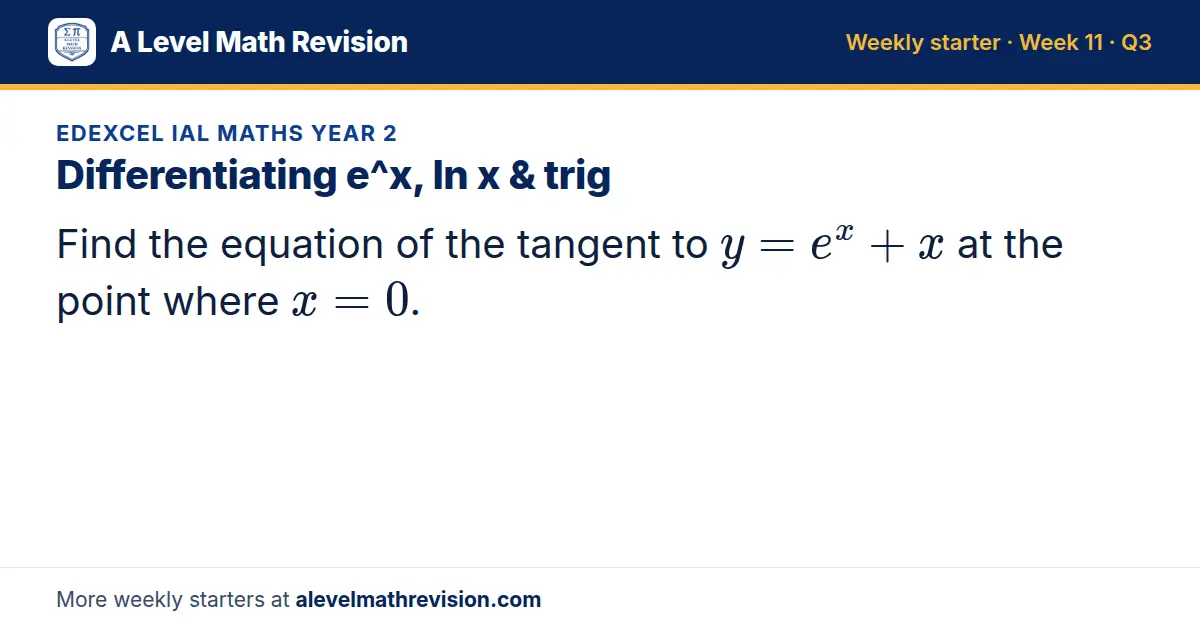
Question 3: Differentiating e^x, ln x & trig
Find the equation of the tangent to y = e^x + x at the point where x = 0.
Week 12
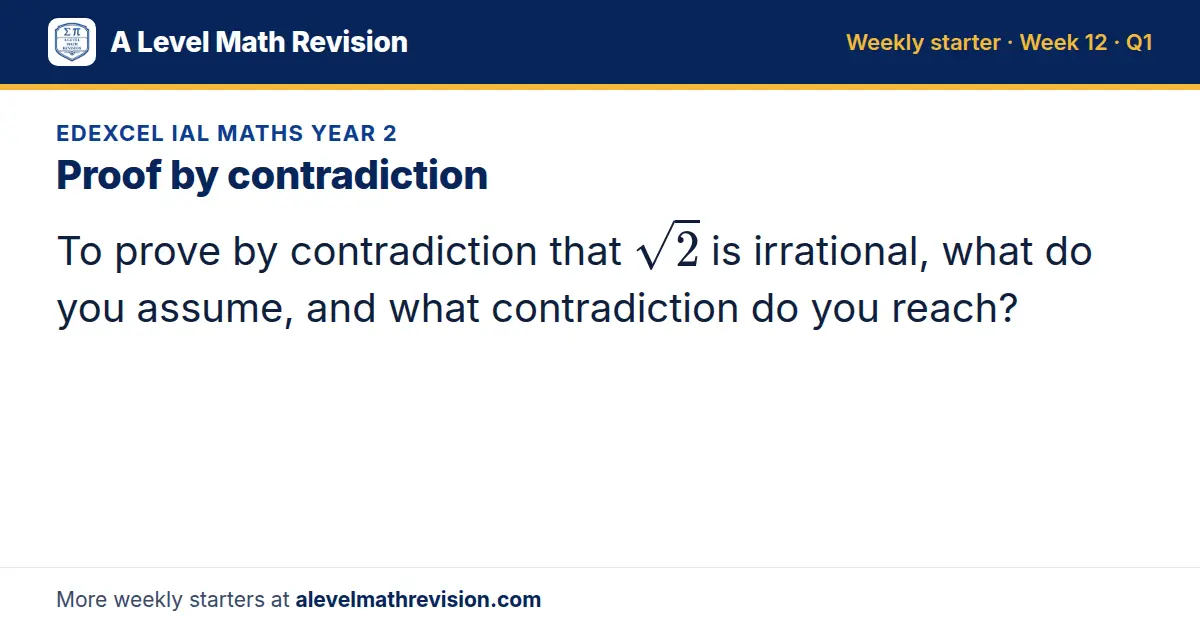
Question 1: Proof by contradiction
To prove by contradiction that √2 is irrational, what do you assume, and what contradiction do you reach?
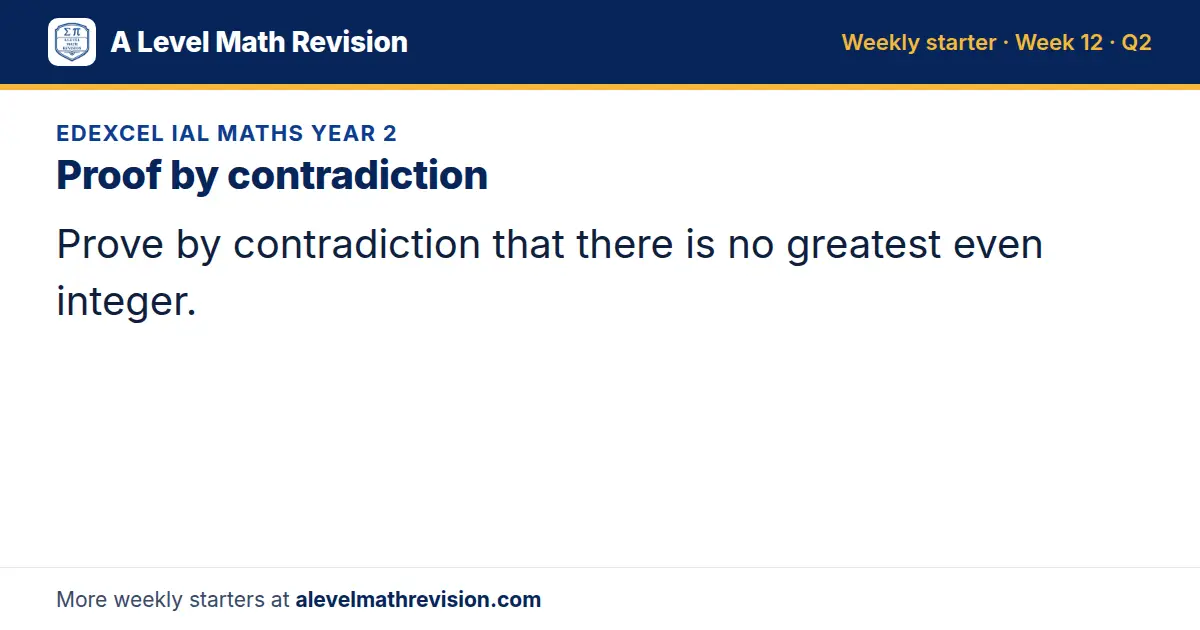
Question 2: Proof by contradiction
Prove by contradiction that there is no greatest even integer.
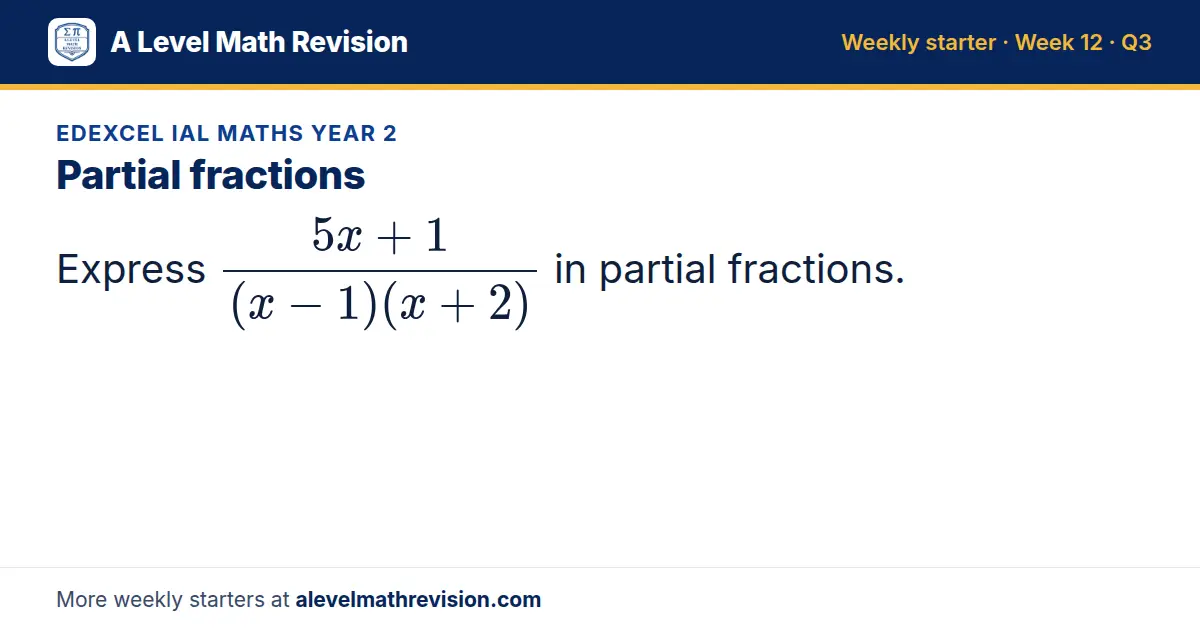
Question 3: Partial fractions
Express (5x + 1)/((x - 1)(x + 2)) in partial fractions.
Week 13
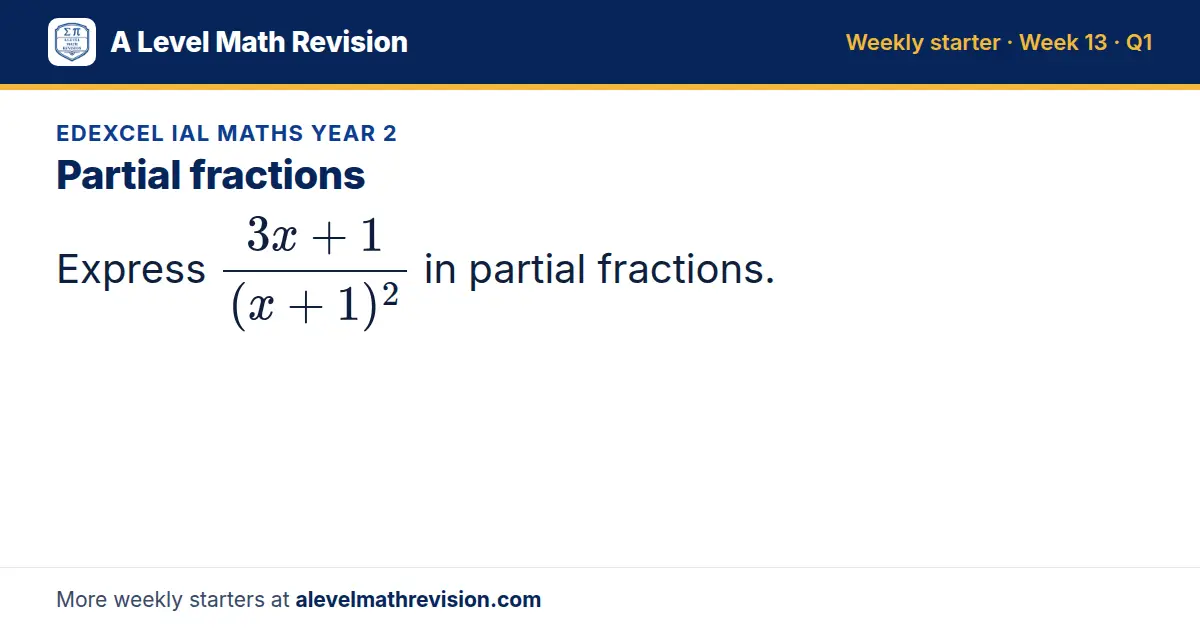
Question 1: Partial fractions
Express (3x + 1)/((x + 1)²) in partial fractions.
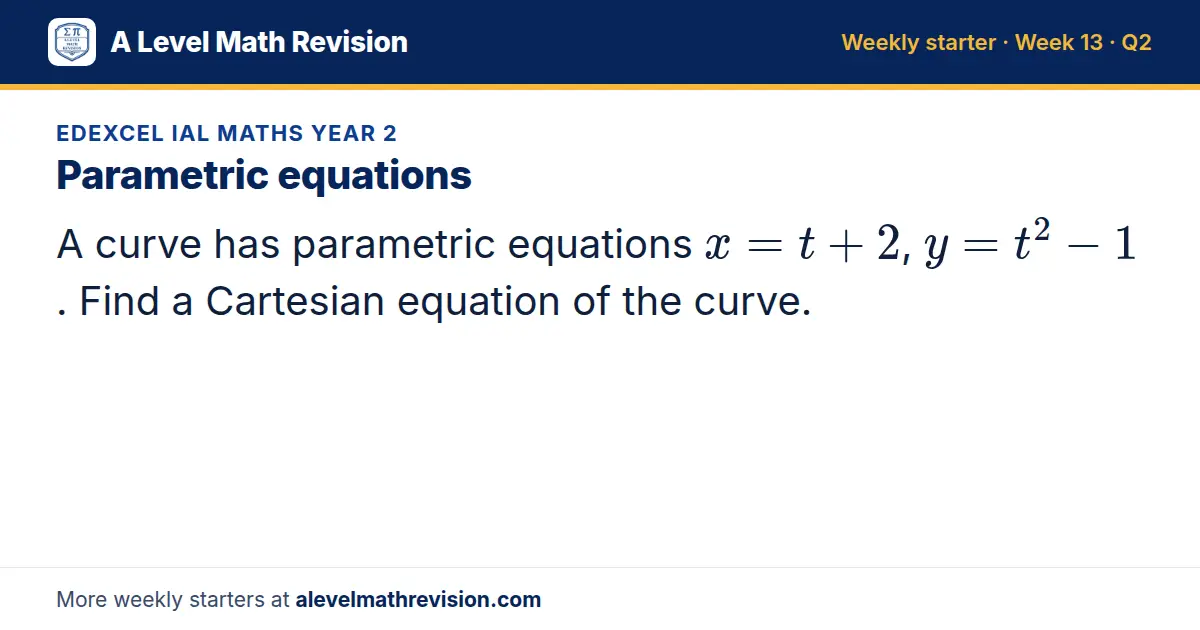
Question 2: Parametric equations
A curve has parametric equations x = t + 2, y = t² - 1. Find a Cartesian equation of the curve.
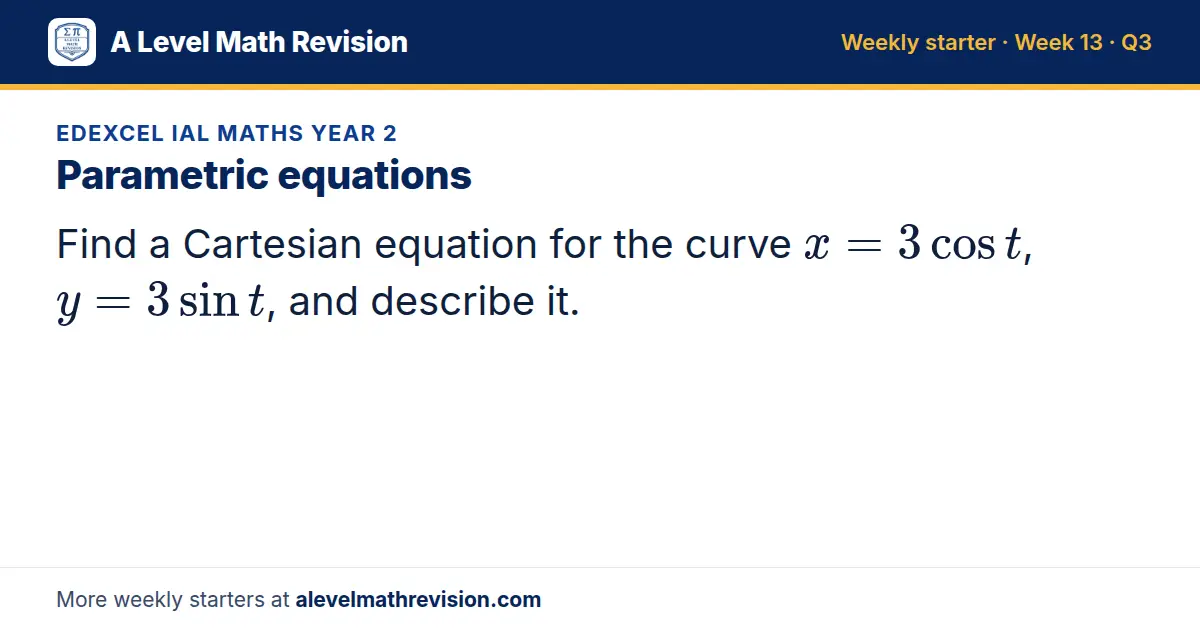
Question 3: Parametric equations
Find a Cartesian equation for the curve x = 3cos t, y = 3sin t, and describe it.
More starter questions
Other weeks: Weeks 1–13 · Weeks 14–26 · Weeks 27–40. Answers and mark schemes are in the starter tasks for teachers.