Edexcel IAL Maths Year 2 starter questions: weeks 27–40
42 short questions to open a lesson for Edexcel International A Level Maths Year 2, weeks 27–40 of the teaching year, three or four a week. Each question is shown as an image with its text underneath; answers and mark schemes stay with teachers.
Week 27
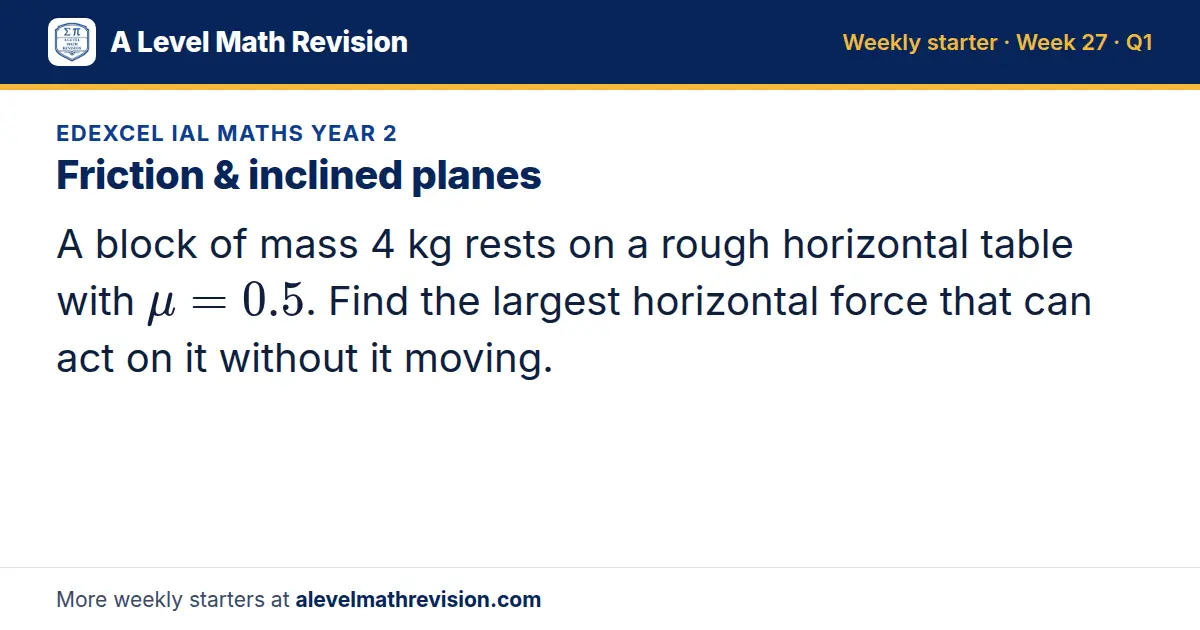
Question 1: Friction & inclined planes
A block of mass 4 kg rests on a rough horizontal table with μ = 0.5. Find the largest horizontal force that can act on it without it moving.
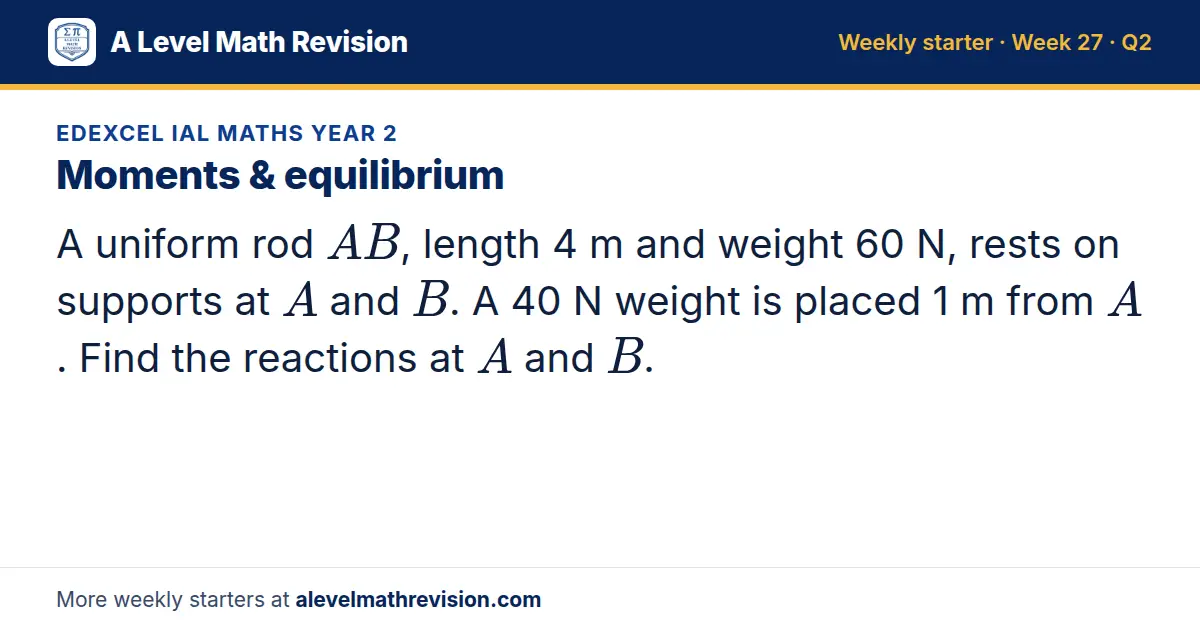
Question 2: Moments & equilibrium
A uniform rod AB, length 4 m and weight 60 N, rests on supports at A and B. A 40 N weight is placed 1 m from A. Find the reactions at A and B.
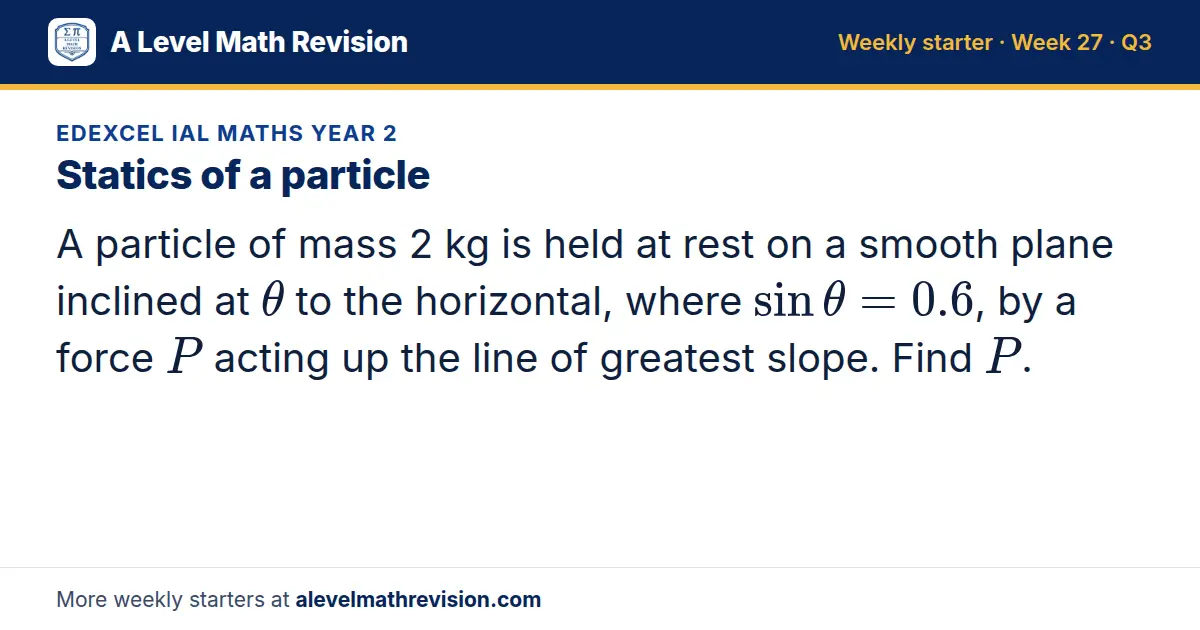
Question 3: Statics of a particle
A particle of mass 2 kg is held at rest on a smooth plane inclined at θ to the horizontal, where sinθ = 0.6, by a force P acting up the line of greatest slope. Find P.
Week 28
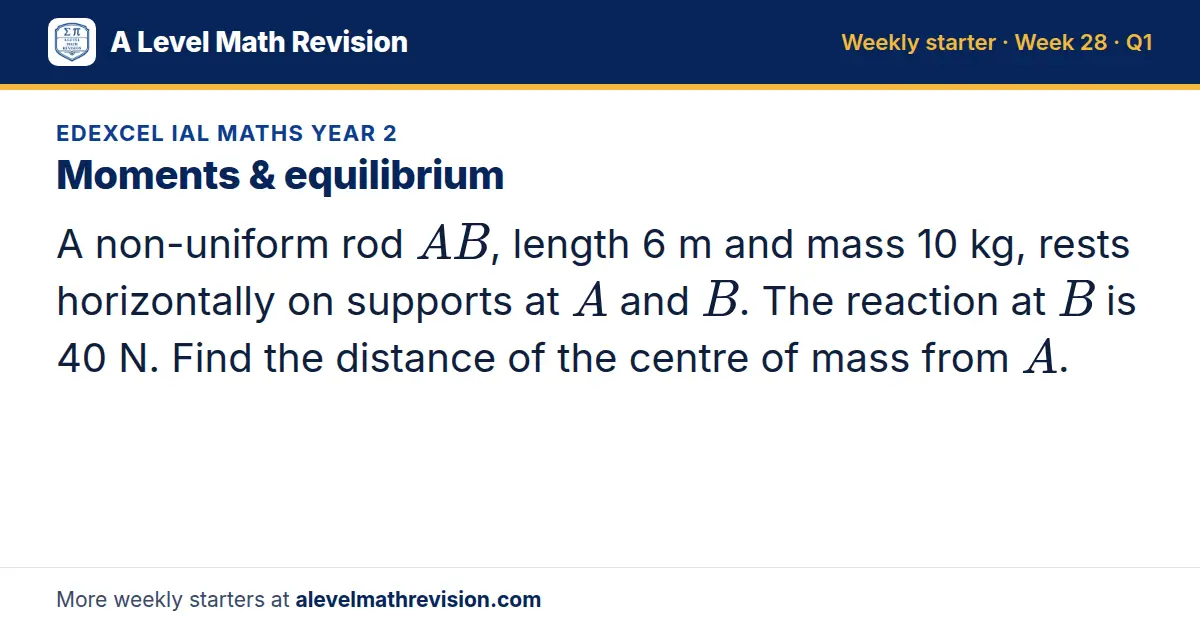
Question 1: Moments & equilibrium
A non-uniform rod AB, length 6 m and mass 10 kg, rests horizontally on supports at A and B. The reaction at B is 40 N. Find the distance of the centre of mass from A.
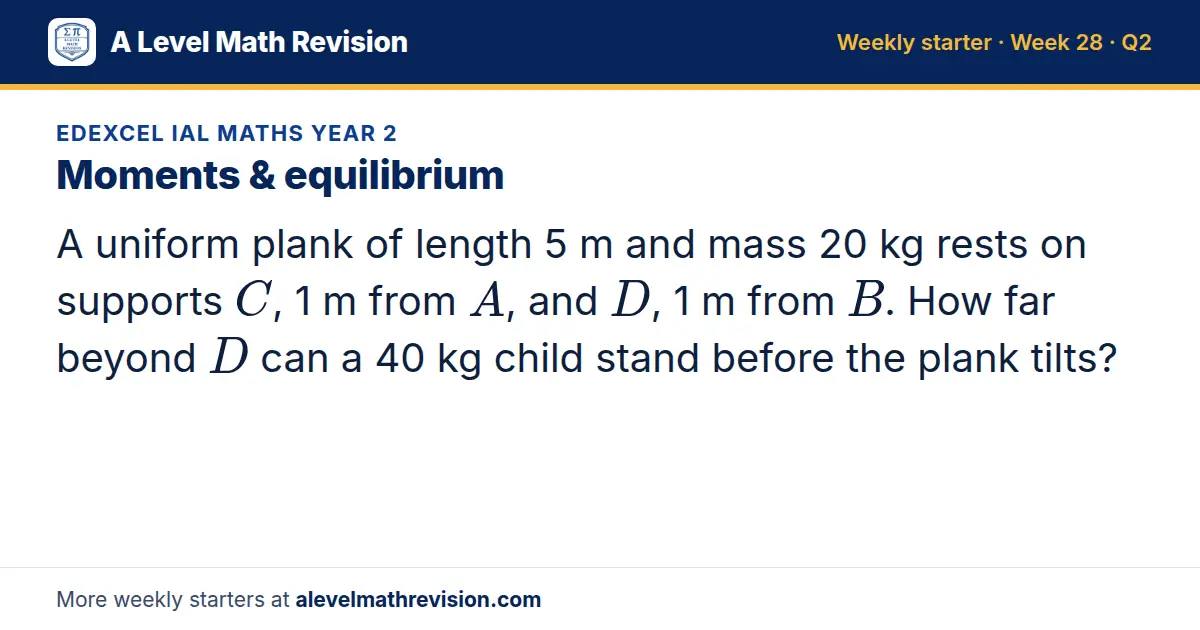
Question 2: Moments & equilibrium
A uniform plank of length 5 m and mass 20 kg rests on supports C, 1 m from A, and D, 1 m from B. How far beyond D can a 40 kg child stand before the plank tilts?
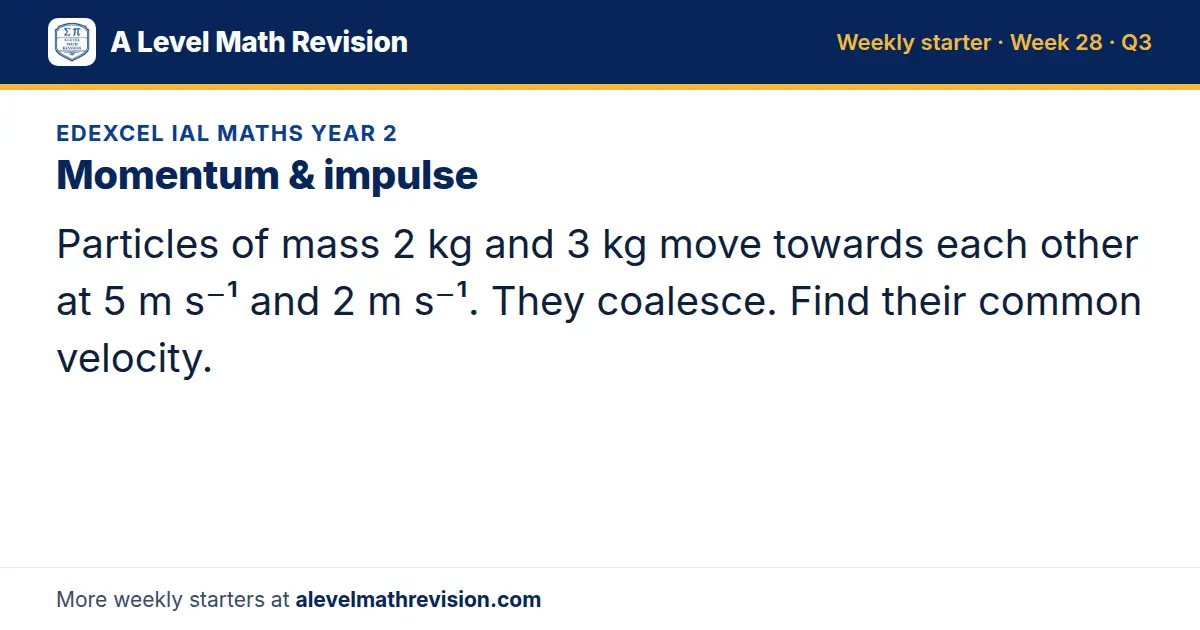
Question 3: Momentum & impulse
Particles of mass 2 kg and 3 kg move towards each other at 5 m s⁻¹ and 2 m s⁻¹. They coalesce. Find their common velocity.
Week 29
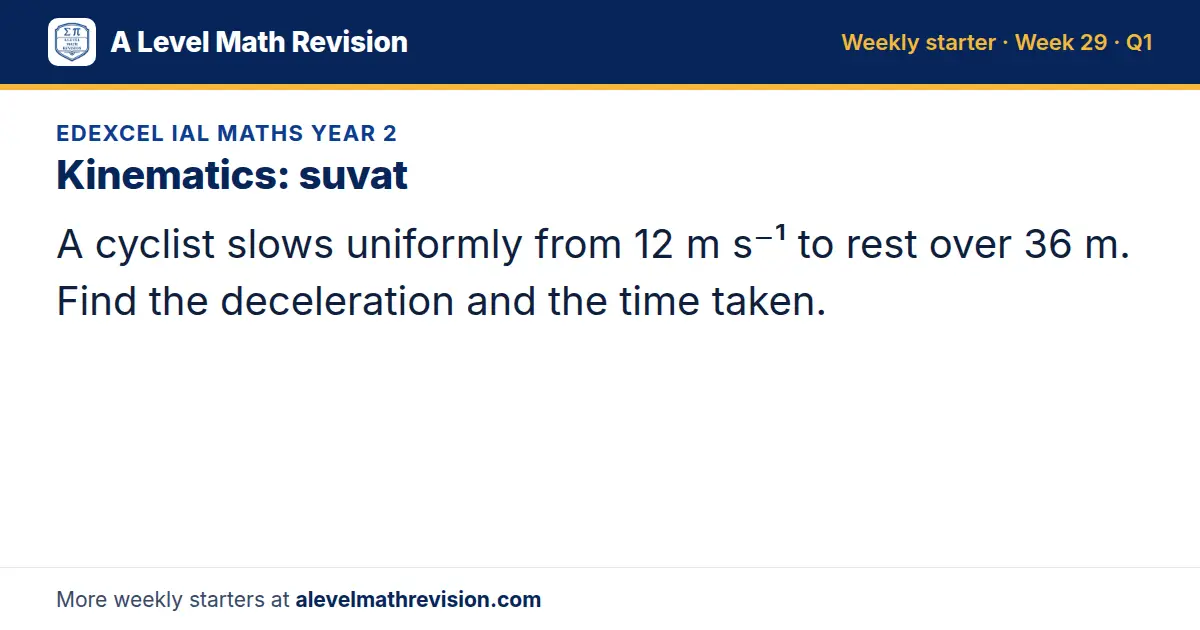
Question 1: Kinematics: suvat
A cyclist slows uniformly from 12 m s⁻¹ to rest over 36 m. Find the deceleration and the time taken.
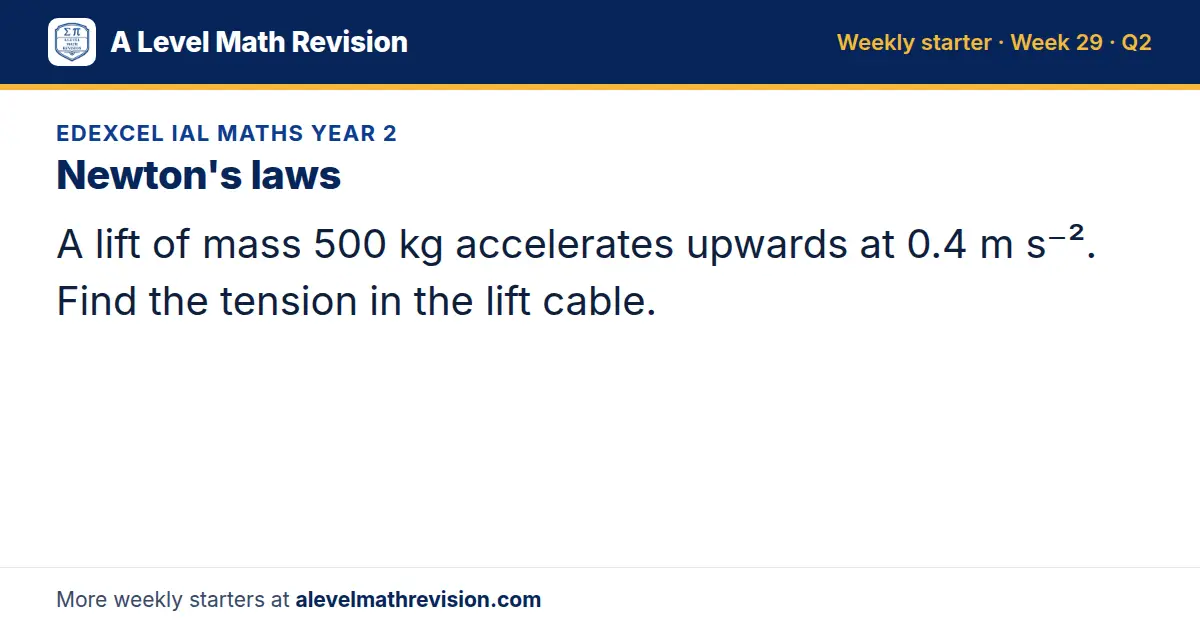
Question 2: Newton's laws
A lift of mass 500 kg accelerates upwards at 0.4 m s⁻². Find the tension in the lift cable.
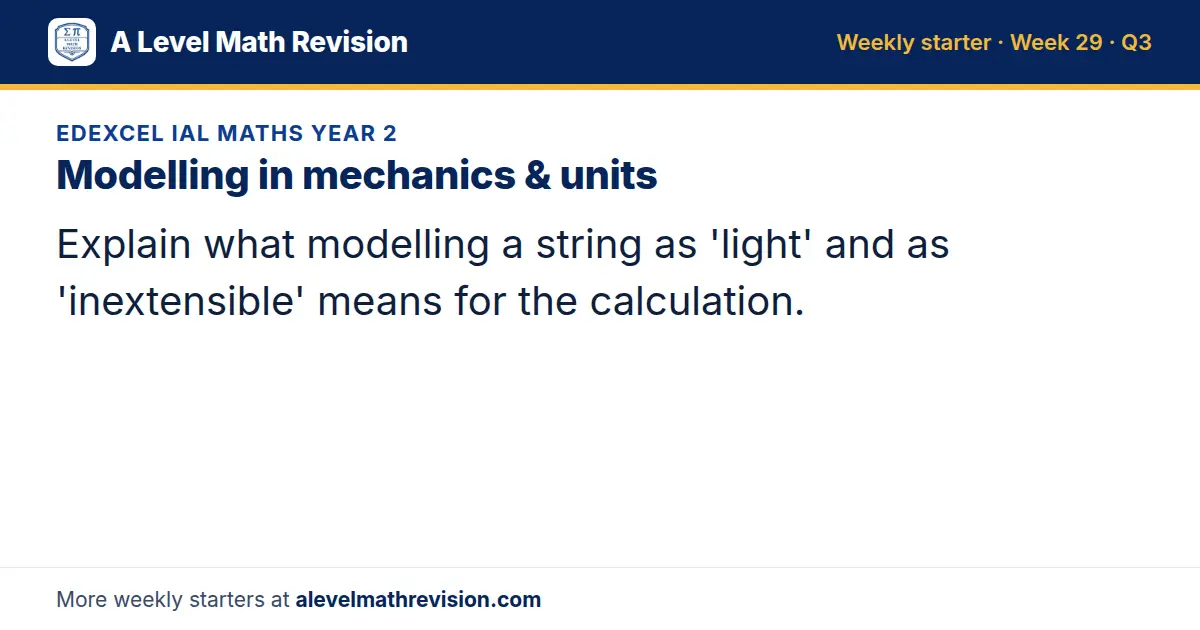
Question 3: Modelling in mechanics & units
Explain what modelling a string as 'light' and as 'inextensible' means for the calculation.
Week 30
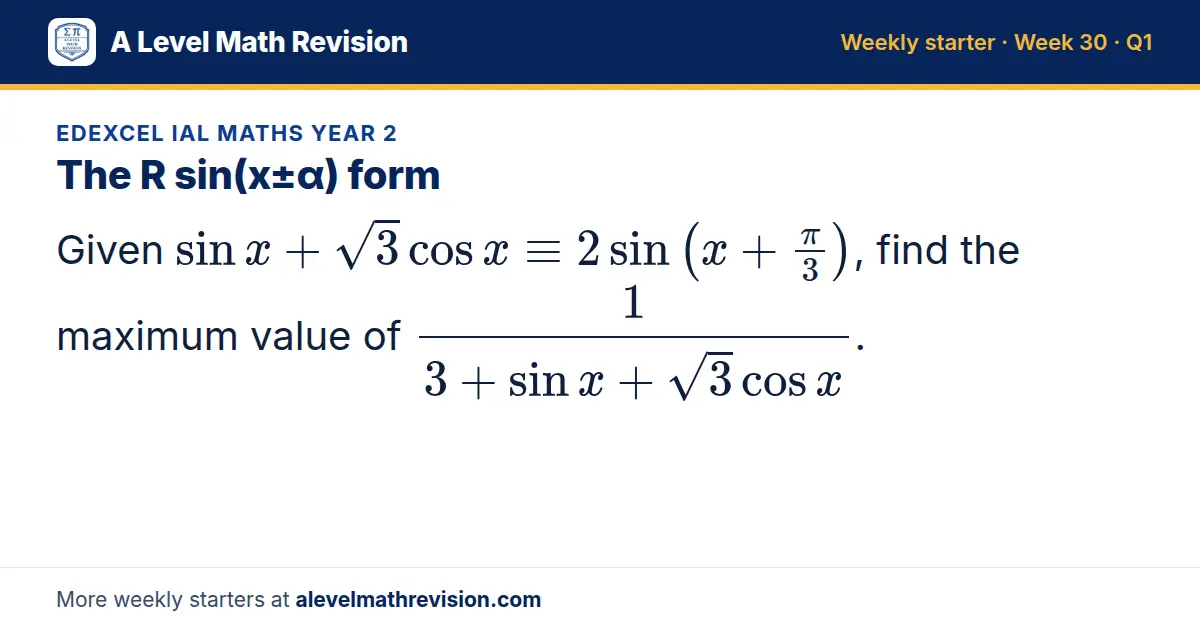
Question 1: The R sin(x±α) form
Given sin x + √3cos x ≡ 2sin(x + (π)/3), find the maximum value of 1/(3 + sin x + √3cos x).
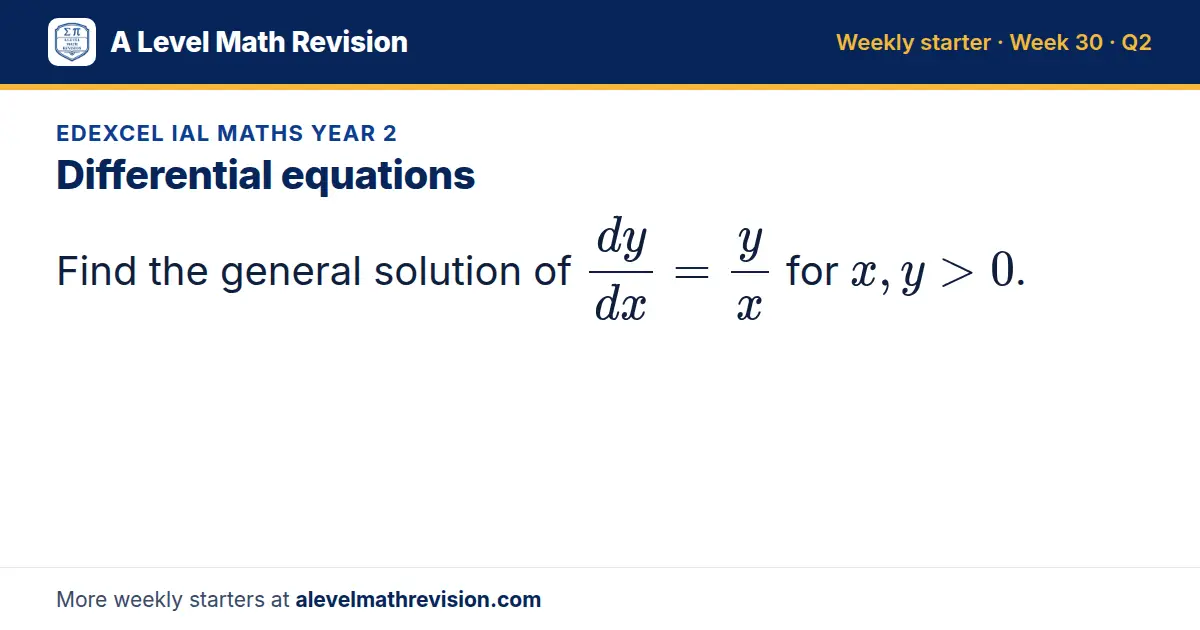
Question 2: Differential equations
Find the general solution of dy/dx = y/x for x, y > 0.
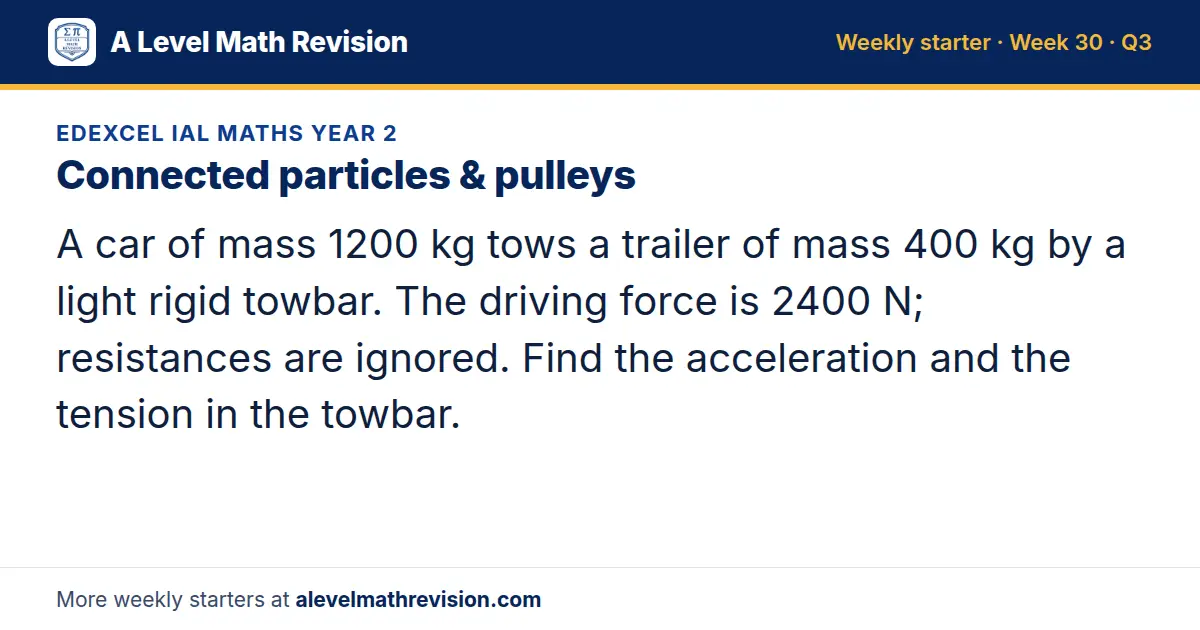
Question 3: Connected particles & pulleys
A car of mass 1200 kg tows a trailer of mass 400 kg by a light rigid towbar. The driving force is 2400 N; resistances are ignored. Find the acceleration and the tension in the towbar.
Week 31
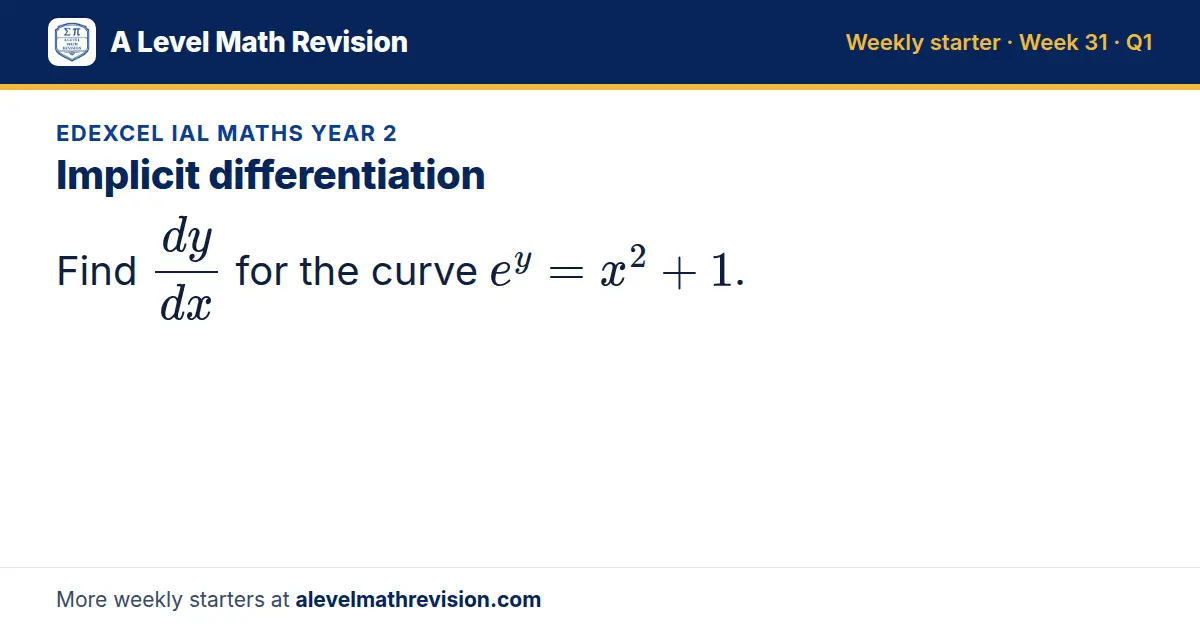
Question 1: Implicit differentiation
Find dy/dx for the curve e^y = x² + 1.
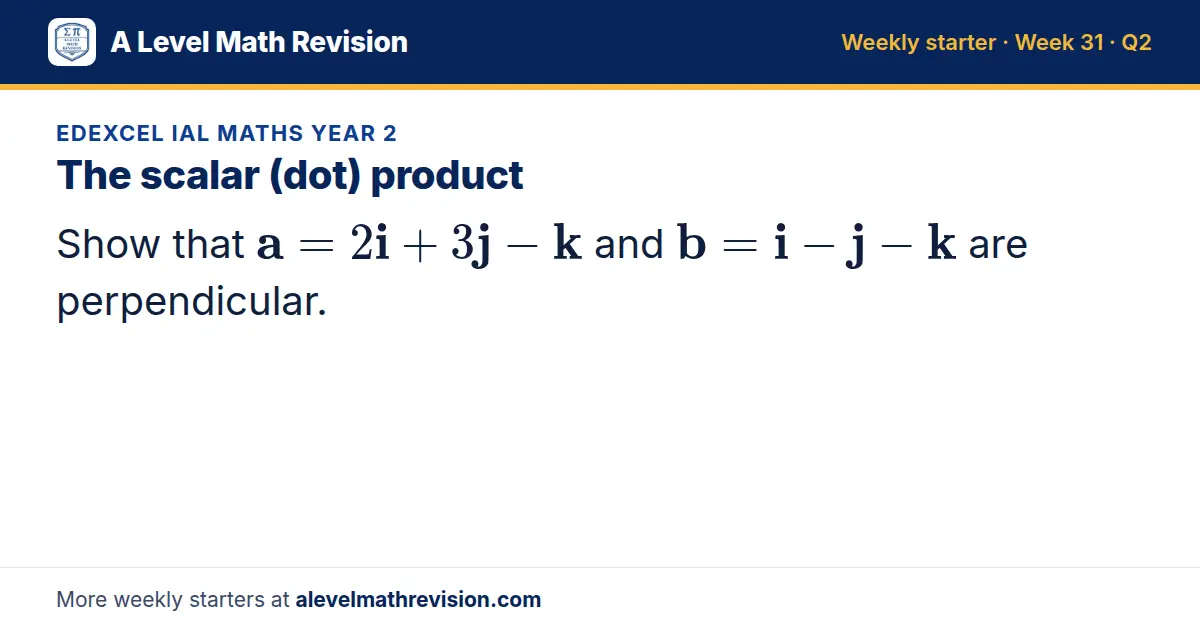
Question 2: The scalar (dot) product
Show that a = 2i + 3j - k and b = i - j - k are perpendicular.
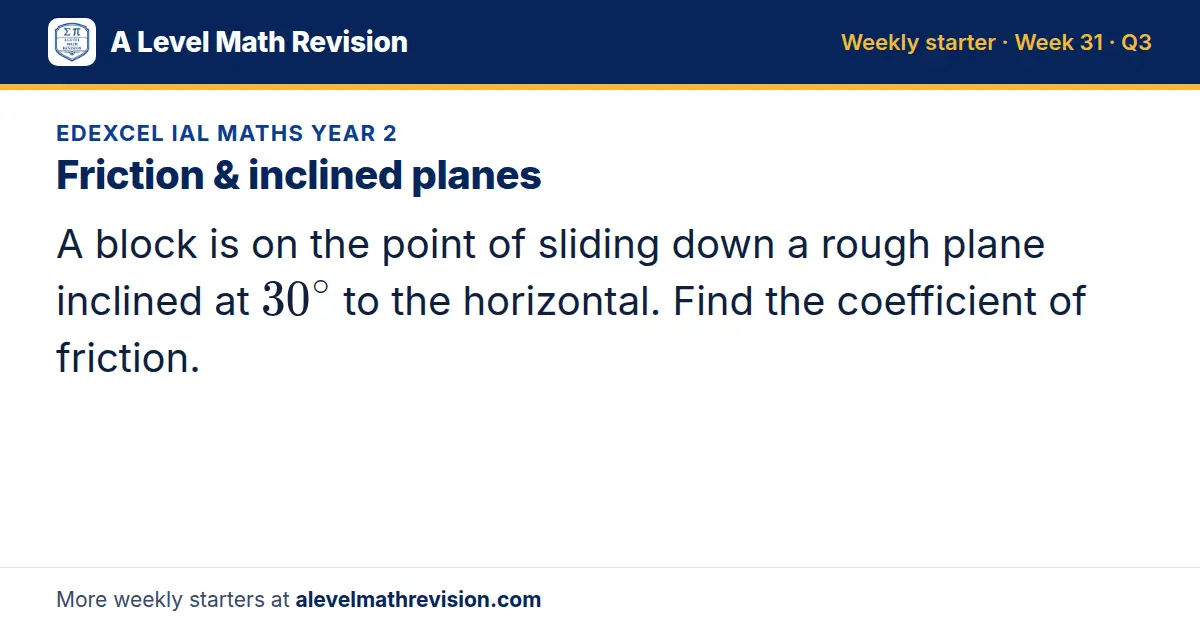
Question 3: Friction & inclined planes
A block is on the point of sliding down a rough plane inclined at 30^∘ to the horizontal. Find the coefficient of friction.
Week 32
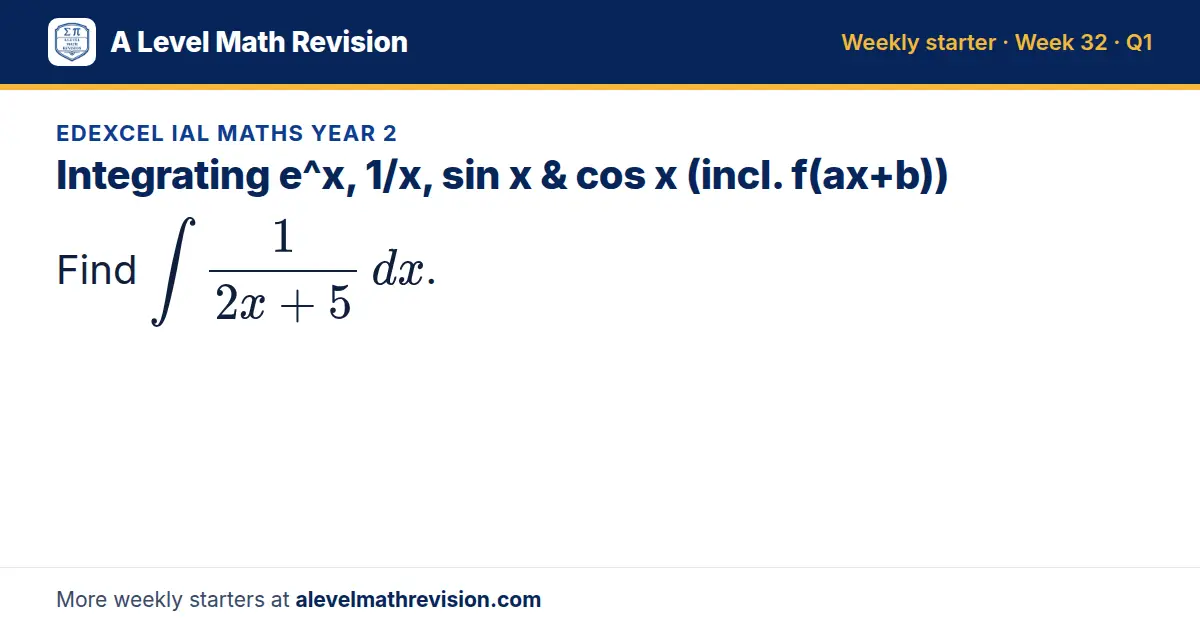
Question 1: Integrating e^x, 1/x, sin x & cos x (incl. f(ax+b))
Find ∫ 1/(2x + 5) dx.
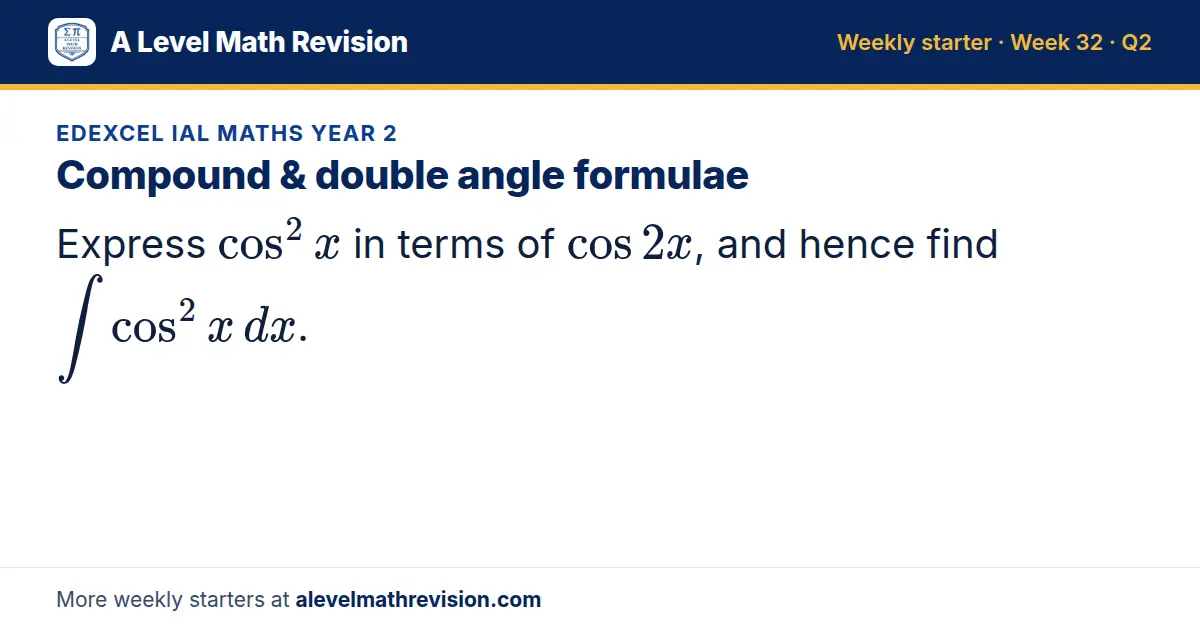
Question 2: Compound & double angle formulae
Express cos² x in terms of cos 2x, and hence find ∫ cos² x dx.
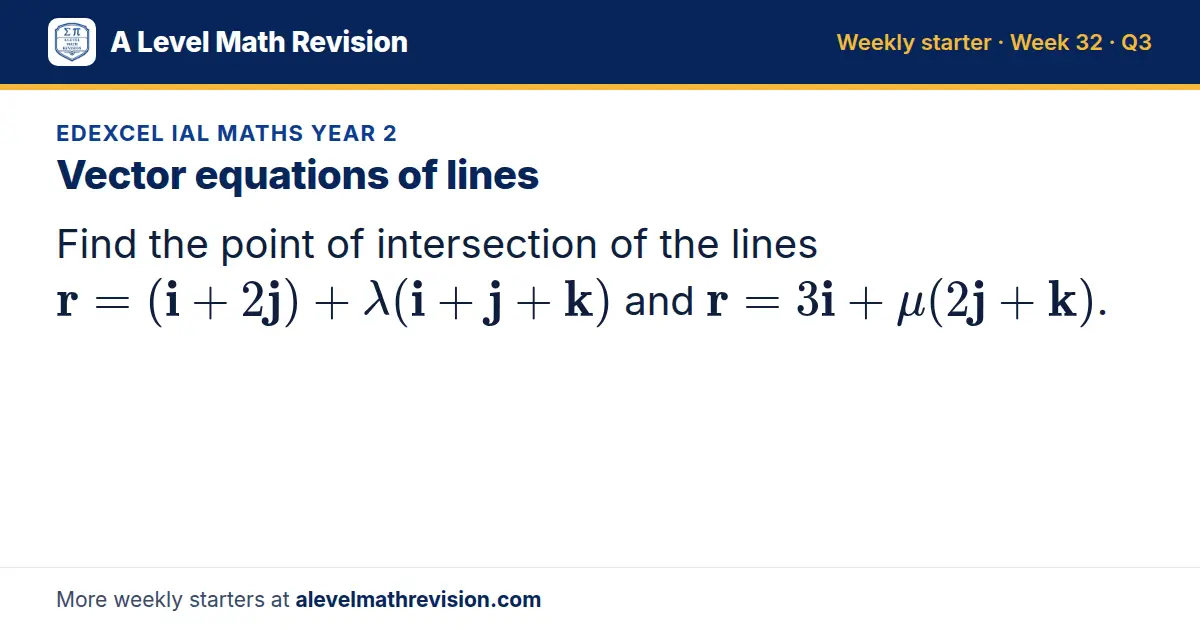
Question 3: Vector equations of lines
Find the point of intersection of the lines r = (i + 2j) + λ(i + j + k) and r = 3i + μ(2j + k).
Week 33
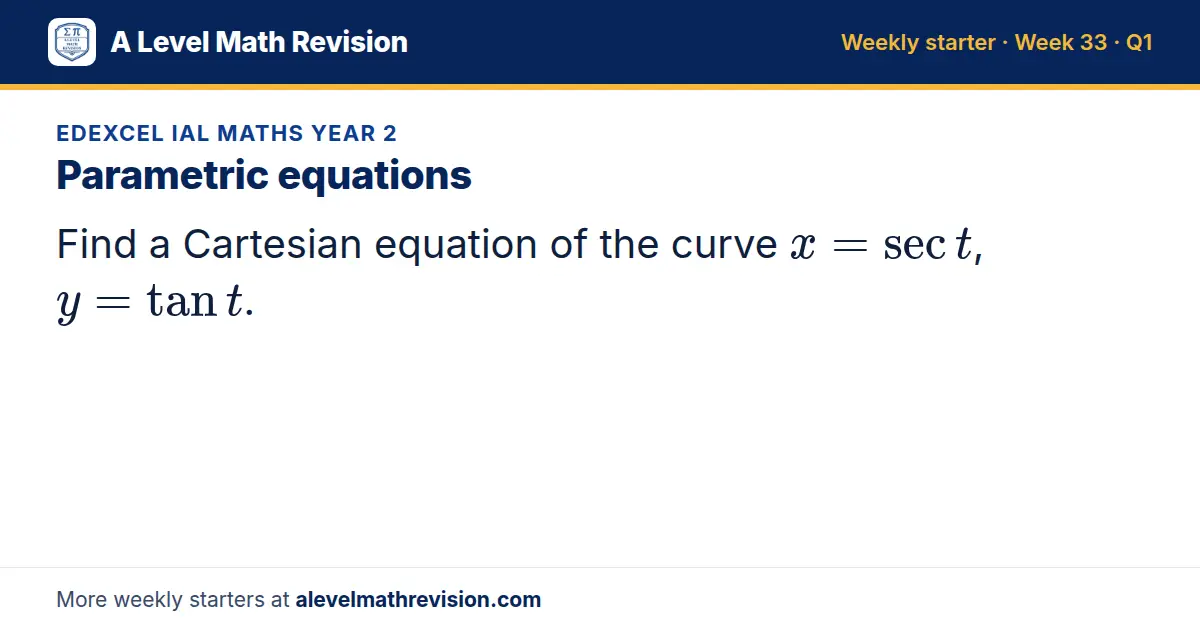
Question 1: Parametric equations
Find a Cartesian equation of the curve x = sec t, y = tan t.
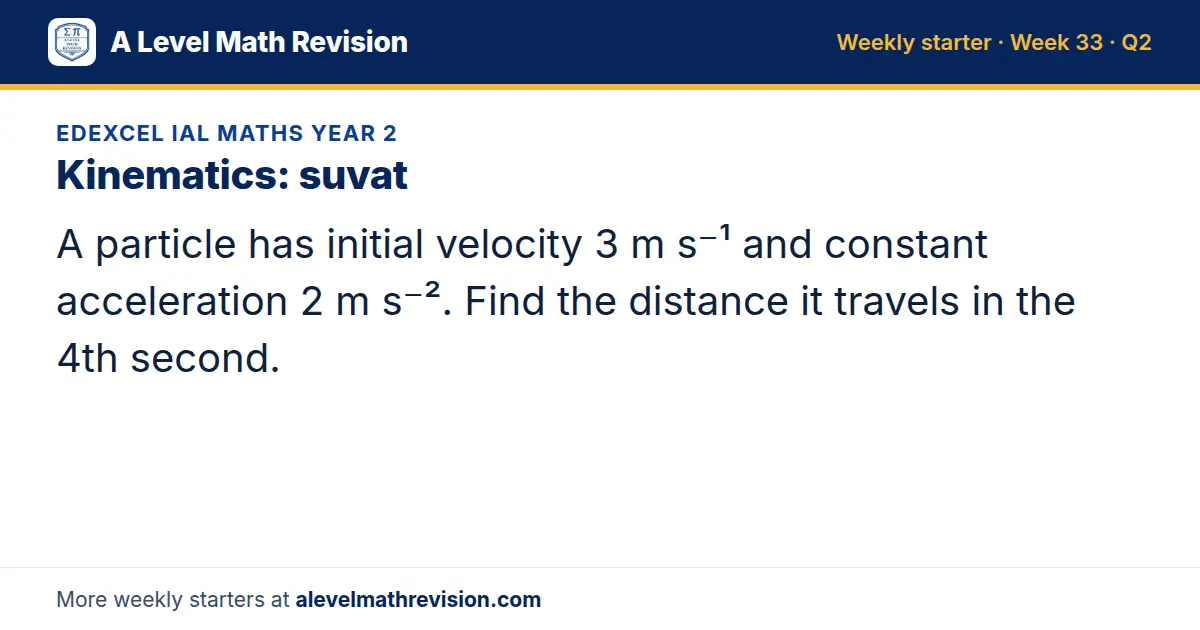
Question 2: Kinematics: suvat
A particle has initial velocity 3 m s⁻¹ and constant acceleration 2 m s⁻². Find the distance it travels in the 4th second.
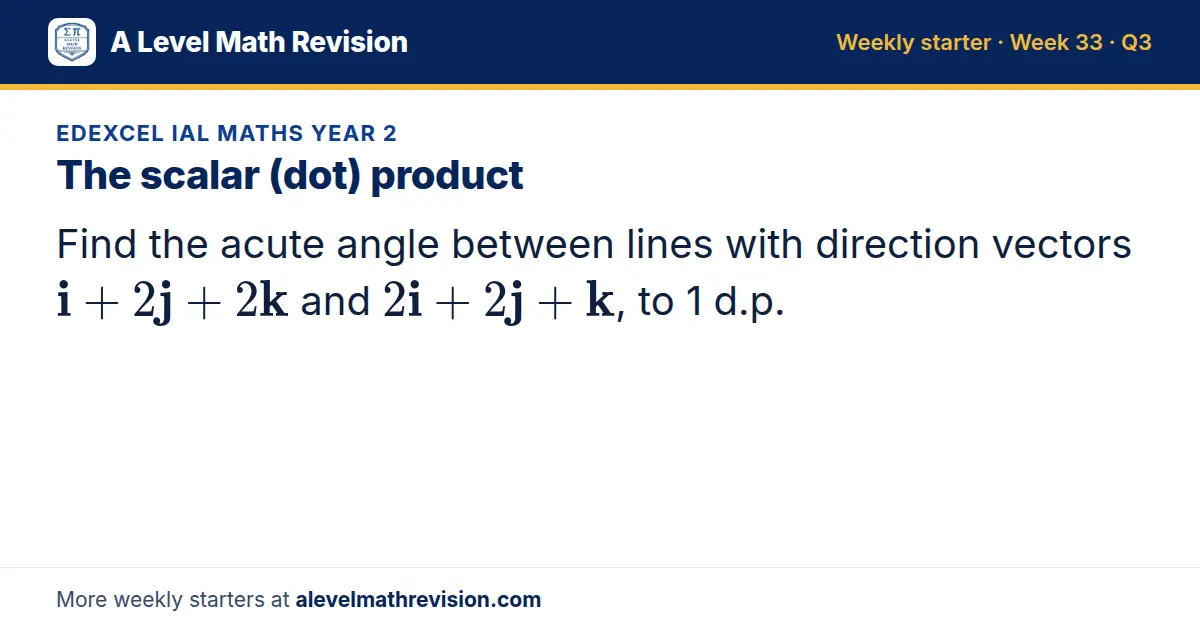
Question 3: The scalar (dot) product
Find the acute angle between lines with direction vectors i + 2j + 2k and 2i + 2j + k, to 1 d.p.
Week 34
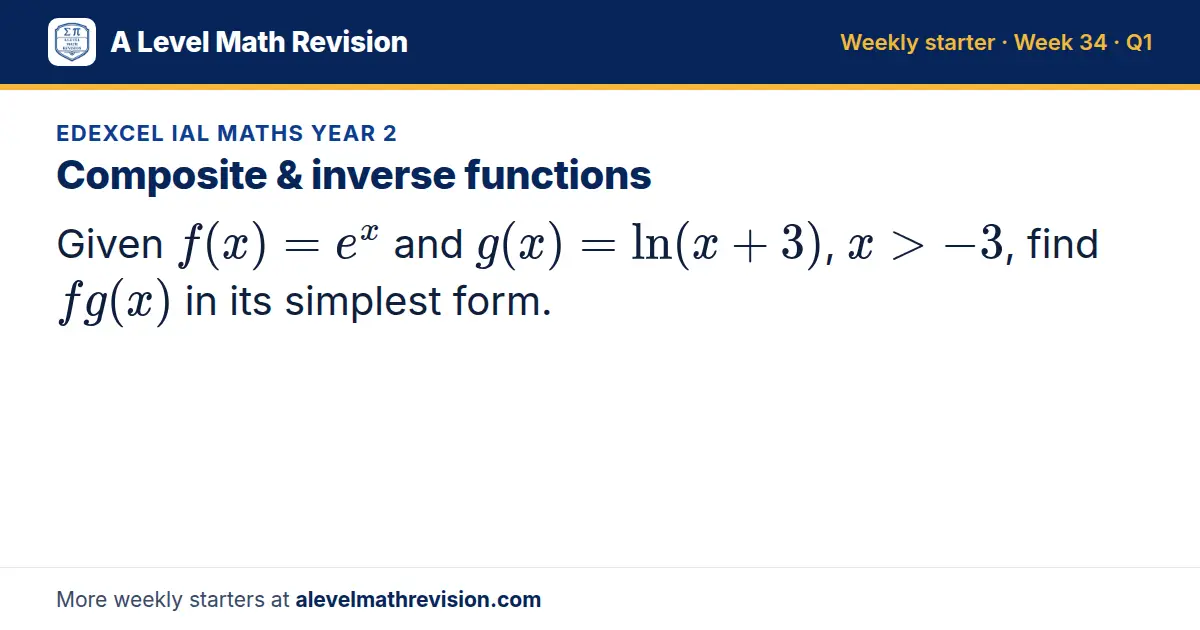
Question 1: Composite & inverse functions
Given f(x) = e^x and g(x) = ln(x + 3), x > -3, find fg(x) in its simplest form.
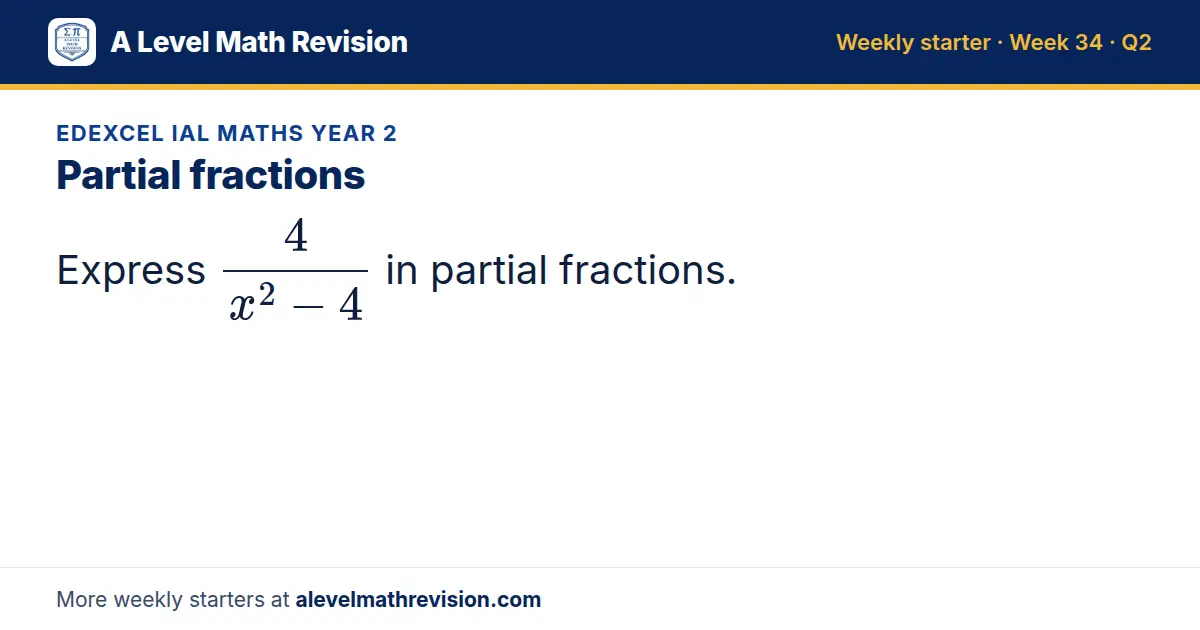
Question 2: Partial fractions
Express 4/(x² - 4) in partial fractions.
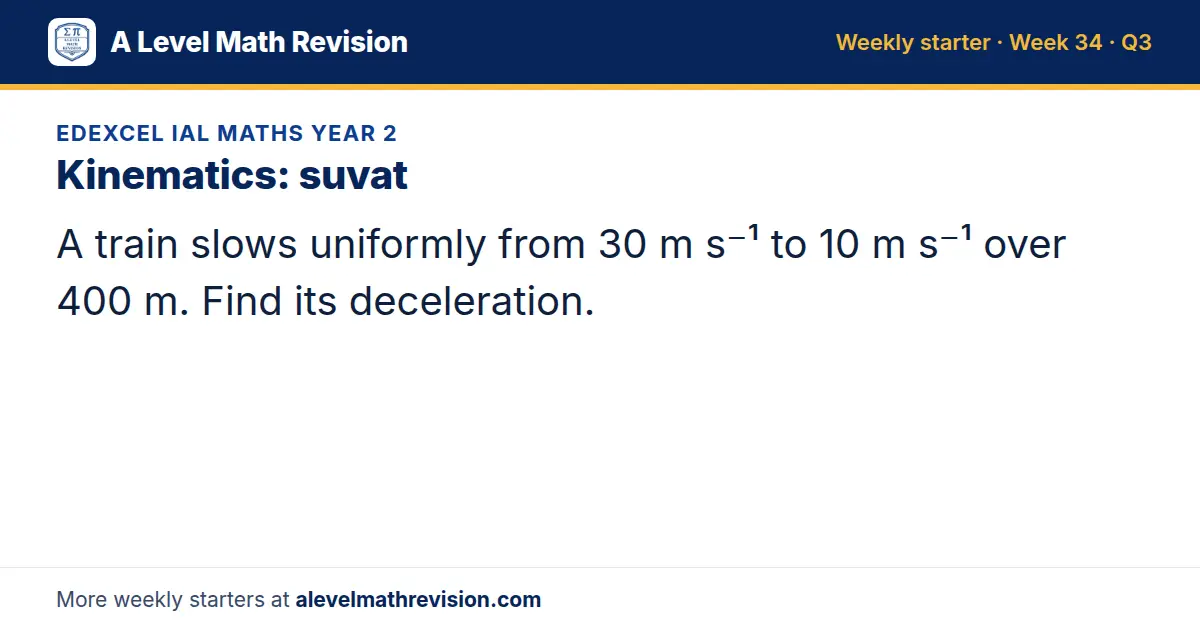
Question 3: Kinematics: suvat
A train slows uniformly from 30 m s⁻¹ to 10 m s⁻¹ over 400 m. Find its deceleration.
Week 35
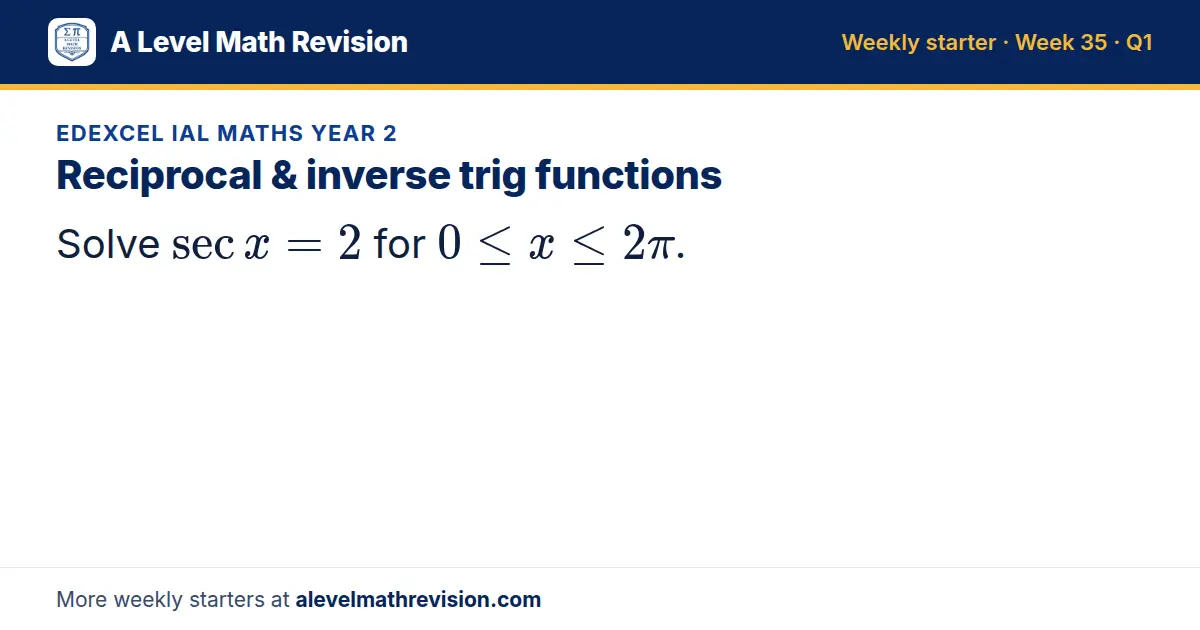
Question 1: Reciprocal & inverse trig functions
Solve sec x = 2 for 0 ≤ x ≤ 2π.
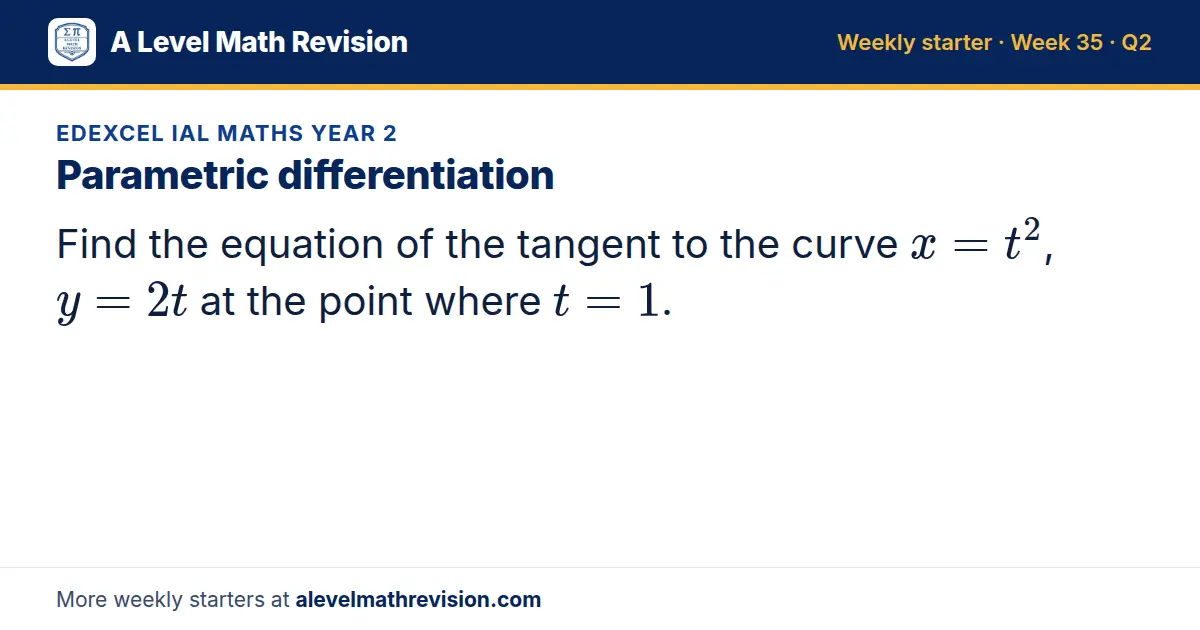
Question 2: Parametric differentiation
Find the equation of the tangent to the curve x = t², y = 2t at the point where t = 1.
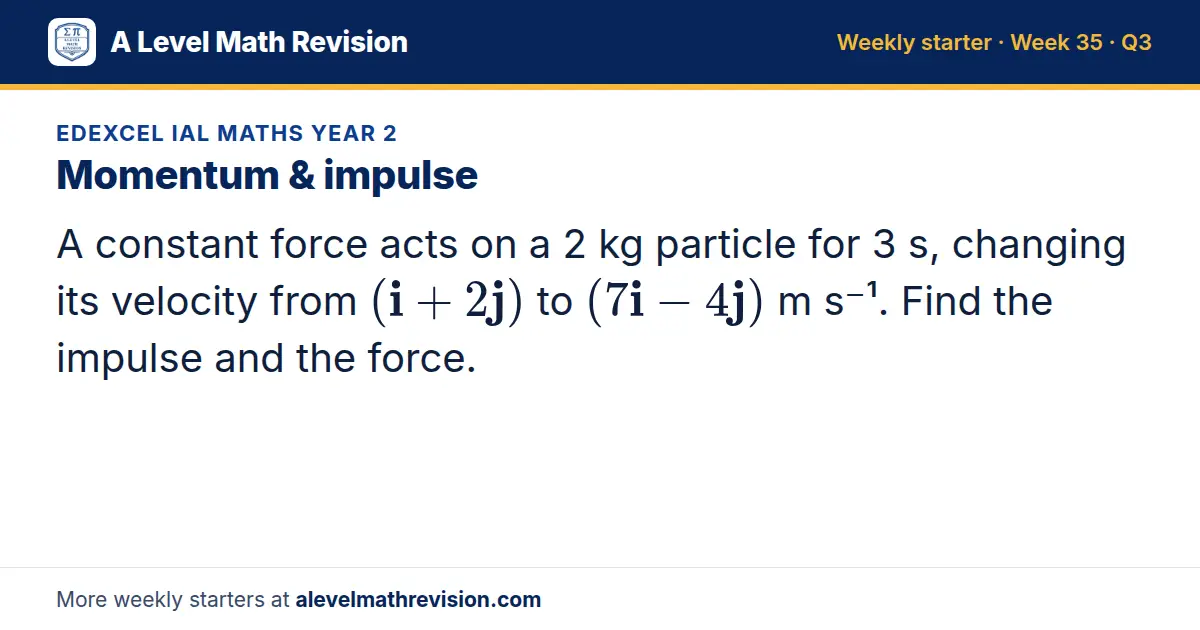
Question 3: Momentum & impulse
A constant force acts on a 2 kg particle for 3 s, changing its velocity from (i + 2j) to (7i - 4j) m s⁻¹. Find the impulse and the force.
Week 36
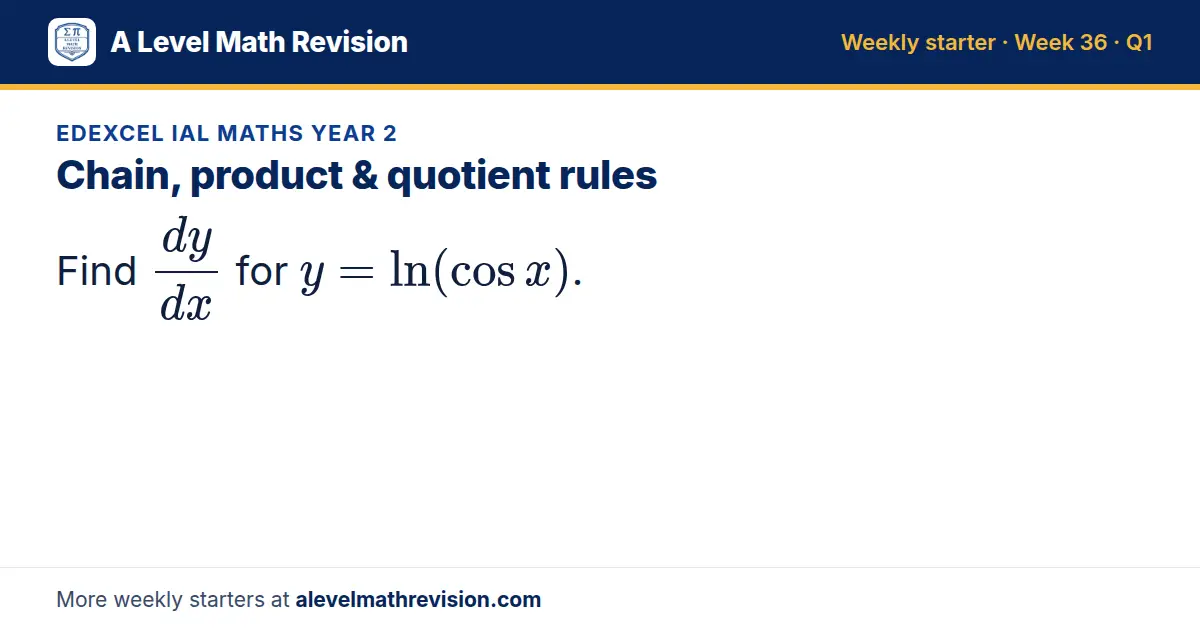
Question 1: Chain, product & quotient rules
Find dy/dx for y = ln(cos x).
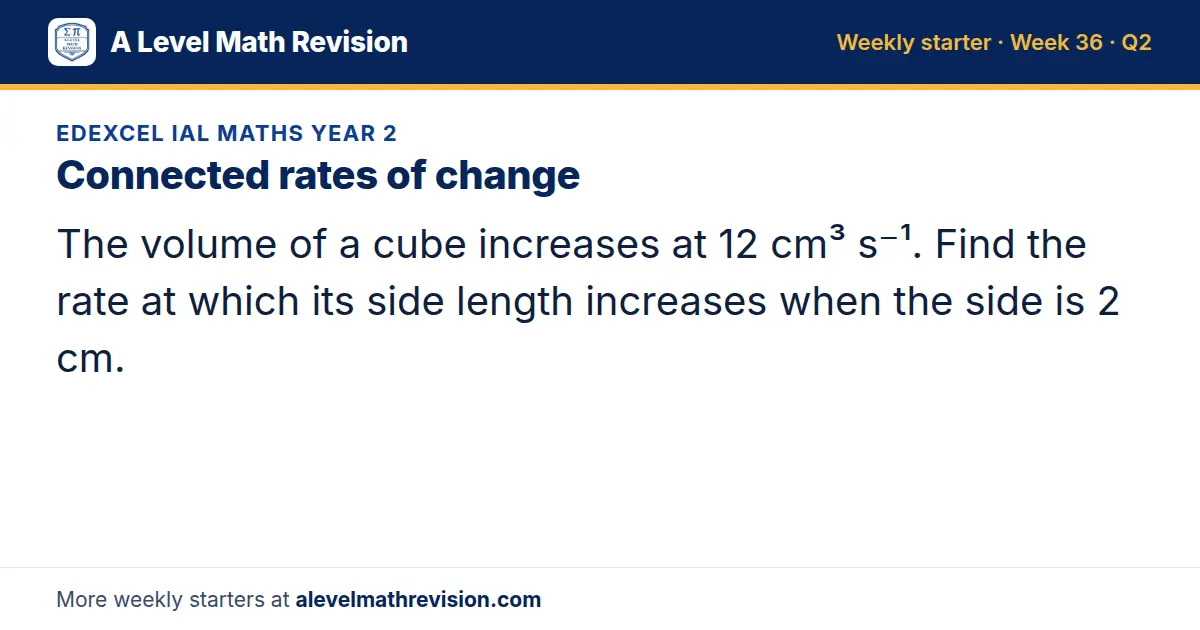
Question 2: Connected rates of change
The volume of a cube increases at 12 cm³ s⁻¹. Find the rate at which its side length increases when the side is 2 cm.
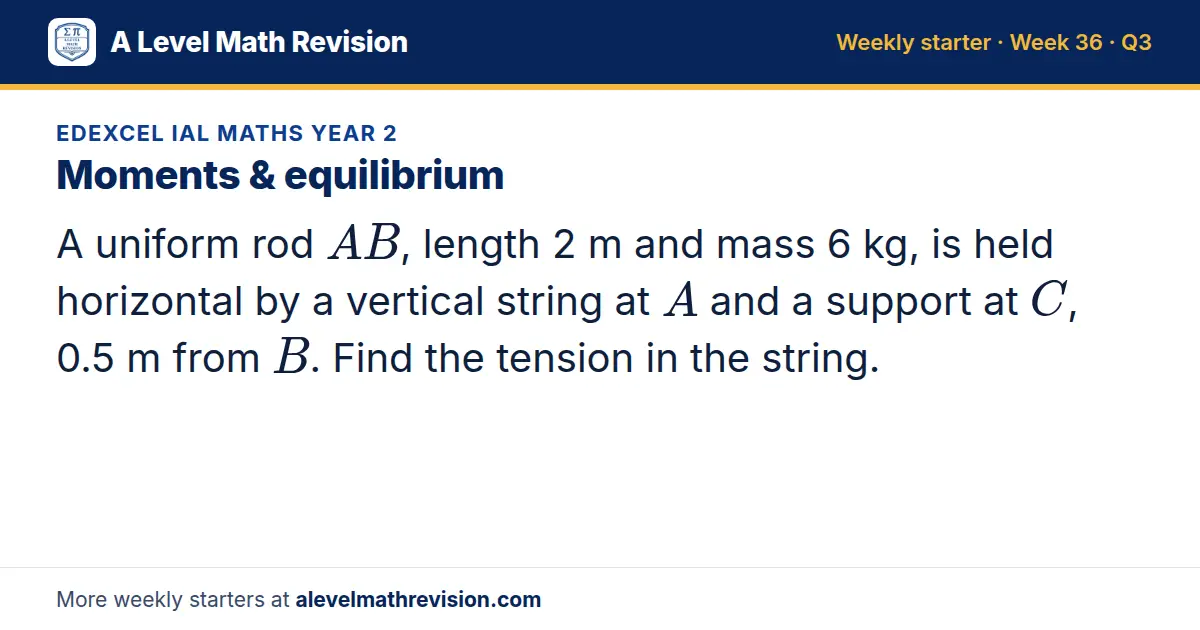
Question 3: Moments & equilibrium
A uniform rod AB, length 2 m and mass 6 kg, is held horizontal by a vertical string at A and a support at C, 0.5 m from B. Find the tension in the string.
Week 37
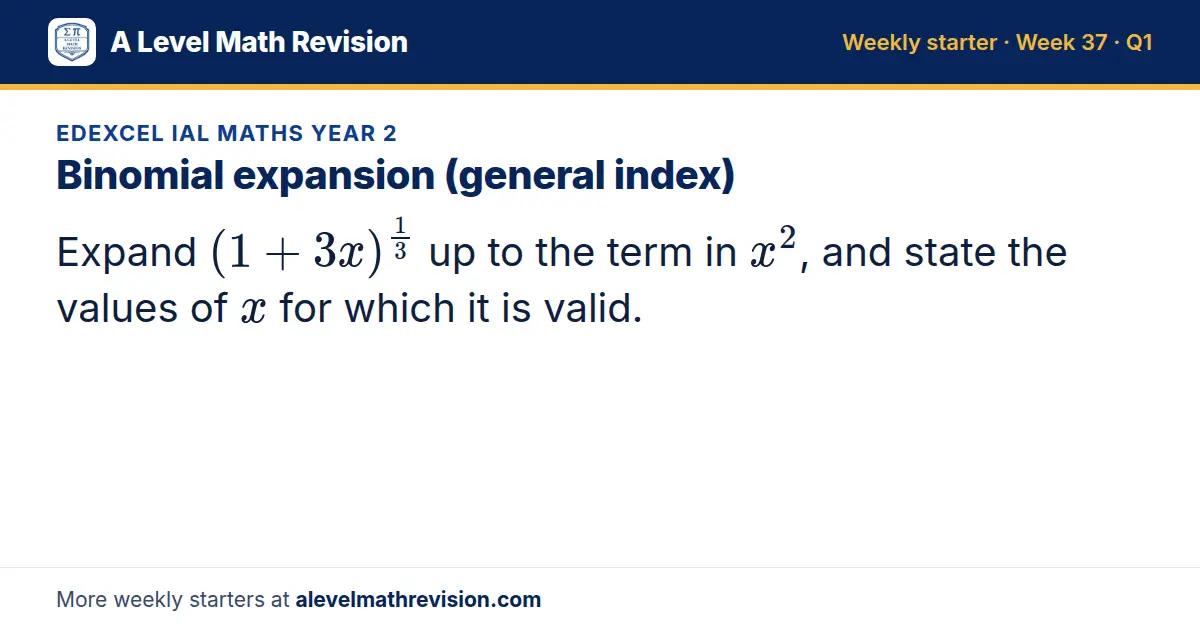
Question 1: Binomial expansion (general index)
Expand (1 + 3x)^(1/3) up to the term in x², and state the values of x for which it is valid.
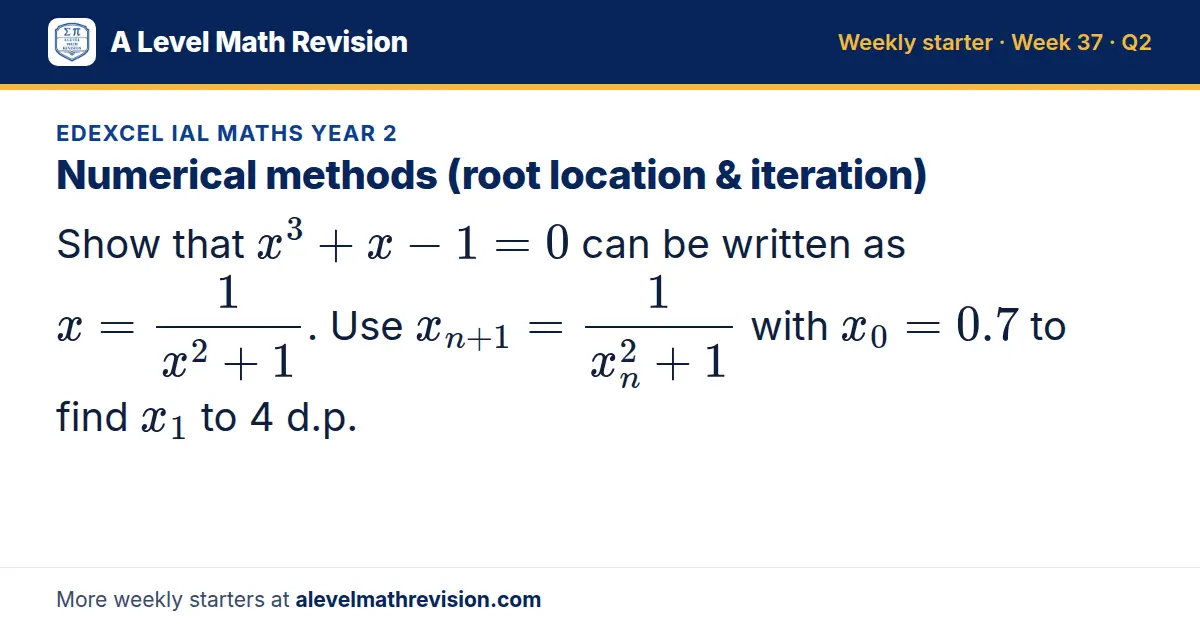
Question 2: Numerical methods (root location & iteration)
Show that x³ + x - 1 = 0 can be written as x = 1/(x² + 1). Use x_n+1 = 1/(x_n² + 1) with x_0 = 0.7 to find x_1 to 4 d.p.
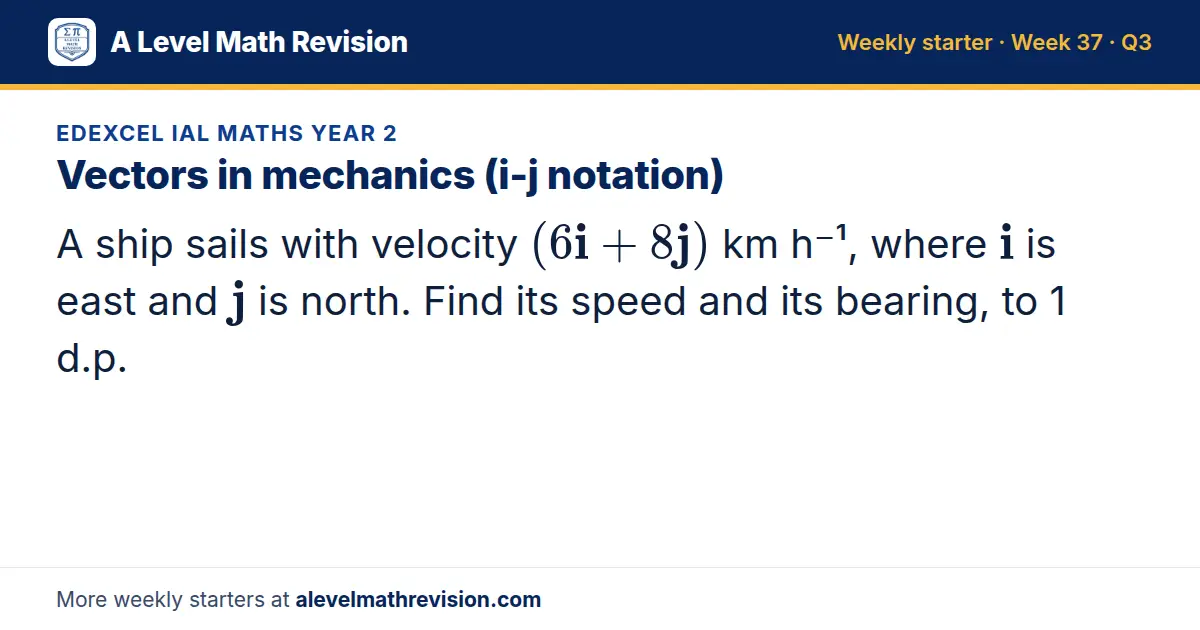
Question 3: Vectors in mechanics (i-j notation)
A ship sails with velocity (6i + 8j) km h⁻¹, where i is east and j is north. Find its speed and its bearing, to 1 d.p.
Week 38
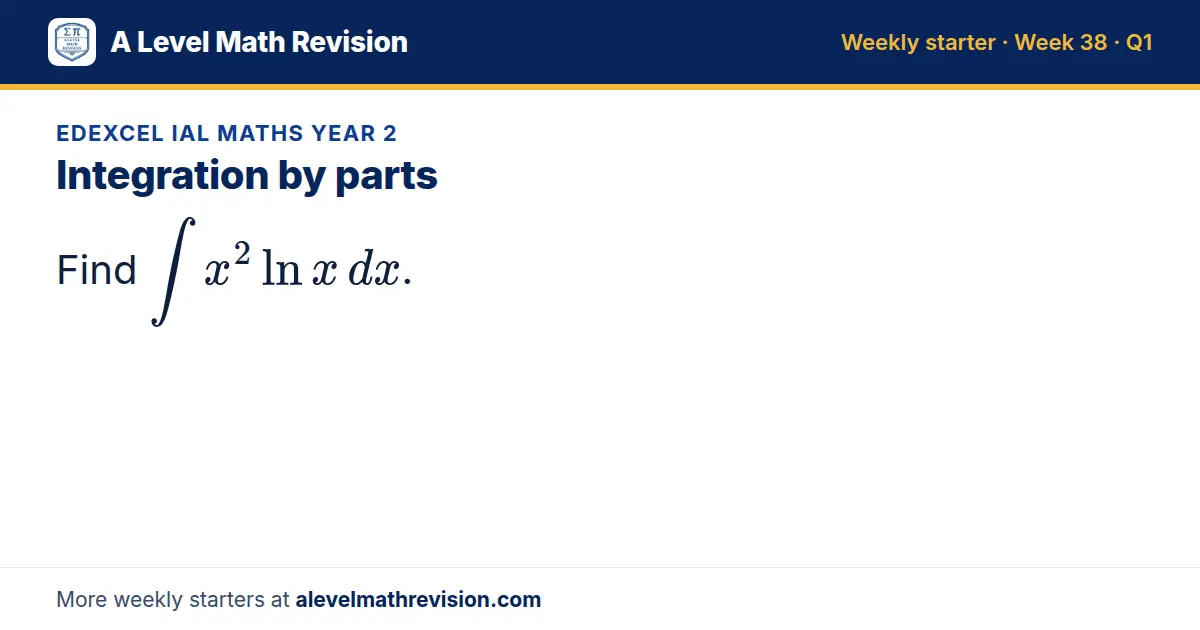
Question 1: Integration by parts
Find ∫ x² ln x dx.
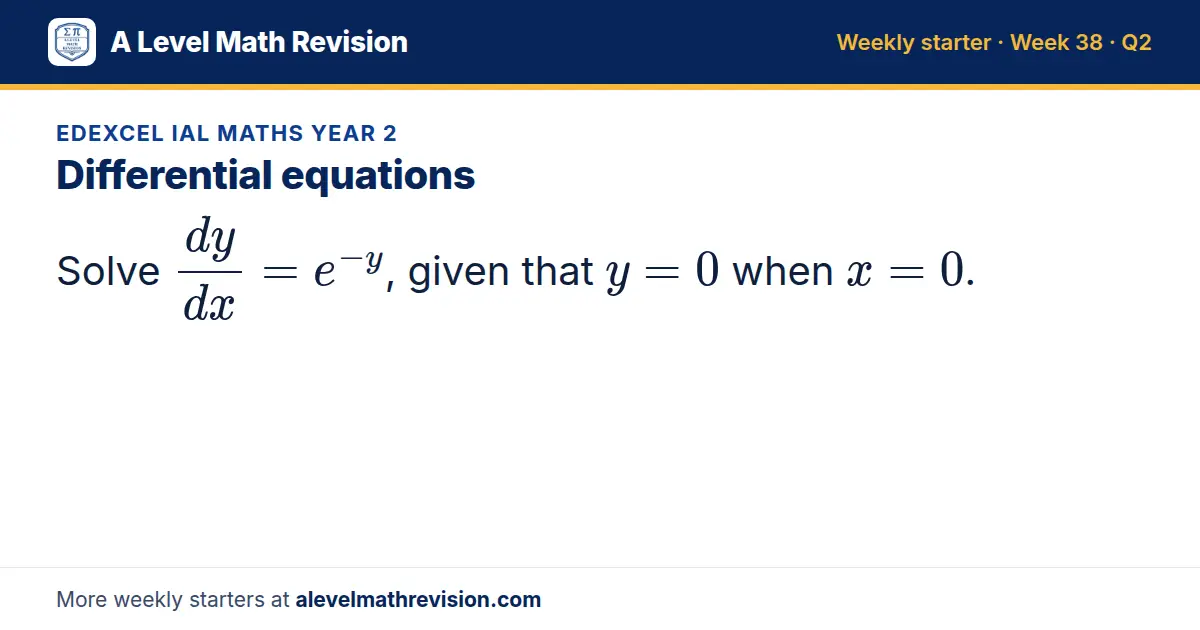
Question 2: Differential equations
Solve dy/dx = e^(-y), given that y = 0 when x = 0.
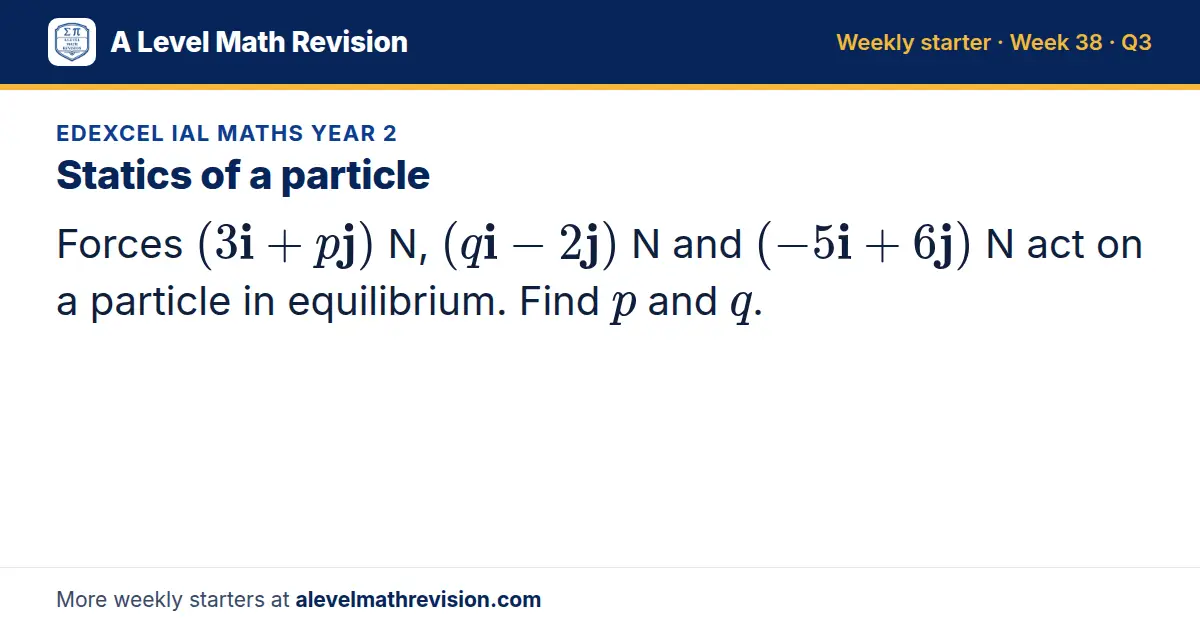
Question 3: Statics of a particle
Forces (3i + pj) N, (qi - 2j) N and (-5i + 6j) N act on a particle in equilibrium. Find p and q.
Week 39
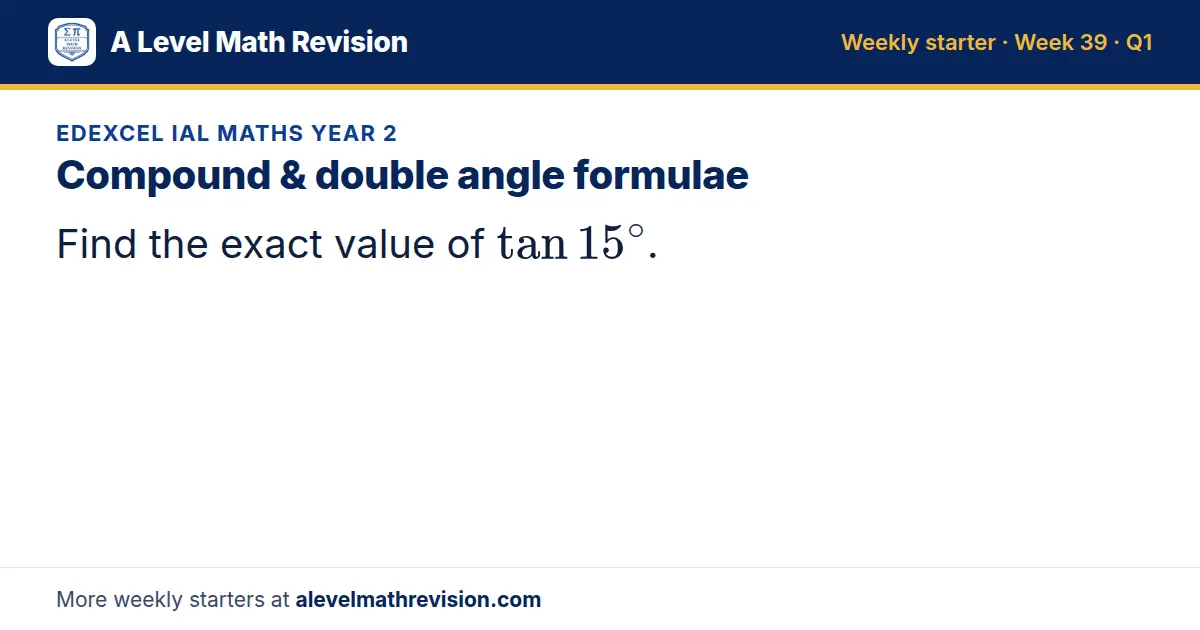
Question 1: Compound & double angle formulae
Find the exact value of tan 15^∘.
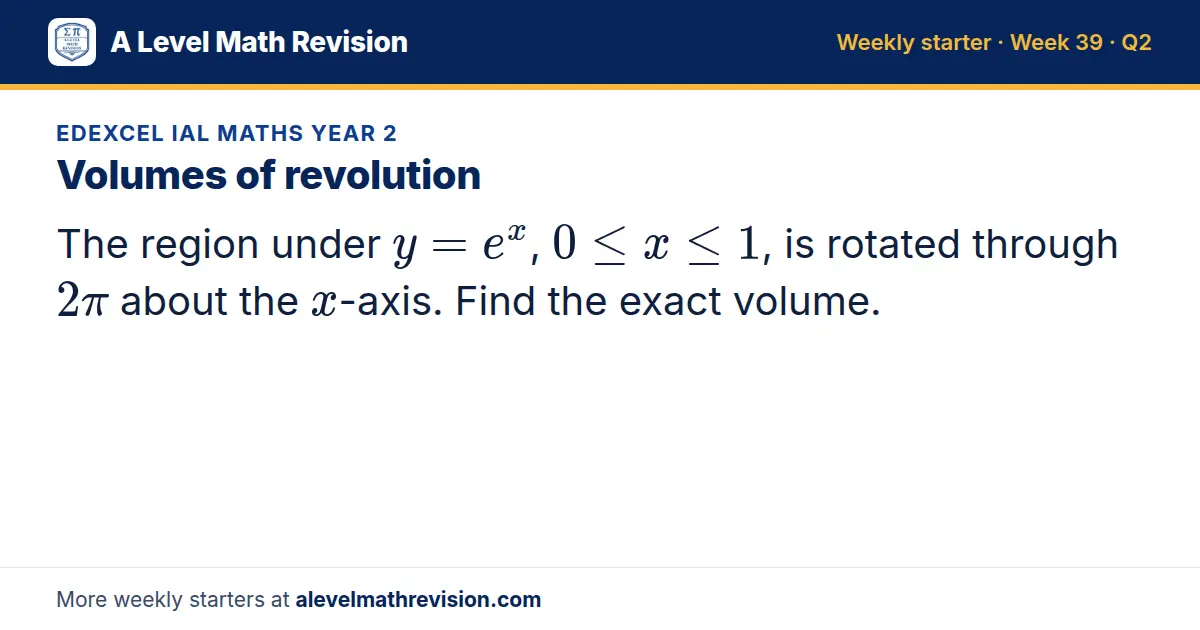
Question 2: Volumes of revolution
The region under y = e^x, 0 ≤ x ≤ 1, is rotated through 2π about the x-axis. Find the exact volume.
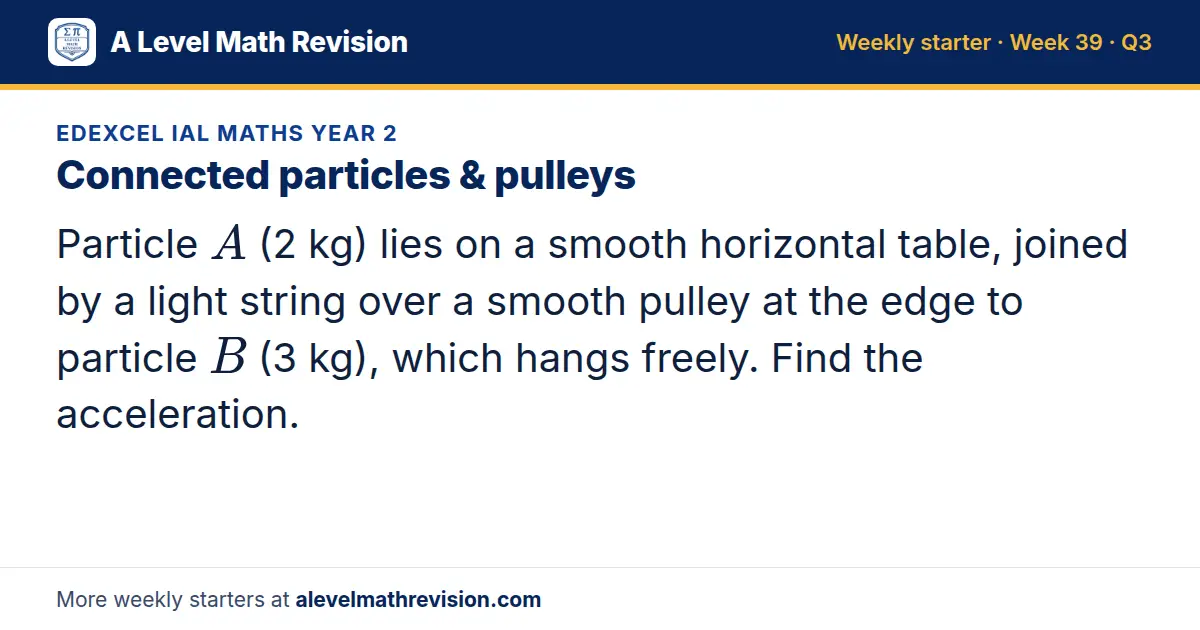
Question 3: Connected particles & pulleys
Particle A (2 kg) lies on a smooth horizontal table, joined by a light string over a smooth pulley at the edge to particle B (3 kg), which hangs freely. Find the acceleration.
Week 40
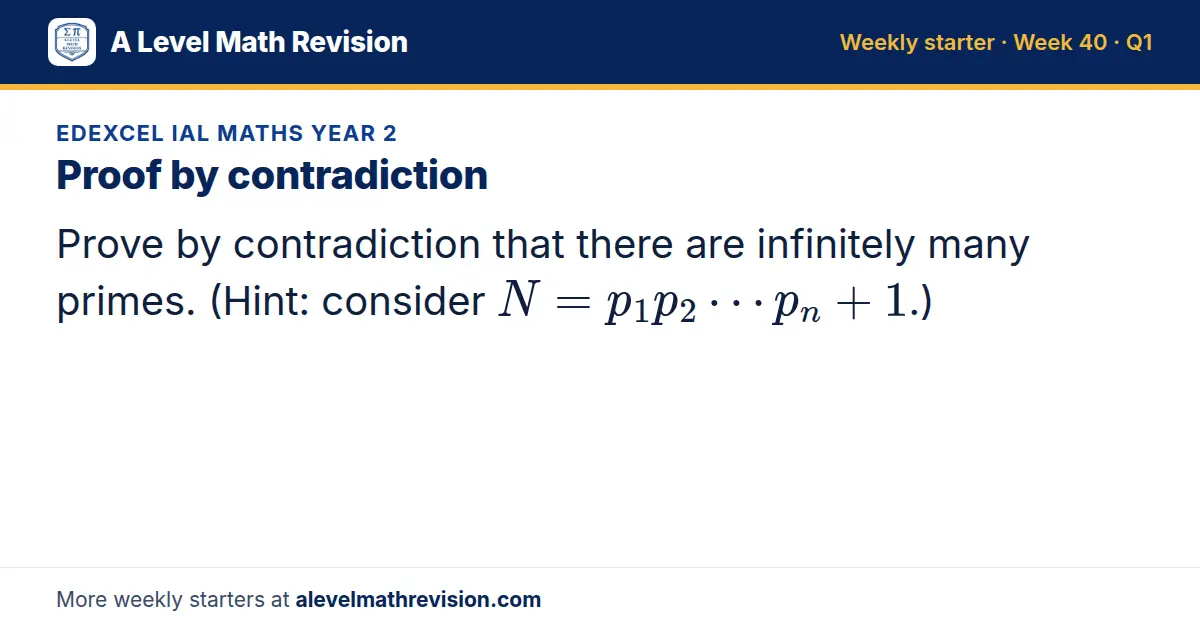
Question 1: Proof by contradiction
Prove by contradiction that there are infinitely many primes. (Hint: consider N = p_1p_2… p_n + 1.)
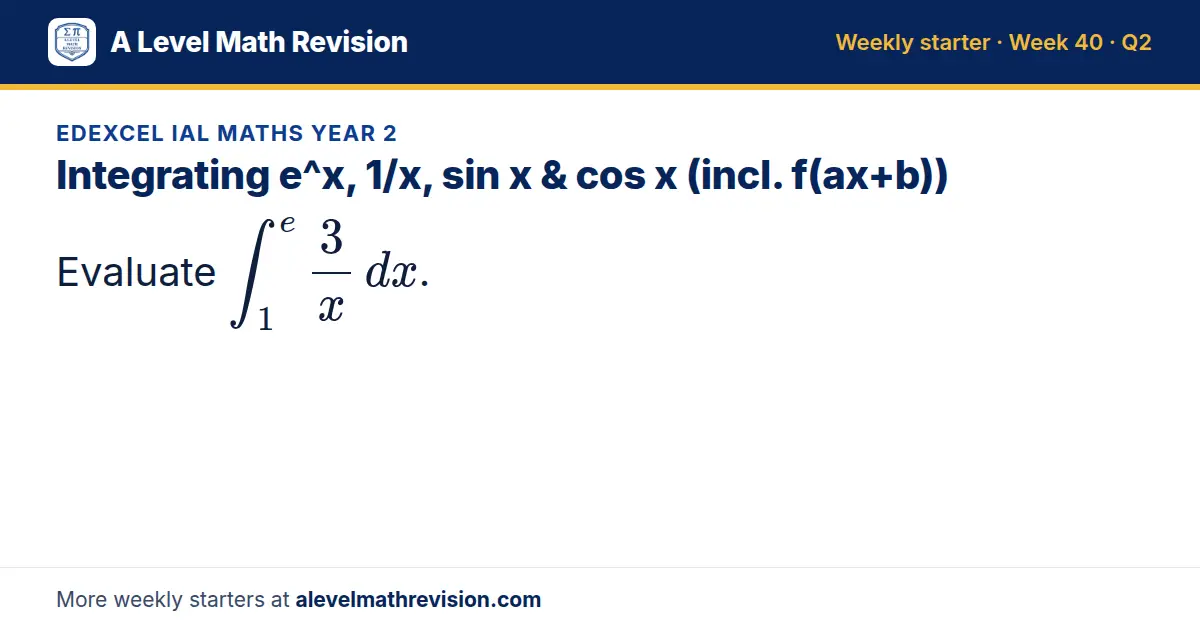
Question 2: Integrating e^x, 1/x, sin x & cos x (incl. f(ax+b))
Evaluate ∫_1^e 3/x dx.
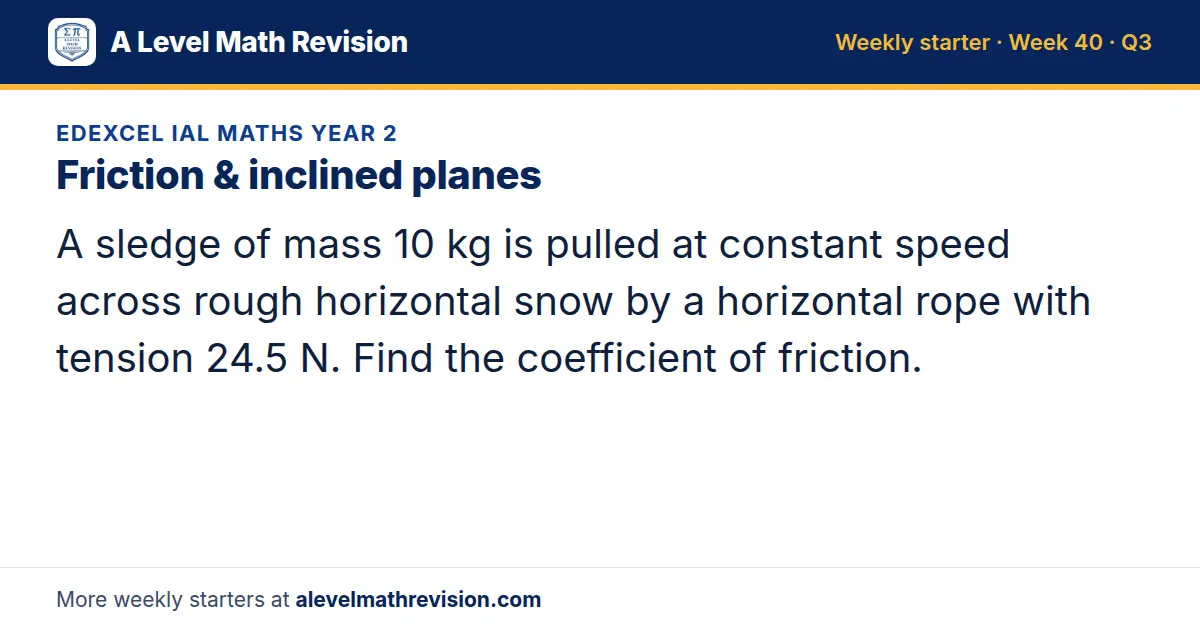
Question 3: Friction & inclined planes
A sledge of mass 10 kg is pulled at constant speed across rough horizontal snow by a horizontal rope with tension 24.5 N. Find the coefficient of friction.
More starter questions
Other weeks: Weeks 1–13 · Weeks 14–26 · Weeks 27–40. Answers and mark schemes are in the starter tasks for teachers.