Edexcel IAL Maths Year 2 starter questions: weeks 14–26
39 short questions to open a lesson for Edexcel International A Level Maths Year 2, weeks 14–26 of the teaching year, three or four a week. Each question is shown as an image with its text underneath; answers and mark schemes stay with teachers.
- ← Edexcel IAL Maths Year 2, weeks 1–13
- Edexcel IAL Maths Year 2, weeks 27–40 →
- All A Level Maths daily and weekly questions
Week 14
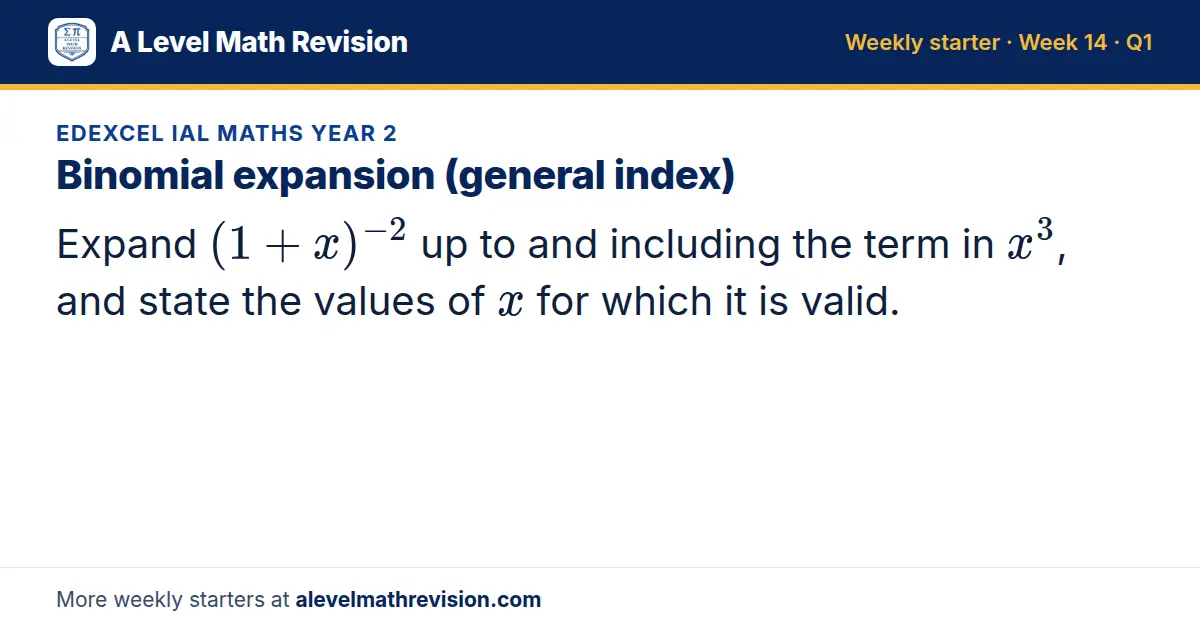
Question 1: Binomial expansion (general index)
Expand (1 + x)⁻² up to and including the term in x³, and state the values of x for which it is valid.
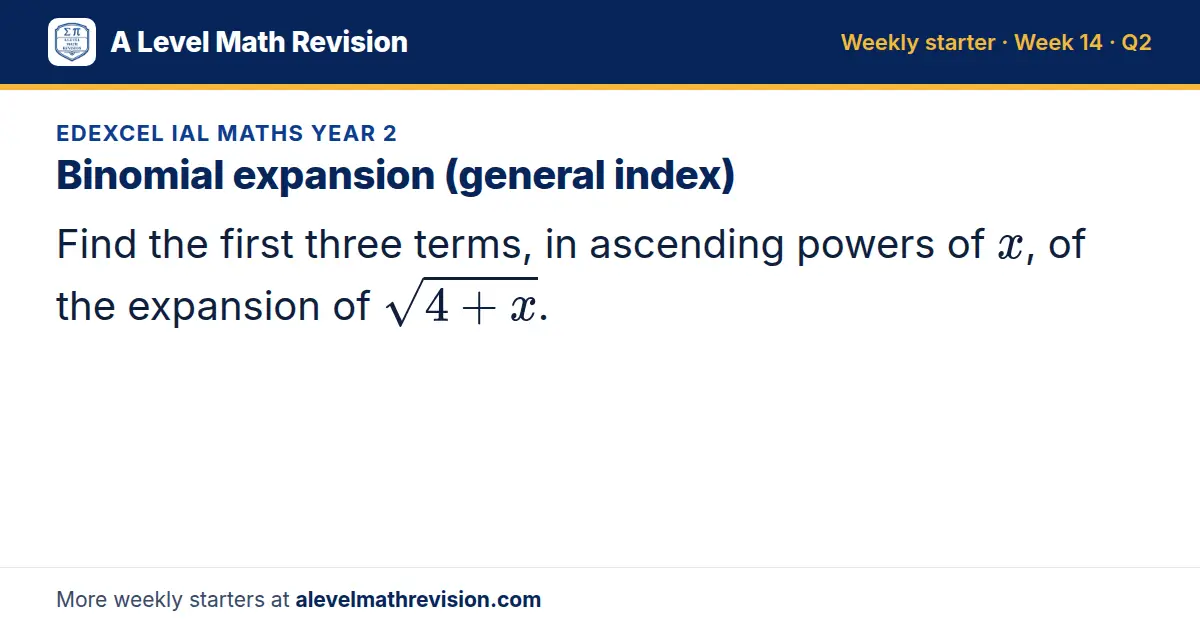
Question 2: Binomial expansion (general index)
Find the first three terms, in ascending powers of x, of the expansion of √(4 + x).
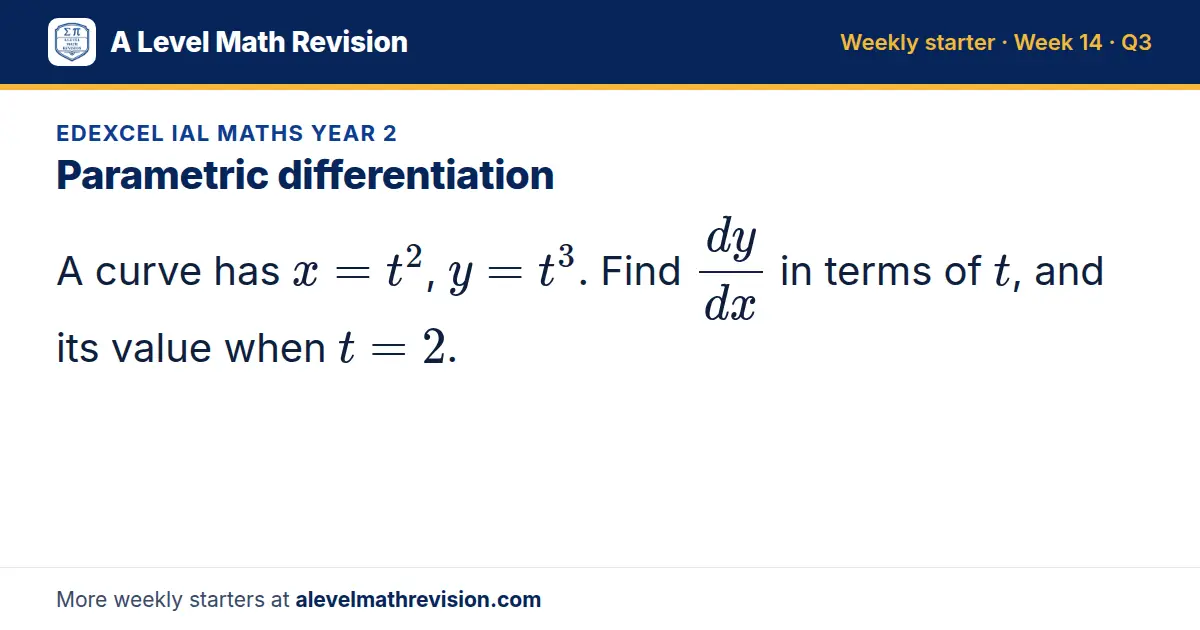
Question 3: Parametric differentiation
A curve has x = t², y = t^3. Find dy/dx in terms of t, and its value when t = 2.
Week 15
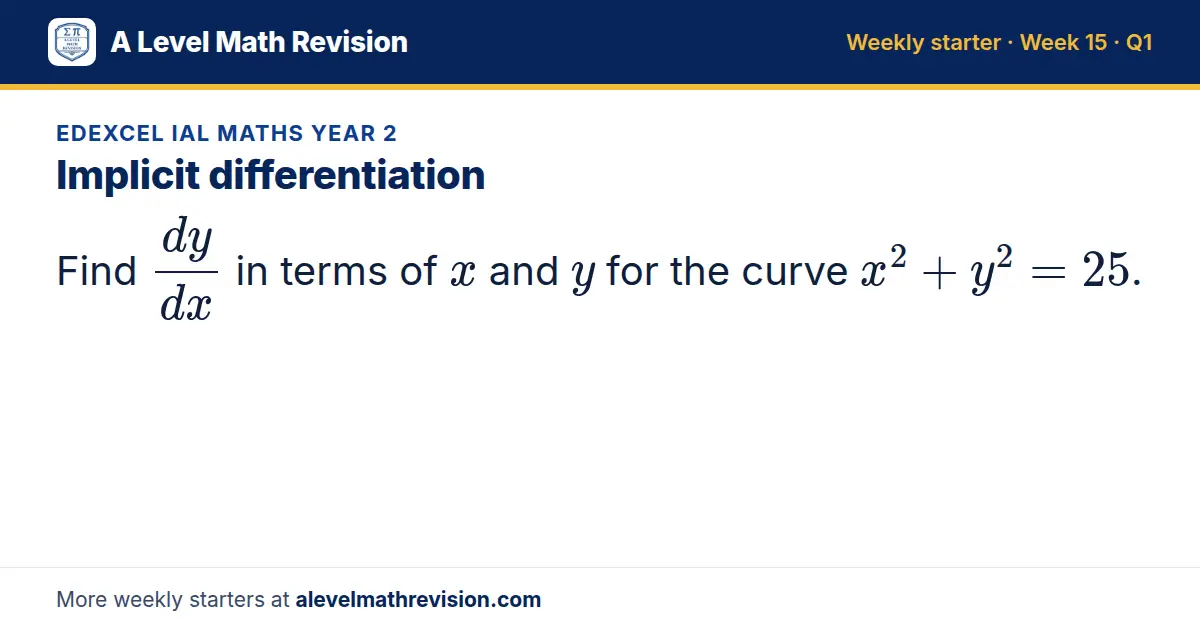
Question 1: Implicit differentiation
Find dy/dx in terms of x and y for the curve x² + y² = 25.
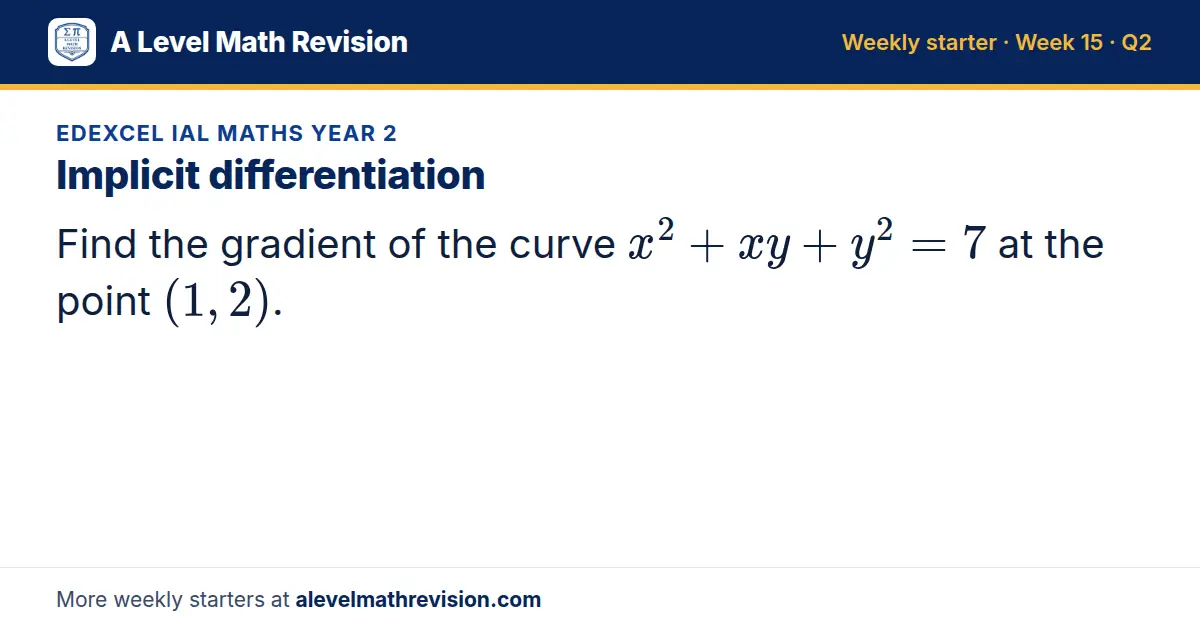
Question 2: Implicit differentiation
Find the gradient of the curve x² + xy + y² = 7 at the point (1, 2).
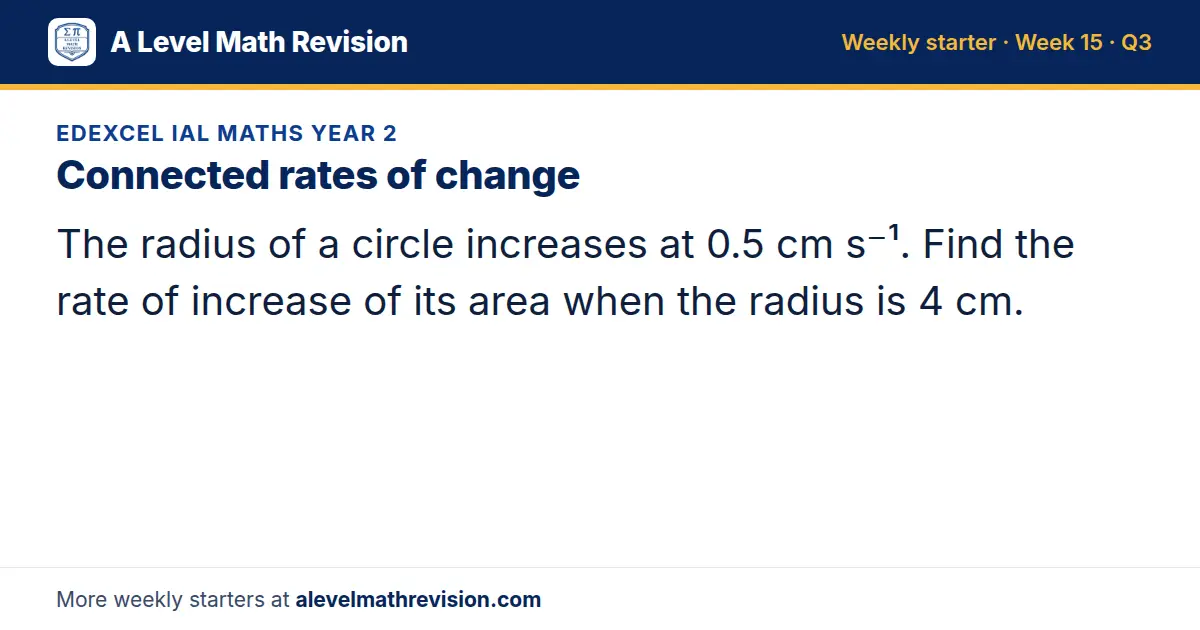
Question 3: Connected rates of change
The radius of a circle increases at 0.5 cm s⁻¹. Find the rate of increase of its area when the radius is 4 cm.
Week 16
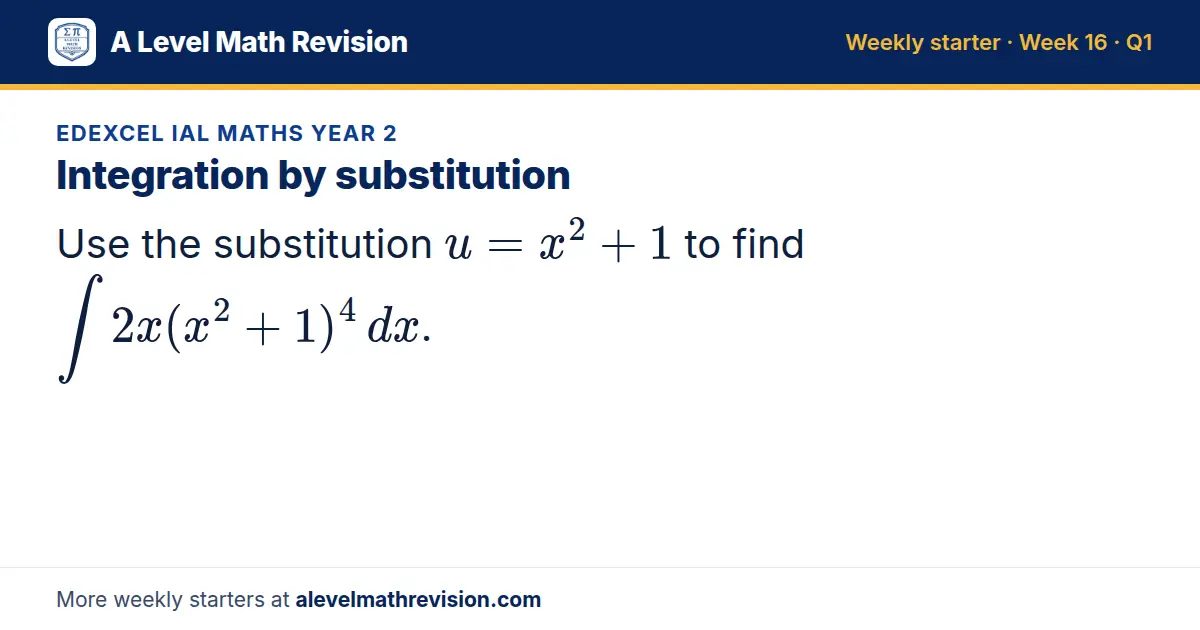
Question 1: Integration by substitution
Use the substitution u = x² + 1 to find ∫ 2x(x² + 1)⁴ dx.
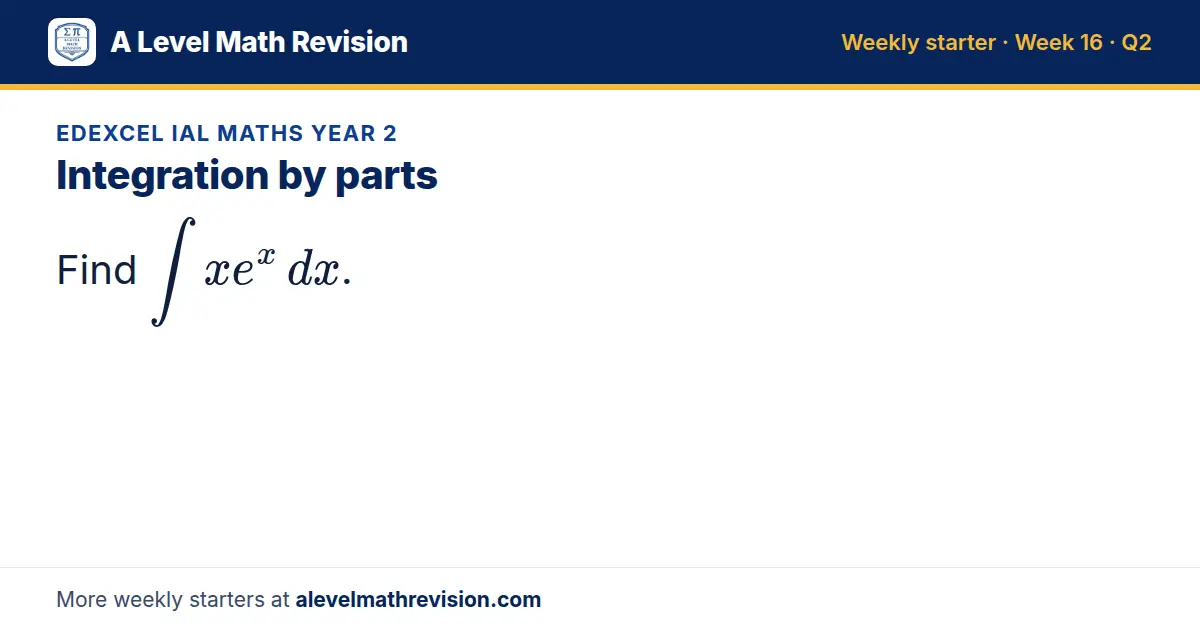
Question 2: Integration by parts
Find ∫ x e^x dx.
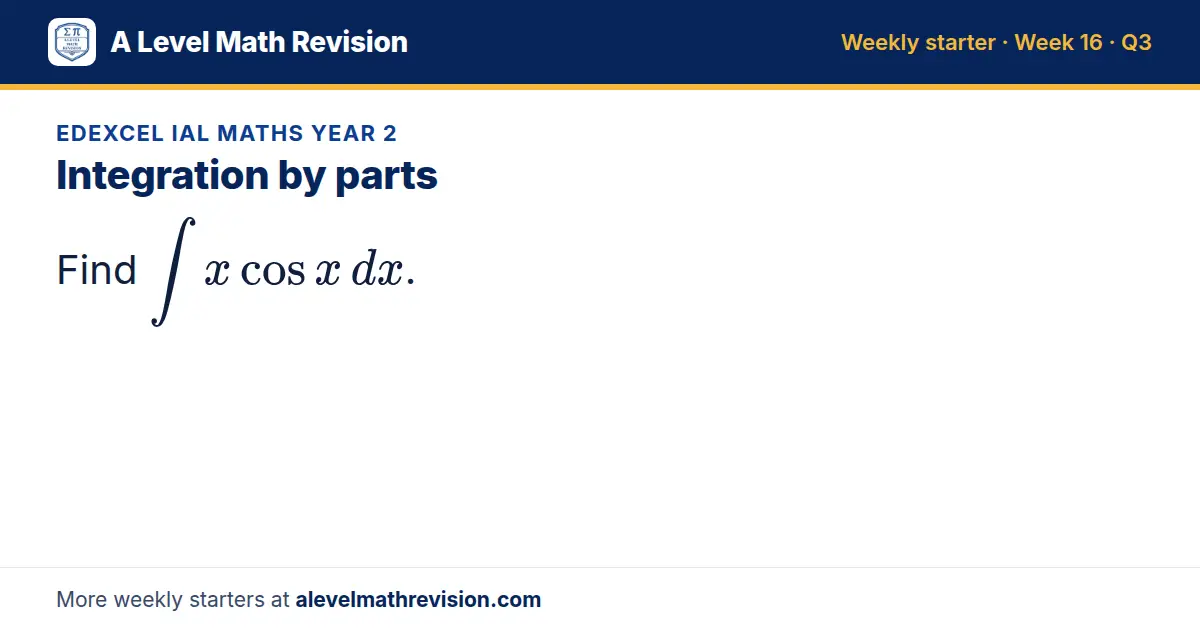
Question 3: Integration by parts
Find ∫ xcos x dx.
Week 17
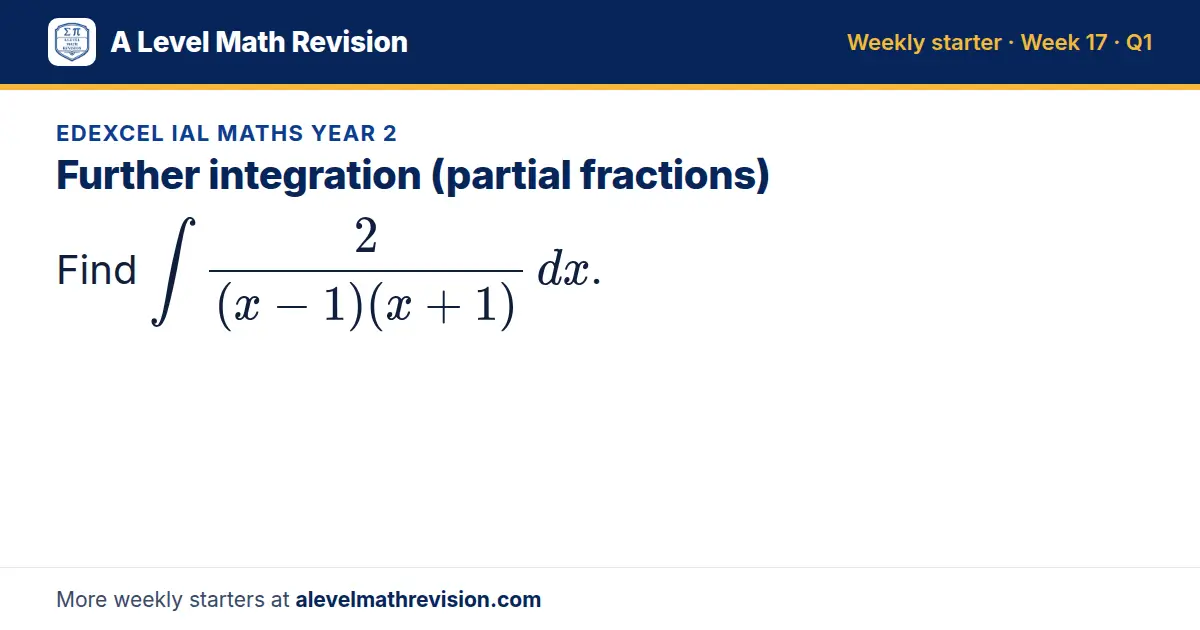
Question 1: Further integration (partial fractions)
Find ∫ 2/((x - 1)(x + 1)) dx.
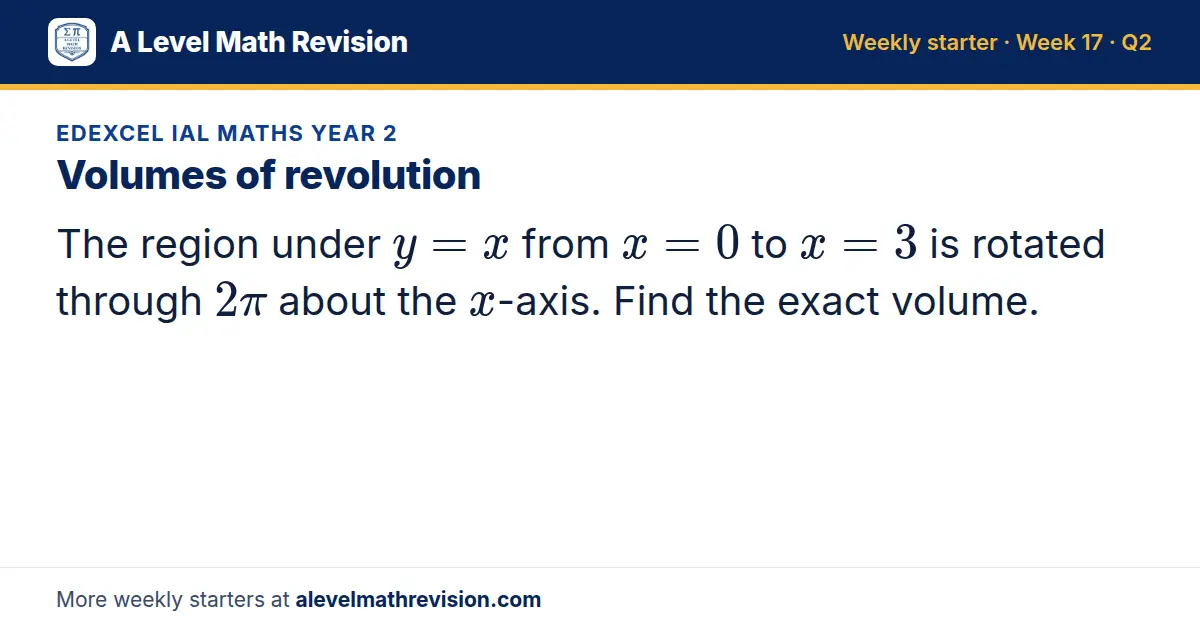
Question 2: Volumes of revolution
The region under y = x from x = 0 to x = 3 is rotated through 2π about the x-axis. Find the exact volume.
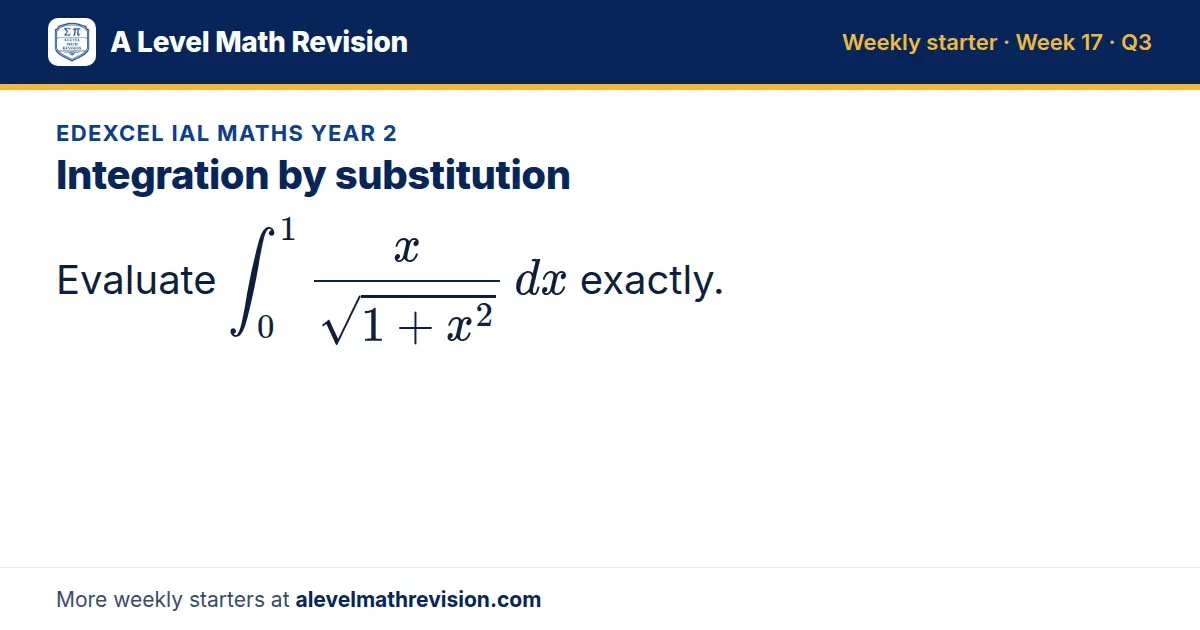
Question 3: Integration by substitution
Evaluate ∫_0¹ x/(√(1 + x²)) dx exactly.
Week 18
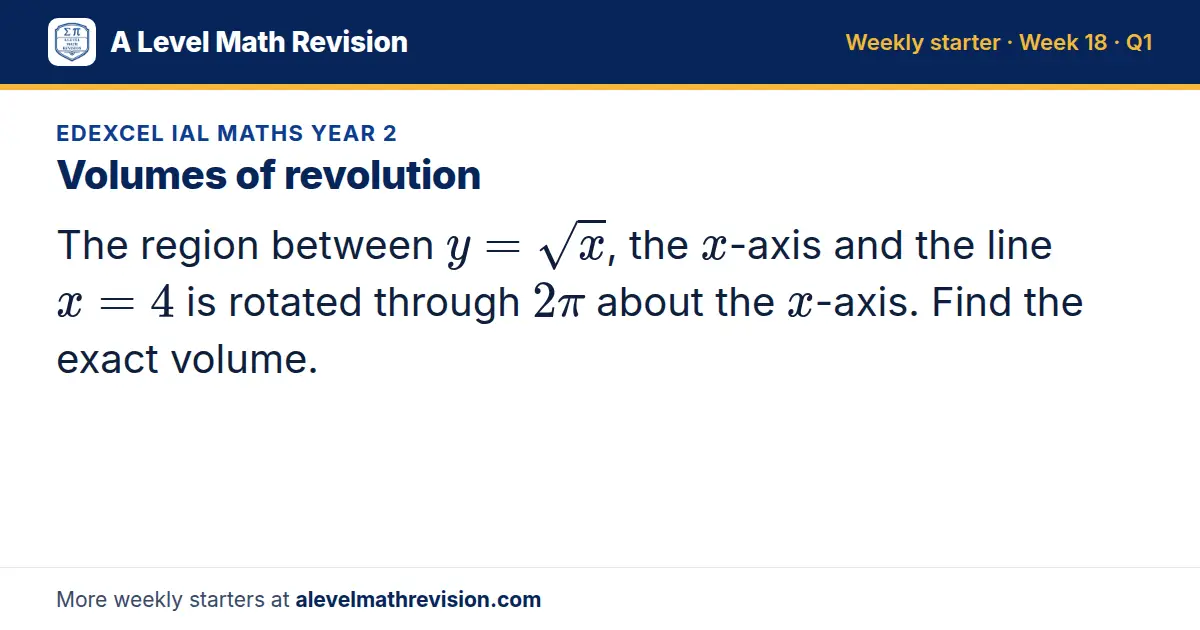
Question 1: Volumes of revolution
The region between y = √x, the x-axis and the line x = 4 is rotated through 2π about the x-axis. Find the exact volume.
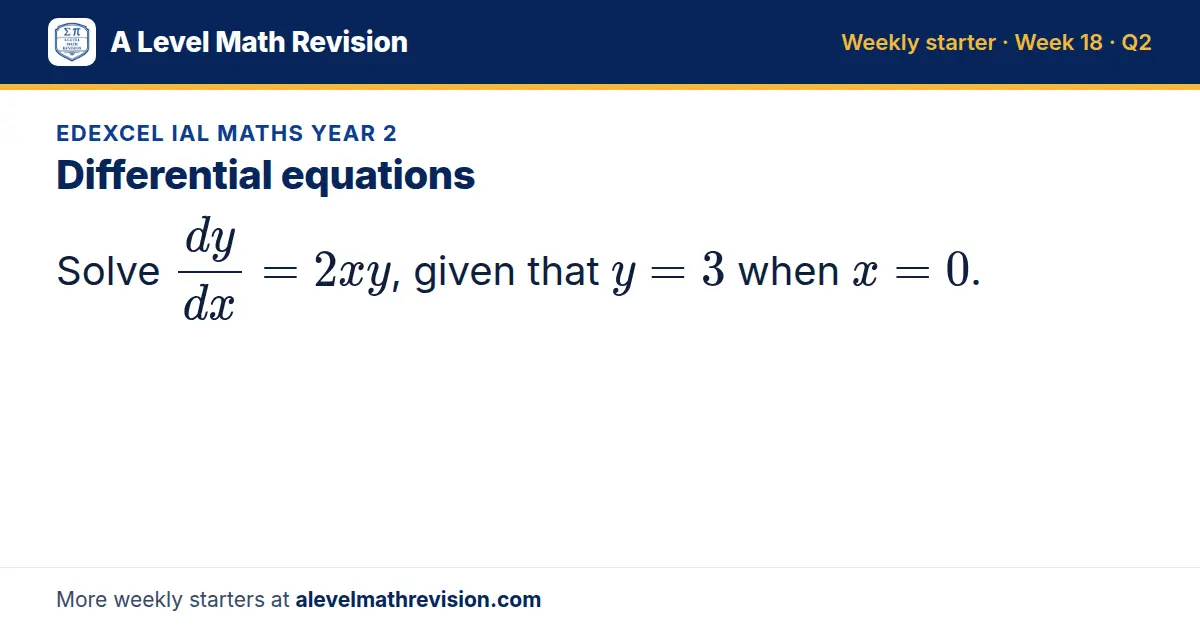
Question 2: Differential equations
Solve dy/dx = 2xy, given that y = 3 when x = 0.
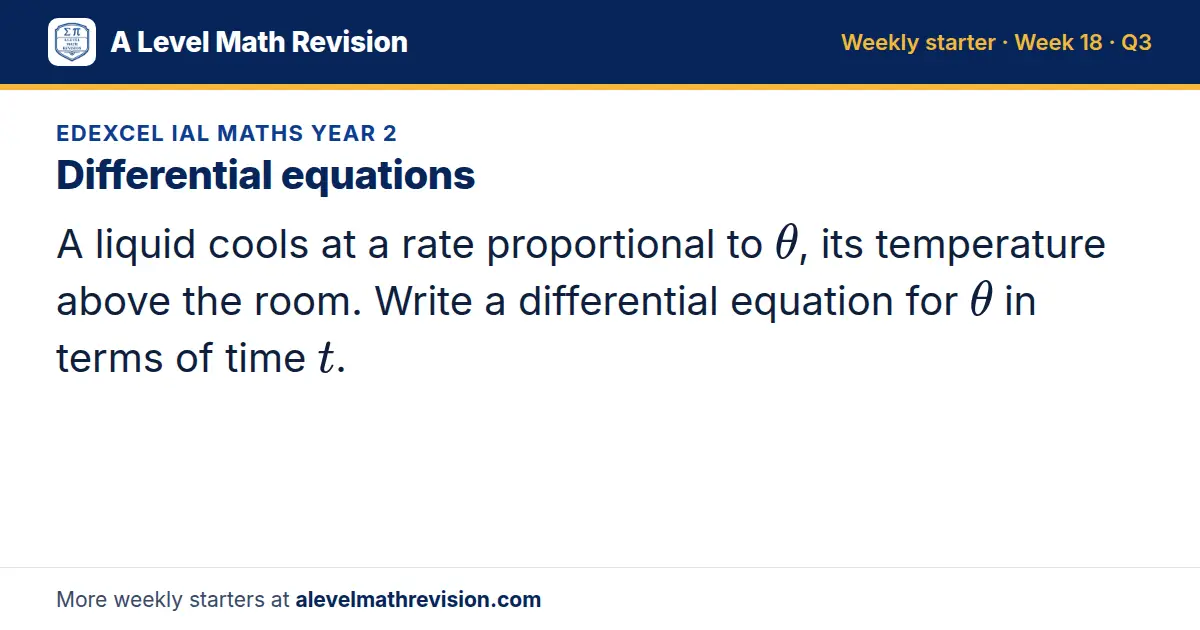
Question 3: Differential equations
A liquid cools at a rate proportional to θ, its temperature above the room. Write a differential equation for θ in terms of time t.
Week 19
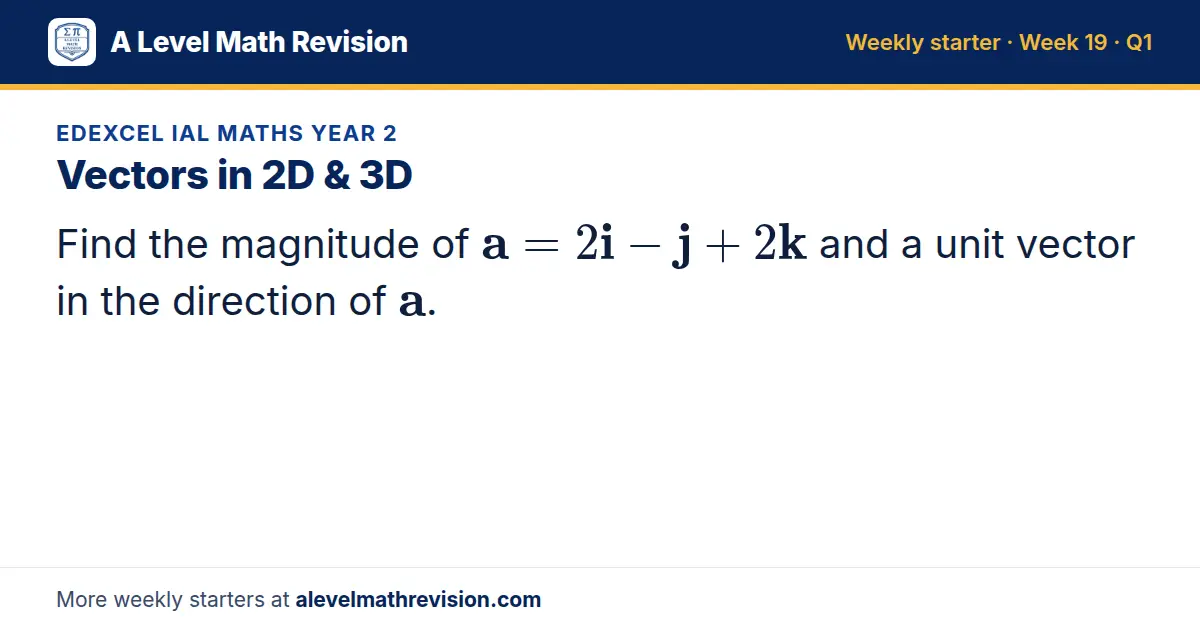
Question 1: Vectors in 2D & 3D
Find the magnitude of a = 2i - j + 2k and a unit vector in the direction of a.
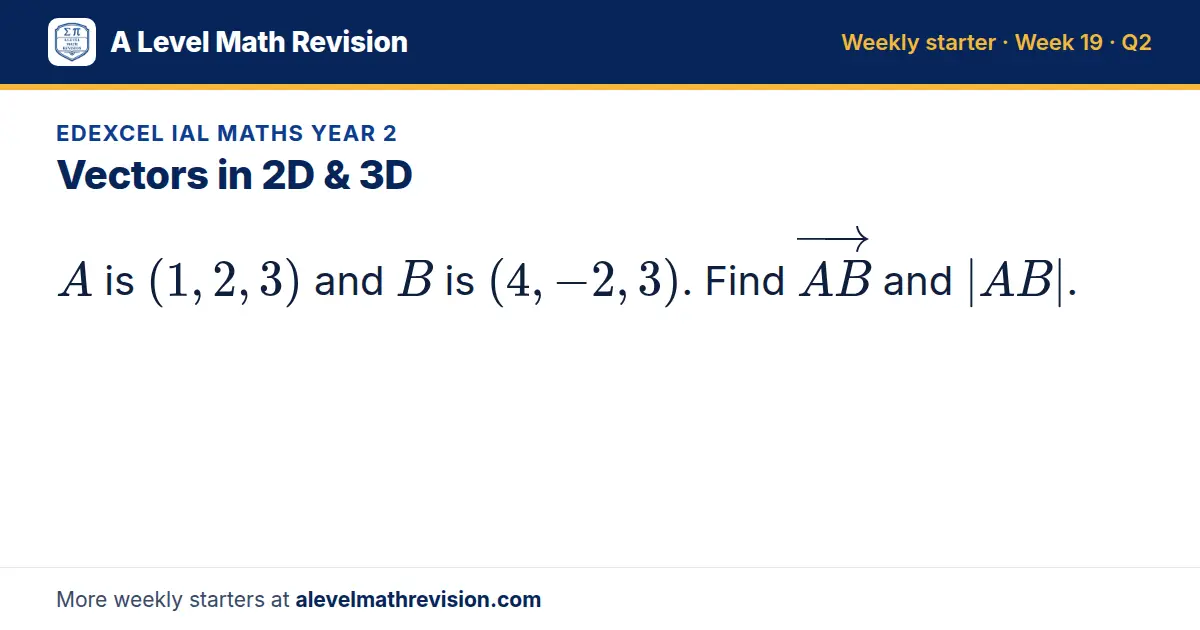
Question 2: Vectors in 2D & 3D
A is (1, 2, 3) and B is (4, -2, 3). Find AB and |AB|.
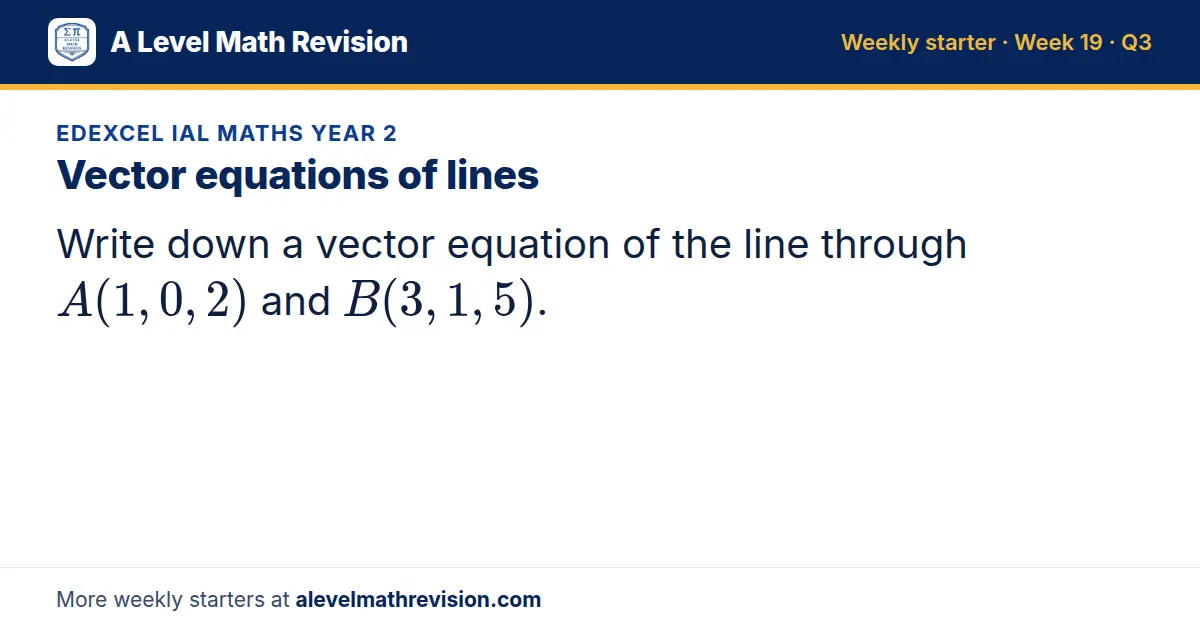
Question 3: Vector equations of lines
Write down a vector equation of the line through A(1, 0, 2) and B(3, 1, 5).
Week 20
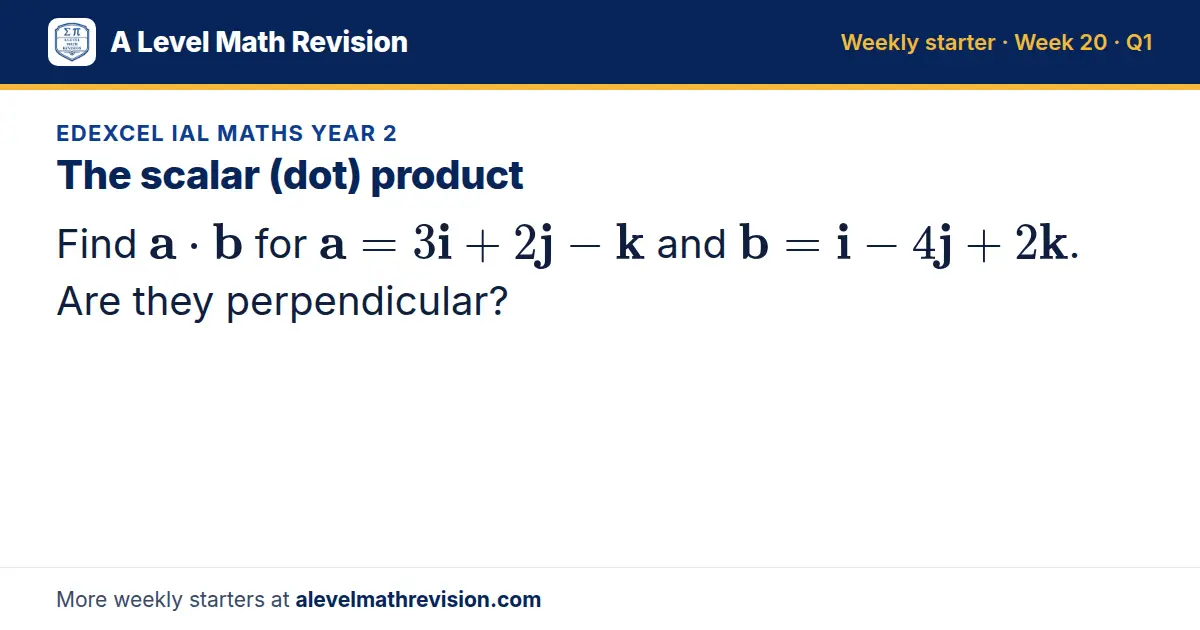
Question 1: The scalar (dot) product
Find a for a = 3i + 2j - k and b = i - 4j + 2k. Are they perpendicular?
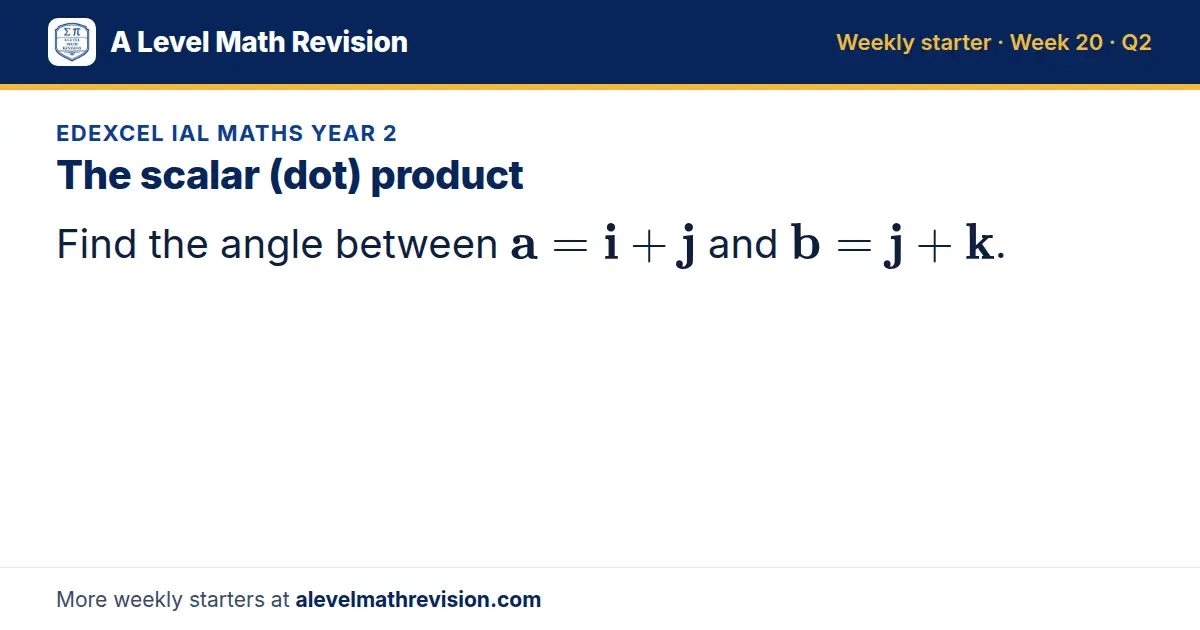
Question 2: The scalar (dot) product
Find the angle between a = i + j and b = j + k.
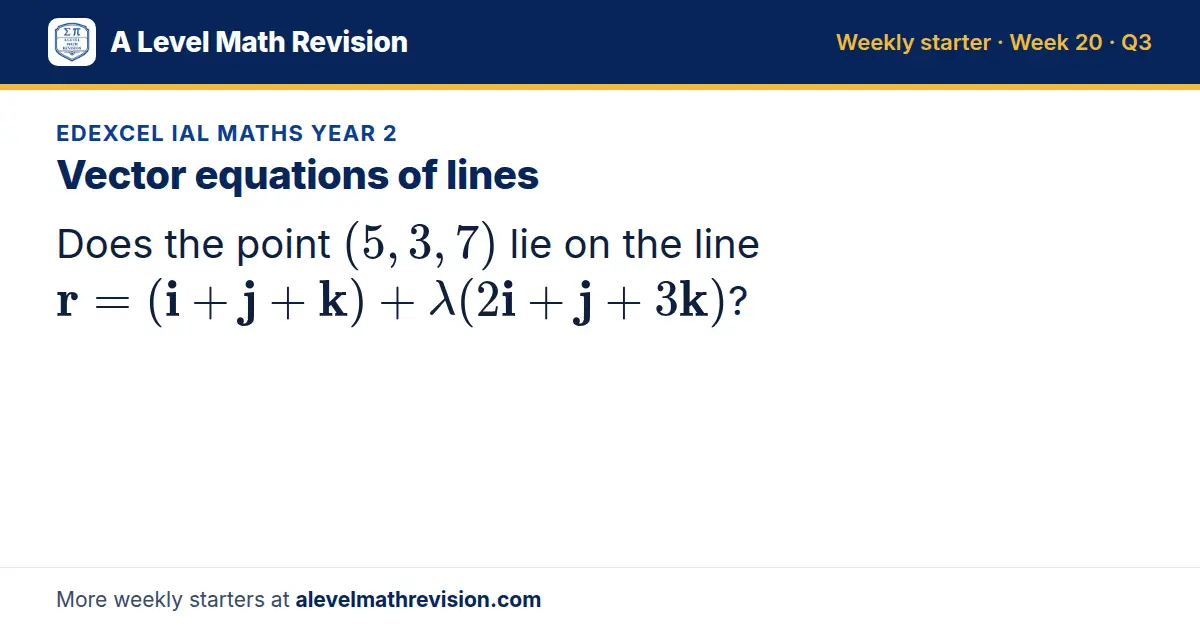
Question 3: Vector equations of lines
Does the point (5, 3, 7) lie on the line r = (i + j + k) + λ(2i + j + 3k)?
Week 21
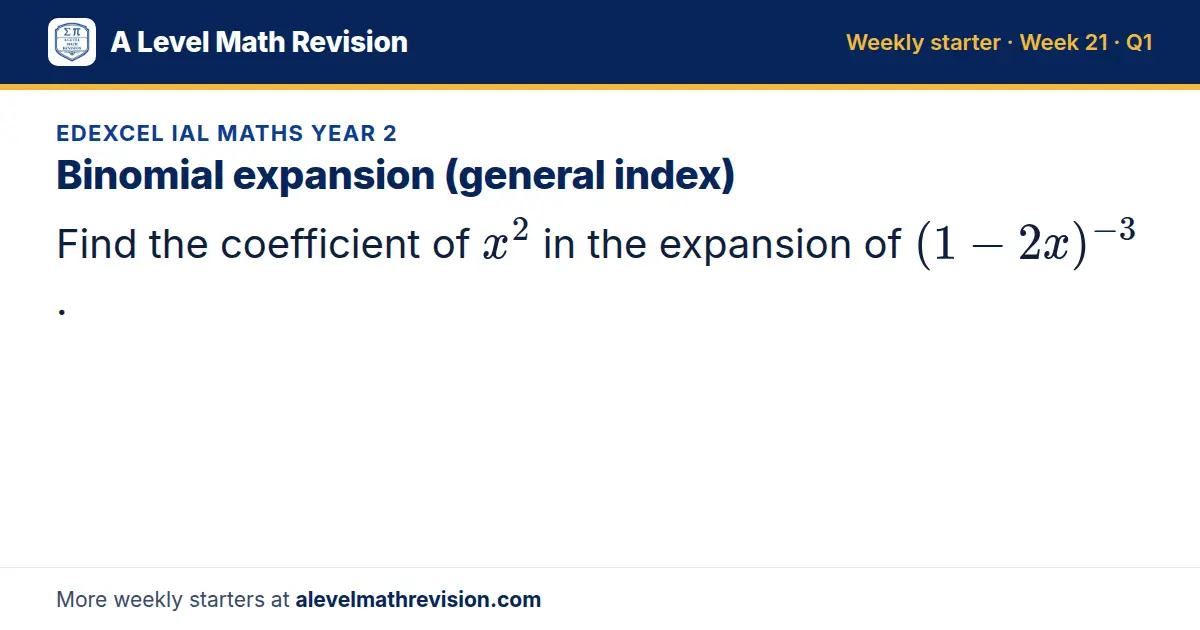
Question 1: Binomial expansion (general index)
Find the coefficient of x² in the expansion of (1 - 2x)⁻³.
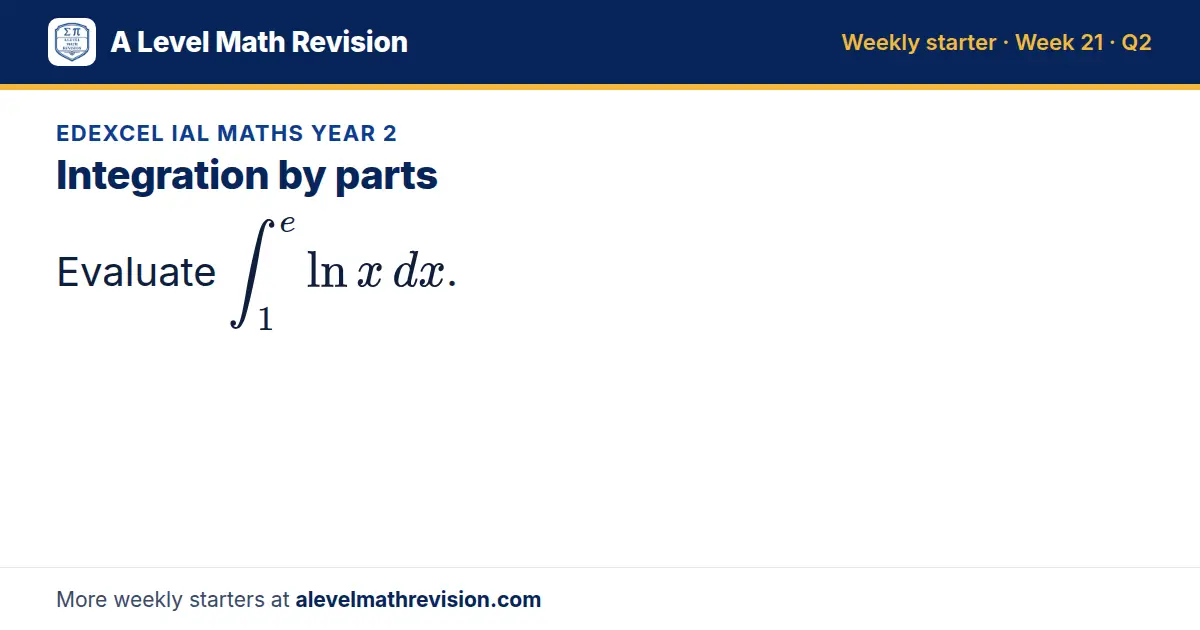
Question 2: Integration by parts
Evaluate ∫_1^e ln x dx.
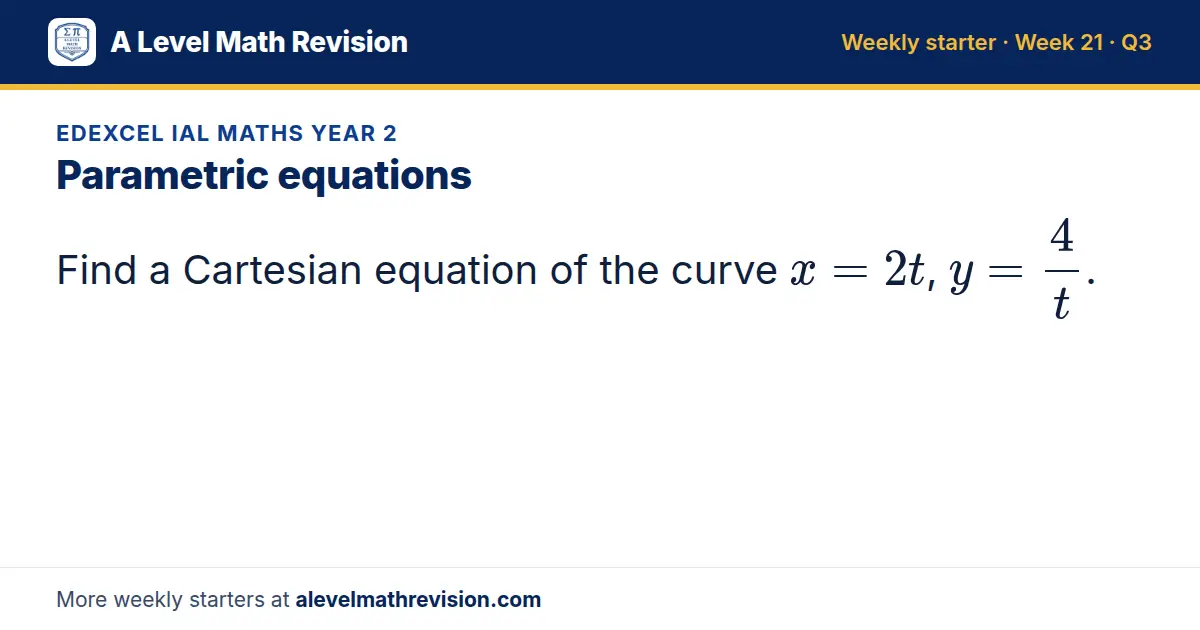
Question 3: Parametric equations
Find a Cartesian equation of the curve x = 2t, y = 4/t.
Week 22
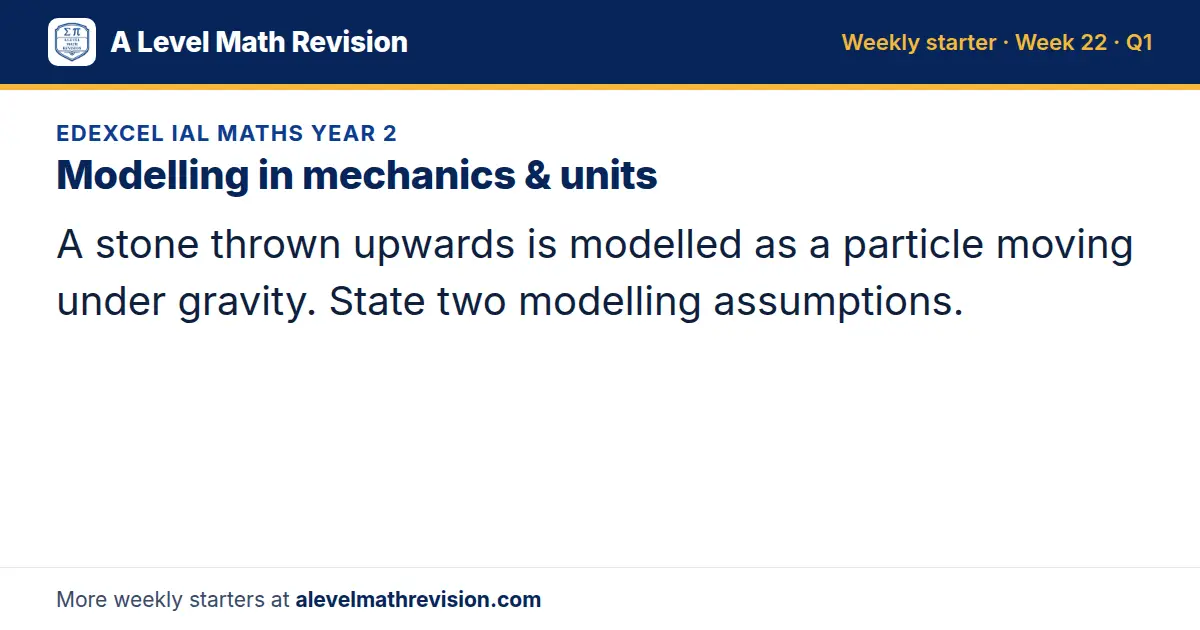
Question 1: Modelling in mechanics & units
A stone thrown upwards is modelled as a particle moving under gravity. State two modelling assumptions.
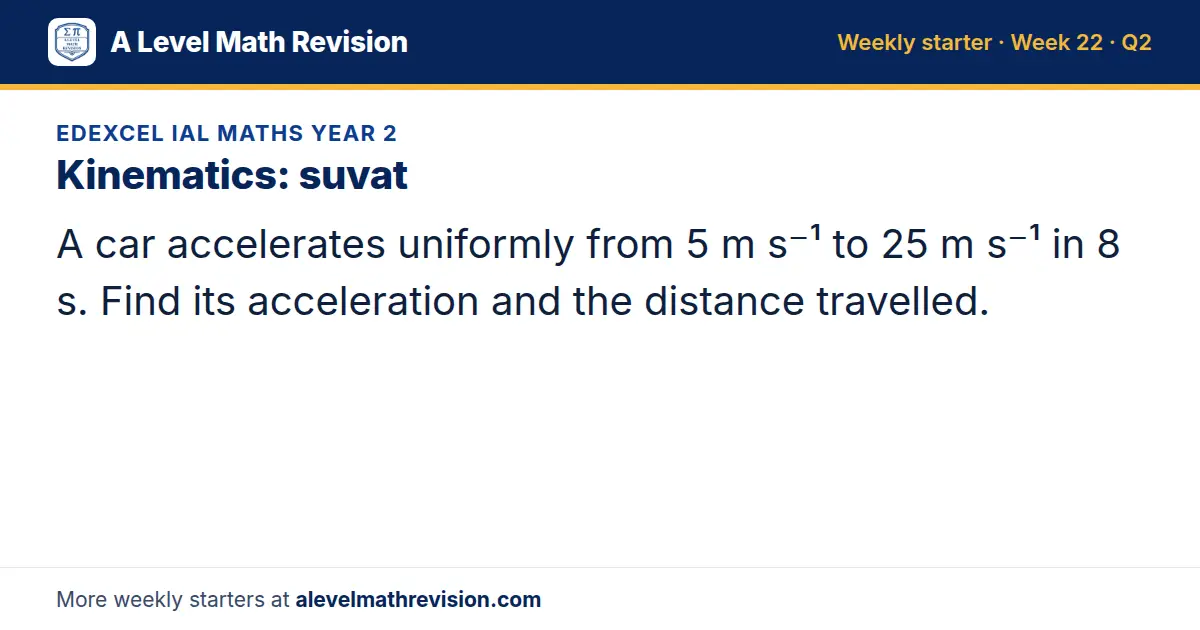
Question 2: Kinematics: suvat
A car accelerates uniformly from 5 m s⁻¹ to 25 m s⁻¹ in 8 s. Find its acceleration and the distance travelled.
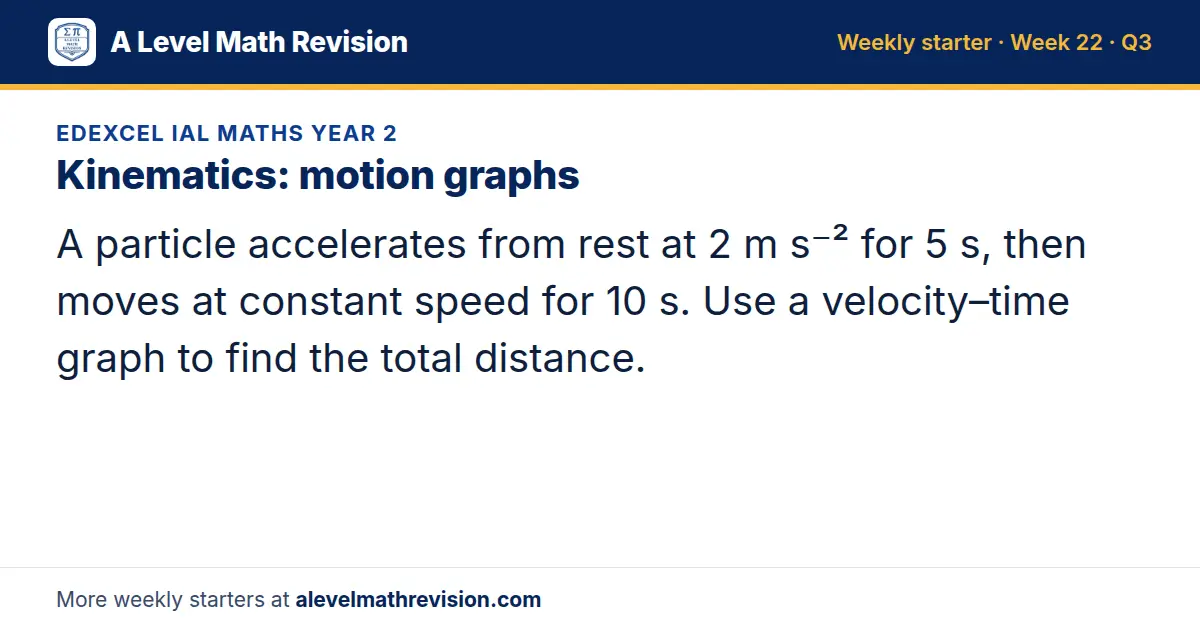
Question 3: Kinematics: motion graphs
A particle accelerates from rest at 2 m s⁻² for 5 s, then moves at constant speed for 10 s. Use a velocity–time graph to find the total distance.
Week 23
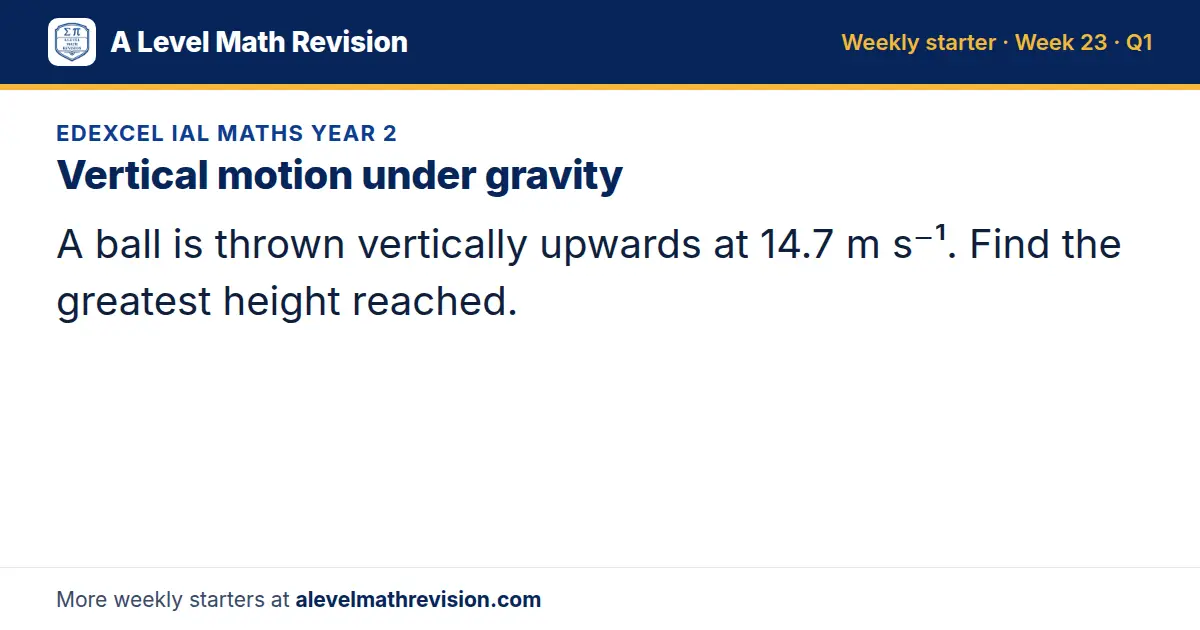
Question 1: Vertical motion under gravity
A ball is thrown vertically upwards at 14.7 m s⁻¹. Find the greatest height reached.
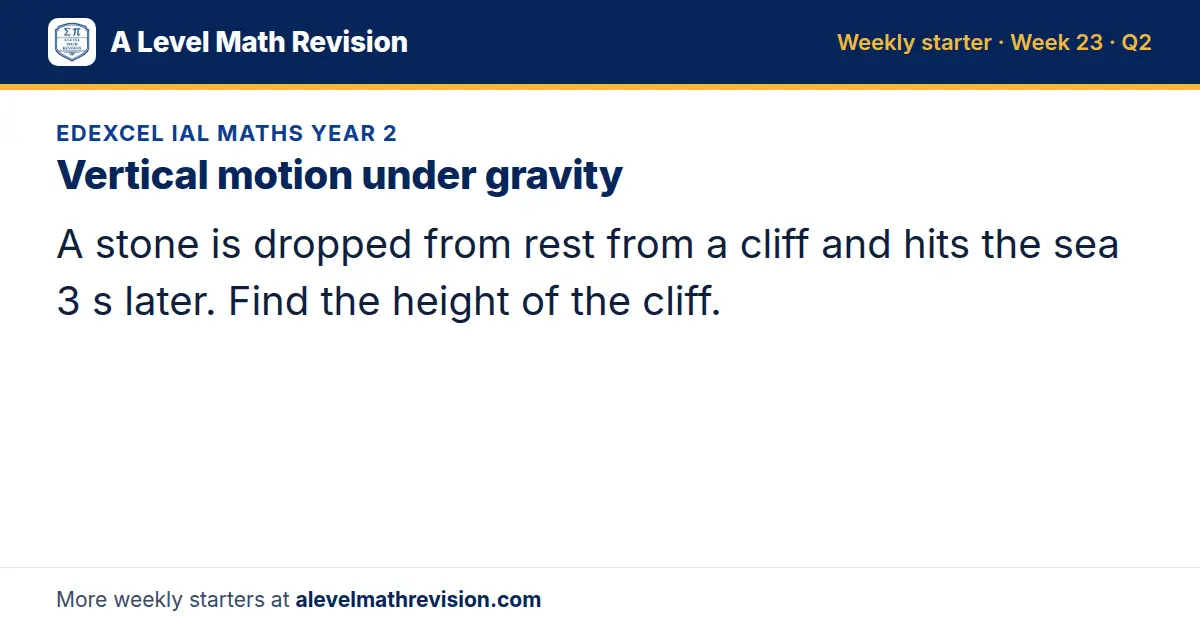
Question 2: Vertical motion under gravity
A stone is dropped from rest from a cliff and hits the sea 3 s later. Find the height of the cliff.
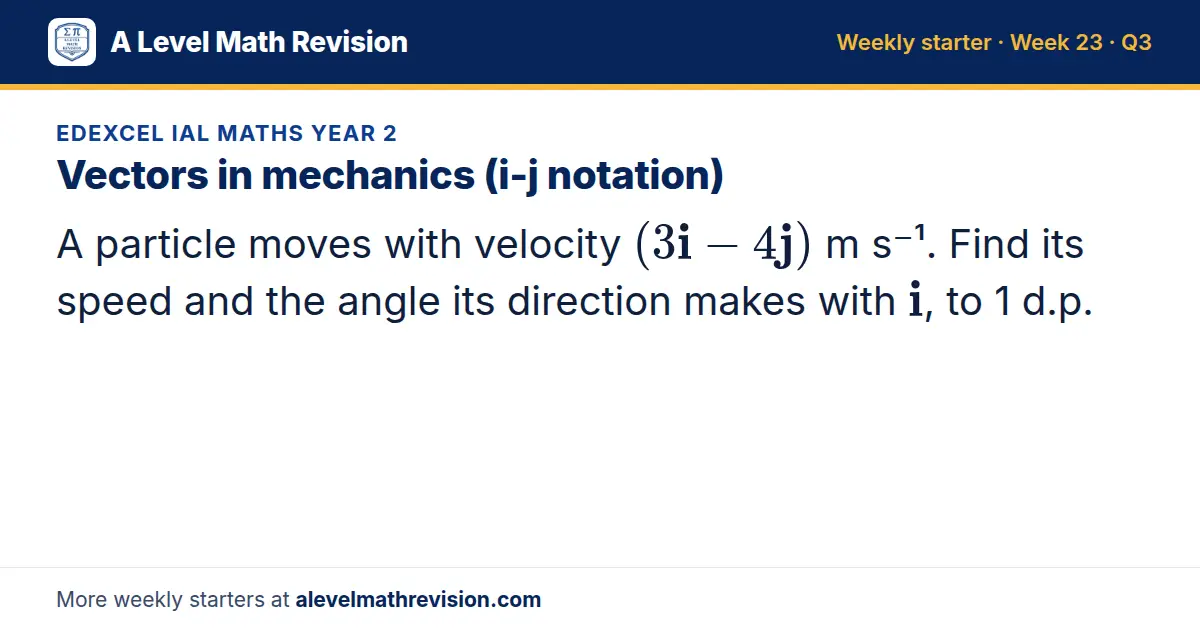
Question 3: Vectors in mechanics (i-j notation)
A particle moves with velocity (3i - 4j) m s⁻¹. Find its speed and the angle its direction makes with i, to 1 d.p.
Week 24
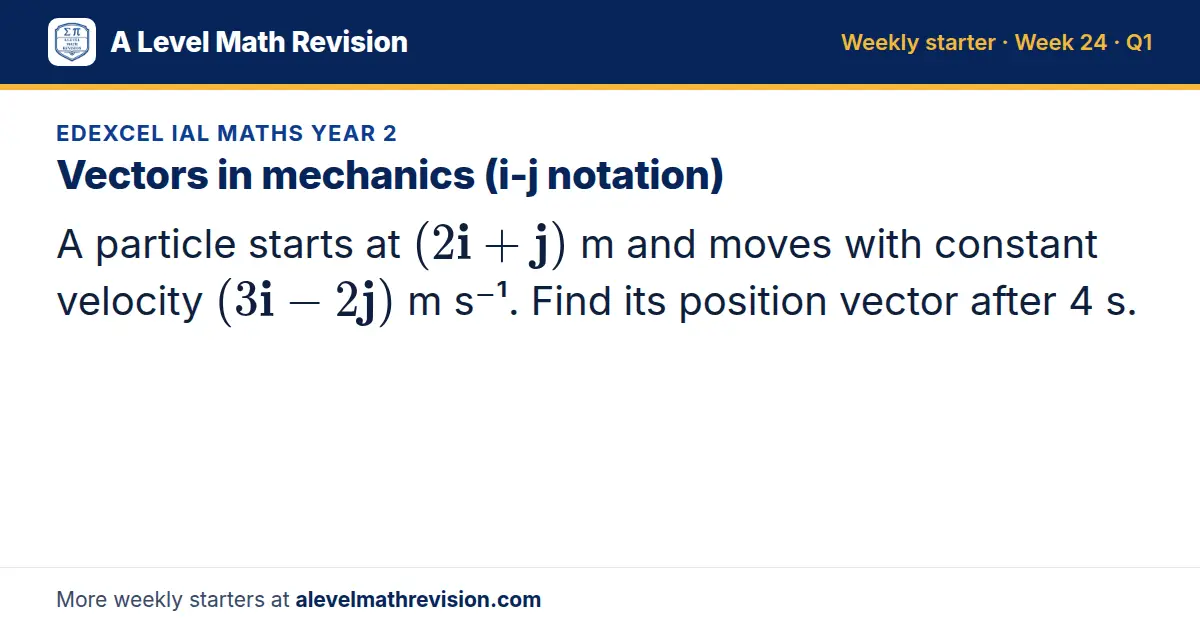
Question 1: Vectors in mechanics (i-j notation)
A particle starts at (2i + j) m and moves with constant velocity (3i - 2j) m s⁻¹. Find its position vector after 4 s.
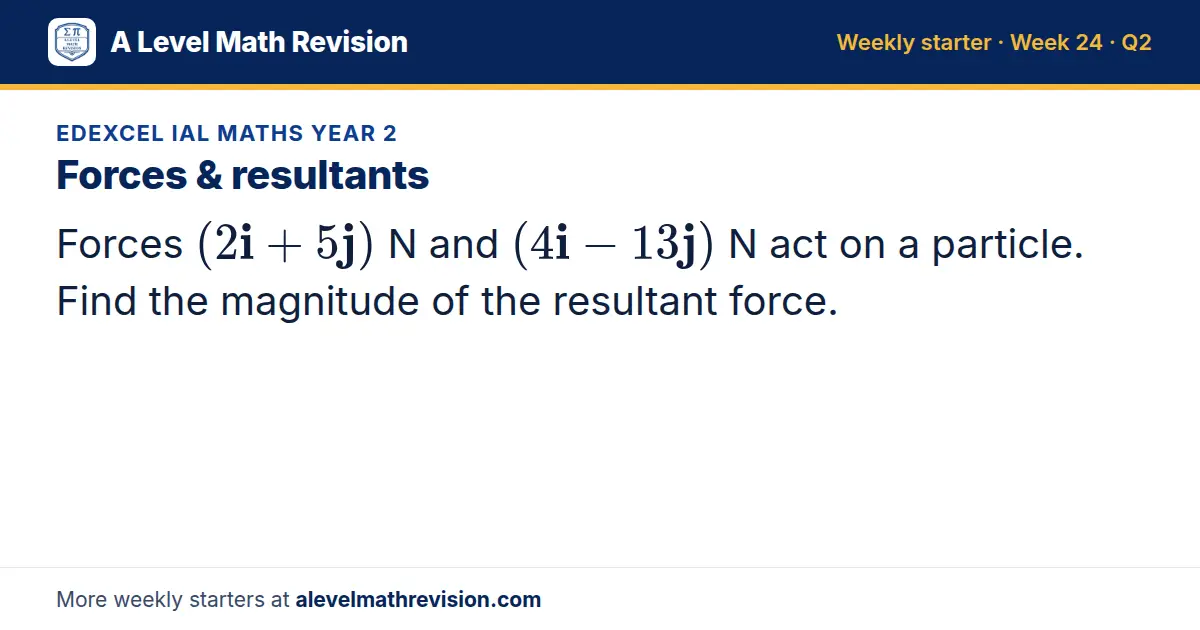
Question 2: Forces & resultants
Forces (2i + 5j) N and (4i - 13j) N act on a particle. Find the magnitude of the resultant force.
Question 3: Newton's laws
A resultant force of 12 N acts on a particle of mass 3 kg, initially at rest. Find its acceleration and its speed after 5 s.
Week 25
Question 1: Friction & inclined planes
A box of mass 5 kg is pulled across rough horizontal ground by a horizontal force of 30 N. The coefficient of friction is 0.4. Find the acceleration.
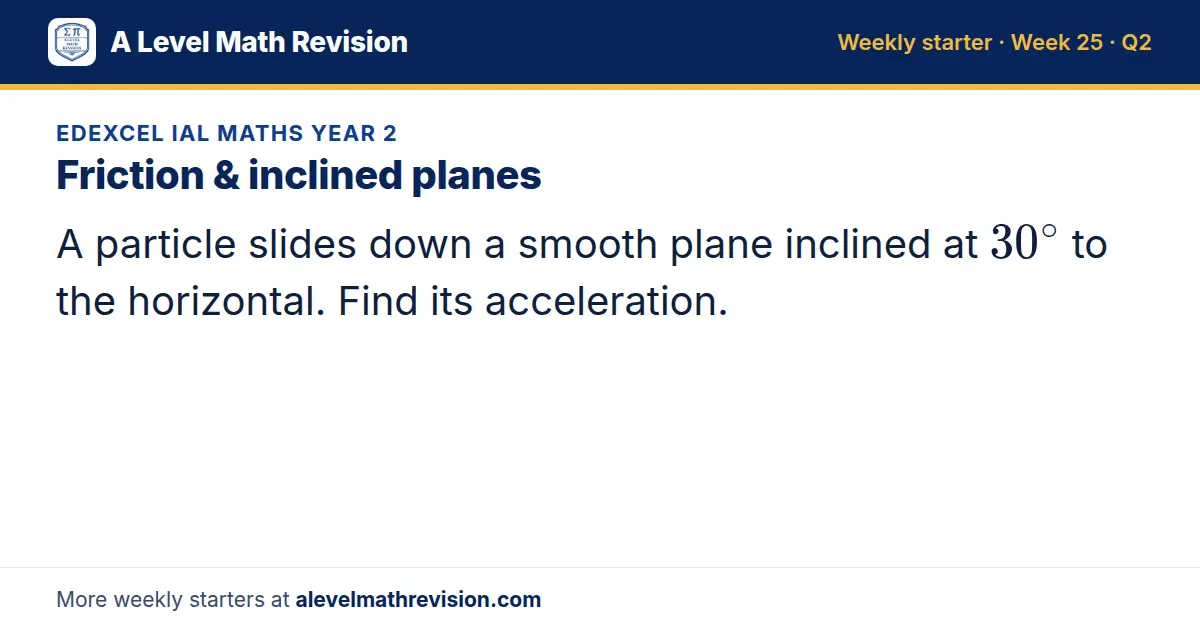
Question 2: Friction & inclined planes
A particle slides down a smooth plane inclined at 30^∘ to the horizontal. Find its acceleration.
Question 3: Connected particles & pulleys
Particles of mass 3 kg and 2 kg hang on either side of a smooth pulley, connected by a light inextensible string. Find the acceleration and the tension.
Week 26
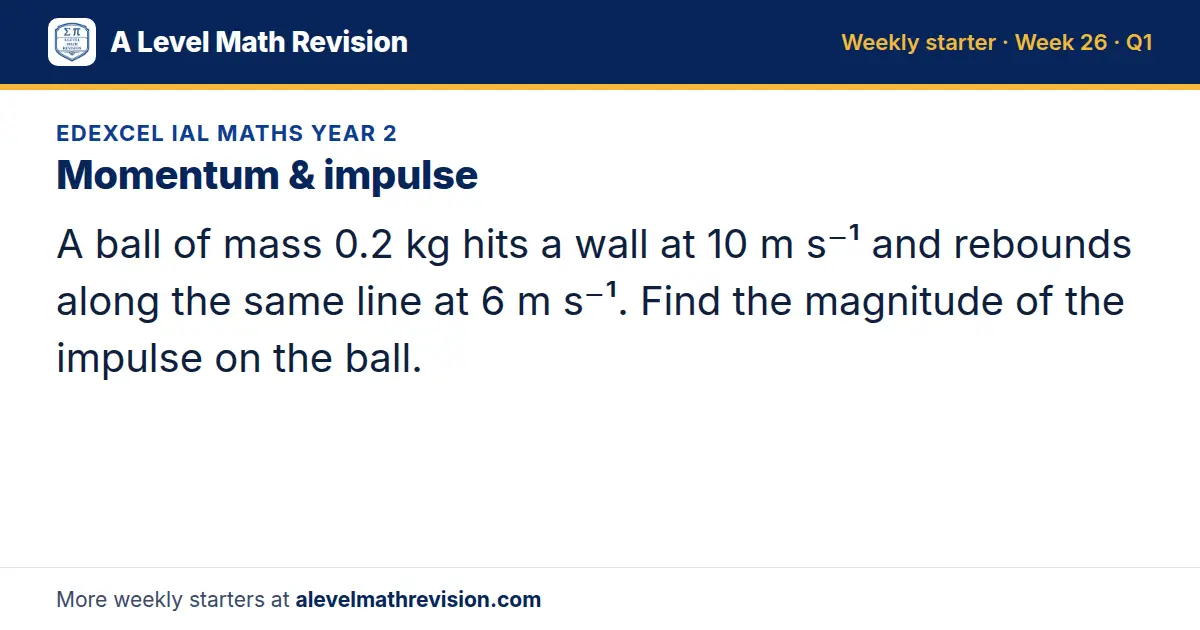
Question 1: Momentum & impulse
A ball of mass 0.2 kg hits a wall at 10 m s⁻¹ and rebounds along the same line at 6 m s⁻¹. Find the magnitude of the impulse on the ball.
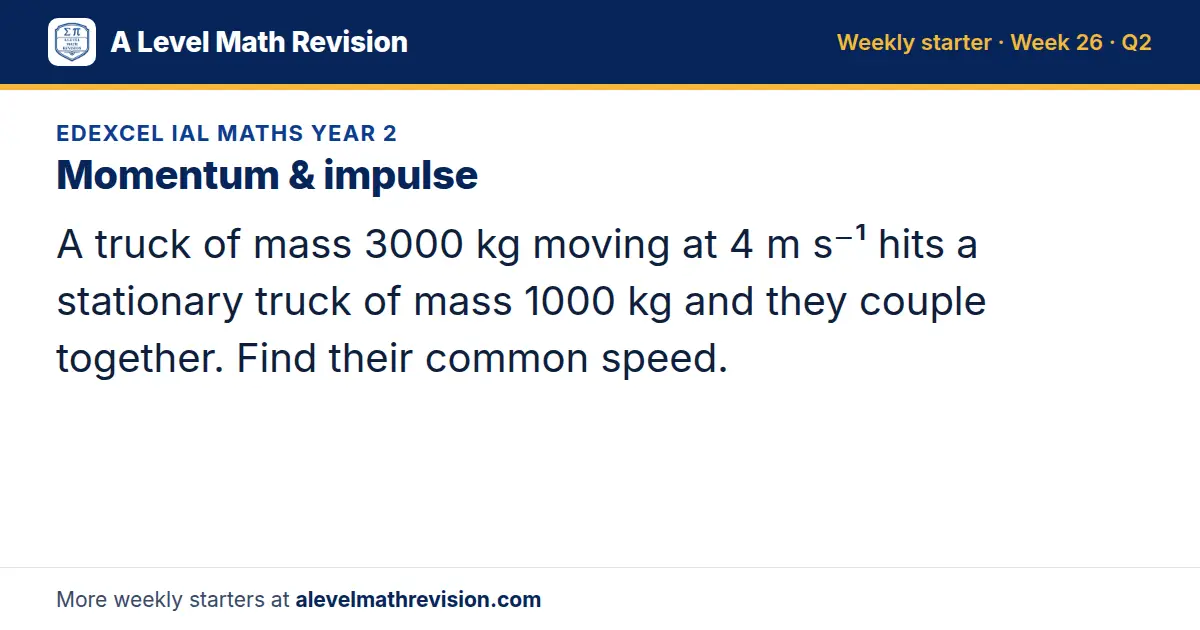
Question 2: Momentum & impulse
A truck of mass 3000 kg moving at 4 m s⁻¹ hits a stationary truck of mass 1000 kg and they couple together. Find their common speed.
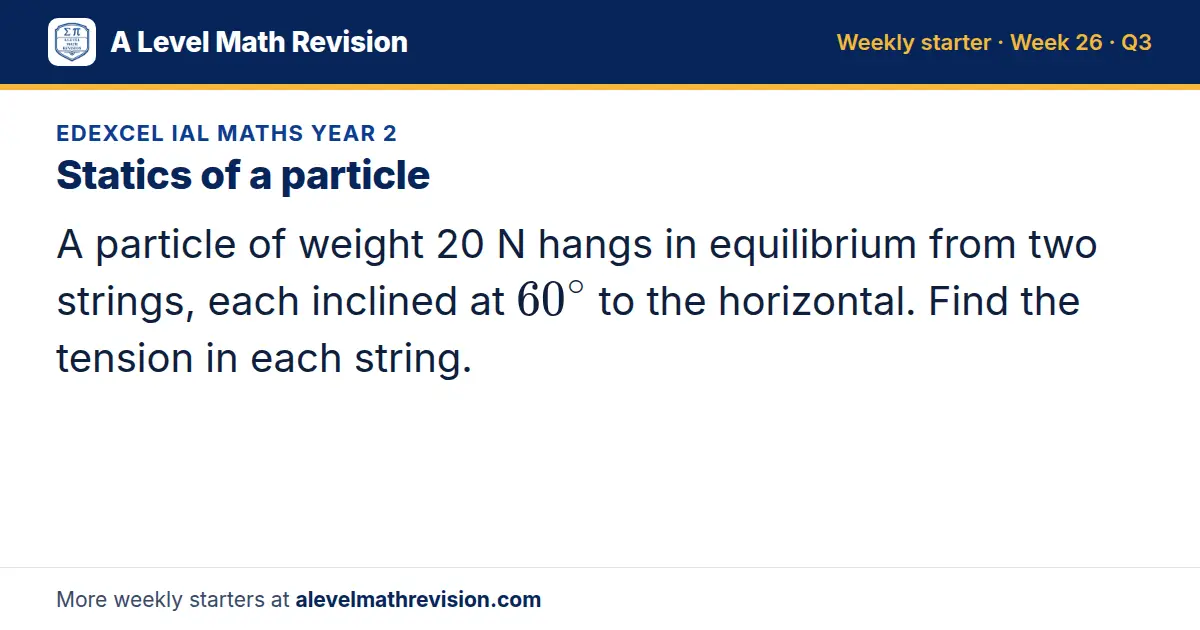
Question 3: Statics of a particle
A particle of weight 20 N hangs in equilibrium from two strings, each inclined at 60^∘ to the horizontal. Find the tension in each string.
More starter questions
Other weeks: Weeks 1–13 · Weeks 14–26 · Weeks 27–40. Answers and mark schemes are in the starter tasks for teachers.