A Level Maths Year 1 starter questions: weeks 27–40
42 short questions to open a lesson for A Level Maths Year 1 (AS), weeks 27–40 of the teaching year, three or four a week. Each question is shown as an image with its text underneath; answers and mark schemes stay with teachers.
Week 27
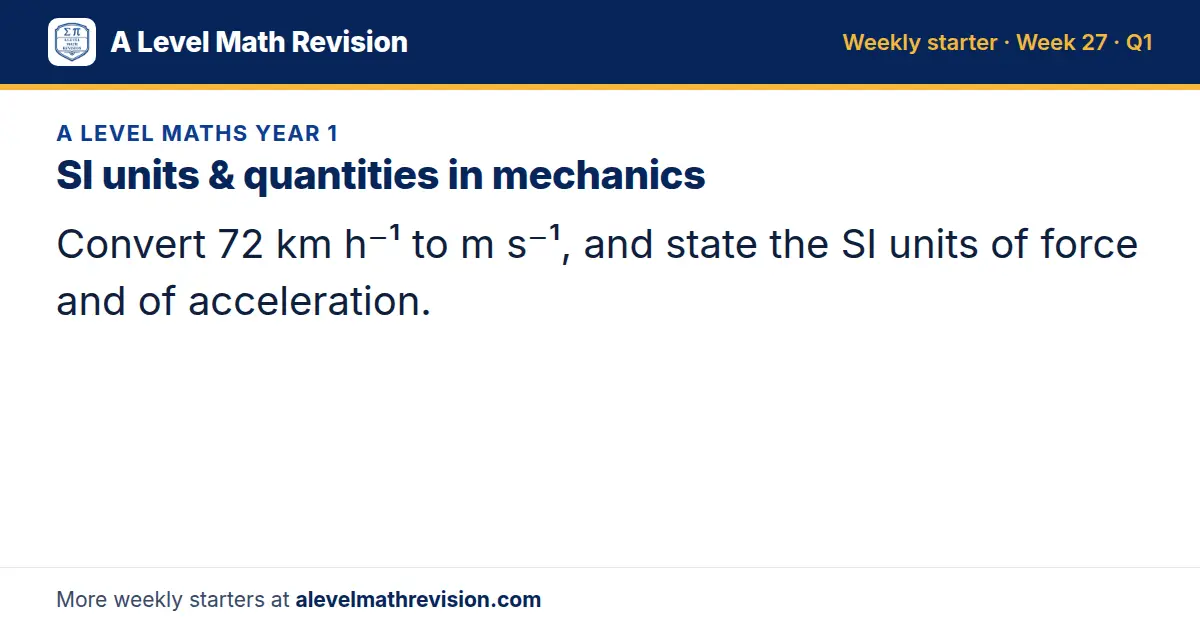
Question 1: SI units & quantities in mechanics
Convert 72 km h⁻¹ to m s⁻¹, and state the SI units of force and of acceleration.
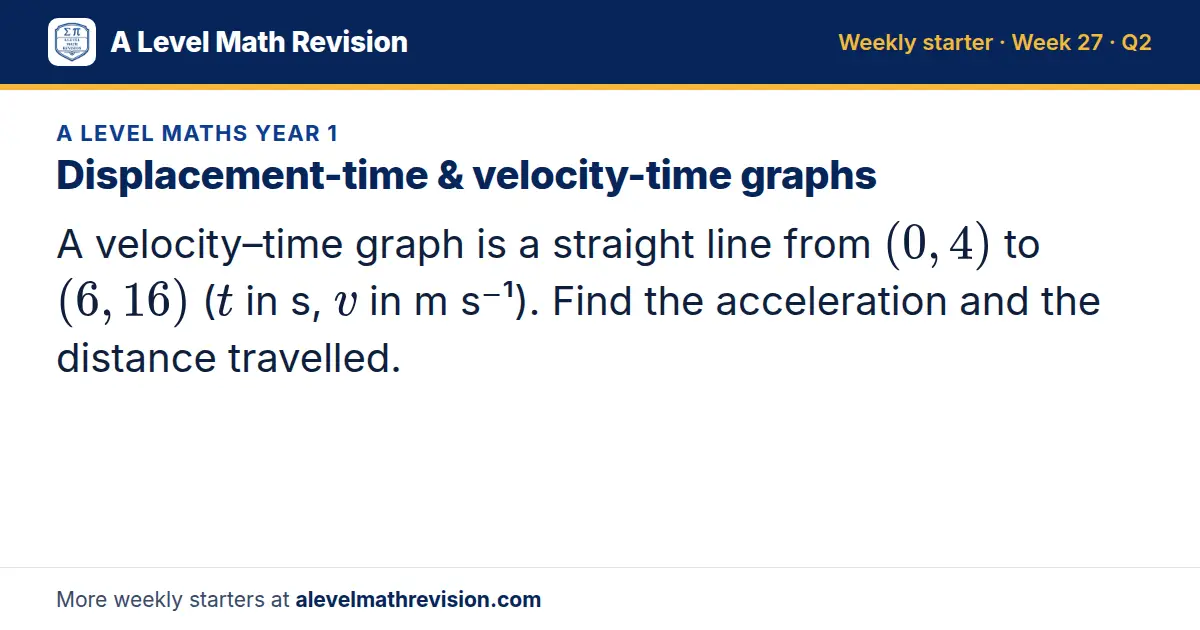
Question 2: Displacement-time & velocity-time graphs
A velocity–time graph is a straight line from (0, 4) to (6, 16) (t in s, v in m s⁻¹). Find the acceleration and the distance travelled.
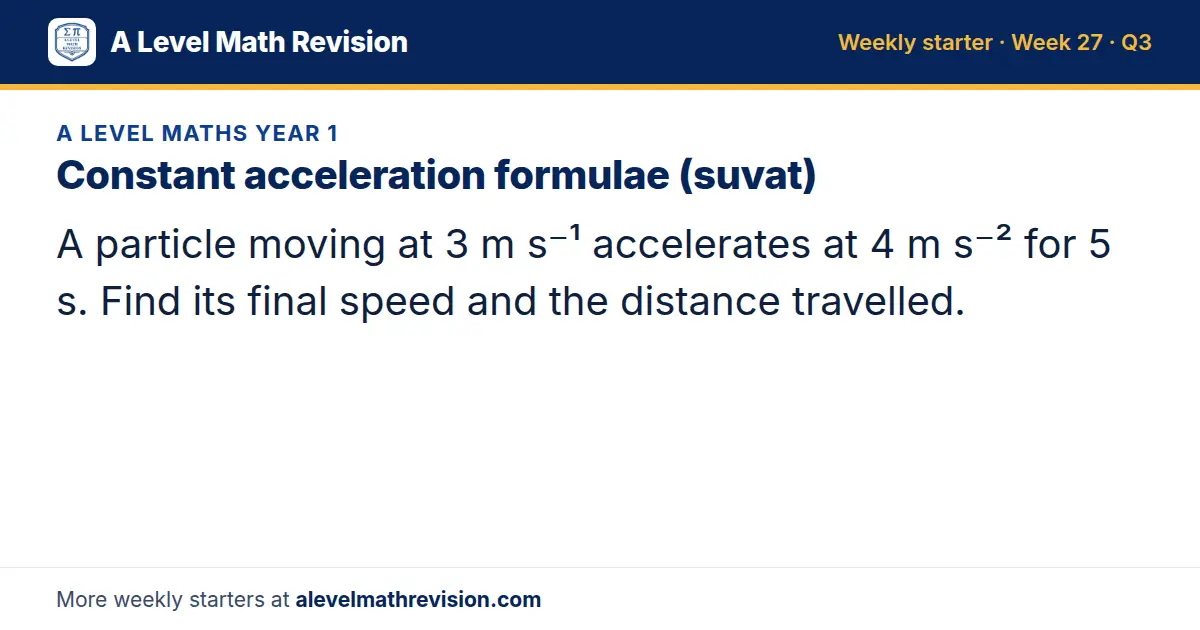
Question 3: Constant acceleration formulae (suvat)
A particle moving at 3 m s⁻¹ accelerates at 4 m s⁻² for 5 s. Find its final speed and the distance travelled.
Week 28
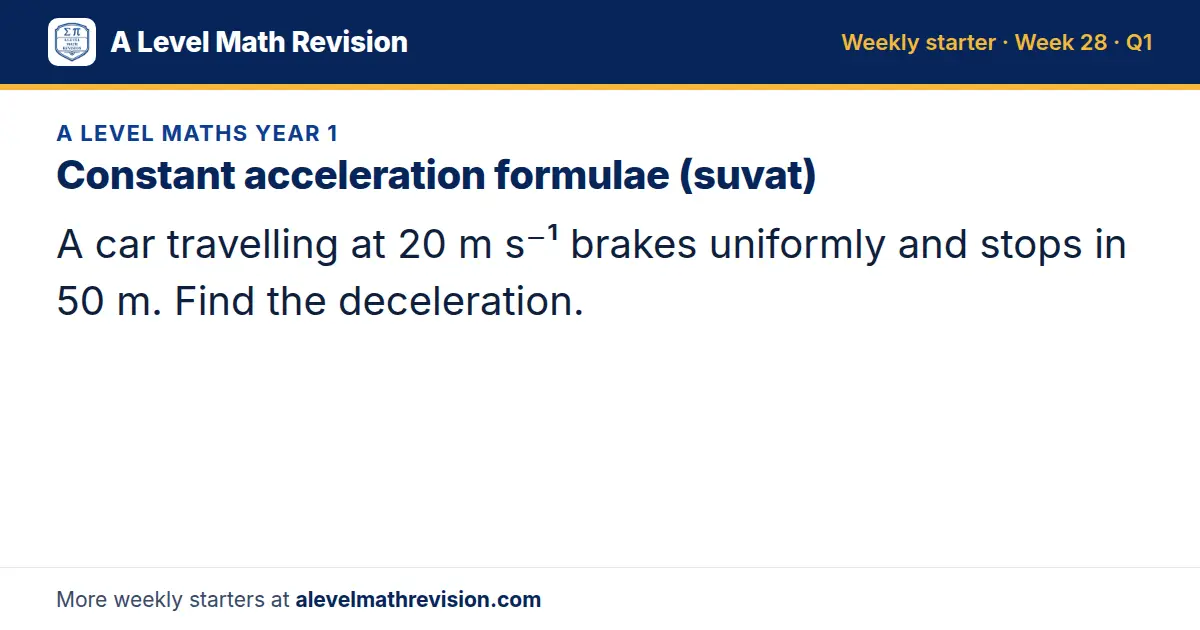
Question 1: Constant acceleration formulae (suvat)
A car travelling at 20 m s⁻¹ brakes uniformly and stops in 50 m. Find the deceleration.
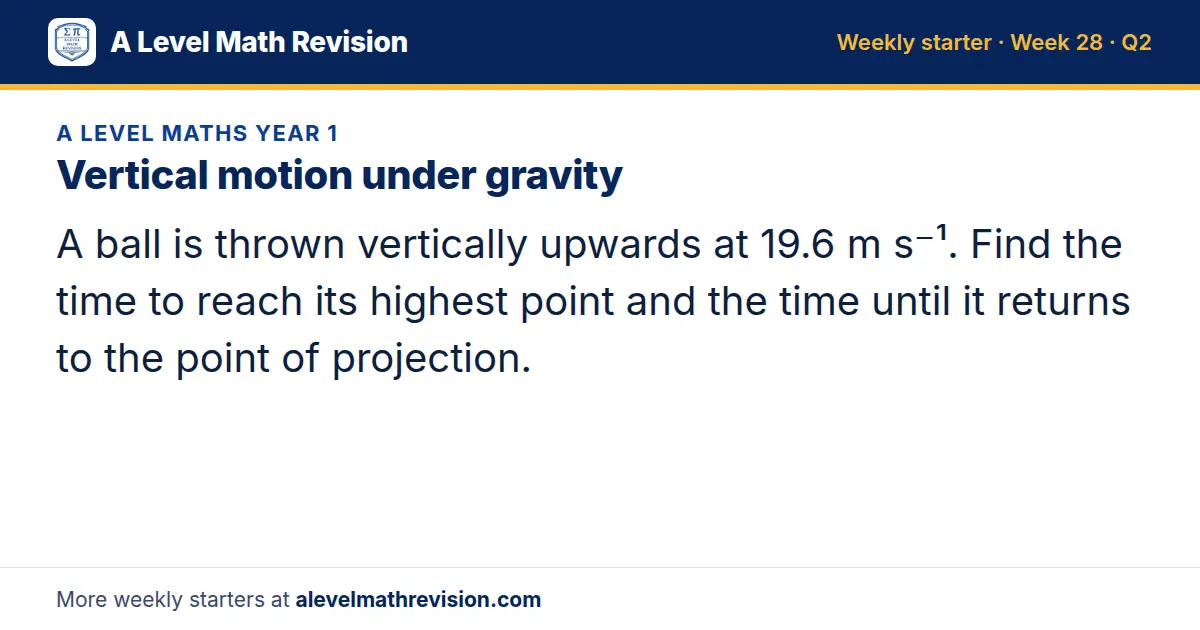
Question 2: Vertical motion under gravity
A ball is thrown vertically upwards at 19.6 m s⁻¹. Find the time to reach its highest point and the time until it returns to the point of projection.
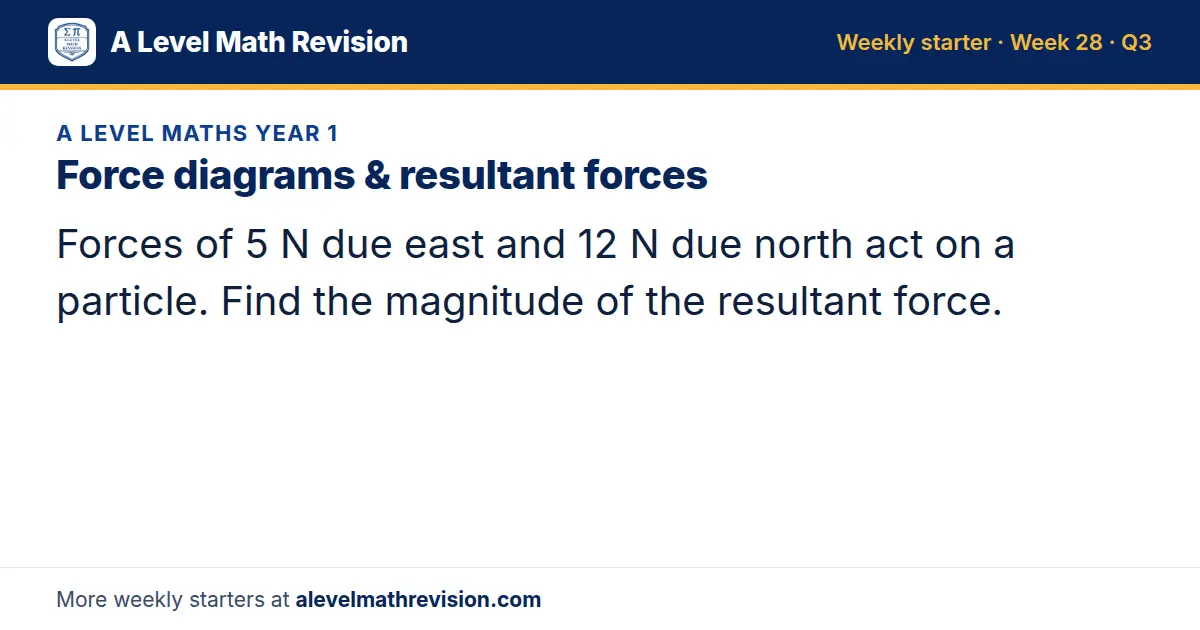
Question 3: Force diagrams & resultant forces
Forces of 5 N due east and 12 N due north act on a particle. Find the magnitude of the resultant force.
Week 29
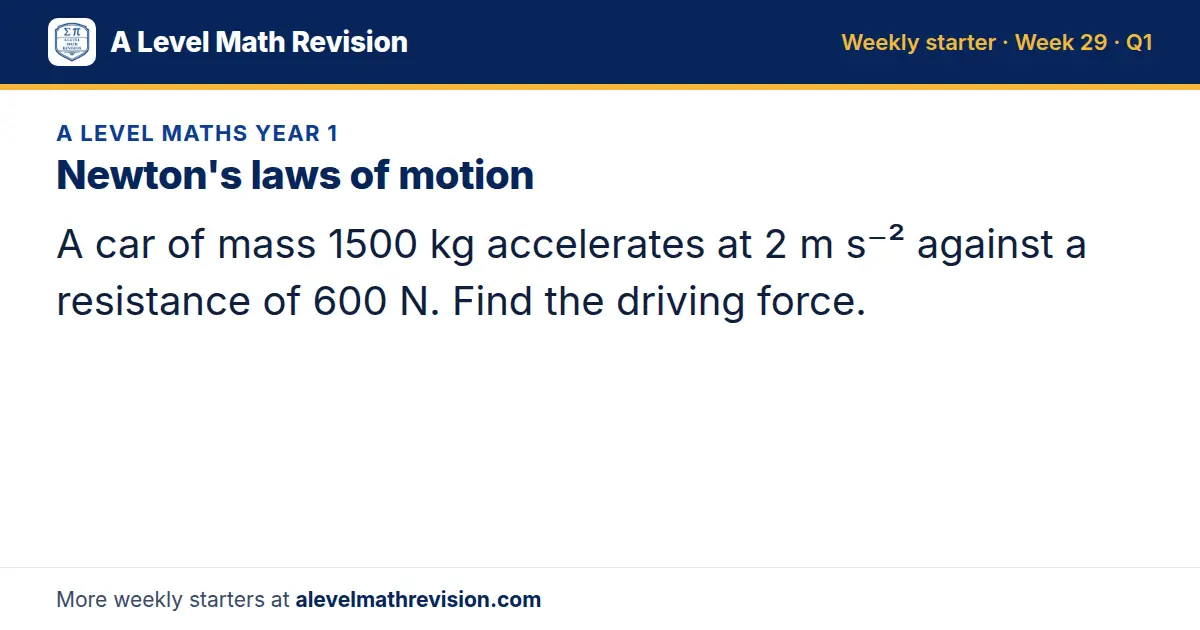
Question 1: Newton's laws of motion
A car of mass 1500 kg accelerates at 2 m s⁻² against a resistance of 600 N. Find the driving force.
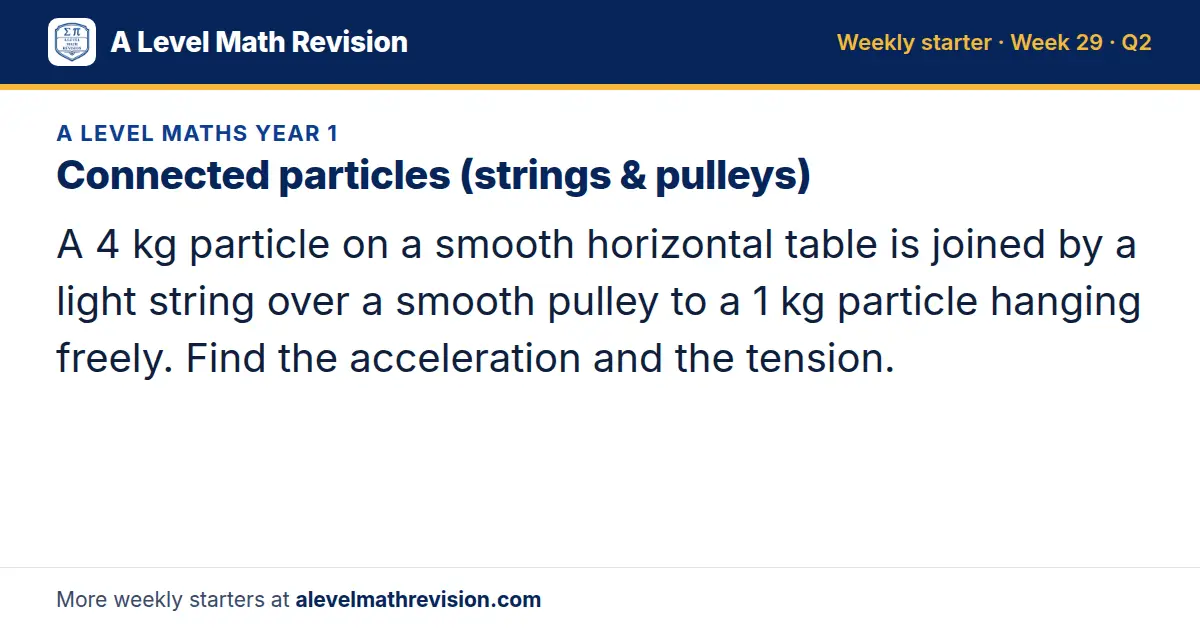
Question 2: Connected particles (strings & pulleys)
A 4 kg particle on a smooth horizontal table is joined by a light string over a smooth pulley to a 1 kg particle hanging freely. Find the acceleration and the tension.
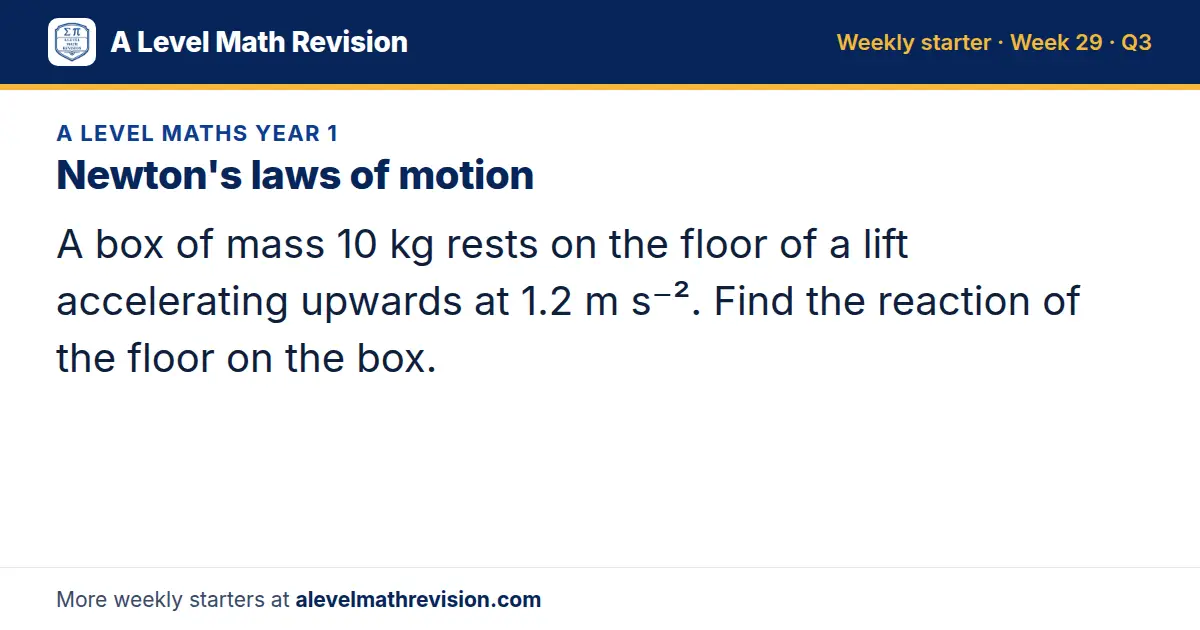
Question 3: Newton's laws of motion
A box of mass 10 kg rests on the floor of a lift accelerating upwards at 1.2 m s⁻². Find the reaction of the floor on the box.
Week 30
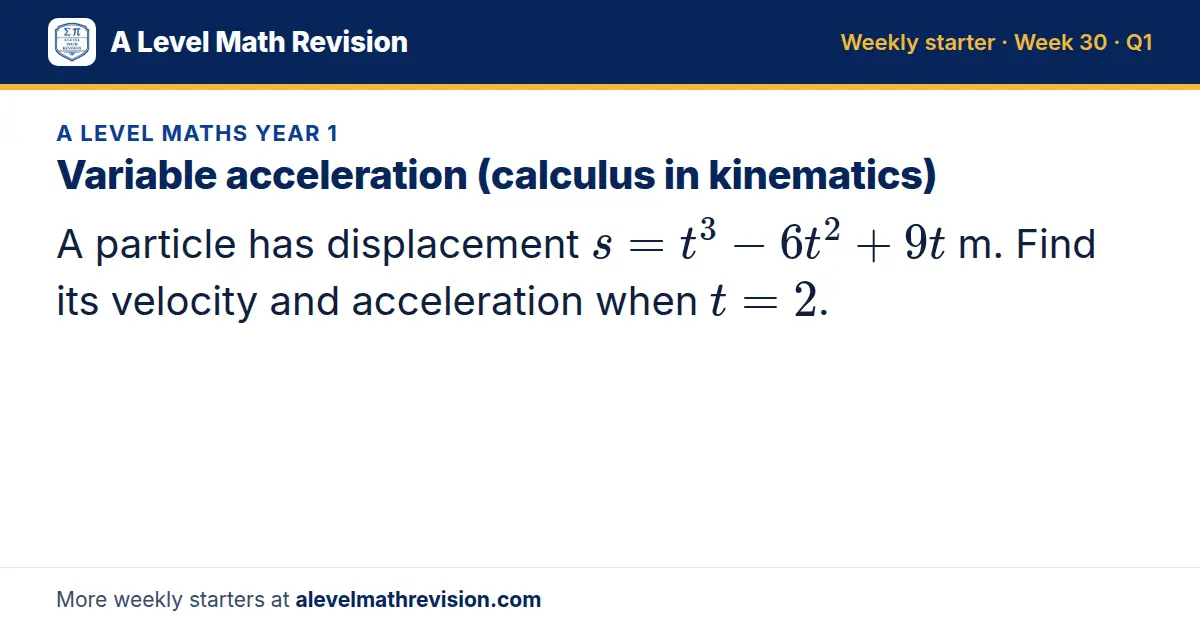
Question 1: Variable acceleration (calculus in kinematics)
A particle has displacement s = t³ - 6t² + 9t m. Find its velocity and acceleration when t = 2.
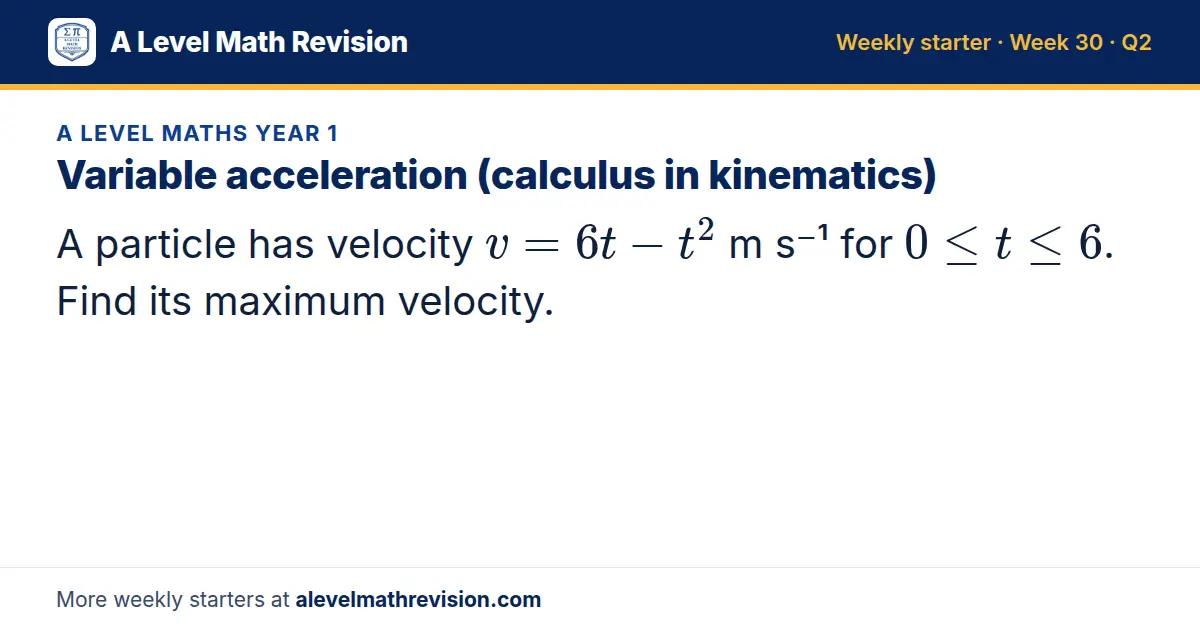
Question 2: Variable acceleration (calculus in kinematics)
A particle has velocity v = 6t - t² m s⁻¹ for 0 ≤ t ≤ 6. Find its maximum velocity.
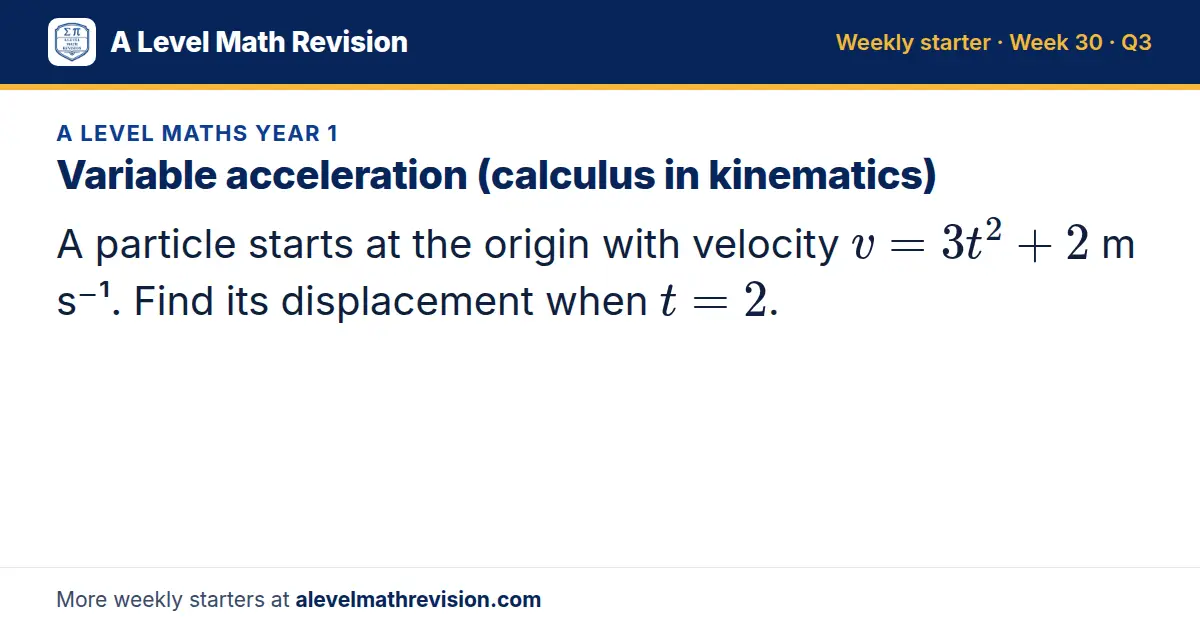
Question 3: Variable acceleration (calculus in kinematics)
A particle starts at the origin with velocity v = 3t² + 2 m s⁻¹. Find its displacement when t = 2.
Week 31
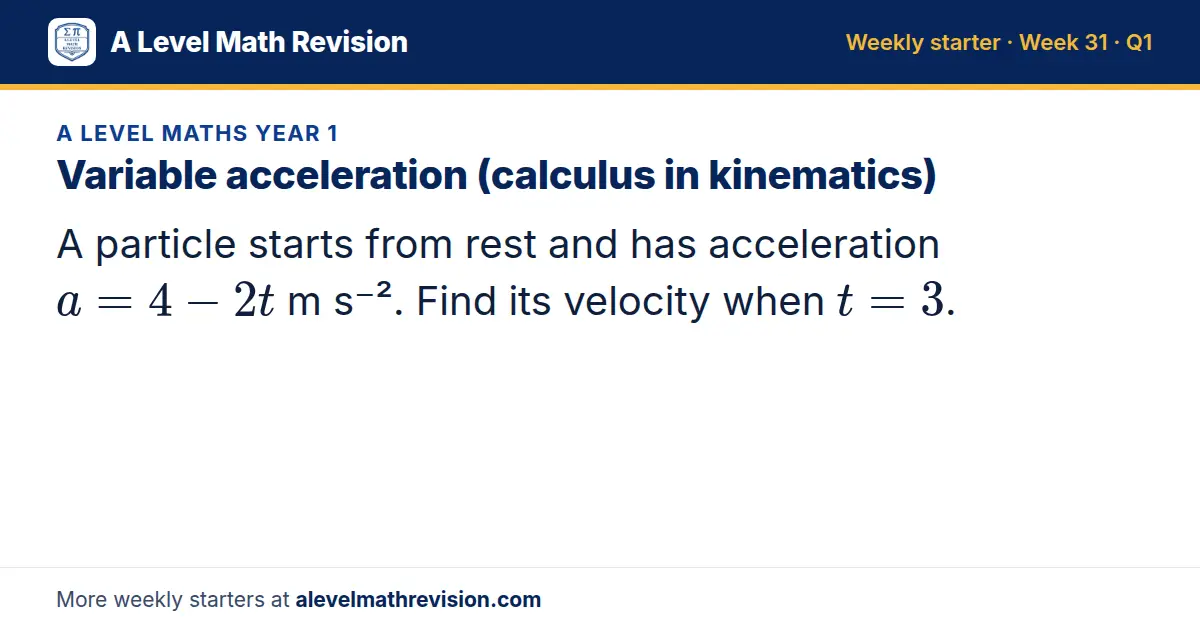
Question 1: Variable acceleration (calculus in kinematics)
A particle starts from rest and has acceleration a = 4 - 2t m s⁻². Find its velocity when t = 3.
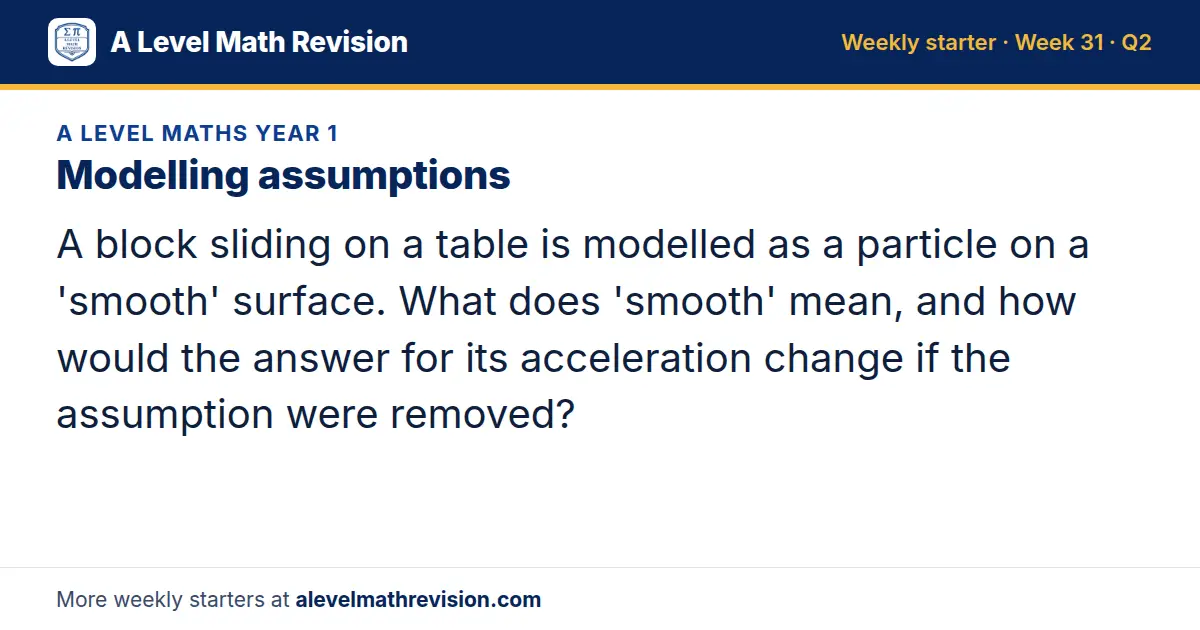
Question 2: Modelling assumptions
A block sliding on a table is modelled as a particle on a 'smooth' surface. What does 'smooth' mean, and how would the answer for its acceleration change if the assumption were removed?
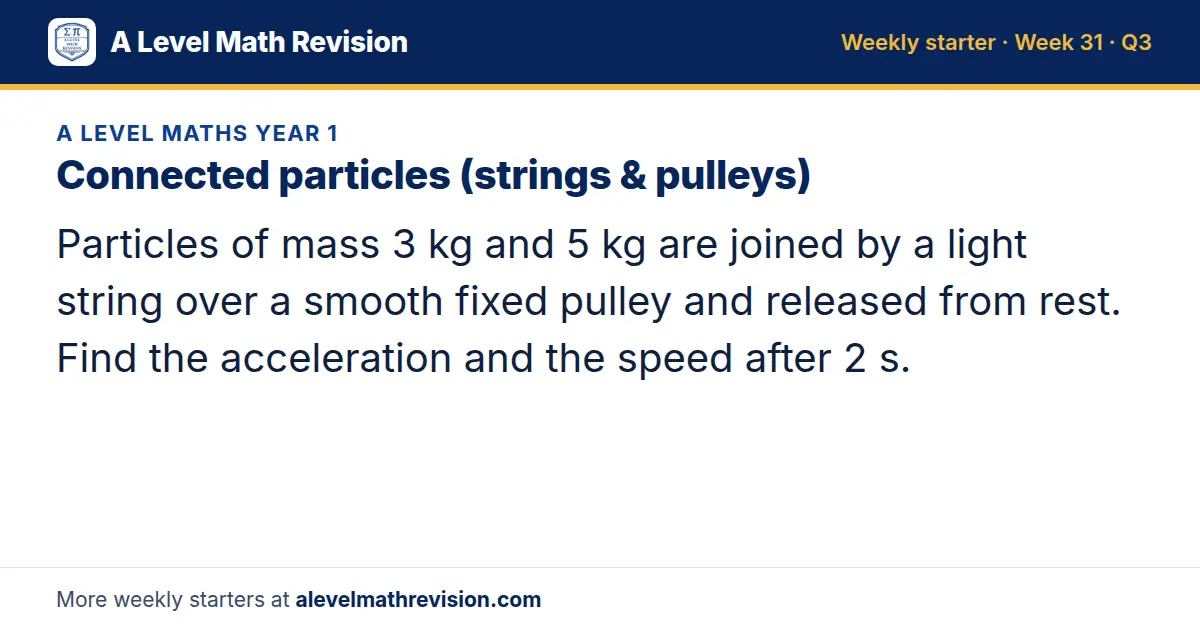
Question 3: Connected particles (strings & pulleys)
Particles of mass 3 kg and 5 kg are joined by a light string over a smooth fixed pulley and released from rest. Find the acceleration and the speed after 2 s.
Week 32
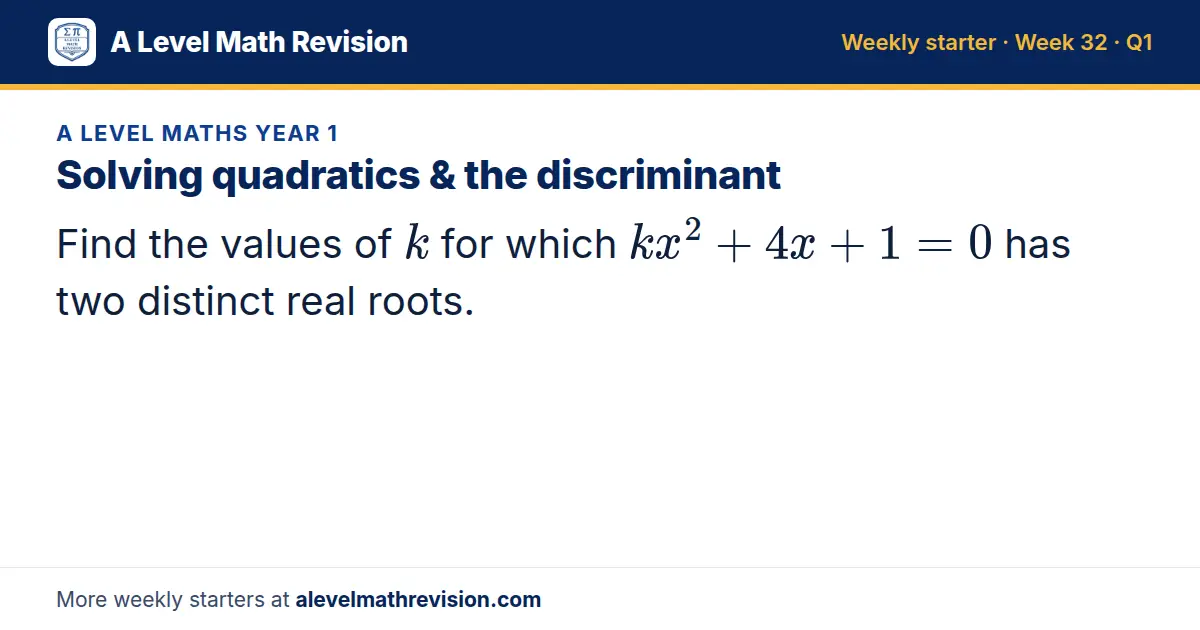
Question 1: Solving quadratics & the discriminant
Find the values of k for which kx² + 4x + 1 = 0 has two distinct real roots.
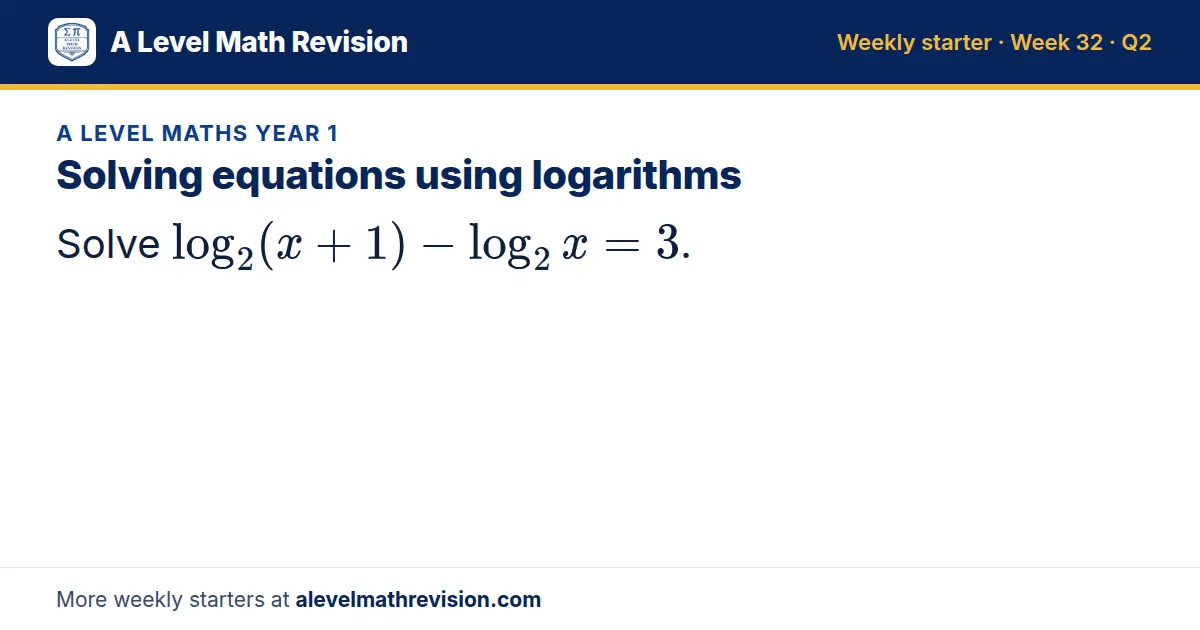
Question 2: Solving equations using logarithms
Solve log_2(x + 1) - log_2 x = 3.
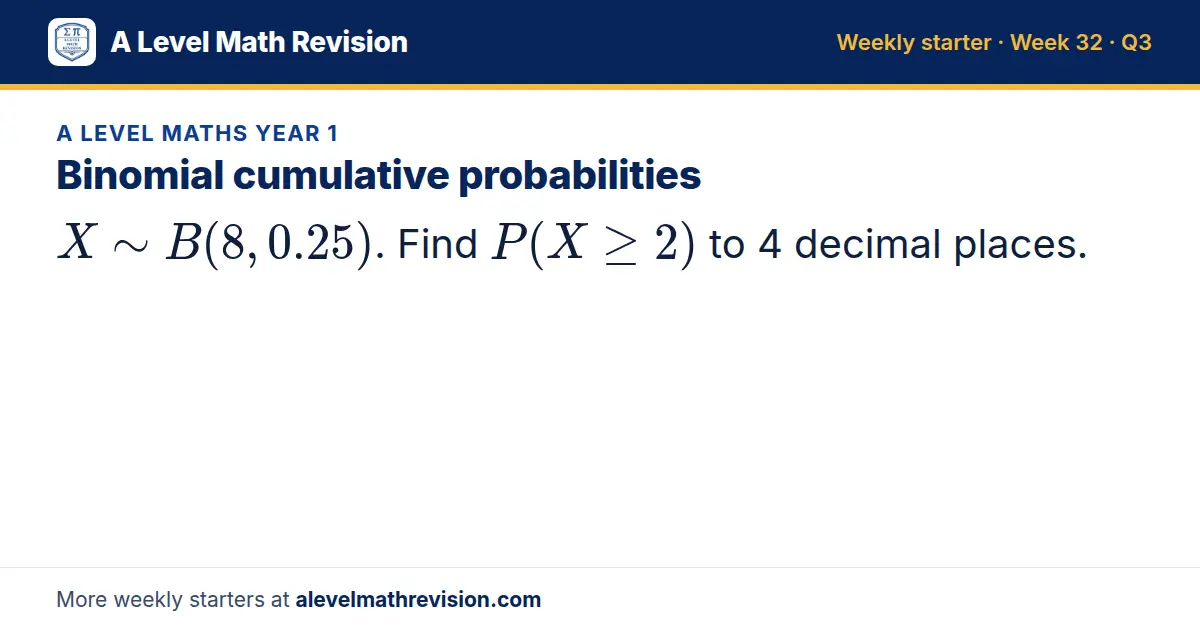
Question 3: Binomial cumulative probabilities
X B(8, 0.25). Find P(X ≥ 2) to 4 decimal places.
Week 33
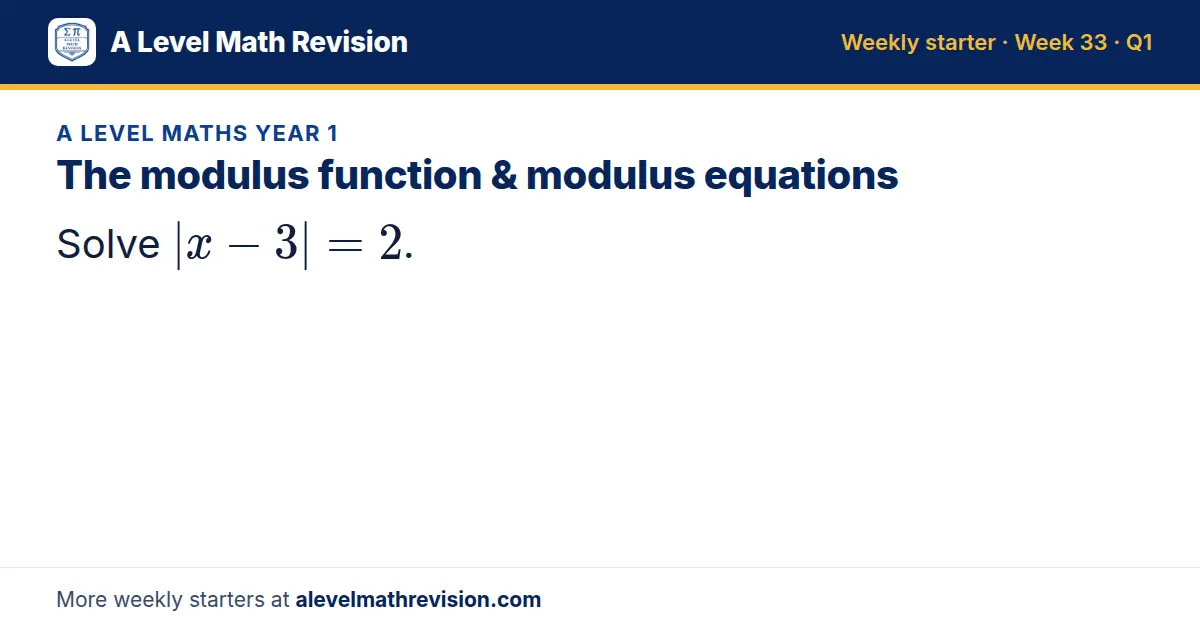
Question 1: The modulus function & modulus equations
Solve |x - 3| = 2.
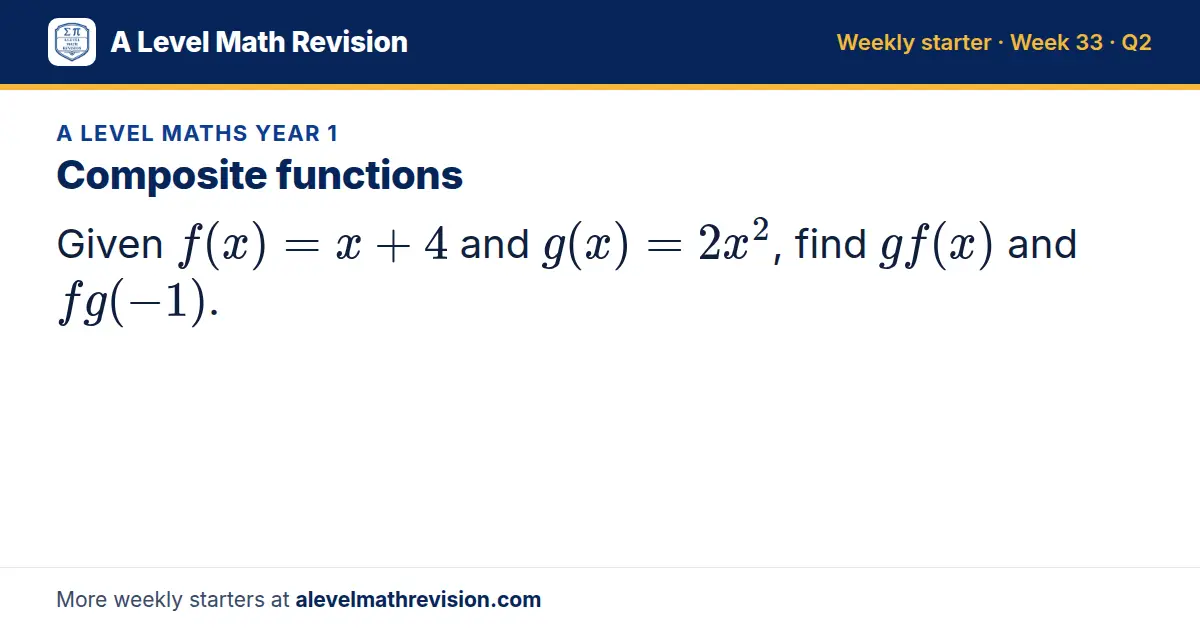
Question 2: Composite functions
Given f(x) = x + 4 and g(x) = 2x², find gf(x) and fg(-1).
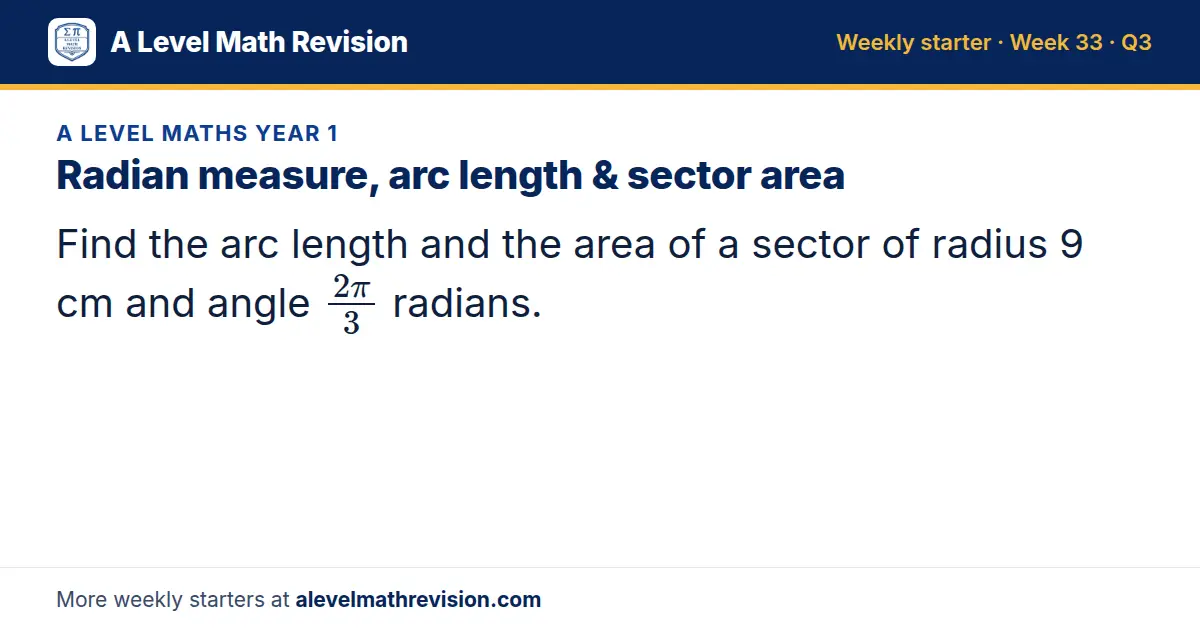
Question 3: Radian measure, arc length & sector area
Find the arc length and the area of a sector of radius 9 cm and angle (2π)/3 radians.
Week 34
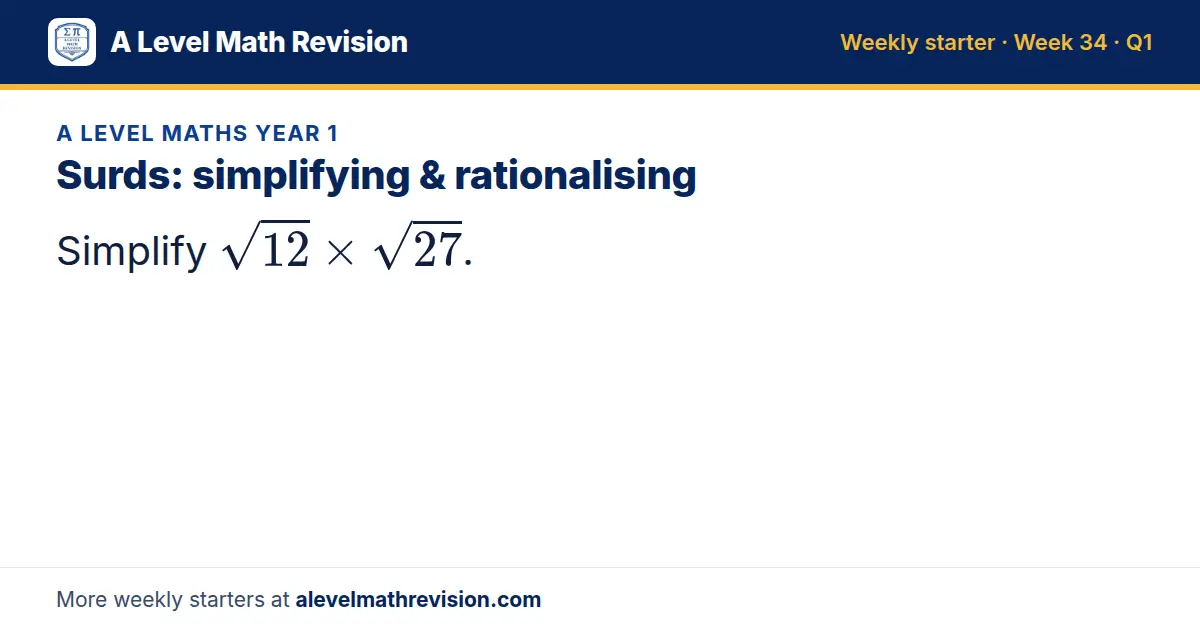
Question 1: Surds: simplifying & rationalising
Simplify √12 × √27.
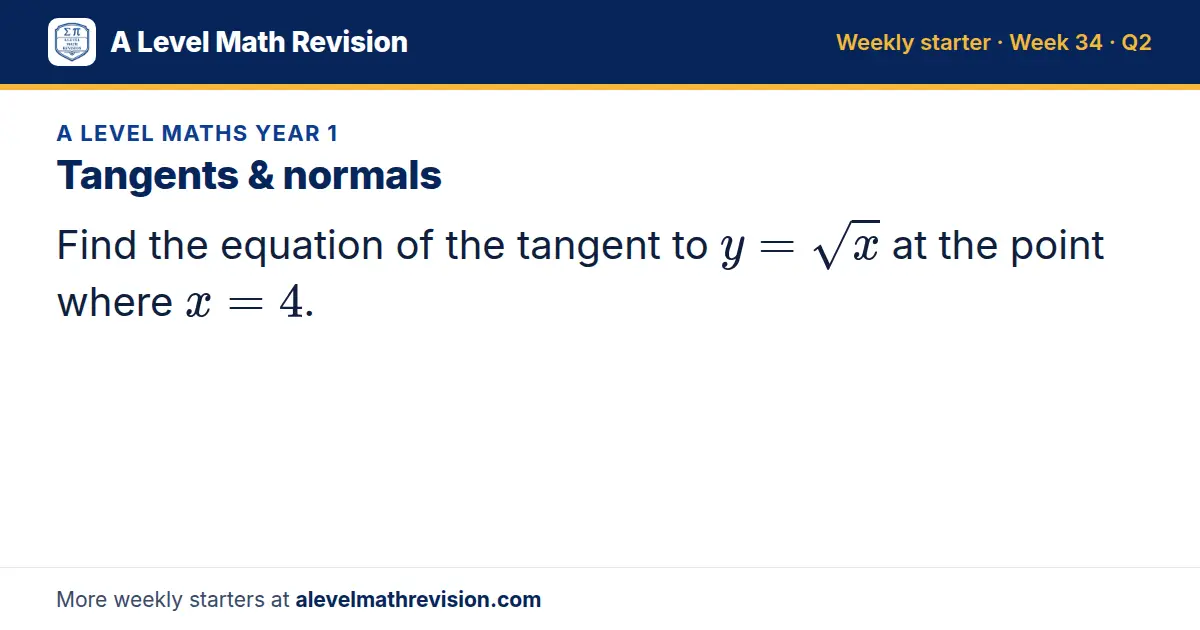
Question 2: Tangents & normals
Find the equation of the tangent to y = √x at the point where x = 4.
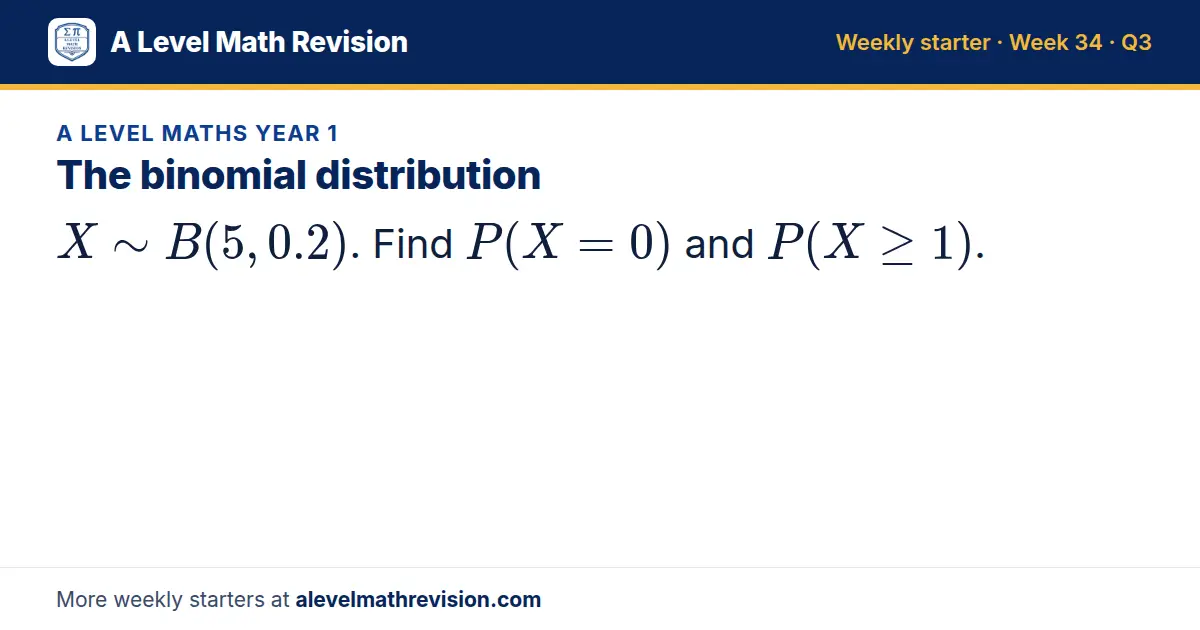
Question 3: The binomial distribution
X B(5, 0.2). Find P(X = 0) and P(X ≥ 1).
Week 35
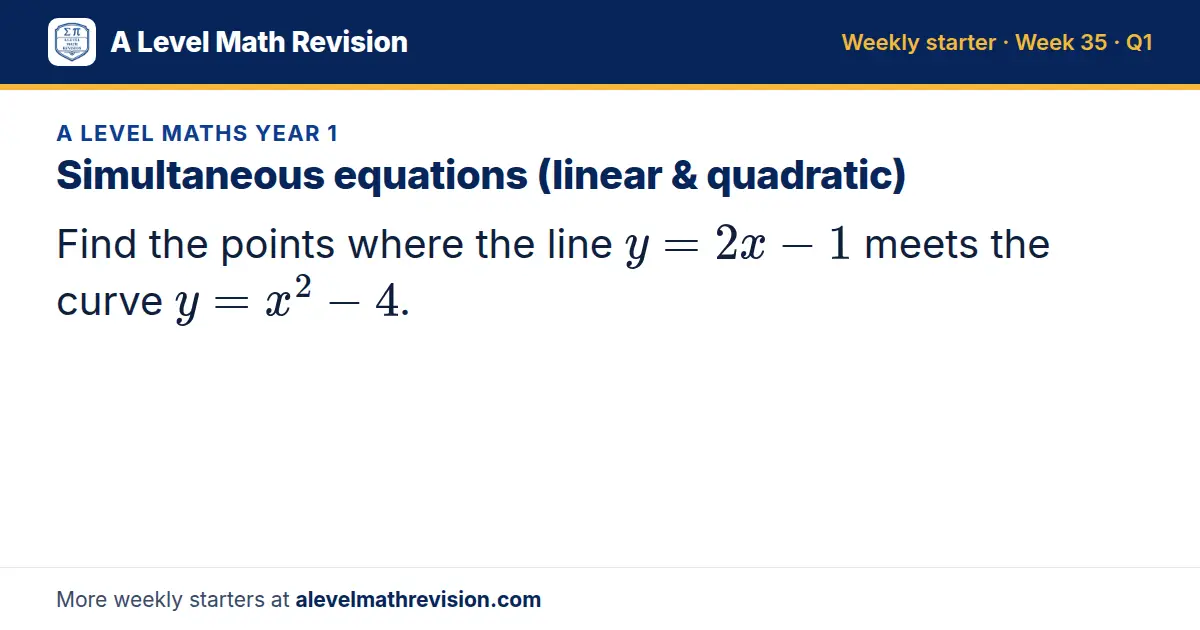
Question 1: Simultaneous equations (linear & quadratic)
Find the points where the line y = 2x - 1 meets the curve y = x² - 4.
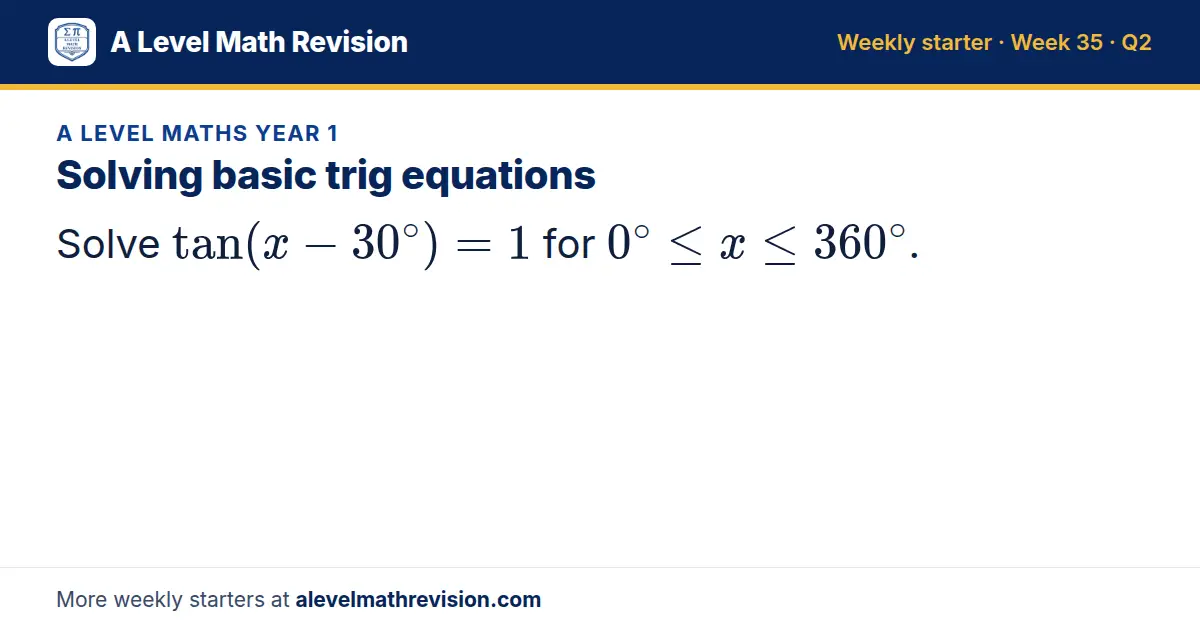
Question 2: Solving basic trig equations
Solve tan(x - 30^∘) = 1 for 0^∘ ≤ x ≤ 360^∘.
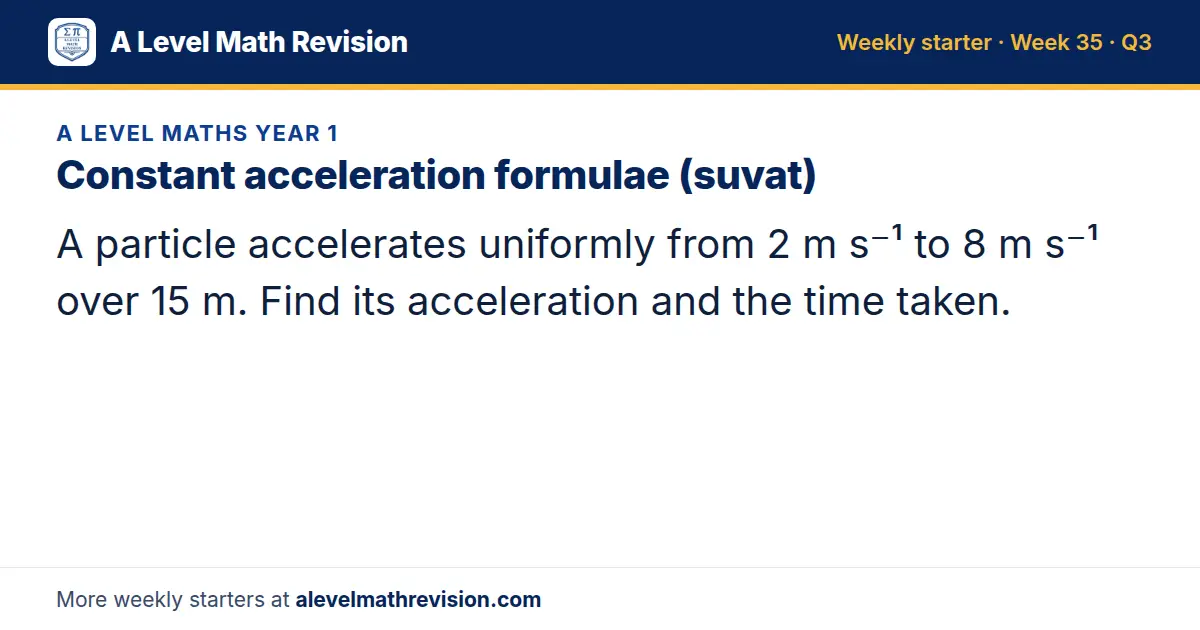
Question 3: Constant acceleration formulae (suvat)
A particle accelerates uniformly from 2 m s⁻¹ to 8 m s⁻¹ over 15 m. Find its acceleration and the time taken.
Week 36
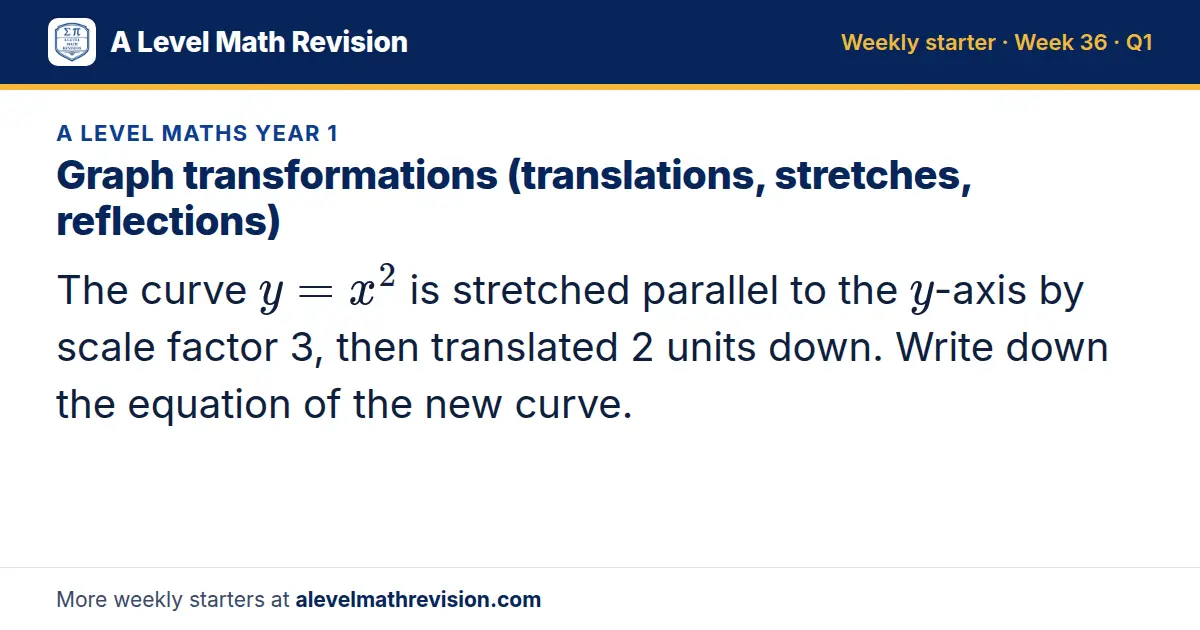
Question 1: Graph transformations (translations, stretches, reflections)
The curve y = x² is stretched parallel to the y-axis by scale factor 3, then translated 2 units down. Write down the equation of the new curve.
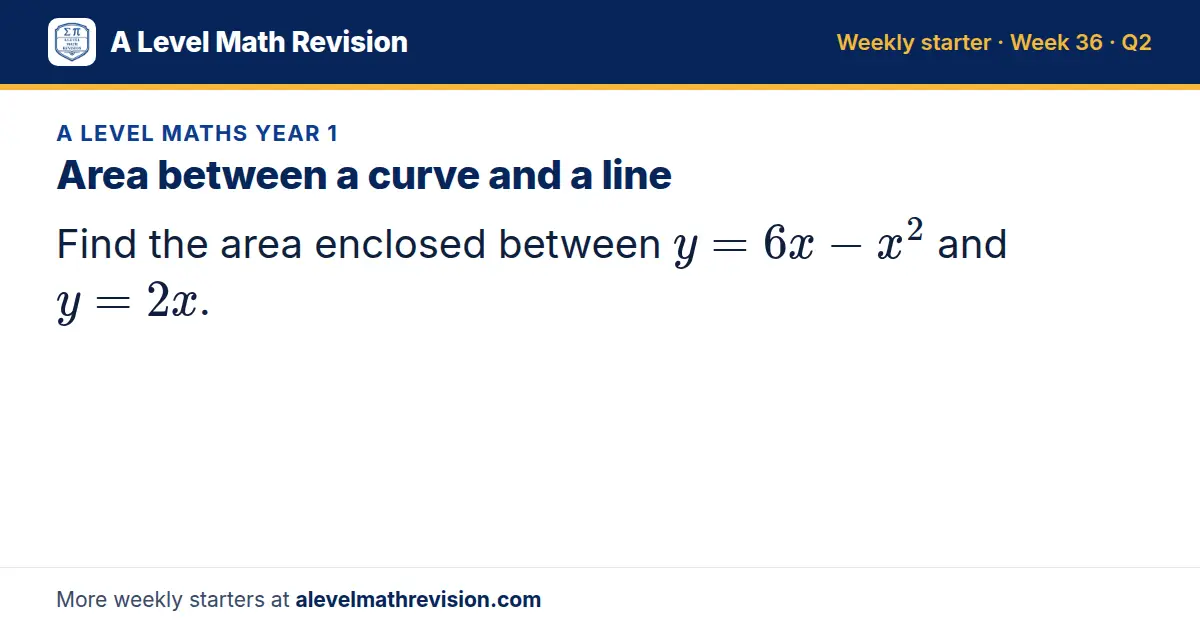
Question 2: Area between a curve and a line
Find the area enclosed between y = 6x - x² and y = 2x.
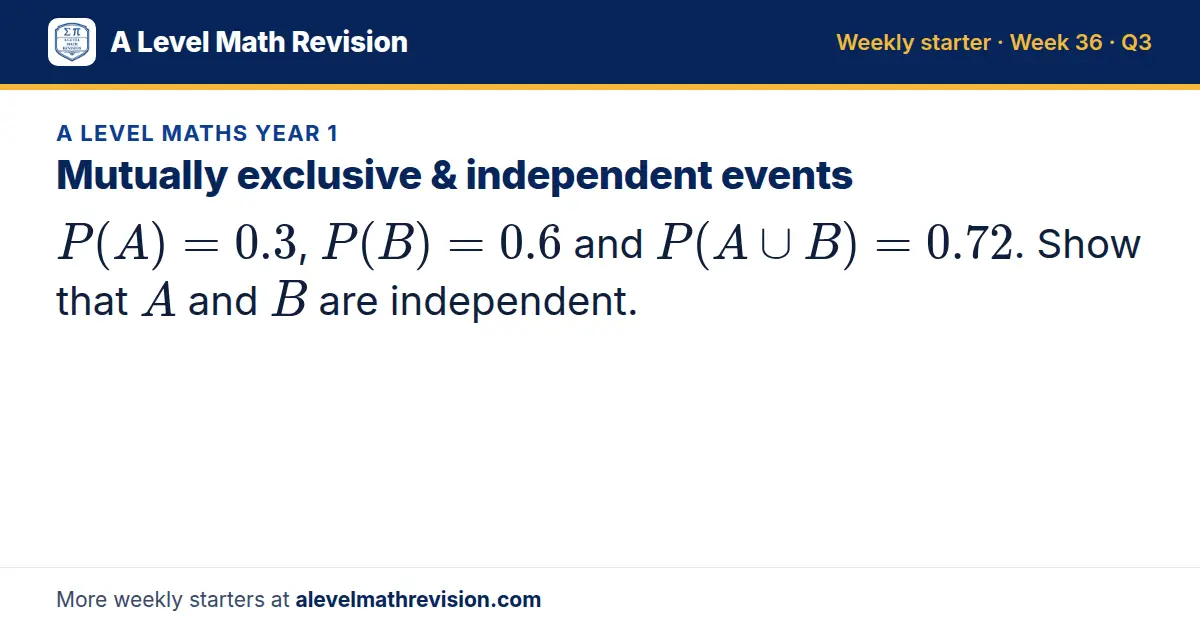
Question 3: Mutually exclusive & independent events
P(A) = 0.3, P(B) = 0.6 and P(A ∪ B) = 0.72. Show that A and B are independent.
Week 37
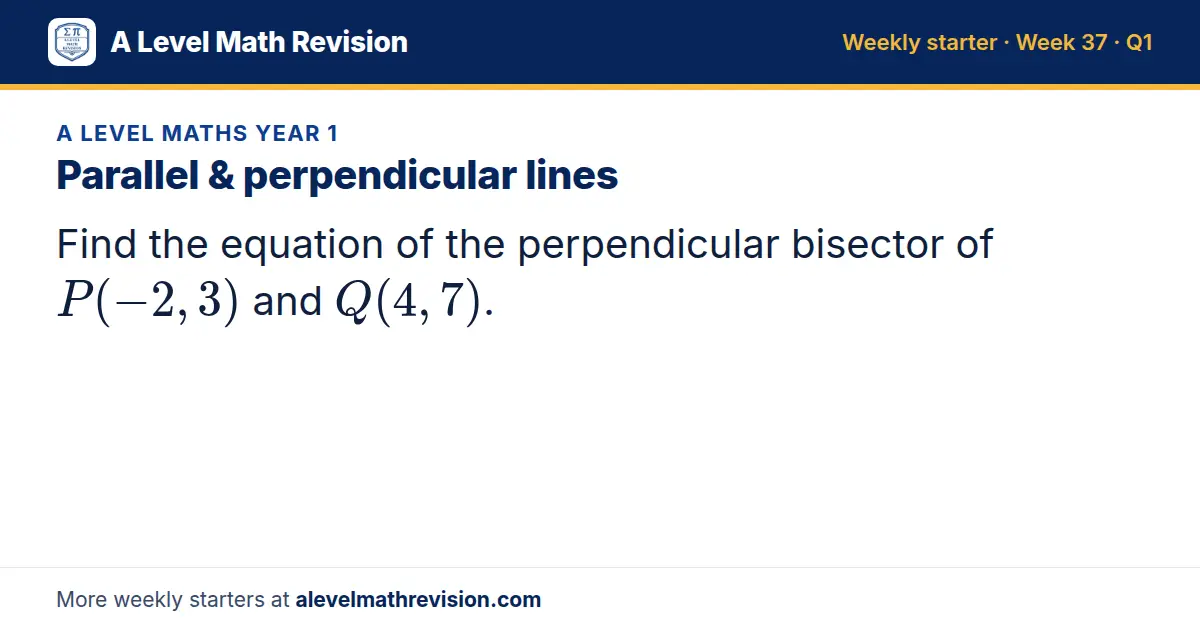
Question 1: Parallel & perpendicular lines
Find the equation of the perpendicular bisector of P(-2, 3) and Q(4, 7).
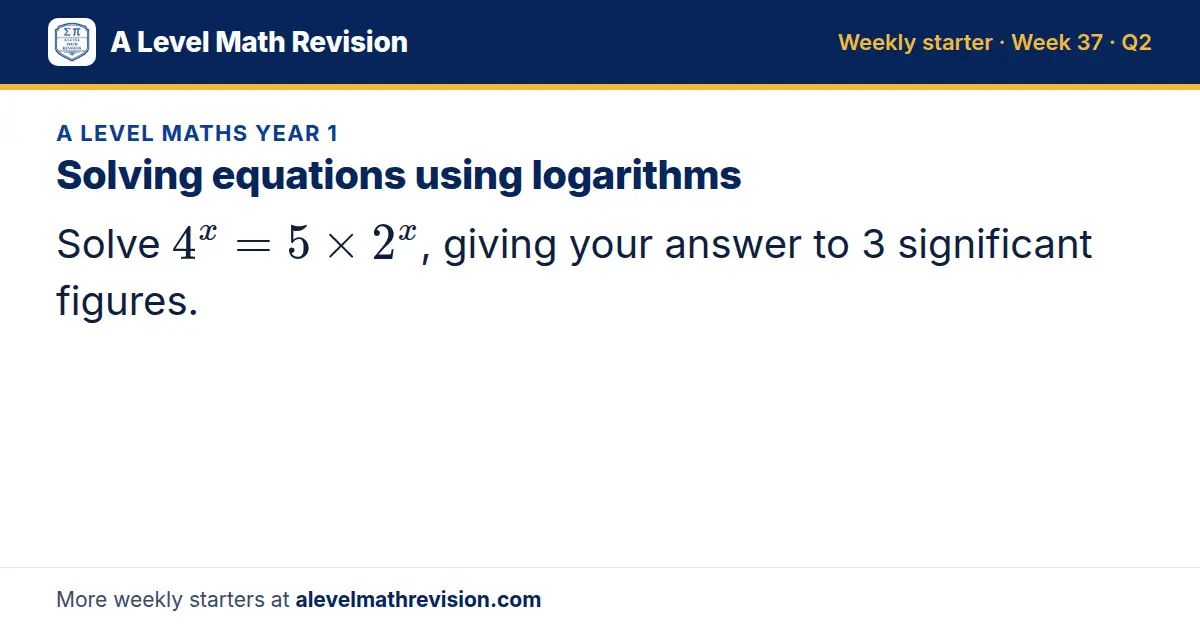
Question 2: Solving equations using logarithms
Solve 4^x = 5 × 2^x, giving your answer to 3 significant figures.
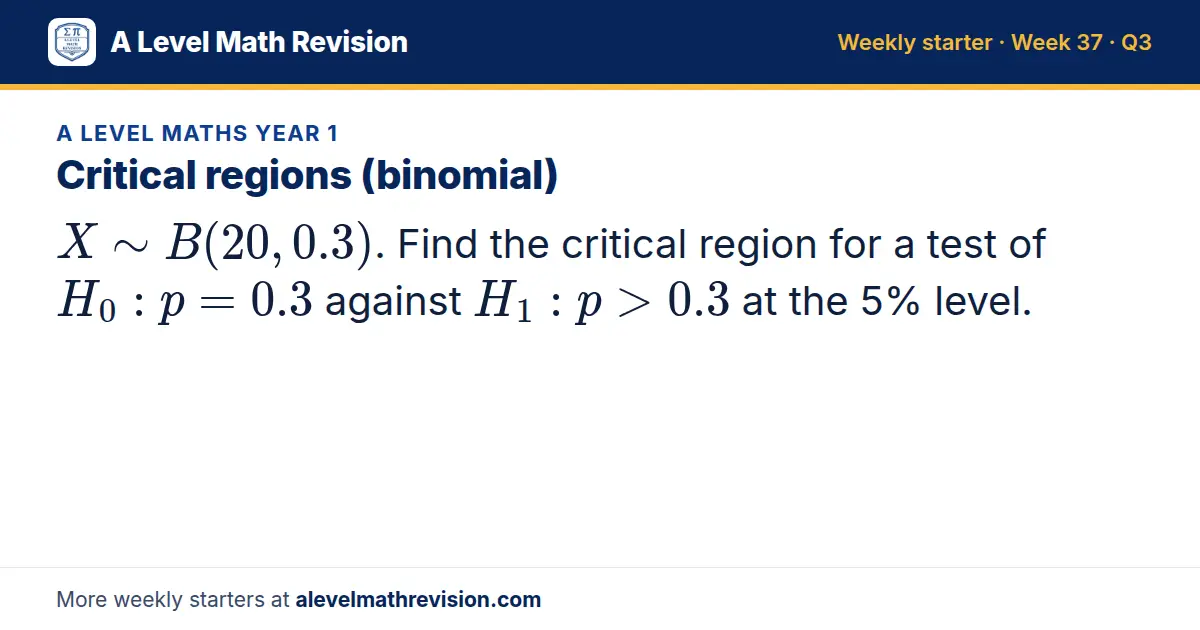
Question 3: Critical regions (binomial)
X B(20, 0.3). Find the critical region for a test of H_0: p = 0.3 against H_1: p > 0.3 at the 5% level.
Week 38
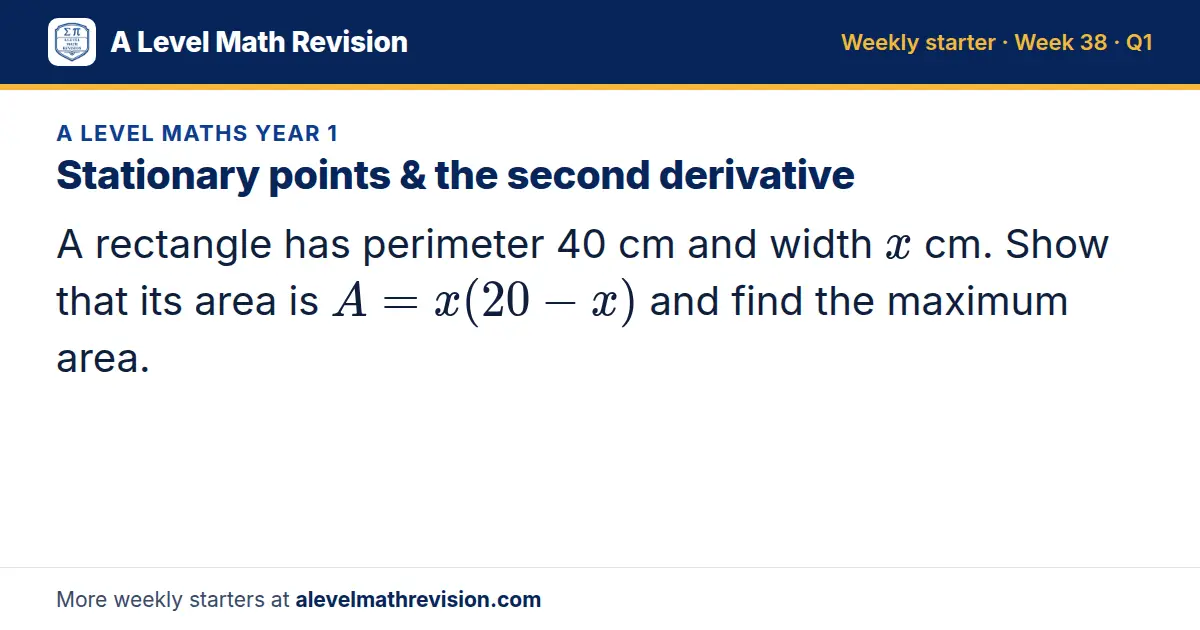
Question 1: Stationary points & the second derivative
A rectangle has perimeter 40 cm and width x cm. Show that its area is A = x(20 - x) and find the maximum area.
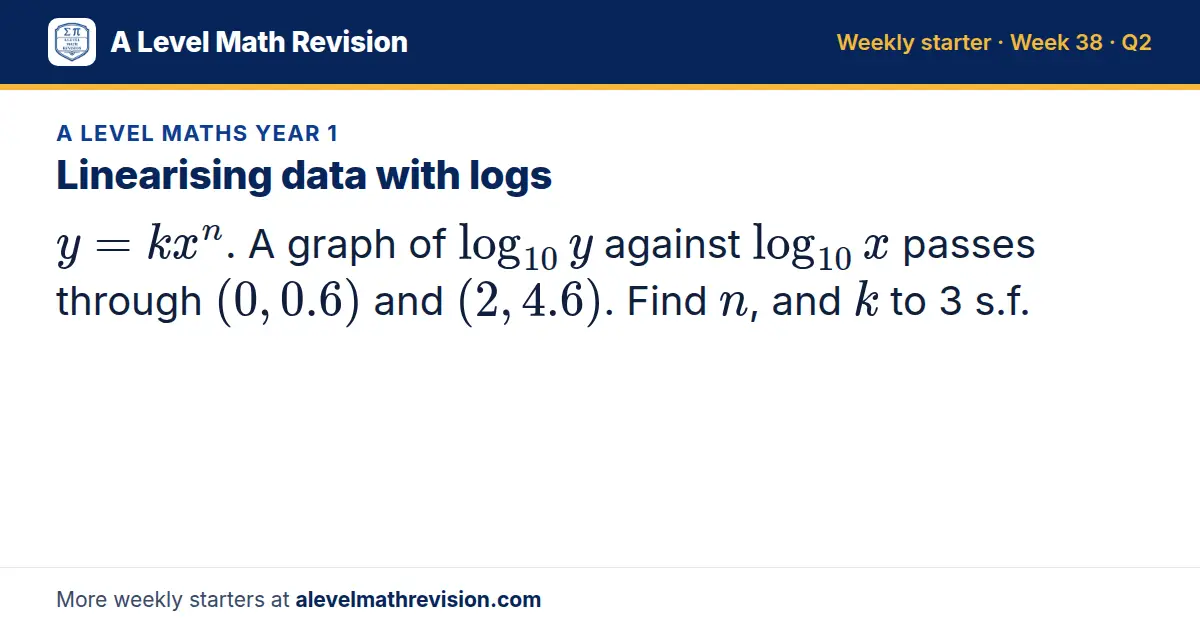
Question 2: Linearising data with logs
y = kx^n. A graph of log_10 y against log_10 x passes through (0, 0.6) and (2, 4.6). Find n, and k to 3 s.f.
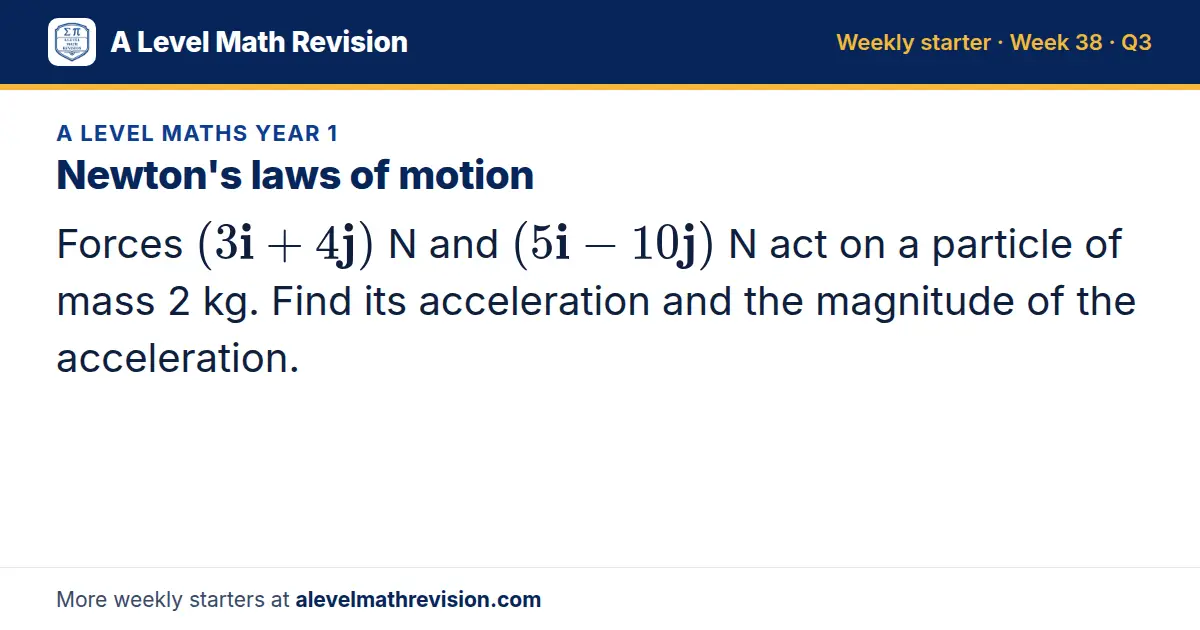
Question 3: Newton's laws of motion
Forces (3i + 4j) N and (5i - 10j) N act on a particle of mass 2 kg. Find its acceleration and the magnitude of the acceleration.
Week 39
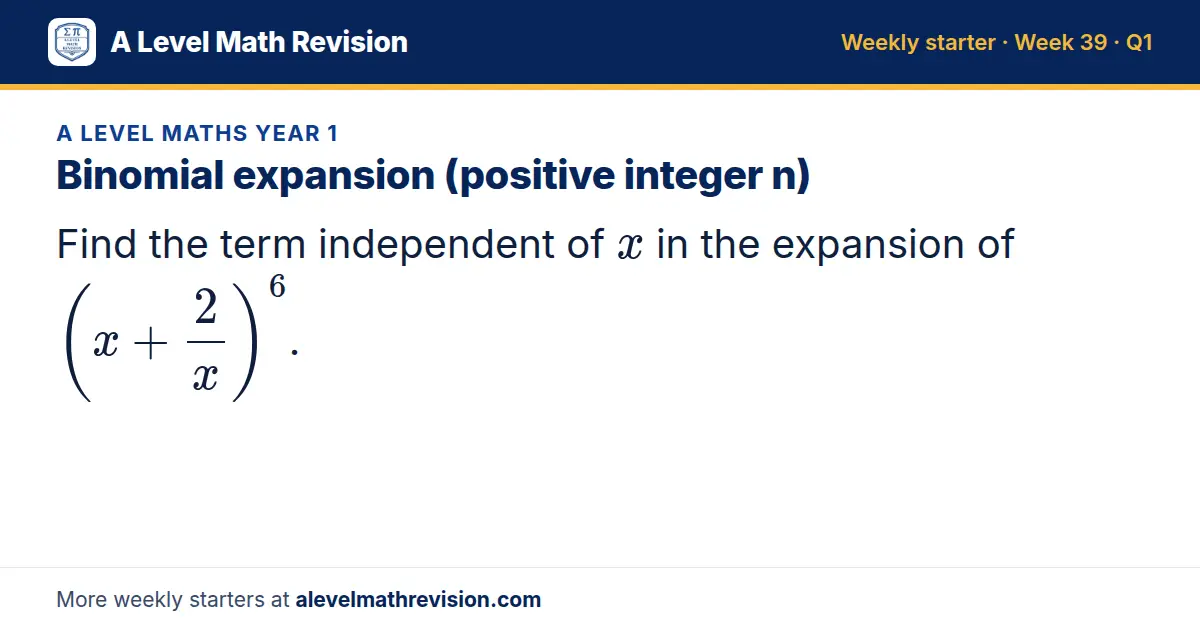
Question 1: Binomial expansion (positive integer n)
Find the term independent of x in the expansion of (x + 2/x)^6.
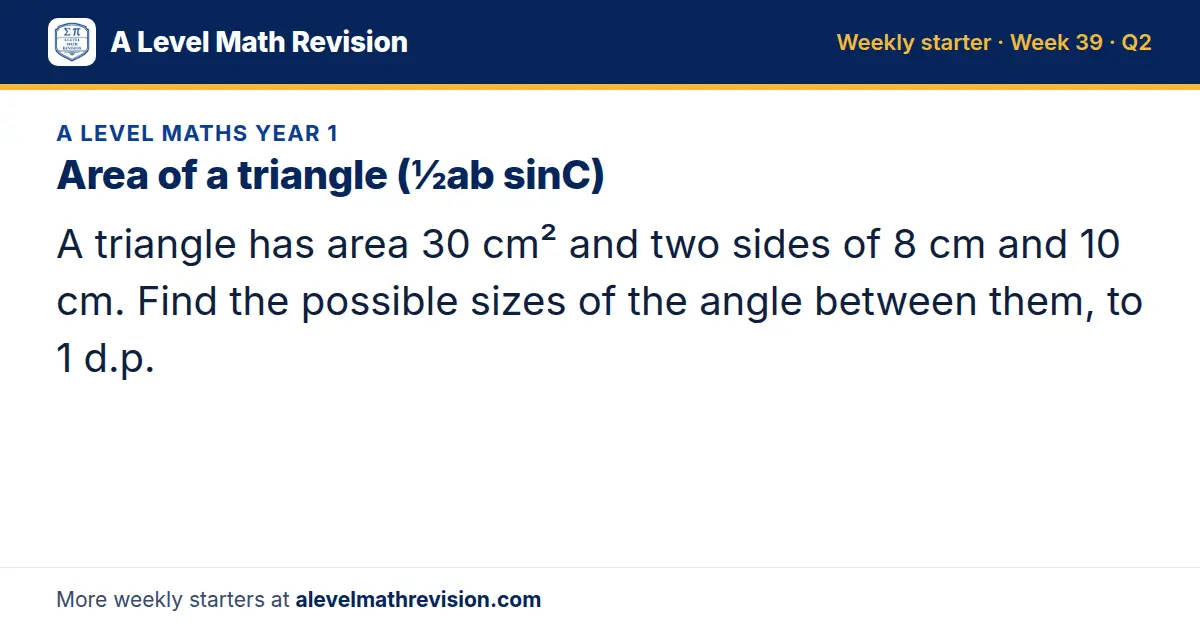
Question 2: Area of a triangle (½ab sinC)
A triangle has area 30 cm² and two sides of 8 cm and 10 cm. Find the possible sizes of the angle between them, to 1 d.p.
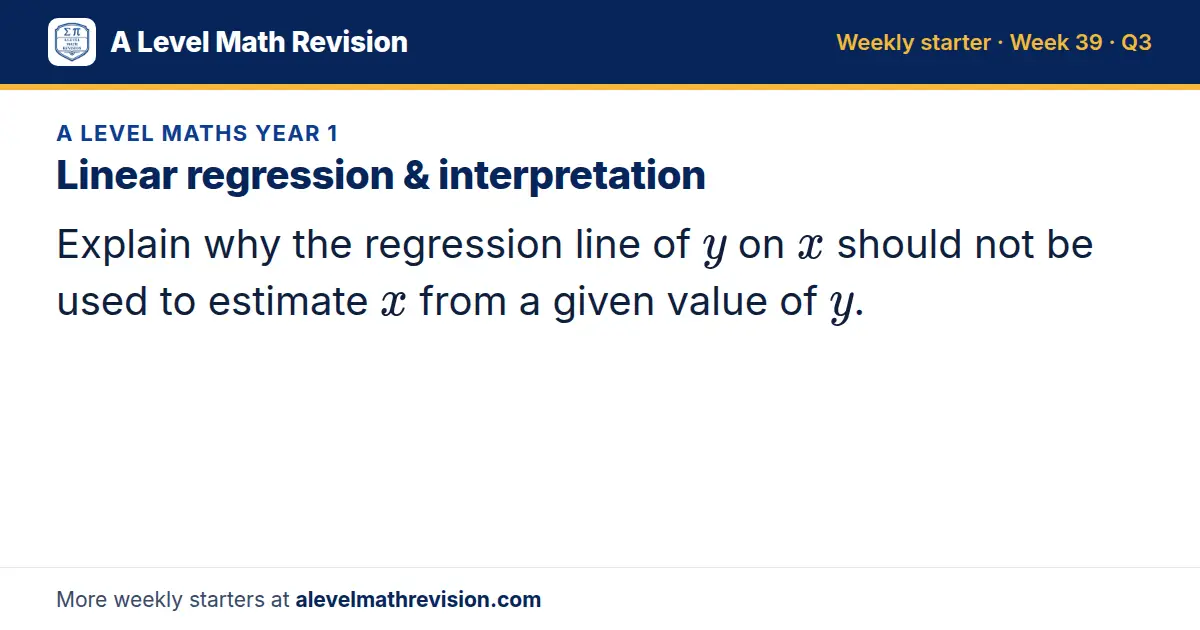
Question 3: Linear regression & interpretation
Explain why the regression line of y on x should not be used to estimate x from a given value of y.
Week 40
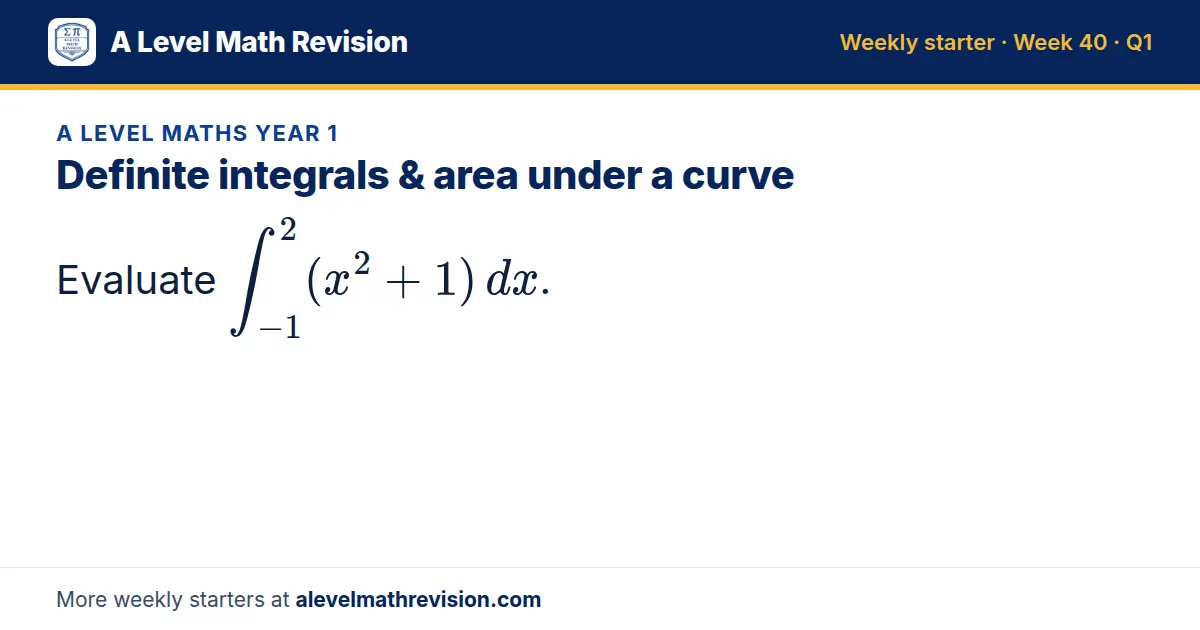
Question 1: Definite integrals & area under a curve
Evaluate ∫_-1² (x² + 1) dx.
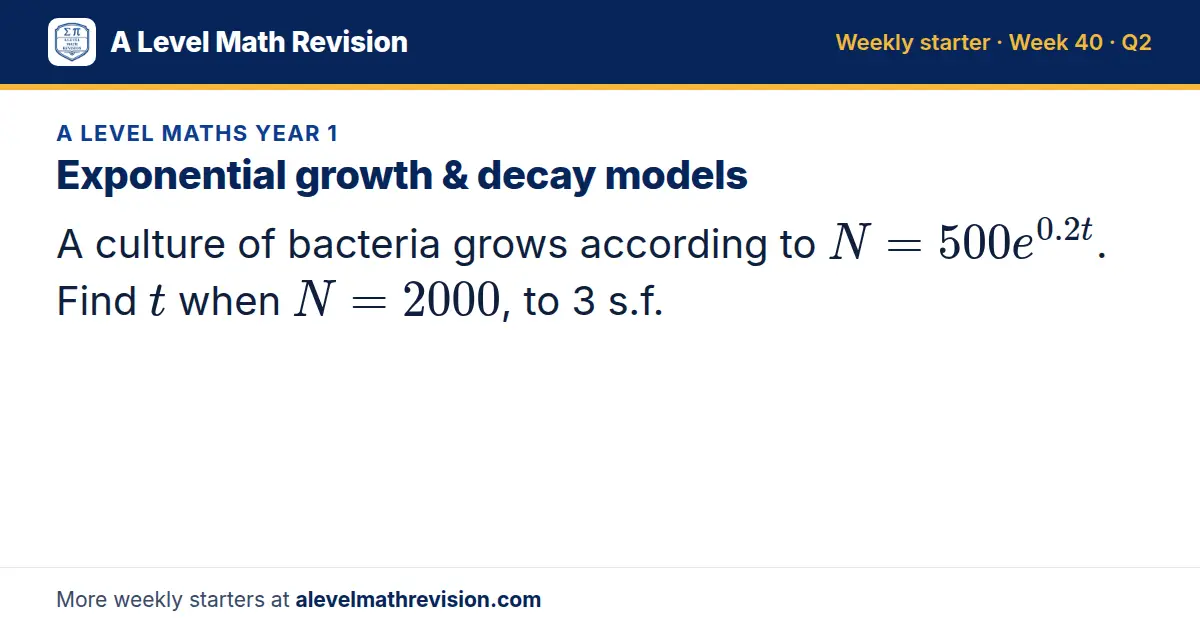
Question 2: Exponential growth & decay models
A culture of bacteria grows according to N = 500e^(0.2t). Find t when N = 2000, to 3 s.f.
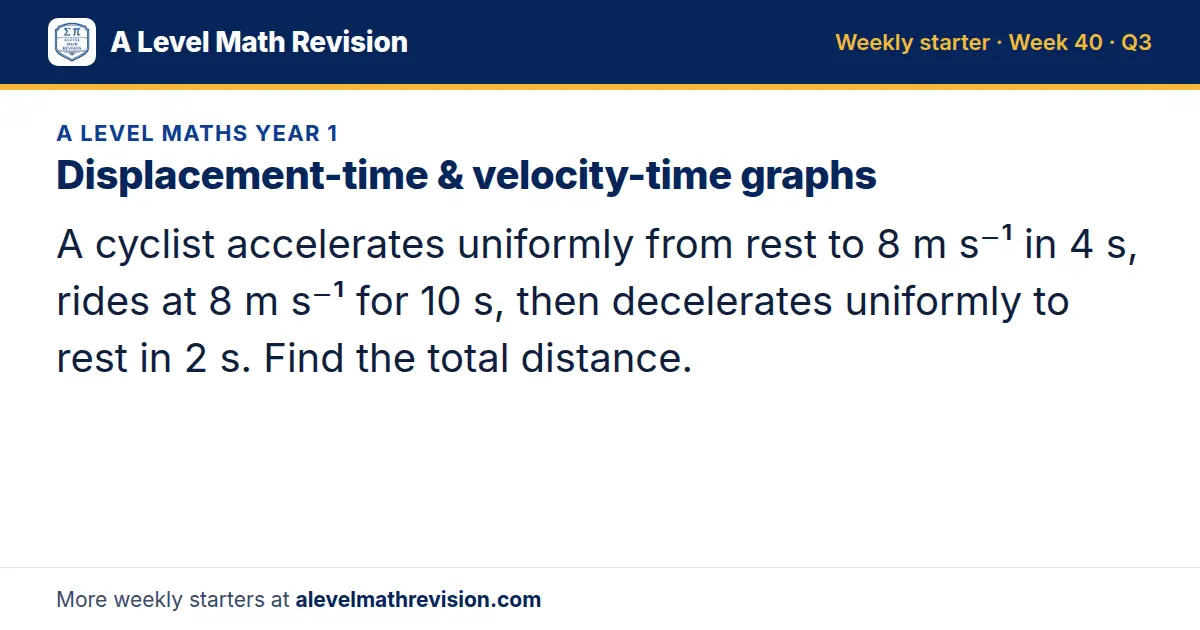
Question 3: Displacement-time & velocity-time graphs
A cyclist accelerates uniformly from rest to 8 m s⁻¹ in 4 s, rides at 8 m s⁻¹ for 10 s, then decelerates uniformly to rest in 2 s. Find the total distance.
More starter questions
Other weeks: Weeks 1–13 · Weeks 14–26 · Weeks 27–40. Answers and mark schemes are in the starter tasks for teachers.