Maths personal statement: the UCAS three questions
From 2026 entry onwards, the UCAS personal statement is three questions instead of one essay. This guide takes each question in turn for a maths application, with what to include, what to leave out and how to turn general claims into specific evidence. It will not write your statement for you: the best statements sound like the student who wrote them.
Check your draft against the checklistThe format
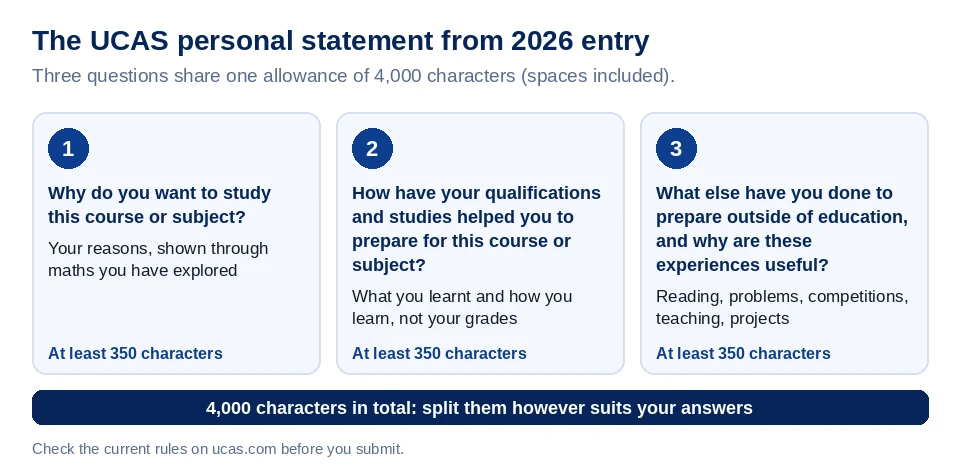
- Three questions, answered separately:
- Why do you want to study this course or subject?
- How have your qualifications and studies helped you to prepare for this course or subject?
- What else have you done to prepare outside of education, and why are these experiences useful?
- 4,000 characters in total, including spaces, shared across the three answers however you like.
- At least 350 characters for each answer. The questions themselves do not count towards the limit.
- One statement goes to every course you apply for, so write about maths (and the other half of a joint course), not about one university.
Question by question
The character splits below are our suggestion for a typical maths applicant, not a UCAS rule: use more space where you have more to say.
1. Why do you want to study this course or subject?
Include
- Name the maths that made you want to study it further: a specific idea, proof or problem, not a general love of numbers.
- Show you know what a maths degree involves: proof and abstraction as well as calculation.
- If you are applying for a joint course (maths with physics, economics or computer science), give a reason for each part.
Leave out
- Opening quotations and clichés.
- Childhood stories with no maths in them.
- Naming universities: every choice reads the same statement.
2. How have your qualifications and studies helped you to prepare for this course or subject?
Include
- Pick one or two things from your courses (A Level, Further Maths, IB, IAL or other) and say what they taught you about doing maths.
- Include school-based work beyond the syllabus: an extended project, a competition, a maths society talk.
- Link other subjects to maths where it is true: modelling in physics, data in biology, algorithms in computing.
Leave out
- Listing subjects and grades: universities see these elsewhere in your application.
- Describing a course without saying what you learnt from it.
3. What else have you done to prepare outside of education, and why are these experiences useful?
Include
- Reading, problems, lectures, programming, teaching or work experience you did yourself, each with what you got out of it.
- Fewer things in more depth: one book or project discussed properly beats five named.
- Responsibilities (a job, caring, a club) count when you say what they taught you.
Leave out
- Hobbies with no link to the course, unless you say why they matter.
- Activities you cannot talk about at interview.
Show, don't tell
A tutor cannot check "I am passionate about maths". They can believe a specific thing you did. Each weak sentence below is a general claim; the right-hand column describes how to replace it with evidence from your own experience. These are patterns, not sentences to copy.
| Instead of a claim like… | …give evidence |
|---|---|
| “I have always loved maths and enjoy solving problems.” | Name one problem or idea, say what you tried, what went wrong and what you learnt from fixing it. |
| “I read Fermat's Last Theorem and found it fascinating.” | Pick one argument from the book, say how far you could follow it yourself and what question it left you with. |
| “Maths is the language of the universe.” | Start with something you have actually done or thought about. Leave out quotations and claims about maths in general. |
| “I am hard-working and resilient.” | Show it: a problem you came back to over several days, or a topic you taught yourself, and how you knew you had understood it. |
| “I got a gold certificate in the Senior Mathematical Challenge.” | Mention the award briefly, then say what the preparation taught you: a technique, or a kind of problem you now enjoy. |
| “In Further Maths I studied complex numbers, matrices and proof.” | Choose one topic and say what surprised you or what you went on to explore beyond the lessons. |
A useful shape for a paragraph: what you met (an idea, problem or book), what you did with it (tried, proved, programmed, taught), what you found (including what went wrong), and what next (the question it left you with). See super-curricular ideas for maths for things to do with a book.
What admissions tutors say
Summarised in our own words from the universities' and UCAS's pages; follow the links for the full text.
- Oxford's Mathematical Institute publishes its admissions criteria: mathematical knowledge and the ability to use it on problems, plus mathematical ability such as making connections between ideas and picking up new concepts quickly. Oxford Mathematical Institute: admissions criteria
- Cambridge's Faculty of Mathematics answers common questions about the application, STEP and the interview on its admissions FAQ. Cambridge Faculty of Mathematics: admissions FAQ
- UCAS's maths and statistics guide says the key is showing motivation and interest beyond the classroom, for example through reading, online courses, clubs or competitions. UCAS: mathematics and statistics personal statement guide
Common mistakes
- Listing books, competitions or courses without saying what you learnt from any of them.
- Repeating the same evidence in two answers. Each answer should add something new.
- Writing mainly about other subjects or hobbies, with little maths.
- Claims you could not defend at interview. If you mention a theorem, be ready to explain it.
- Leaving it to the last week: good statements take several drafts.
Getting help, and using AI
Ask a teacher to read a draft, and ask what they would want to hear more about. Feedback is fine; someone else (a person or an AI tool) writing or rewriting your answers is not, and the statement must be your own work. Read UCAS's guidance before you start.
Count your characters
0 of 4,000 characters
FAQ
What are the UCAS personal statement questions for maths?
From 2026 entry onwards there are three questions for every subject: (1) Why do you want to study this course or subject? (2) How have your qualifications and studies helped you to prepare for this course or subject? (3) What else have you done to prepare outside of education, and why are these experiences useful? You answer them in one statement that goes to all your choices.
How long is the UCAS personal statement?
4,000 characters in total, including spaces, shared across the three answers however you like, with at least 350 characters for each answer. The questions themselves do not count.
Should I write about books in a maths personal statement?
Only if you can say what you did with one idea from the book: a problem you tried, a proof you followed, a question it raised. A list of titles tells a tutor nothing.
Can someone else, or an AI tool, write my personal statement?
No. The statement must be your own work. Teachers and family can comment on drafts; the words and the ideas must be yours. UCAS publishes guidance on this, linked from this page.
Next steps
- Personal statement checklist: go through it before you submit.
- Super-curricular reading and activities for question 3.
- Maths interviews: if a university interviews, expect questions about what you wrote.
- TMUA preparation: some universities ask for the TMUA as well.
A Level Math Revision is independent: it is not affiliated with or endorsed by UCAS or any university. Facts about UCAS and universities are summarised in our own words with links: always check the official page. We give guidance only and never write statements for students.