Edexcel IAL Maths Year 1 starter questions: weeks 14–26
39 short questions to open a lesson for Edexcel International A Level Maths Year 1, weeks 14–26 of the teaching year, three or four a week. Each question is shown as an image with its text underneath; answers and mark schemes stay with teachers.
- ← Edexcel IAL Maths Year 1, weeks 1–13
- Edexcel IAL Maths Year 1, weeks 27–40 →
- All A Level Maths daily and weekly questions
Week 14
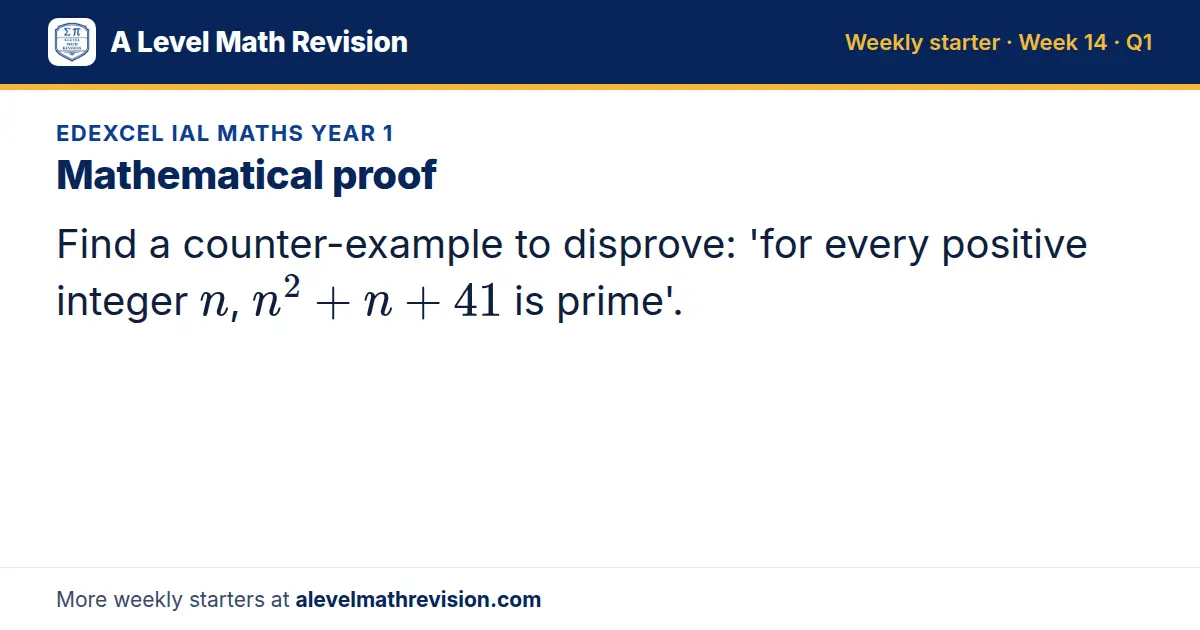
Question 1: Mathematical proof
Find a counter-example to disprove: 'for every positive integer n, n² + n + 41 is prime'.
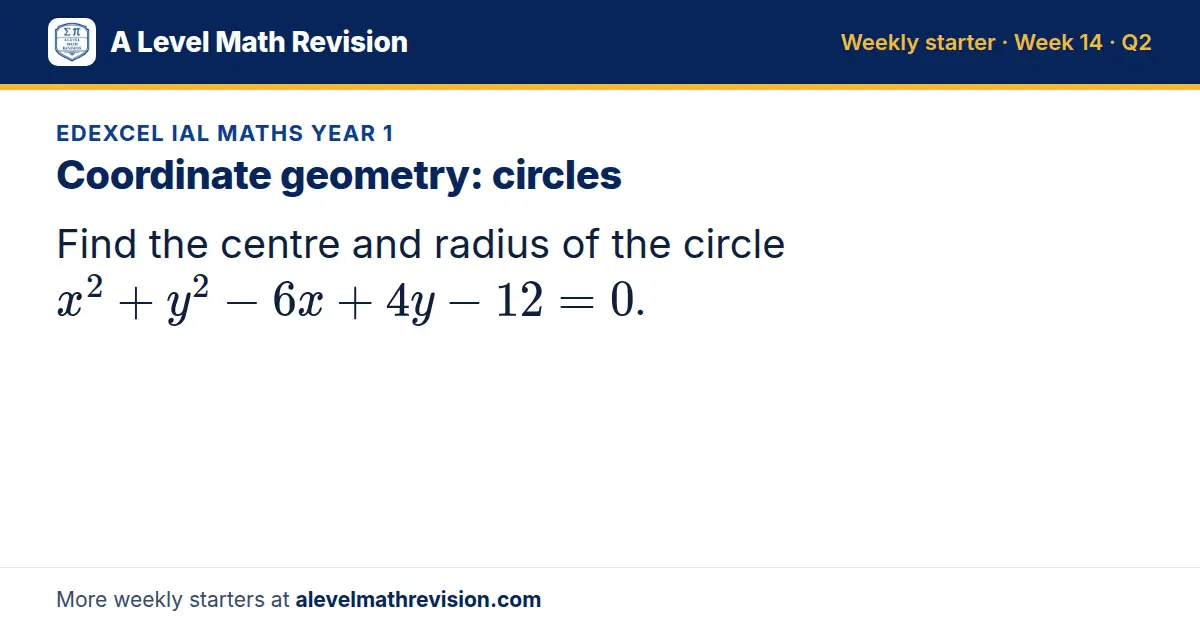
Question 2: Coordinate geometry: circles
Find the centre and radius of the circle x² + y² - 6x + 4y - 12 = 0.
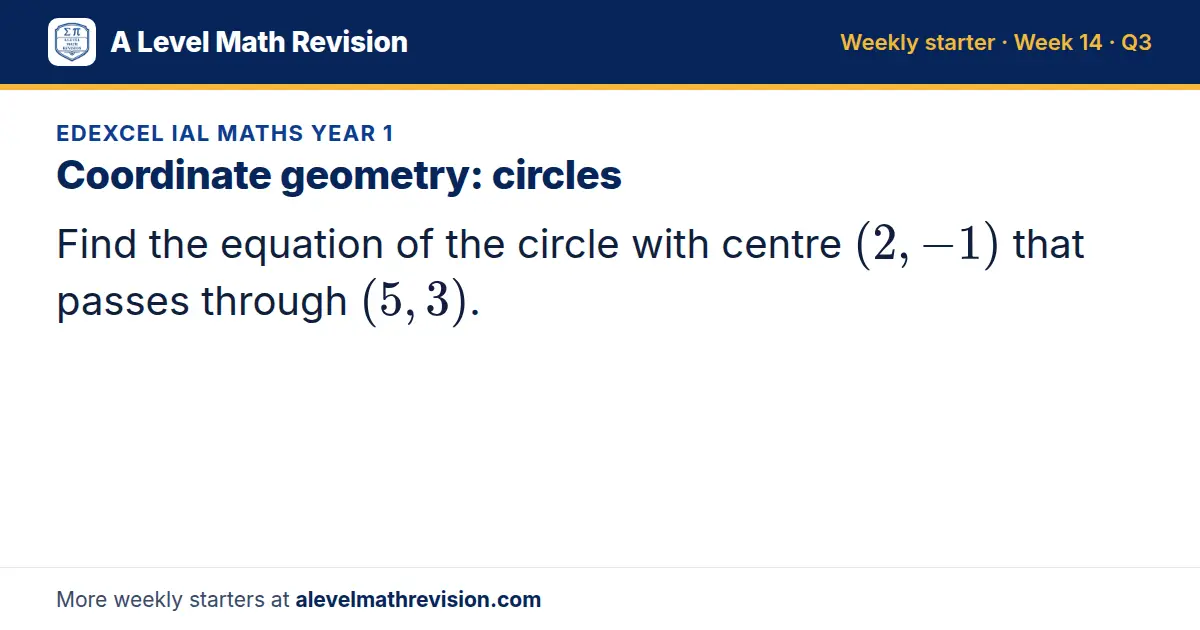
Question 3: Coordinate geometry: circles
Find the equation of the circle with centre (2, -1) that passes through (5, 3).
Week 15
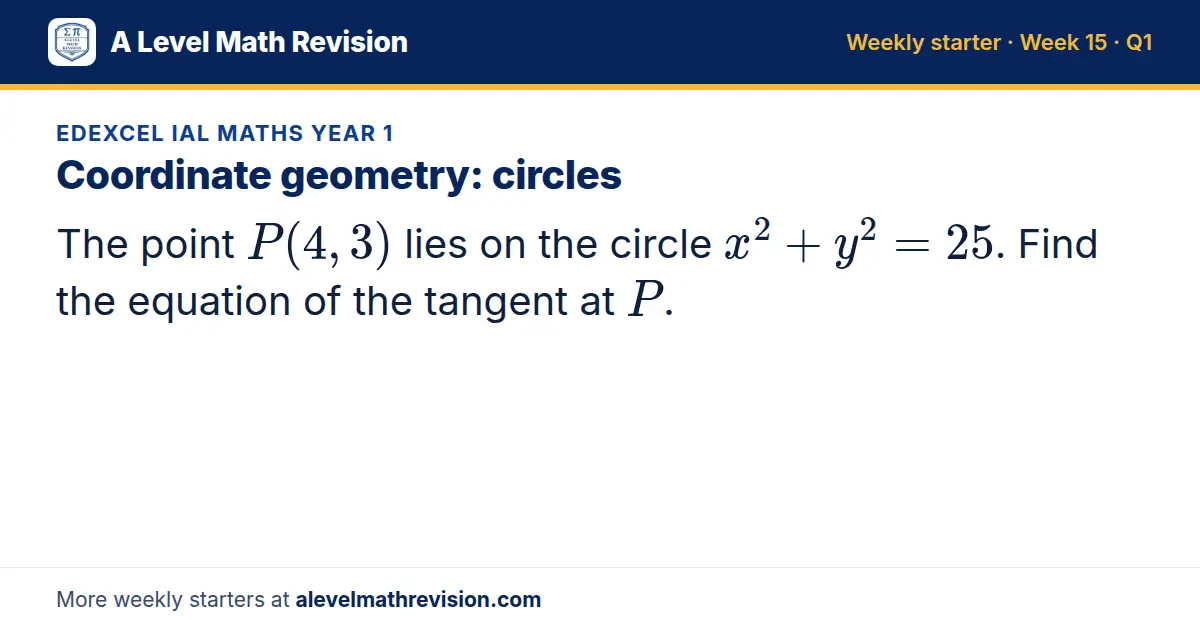
Question 1: Coordinate geometry: circles
The point P(4, 3) lies on the circle x² + y² = 25. Find the equation of the tangent at P.
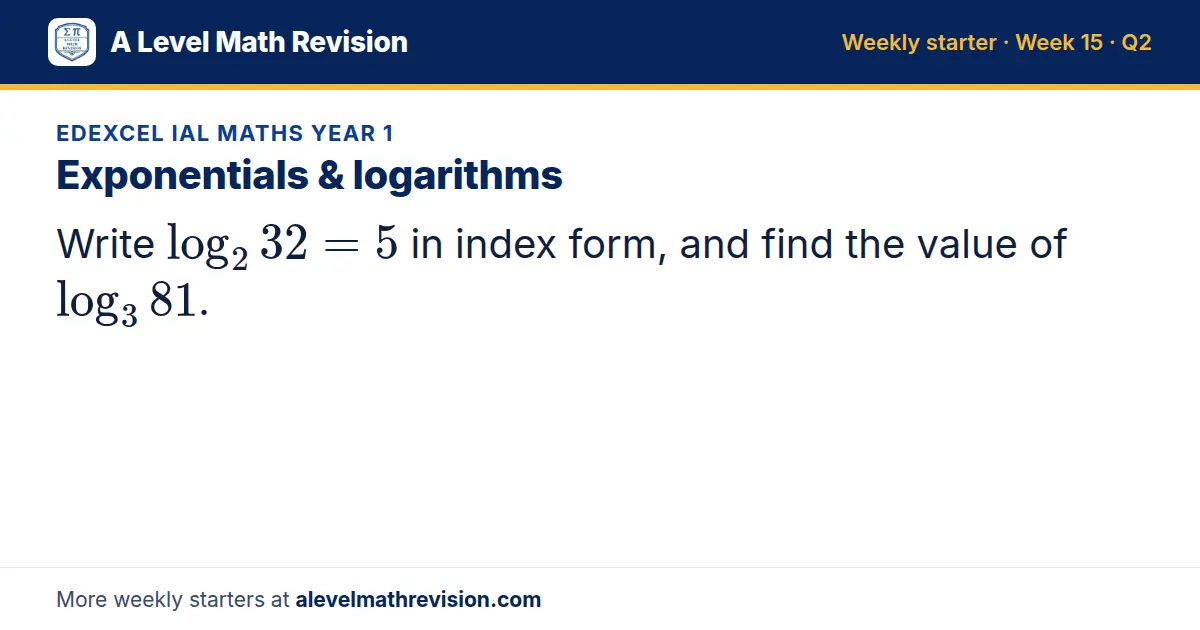
Question 2: Exponentials & logarithms
Write log_2 32 = 5 in index form, and find the value of log_3 81.
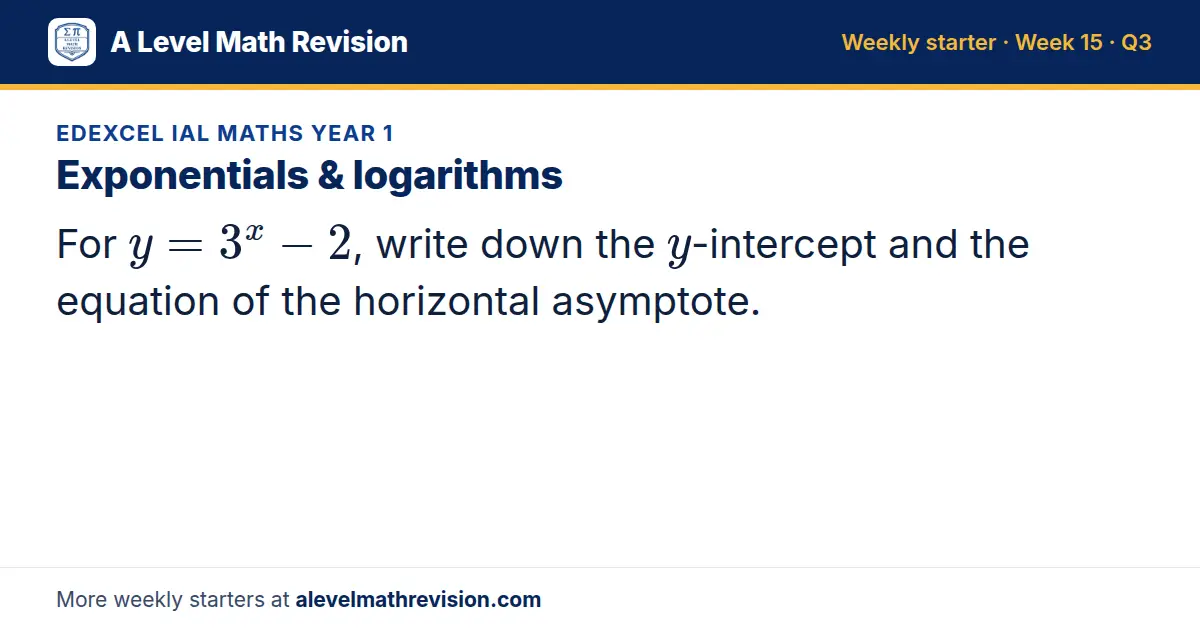
Question 3: Exponentials & logarithms
For y = 3^x - 2, write down the y-intercept and the equation of the horizontal asymptote.
Week 16
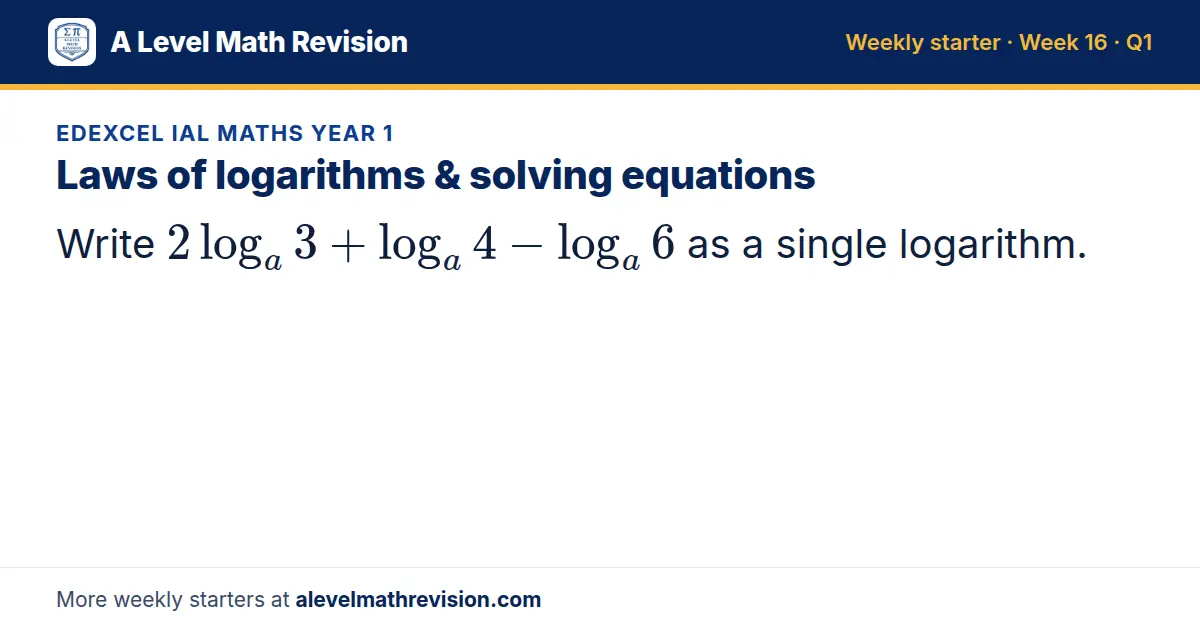
Question 1: Laws of logarithms & solving equations
Write 2log_a 3 + log_a 4 - log_a 6 as a single logarithm.
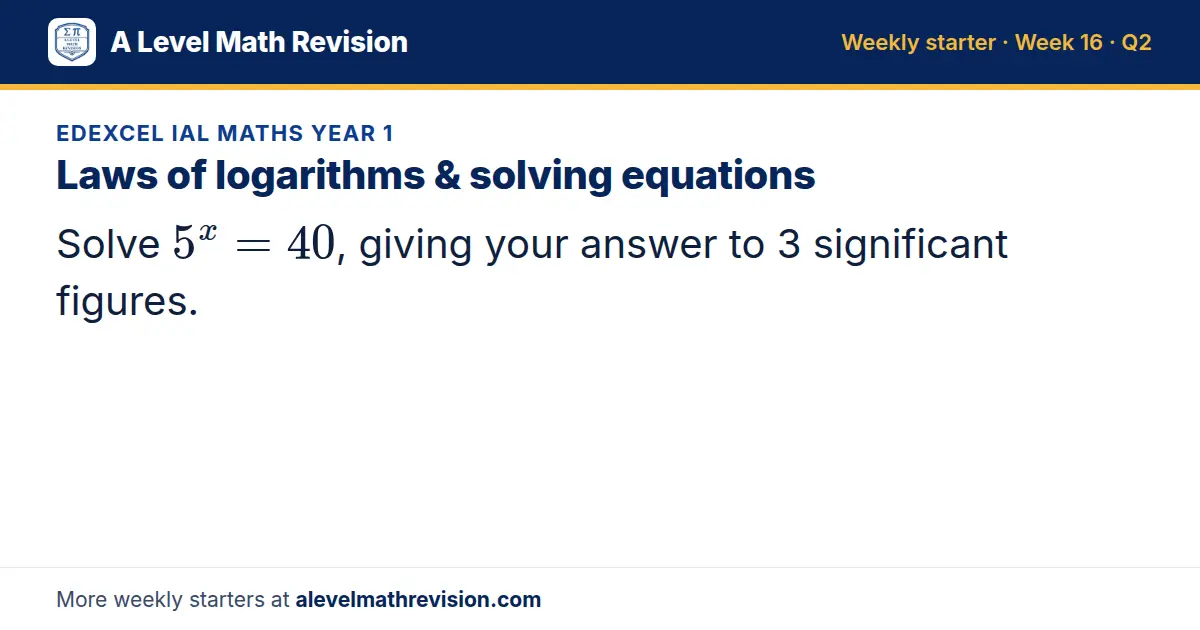
Question 2: Laws of logarithms & solving equations
Solve 5^x = 40, giving your answer to 3 significant figures.
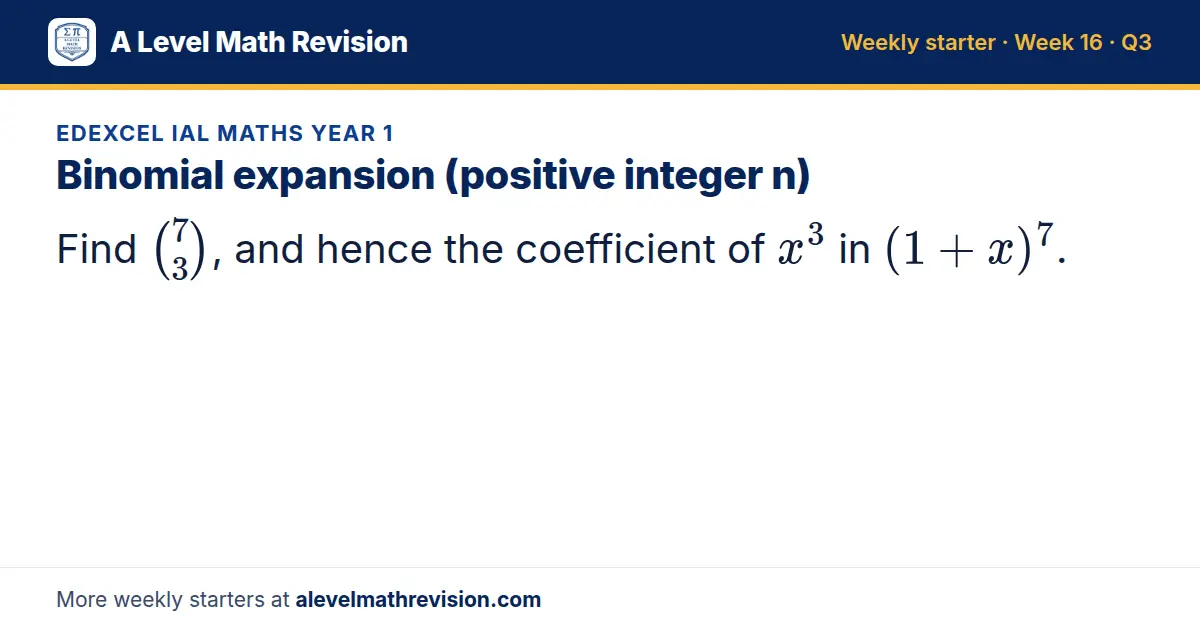
Question 3: Binomial expansion (positive integer n)
Find 73, and hence the coefficient of x³ in (1 + x)^7.
Week 17
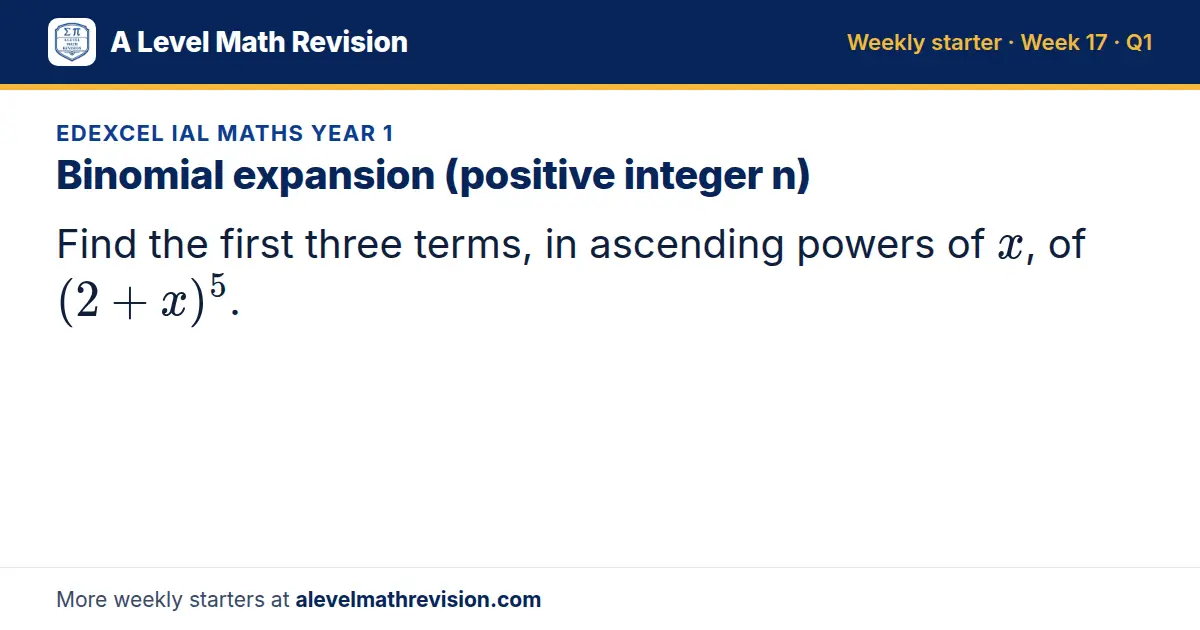
Question 1: Binomial expansion (positive integer n)
Find the first three terms, in ascending powers of x, of (2 + x)^5.
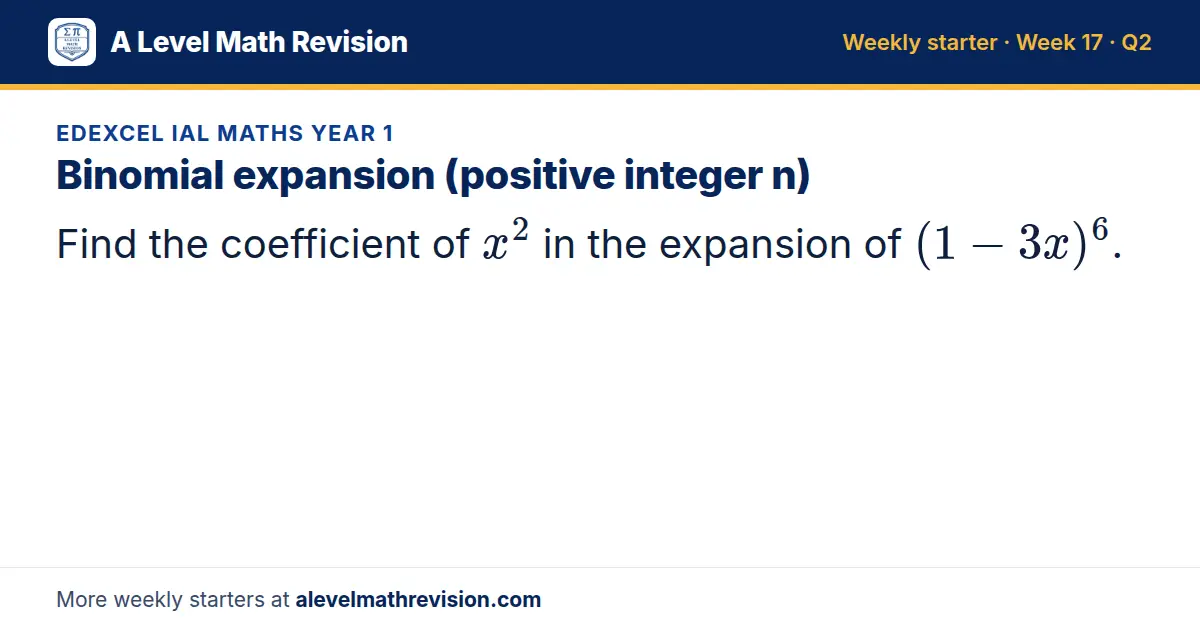
Question 2: Binomial expansion (positive integer n)
Find the coefficient of x² in the expansion of (1 - 3x)^6.
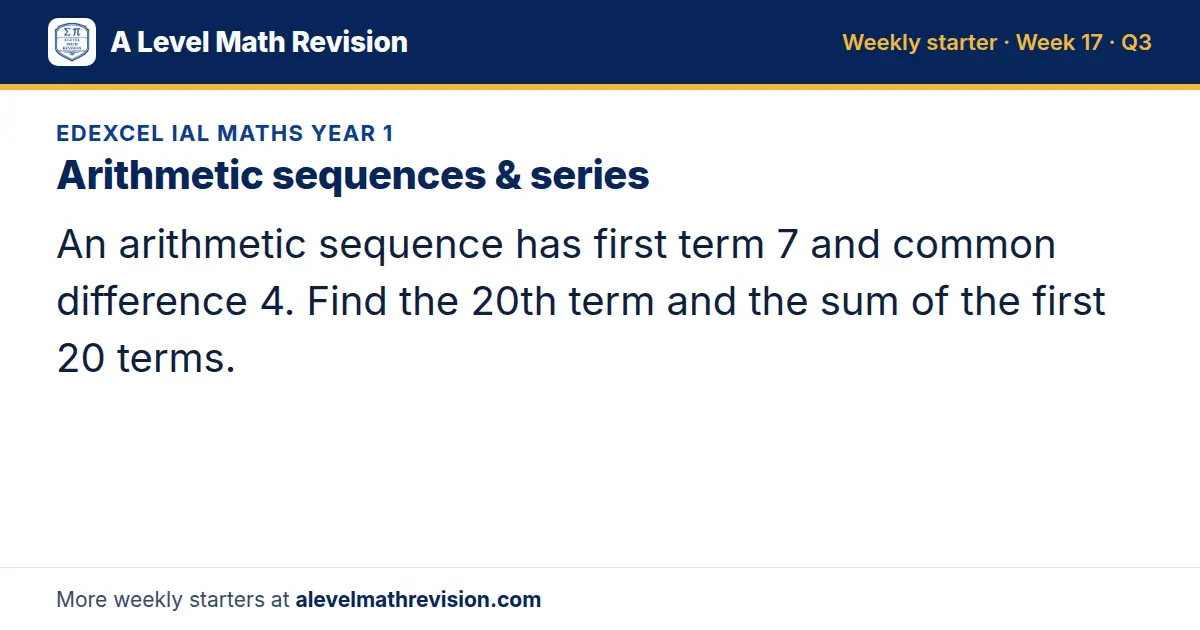
Question 3: Arithmetic sequences & series
An arithmetic sequence has first term 7 and common difference 4. Find the 20th term and the sum of the first 20 terms.
Week 18
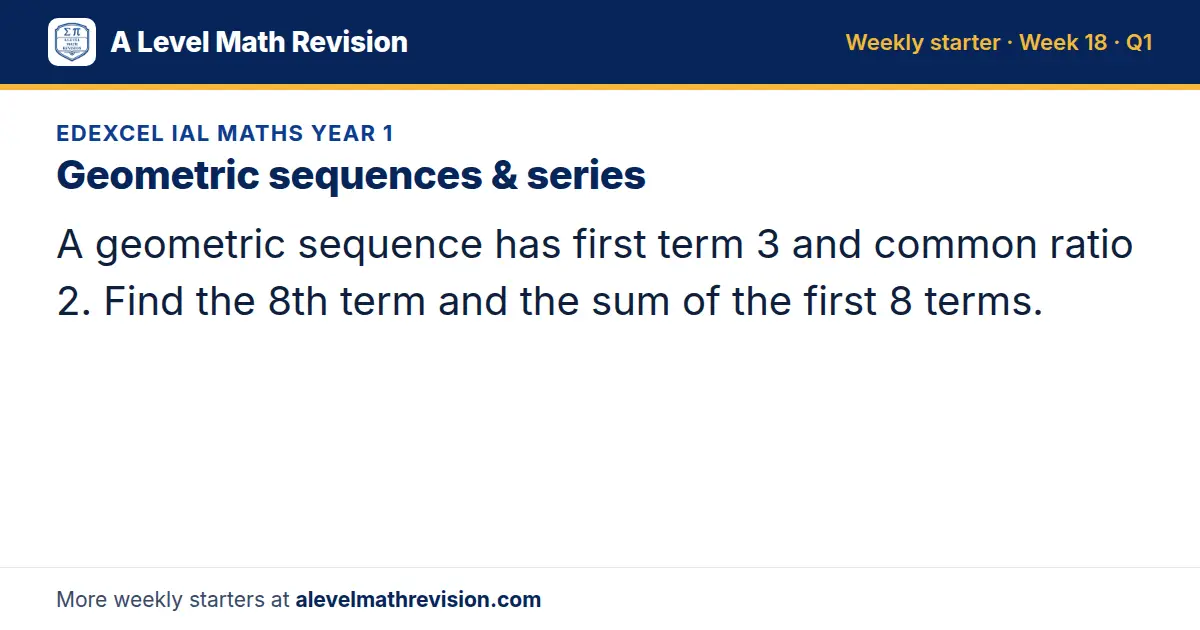
Question 1: Geometric sequences & series
A geometric sequence has first term 3 and common ratio 2. Find the 8th term and the sum of the first 8 terms.
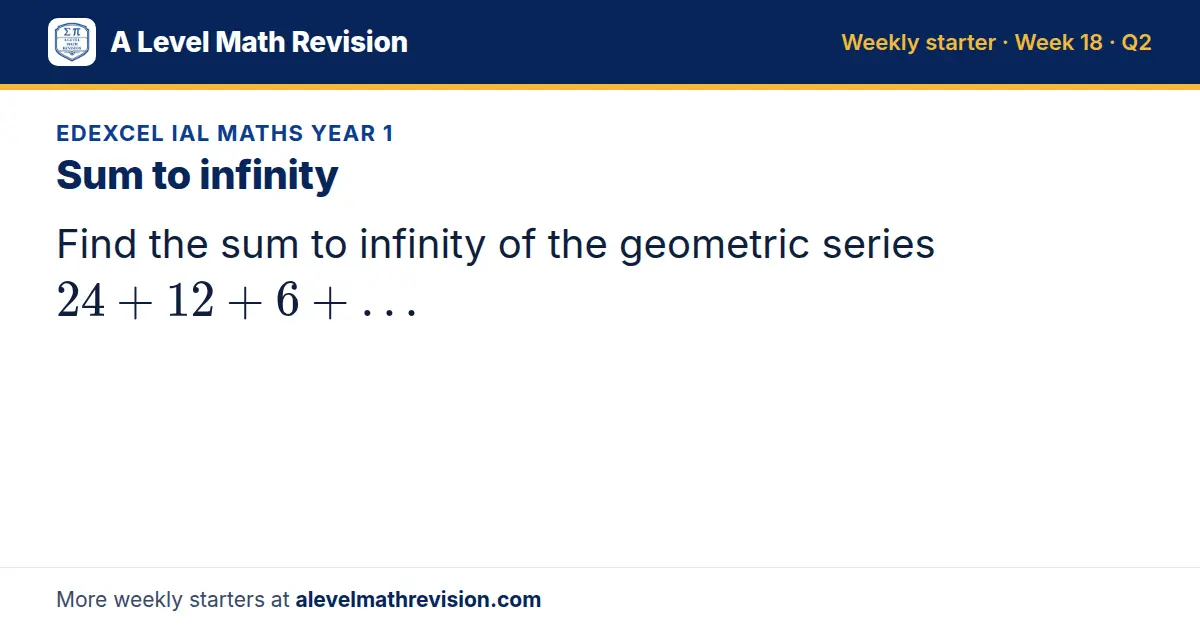
Question 2: Sum to infinity
Find the sum to infinity of the geometric series 24 + 12 + 6 + …
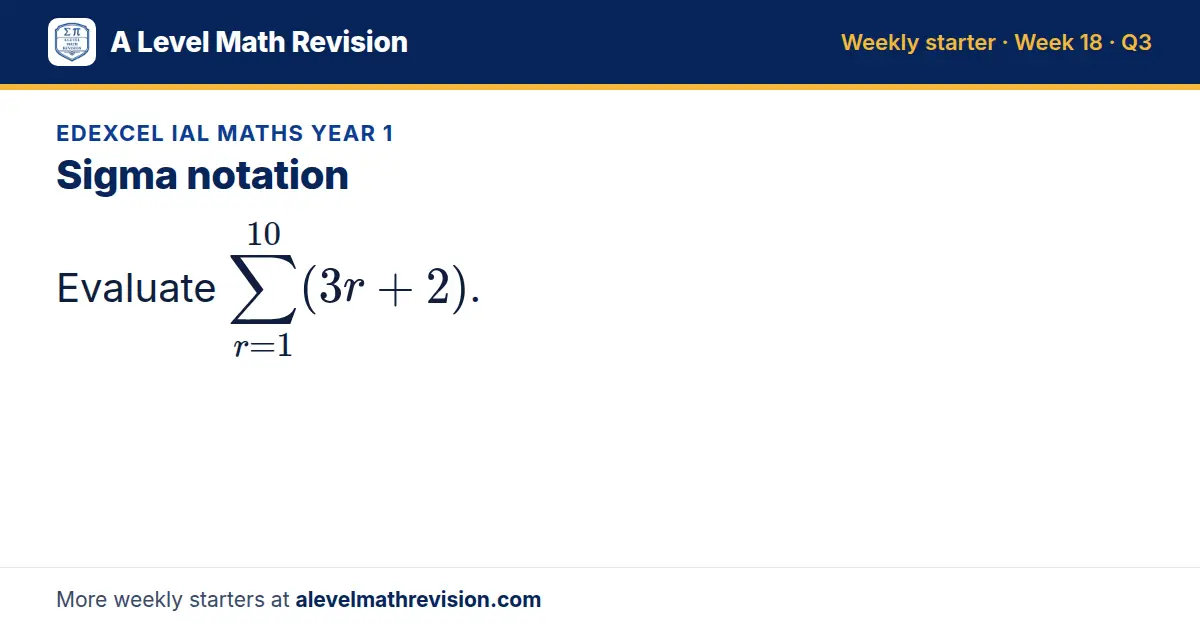
Question 3: Sigma notation
Evaluate Σ_r=1¹⁰ (3r + 2).
Week 19
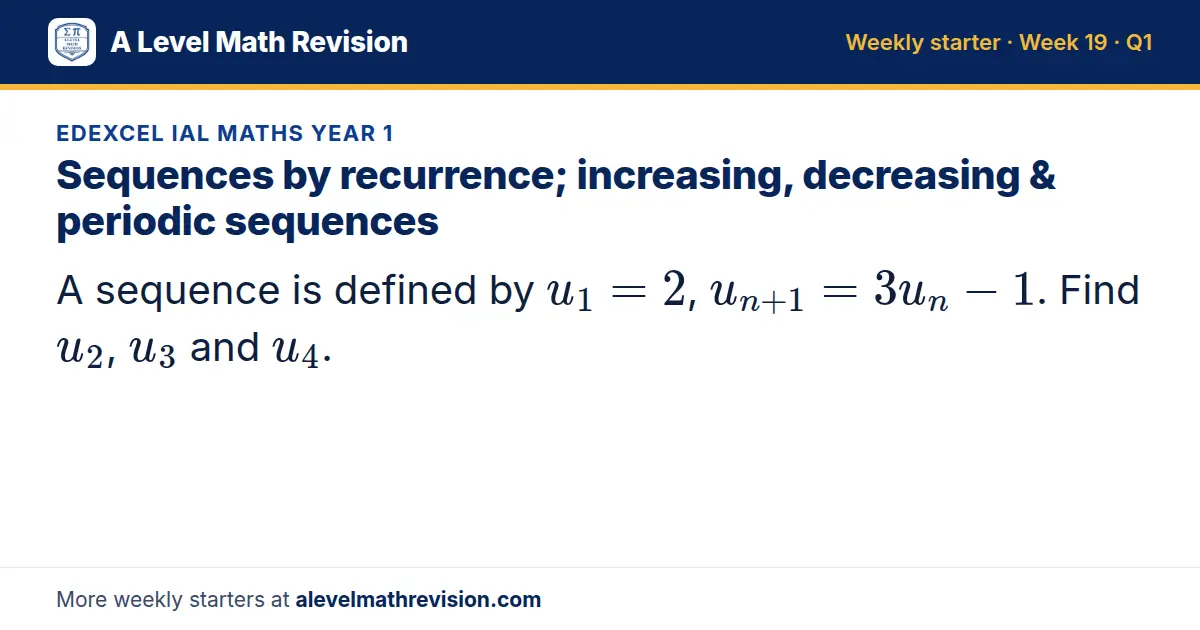
Question 1: Sequences by recurrence; increasing, decreasing & periodic sequences
A sequence is defined by u_1 = 2, u_n+1 = 3u_n - 1. Find u_2, u_3 and u_4.
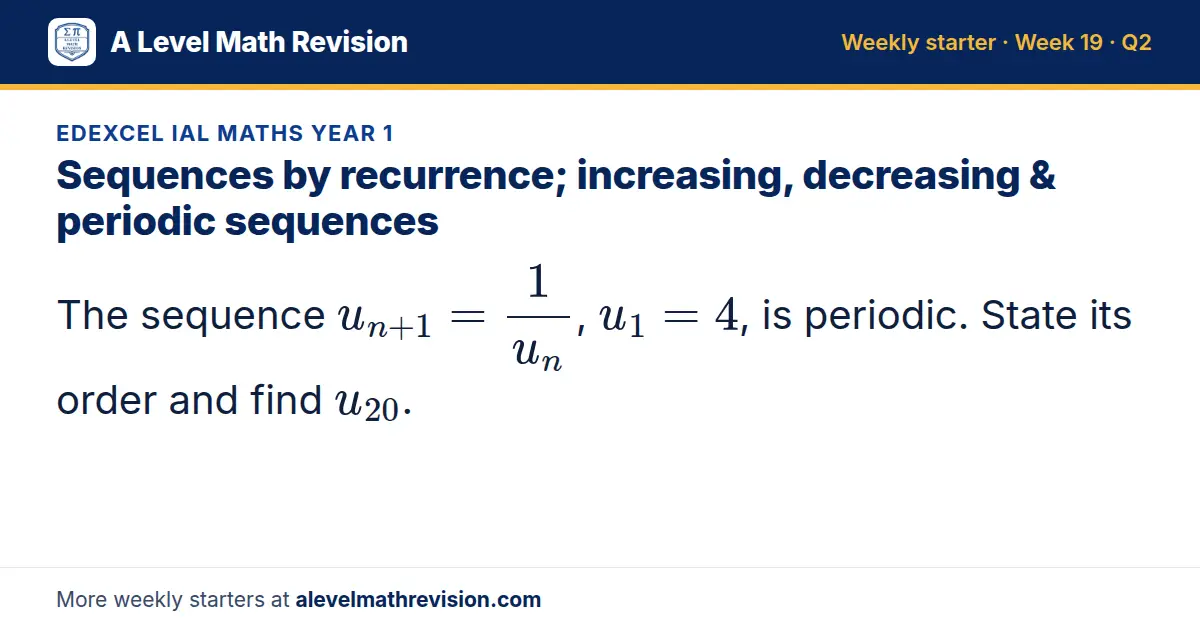
Question 2: Sequences by recurrence; increasing, decreasing & periodic sequences
The sequence u_n+1 = 1/u_n, u_1 = 4, is periodic. State its order and find u_20.
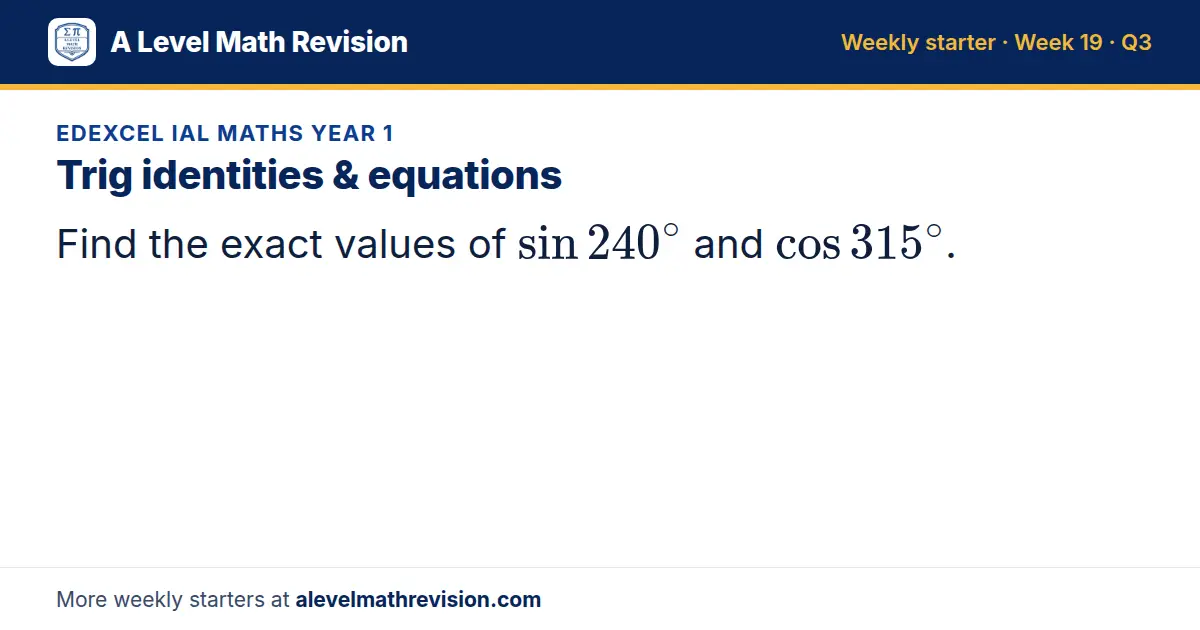
Question 3: Trig identities & equations
Find the exact values of sin 240^∘ and cos 315^∘.
Week 20
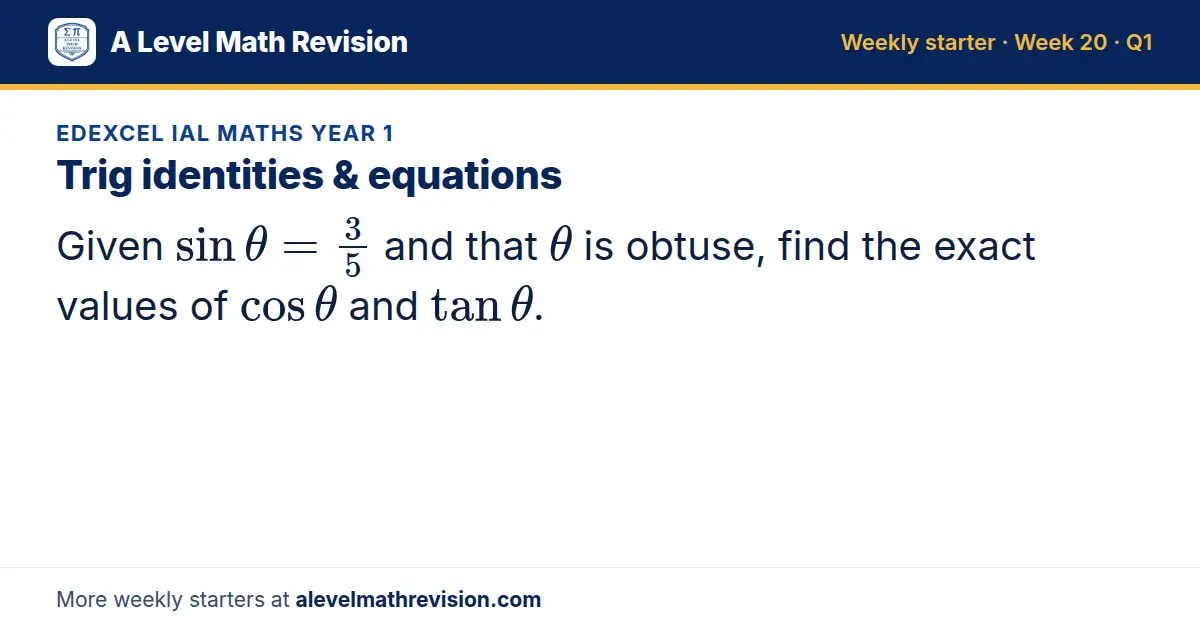
Question 1: Trig identities & equations
Given sinθ = 3/5 and that θ is obtuse, find the exact values of cosθ and tanθ.
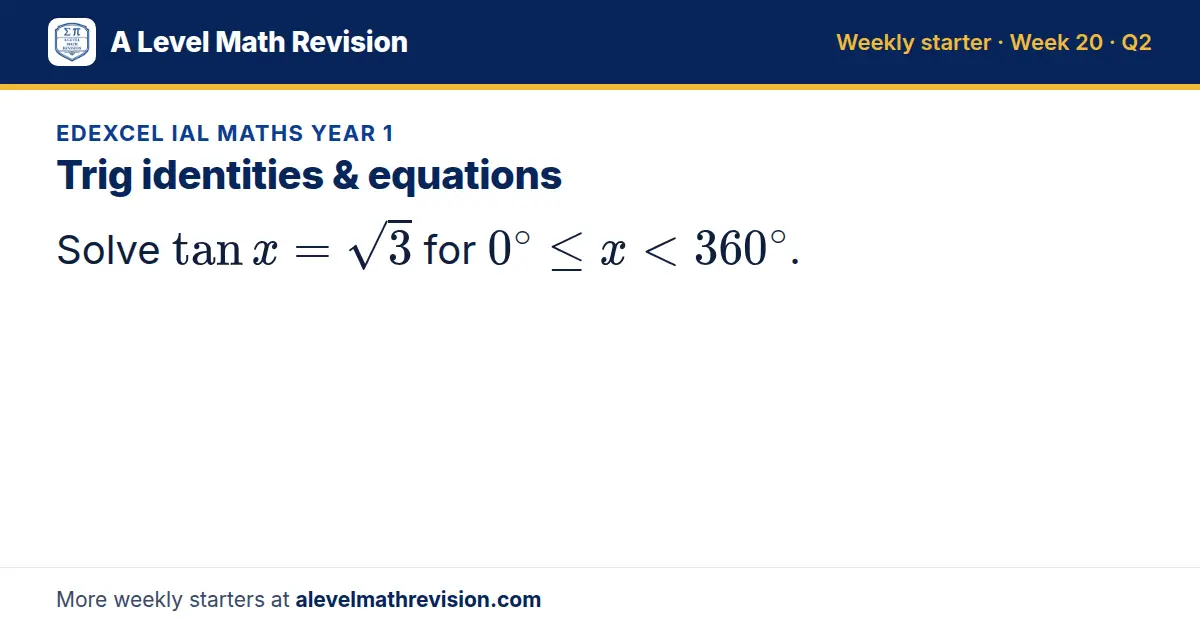
Question 2: Trig identities & equations
Solve tan x = √3 for 0^∘ ≤ x < 360^∘.
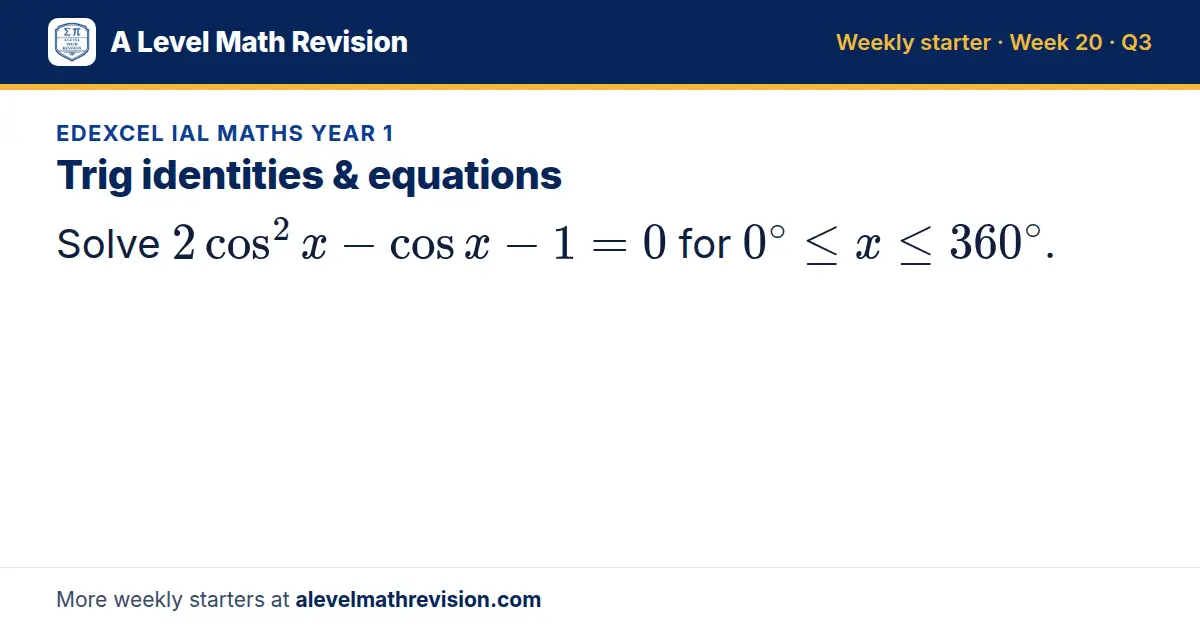
Question 3: Trig identities & equations
Solve 2cos² x - cos x - 1 = 0 for 0^∘ ≤ x ≤ 360^∘.
Week 21
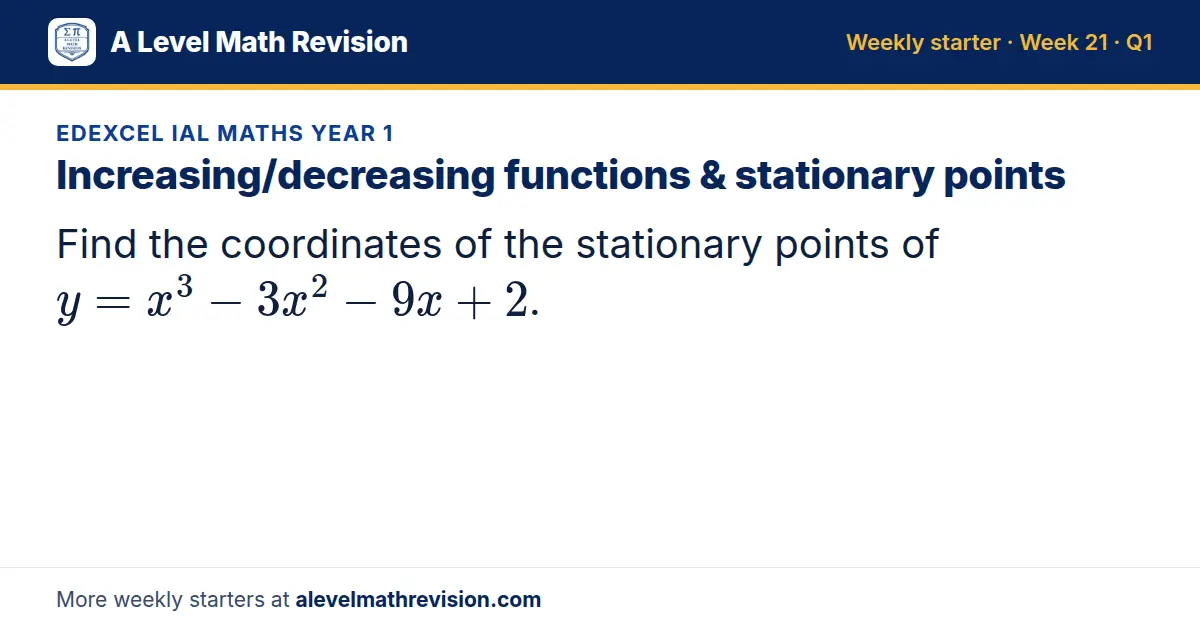
Question 1: Increasing/decreasing functions & stationary points
Find the coordinates of the stationary points of y = x³ - 3x² - 9x + 2.
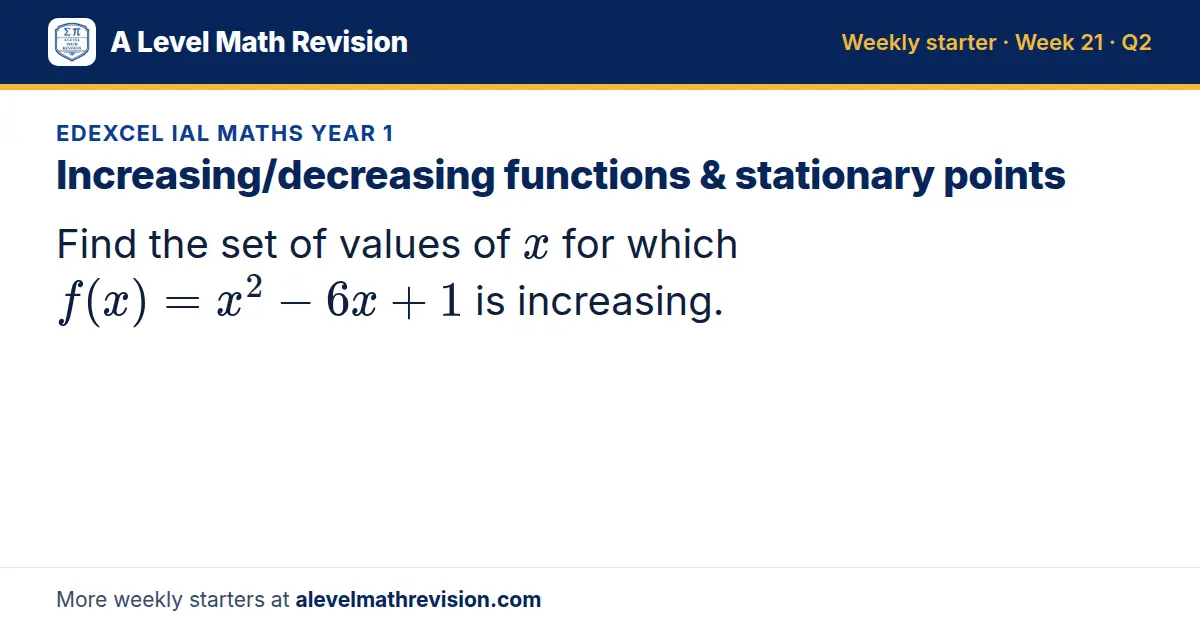
Question 2: Increasing/decreasing functions & stationary points
Find the set of values of x for which f(x) = x² - 6x + 1 is increasing.
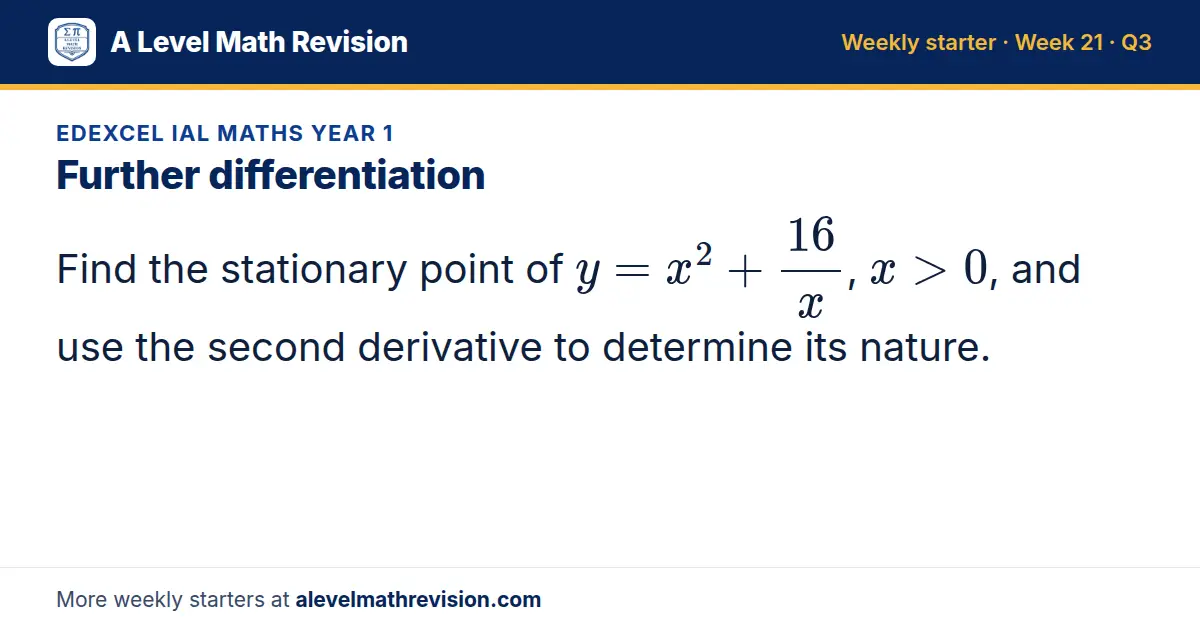
Question 3: Further differentiation
Find the stationary point of y = x² + 16/x, x > 0, and use the second derivative to determine its nature.
Week 22
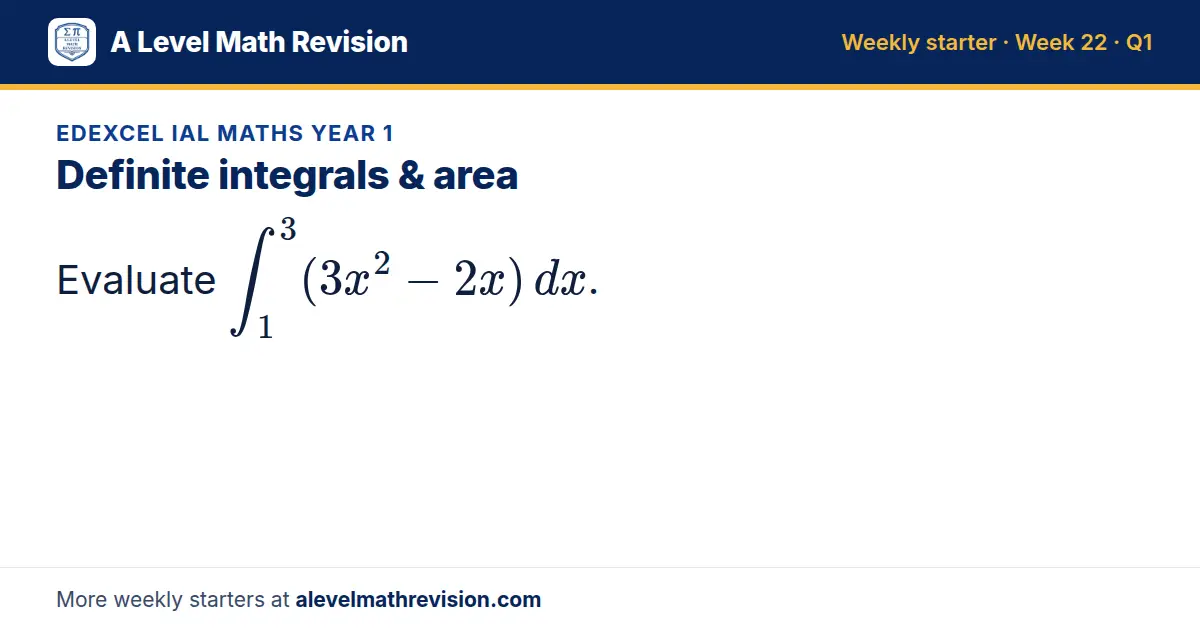
Question 1: Definite integrals & area
Evaluate ∫_1³ (3x² - 2x) dx.
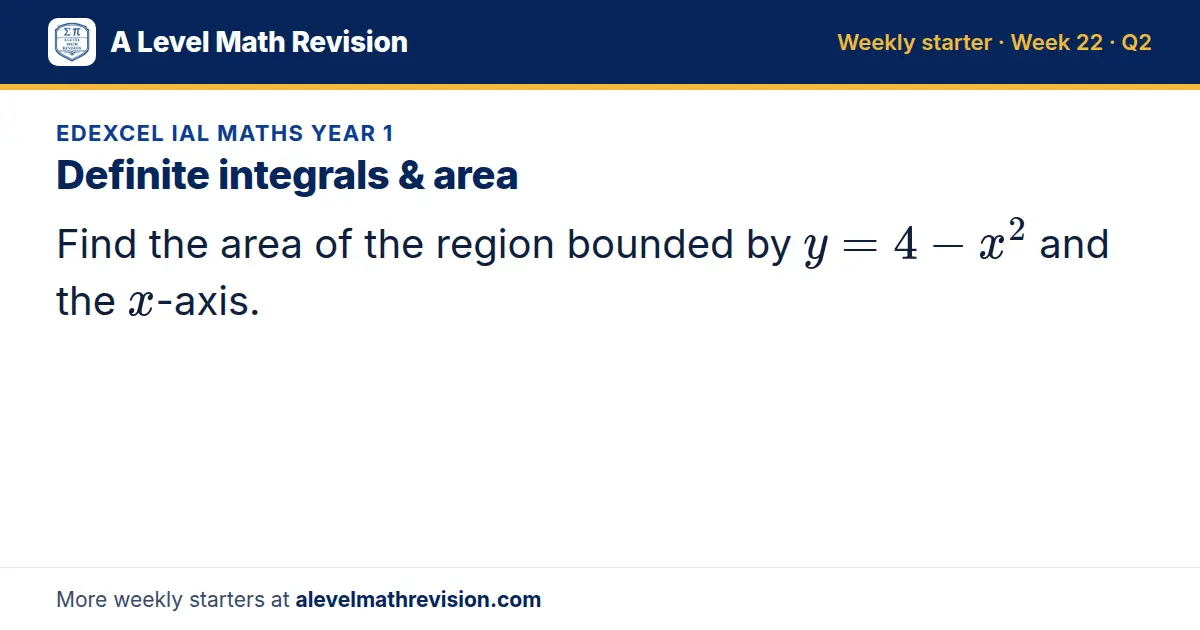
Question 2: Definite integrals & area
Find the area of the region bounded by y = 4 - x² and the x-axis.
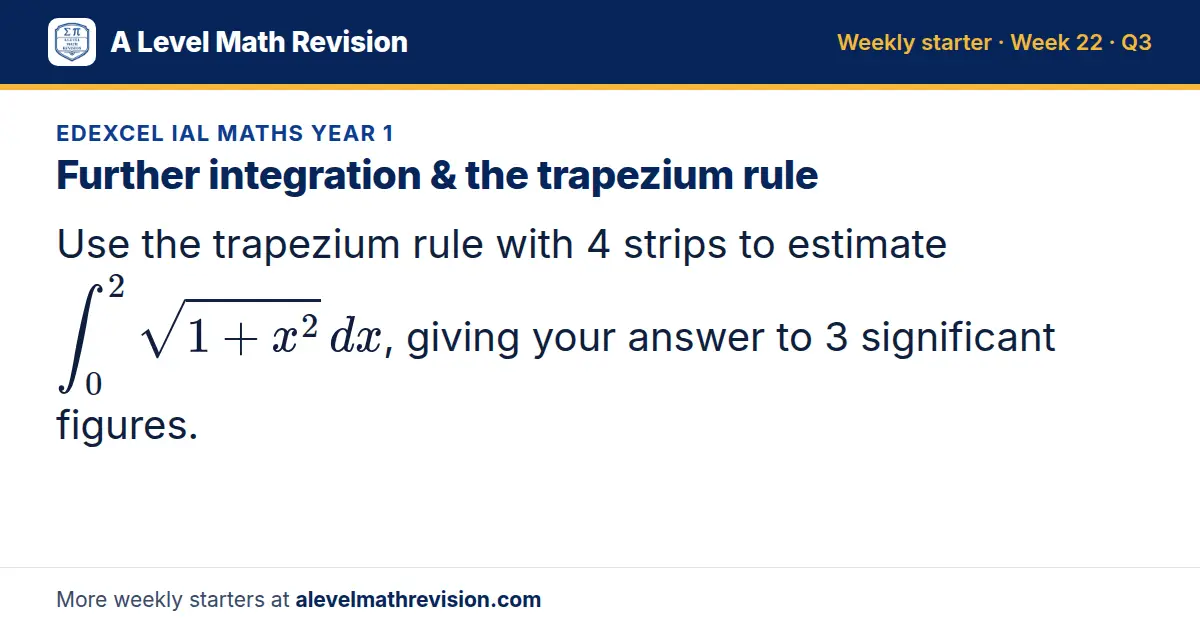
Question 3: Further integration & the trapezium rule
Use the trapezium rule with 4 strips to estimate ∫_0² √(1 + x²) dx, giving your answer to 3 significant figures.
Week 23
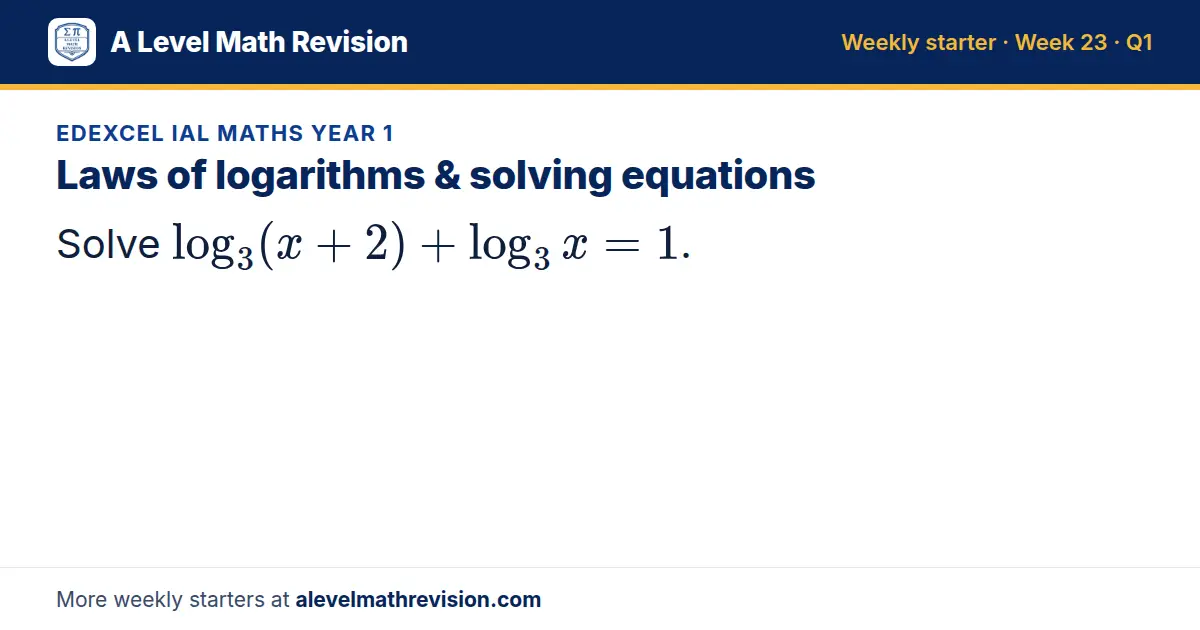
Question 1: Laws of logarithms & solving equations
Solve log_3(x + 2) + log_3 x = 1.
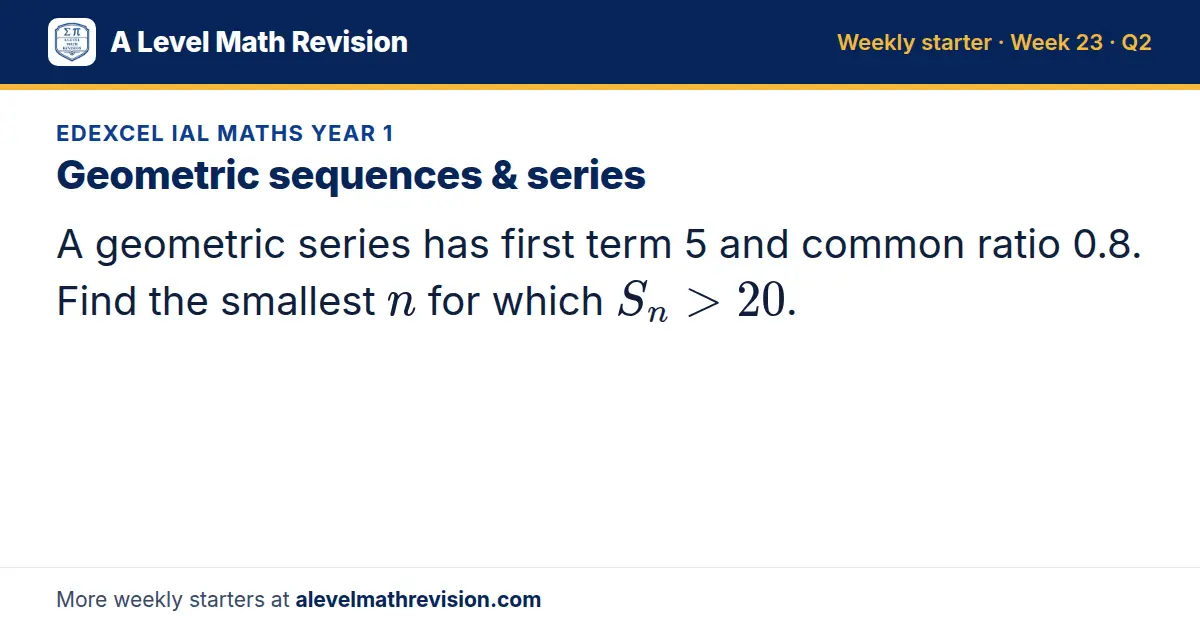
Question 2: Geometric sequences & series
A geometric series has first term 5 and common ratio 0.8. Find the smallest n for which S_n > 20.
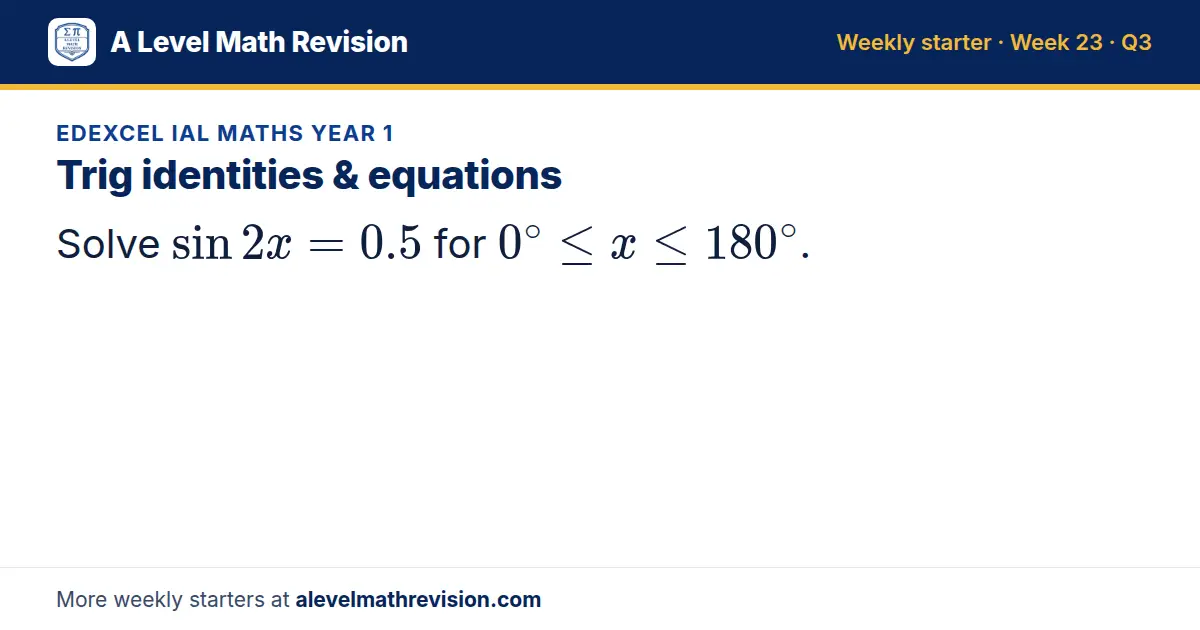
Question 3: Trig identities & equations
Solve sin 2x = 0.5 for 0^∘ ≤ x ≤ 180^∘.
Week 24
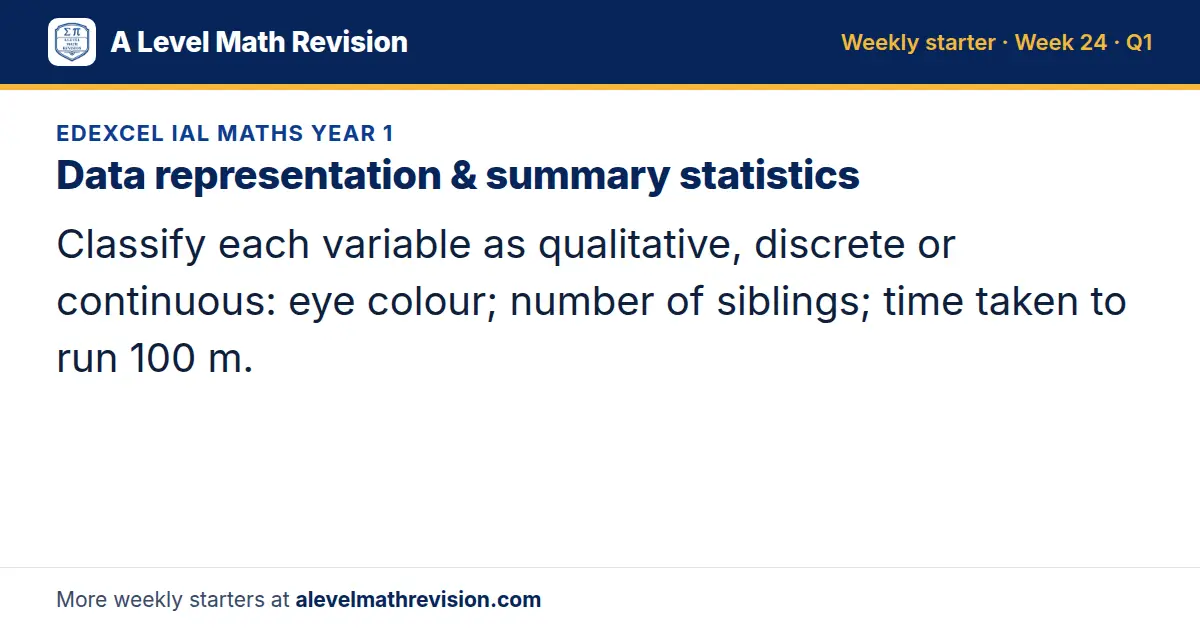
Question 1: Data representation & summary statistics
Classify each variable as qualitative, discrete or continuous: eye colour; number of siblings; time taken to run 100 m.
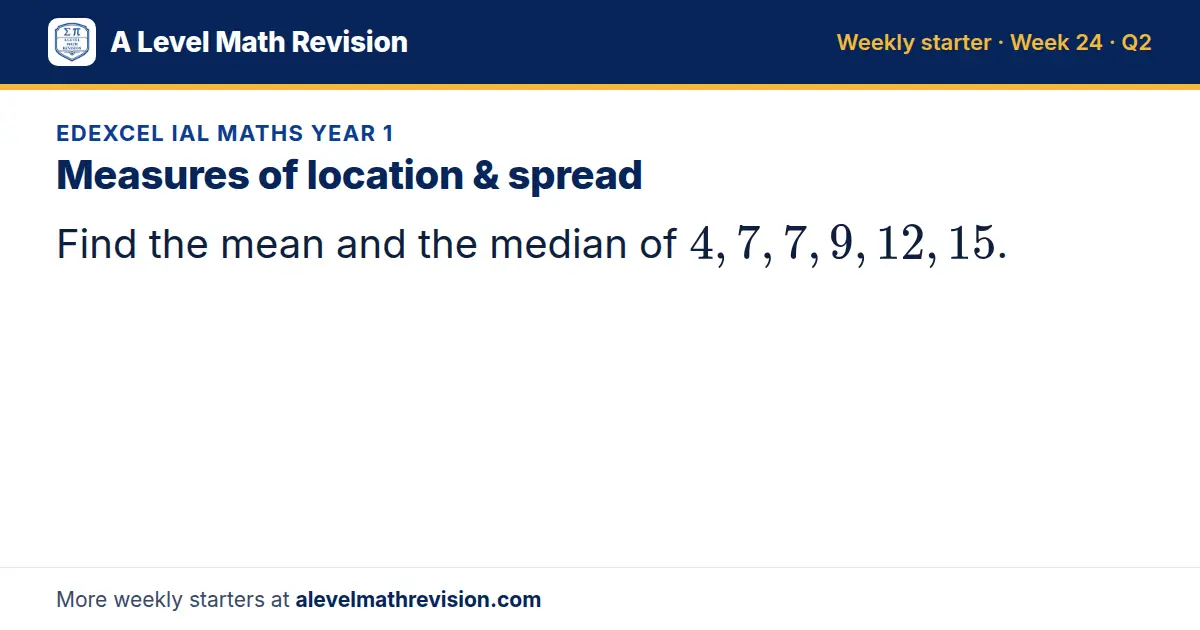
Question 2: Measures of location & spread
Find the mean and the median of 4, 7, 7, 9, 12, 15.
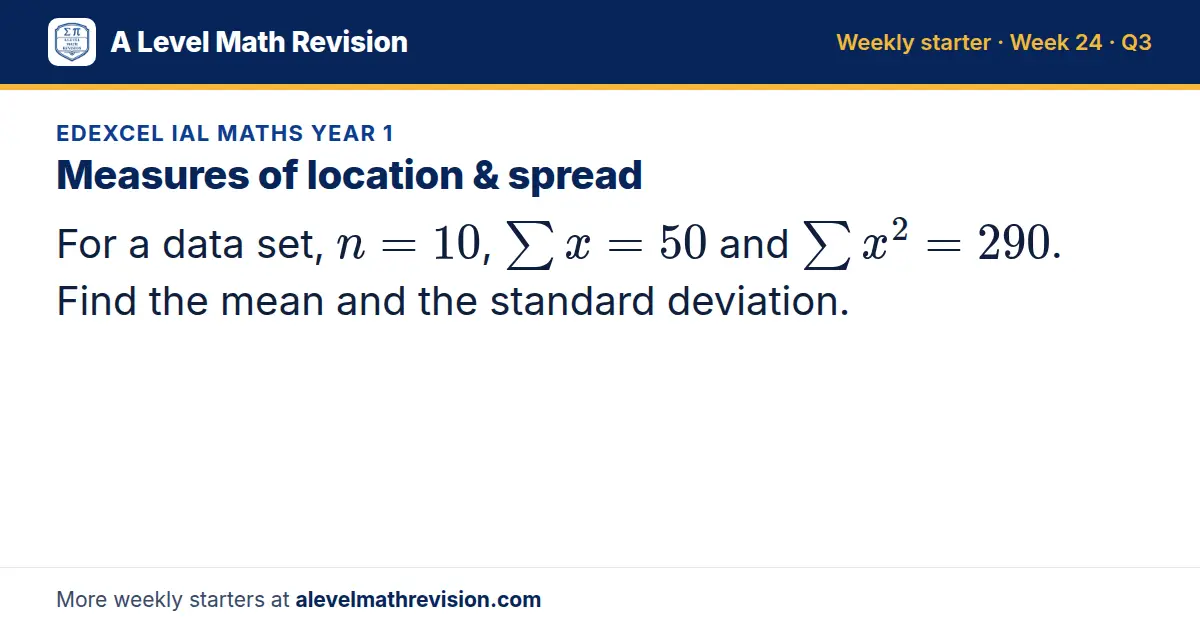
Question 3: Measures of location & spread
For a data set, n = 10, Σ x = 50 and Σ x² = 290. Find the mean and the standard deviation.
Week 25
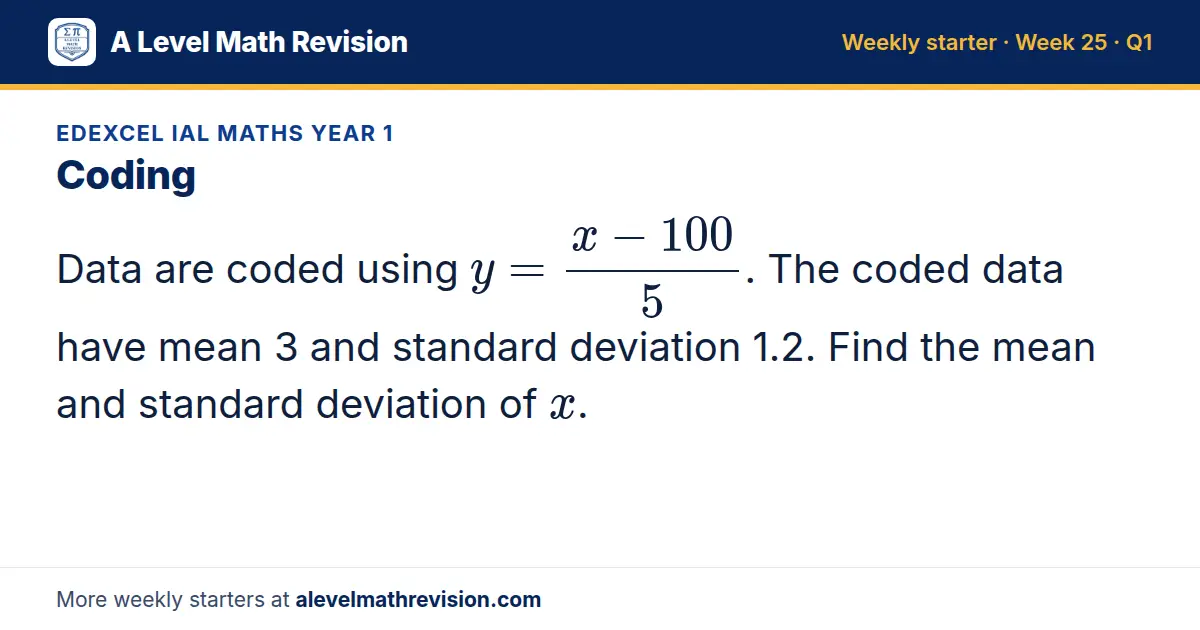
Question 1: Coding
Data are coded using y = (x - 100)/5. The coded data have mean 3 and standard deviation 1.2. Find the mean and standard deviation of x.
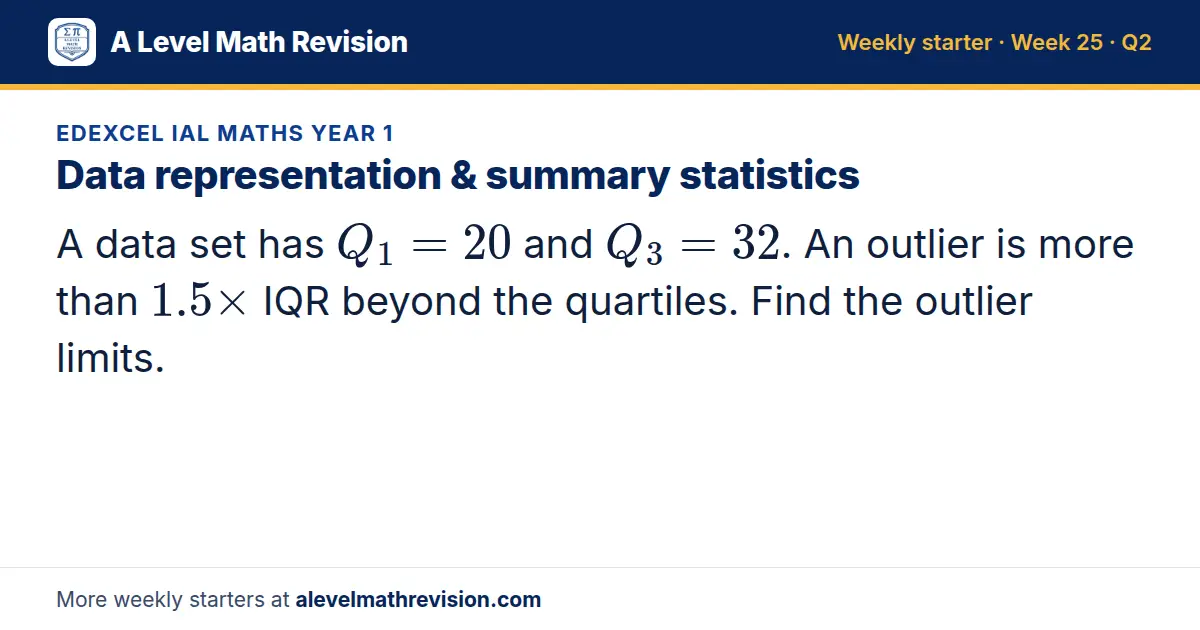
Question 2: Data representation & summary statistics
A data set has Q_1 = 20 and Q_3 = 32. An outlier is more than 1.5 × IQR beyond the quartiles. Find the outlier limits.
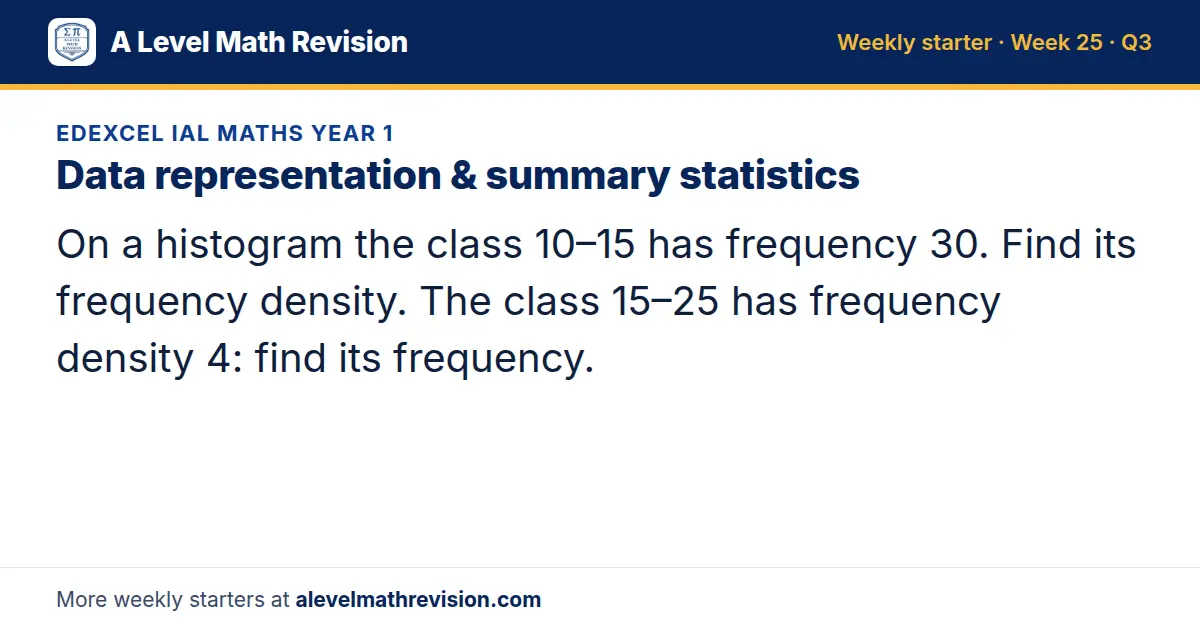
Question 3: Data representation & summary statistics
On a histogram the class 10–15 has frequency 30. Find its frequency density. The class 15–25 has frequency density 4: find its frequency.
Week 26
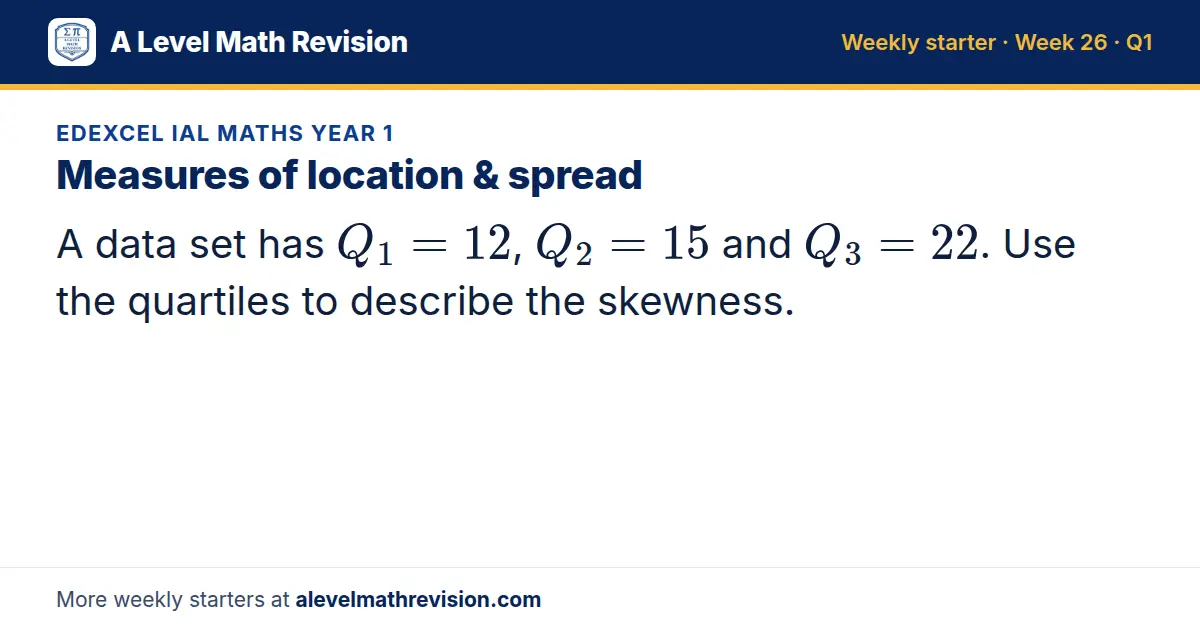
Question 1: Measures of location & spread
A data set has Q_1 = 12, Q_2 = 15 and Q_3 = 22. Use the quartiles to describe the skewness.
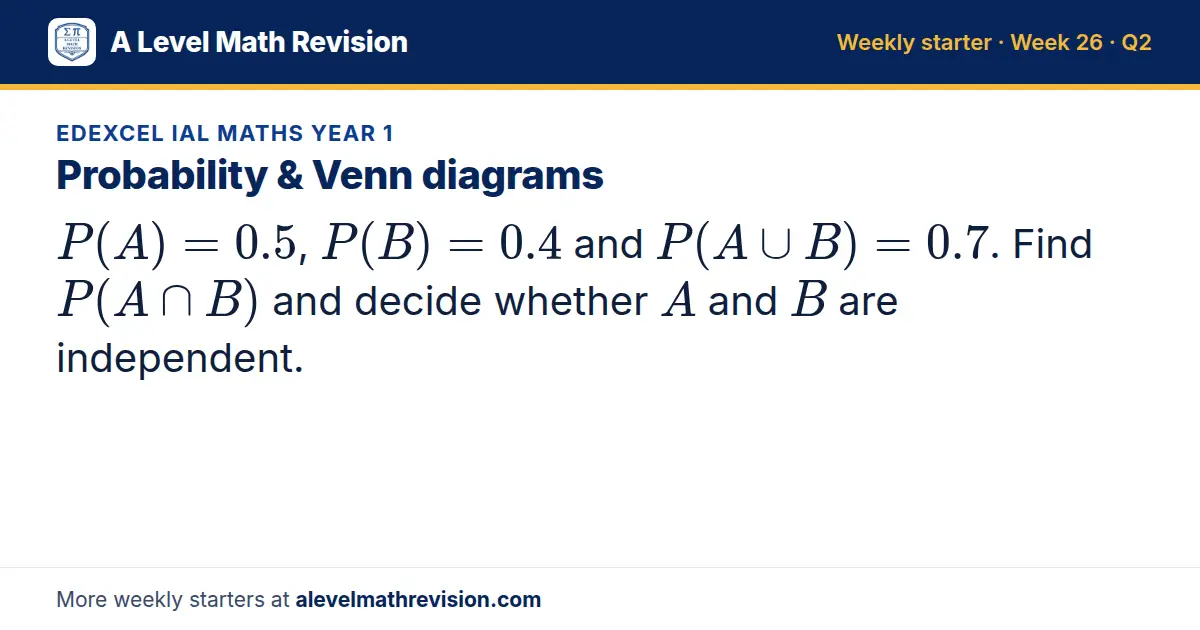
Question 2: Probability & Venn diagrams
P(A) = 0.5, P(B) = 0.4 and P(A ∪ B) = 0.7. Find P(A ∩ B) and decide whether A and B are independent.
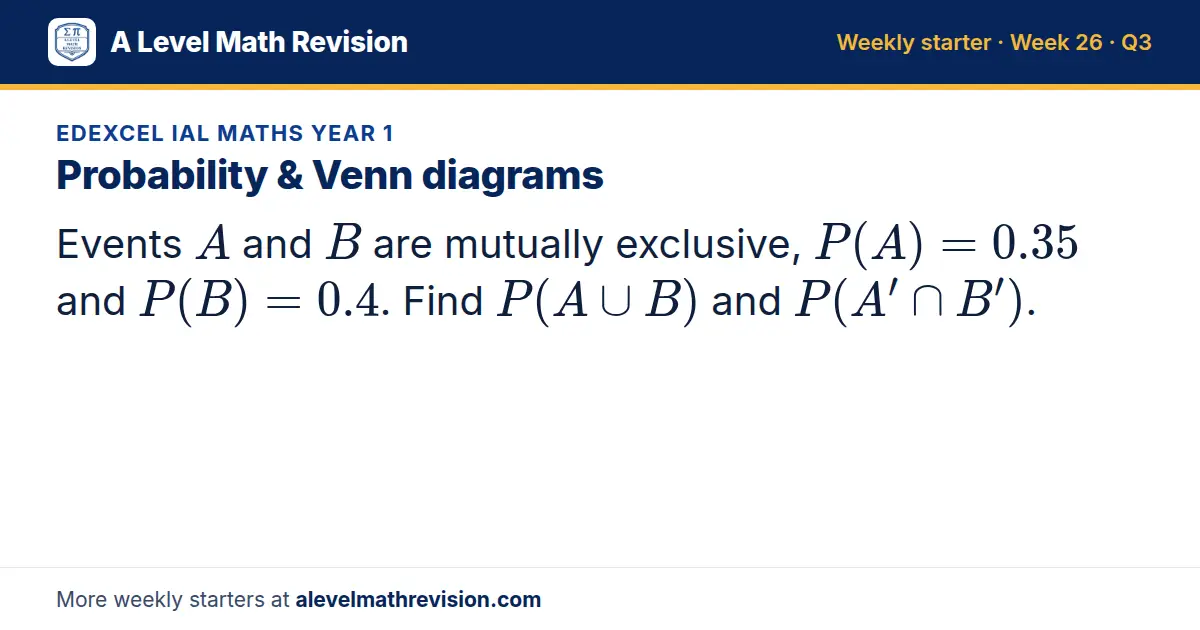
Question 3: Probability & Venn diagrams
Events A and B are mutually exclusive, P(A) = 0.35 and P(B) = 0.4. Find P(A ∪ B) and P(A' ∩ B').
More starter questions
Other weeks: Weeks 1–13 · Weeks 14–26 · Weeks 27–40. Answers and mark schemes are in the starter tasks for teachers.