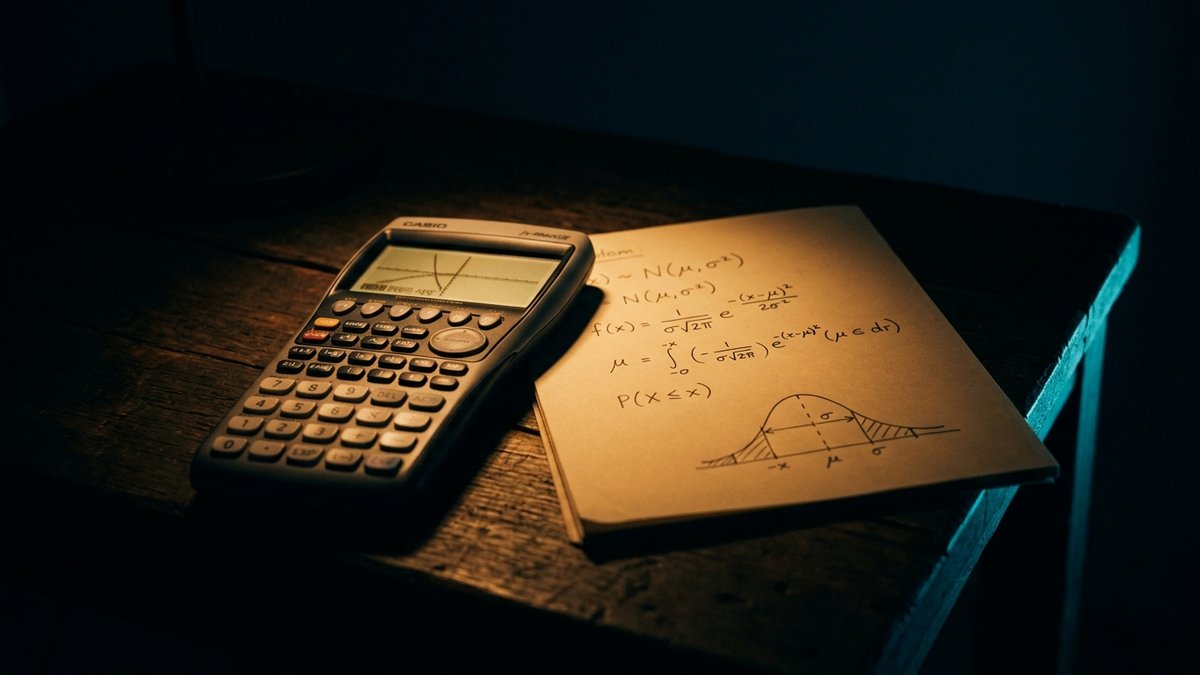
Every S1 paper has 6-10 marks of normal distribution. Every one of those marks is accessible if you know two calculator moves cold. Here they are, on one page.
Move 1 — Finding a probability
Question shape: "$X \sim N(\mu, \sigma^2)$. Find $P(a < X < b)$."
Casio CG50 keystrokes:
- Menu → STAT
- DIST → NORM → Ncd (normal cumulative distribution)
- Lower: $a$
- Upper: $b$
- $\sigma$: standard deviation (NOT variance)
- $\mu$: mean
Press EXE. The probability is on-screen.
Common trap: entering $\sigma^2$ instead of $\sigma$. The question gives you the variance; the calculator wants the standard deviation. Take the square root FIRST.
For $P(X < a)$: set Lower to a very negative number (e.g. $-10^{99}$). The keystroke on Casio is (-)(EXP)99.
For $P(X > a)$: set Upper to a very large number (e.g. $10^{99}$). Keystroke: EXP 99.
Move 2 — Finding a value from a probability
Question shape: "$X \sim N(\mu, \sigma^2)$. Find $a$ such that $P(X < a) = 0.85$."
This is the INVERSE normal — one of the least-known and highest-yielding calculator moves in the S1 syllabus.
Casio CG50 keystrokes:
- Menu → STAT
- DIST → NORM → InvN (inverse normal)
- Area: 0.85 (the given probability)
- $\sigma$: standard deviation
- $\mu$: mean
- Tail: LEFT (for "$P(X < a)$"), RIGHT (for "$P(X > a)$"), or CNTR (for two-tailed).
Press EXE. The value of $a$ is on-screen.
The full workflow
Every normal-distribution question fits one of these two moves. Read the question:
- Does it give you a value ($a$) and ask for a probability? → Move 1 (Ncd).
- Does it give you a probability and ask for a value ($a$)? → Move 2 (InvN).
- Does it give you a mean and standard deviation and ask both? Do them separately.
The three-mark example
*"$X \sim N(50, 100)$. Find $P(X > 65)$."*
- $\sigma^2 = 100$ → $\sigma = 10$.
- Ncd, Lower = 65, Upper = $10^{99}$, $\sigma = 10$, $\mu = 50$.
- Answer: $P(X > 65) \approx 0.0668$.
Total time: 30 seconds.
The four-mark inverse example
*"$X \sim N(80, \sigma^2)$. $P(X > 90) = 0.10$. Find $\sigma$."*
- This is inverse — we know the probability (0.10) and need to work backwards.
- Standardise: $Z = \dfrac{90 - 80}{\sigma}$; $P(Z > z) = 0.10 \Rightarrow z \approx 1.2816$ (InvN, Area 0.9, Tail Left, $\sigma = 1$, $\mu = 0$).
- So $\dfrac{10}{\sigma} = 1.2816 \Rightarrow \sigma \approx 7.80$.
Yes — you use InvN on the STANDARD normal (mean 0, sd 1) first to find $z$, then solve for $\sigma$. This is the third-most-common exam pattern and it catches half the cohort every year.
Setting up your calculator
Two settings to check before the paper:
1. Angle: RADIAN (for calculus questions) or DEGREE (for stats questions with trig). Toggle via SETUP.
2. Fraction format: display fractions (d/c) or decimals (a b/c) — your choice, but stick to one throughout the paper for consistency.
Your drill
Print the two moves. Do six normal-distribution questions from past papers using ONLY these two moves. Time yourself — target: under 3 minutes per question. If you're going over, you're second-guessing the input. Trust the calculator.
Two moves, six questions, 45 minutes of drill. Ten marks unlocked forever.
Ready to put this into practice?
Real Edexcel-style questions, dark-themed engine, method marks tracked as you go.
Practise Statistics →