Every Edexcel examiner's report on Mechanics contains the same complaint: *"Students who did not draw a labelled diagram lost method marks that were freely available."* And yet, year after year, students skip the drawing step and go straight to $F = ma$.
Here is the exact three-line diagramming routine I make every one of my Mechanics students perform before they touch algebra.
The three-line routine
Line 1 — The object. Draw a rectangle or circle. Label what it is (particle, block, sphere). Nothing else.
Line 2 — Every force, arrowed and labelled. Weight, normal reaction, tension, friction, applied force, thrust — all of them. Point each arrow in the direction the force acts on the body. Label with the SYMBOL first ($W$, $R$, $T$), then the value in brackets if given.
Line 3 — The axes. A tiny pair of arrows in the corner: one along the direction of motion (or expected motion), one perpendicular. Label them $\rightarrow$ and $\uparrow$ (or angled if it's a slope).
Why this gets marks
The mark scheme almost always includes a line like *"M1 for correct diagram / resolution attempt"*. That's an available mark BEFORE you've done any algebra. Miss the diagram, miss the mark.
Then, when you resolve, you're less likely to:
- Forget a force. (Friction is the most-forgotten in inclined-plane questions.)
- Get a sign wrong. (Weight always points DOWN — students routinely reverse it on slopes.)
- Miss a component. (When a rope goes over a pulley, the tension pulls the block along the string, not straight up.)
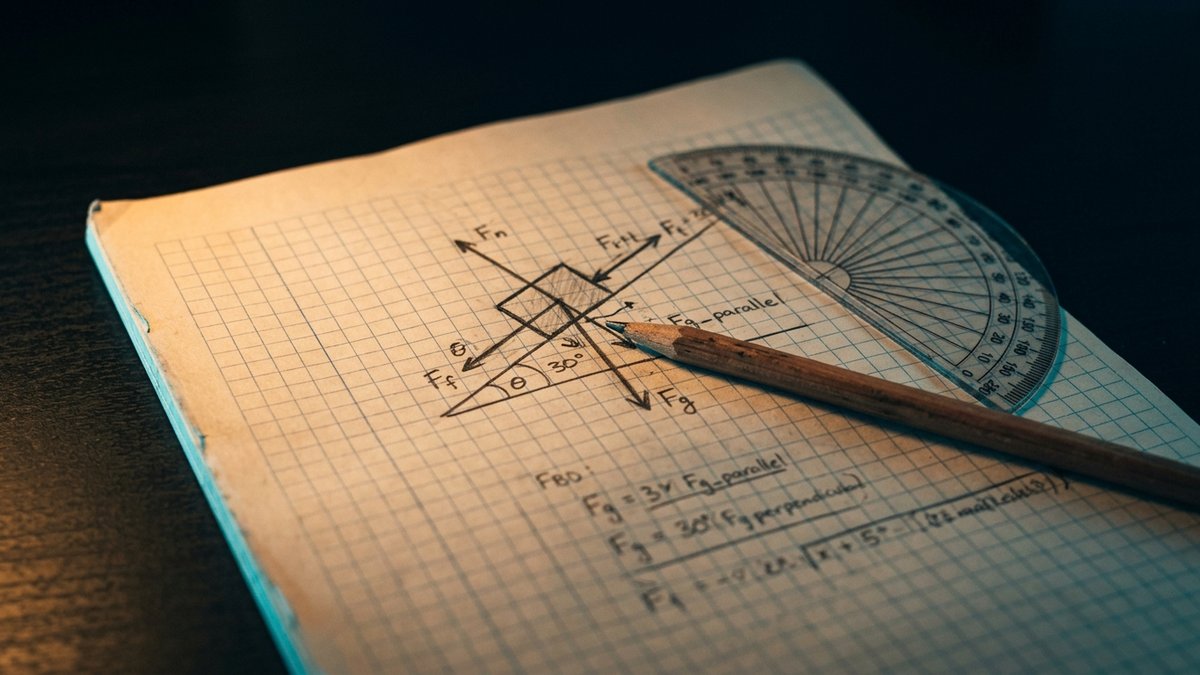
Worked example — inclined plane, block sliding
A block of mass 4 kg rests on a plane inclined at 30°. Coefficient of friction $\mu = 0.2$. Find the acceleration down the slope.
Line 1: Draw the block on the slope.
Line 2: Four forces — $W$ down, $R$ perpendicular to slope, $F$ (friction) up the slope, no applied force. Label each.
Line 3: Axes: one down the slope ($x$), one perpendicular to slope ($y$).
Now resolve:
- Perpendicular: $R = W\cos 30° = 4g\cos 30°$
- Parallel: $ma = W\sin 30° - \mu R = 4g\sin 30° - 0.2 \cdot 4g\cos 30°$
- So $a = g(\sin 30° - 0.2\cos 30°) \approx 3.20 \text{ m s}^{-2}$
If you'd started with $F = ma$ before the diagram, you'd probably have written $W$ as a pure downward force and lost the resolution mark.
Two variations that catch students out
Pulley over a smooth peg. Two blocks connected by a string. Draw TWO free-body diagrams — one for each block — with the tension $T$ pointing INTO the string (upward for a hanging block, along the string for a resting block). Same $T$ on both diagrams.
Rough contact between two blocks stacked vertically. The friction between them acts in OPPOSITE directions on the two blocks (Newton's third law). Students routinely draw them the same way. Draw the pair on the same page so you can eyeball the direction check.
Your action plan
For every Mechanics question you attempt from now until the exam:
1. Draw the diagram before you write any equation.
2. Tick each of the three lines aloud: "object, forces, axes".
3. Mark yourself against the mark scheme and check the diagram earned M1.
Three papers of this discipline and it becomes a reflex. And every M1 is a mark you'd otherwise have missed.
Ready to put this into practice?
Real Edexcel-style questions, dark-themed engine, method marks tracked as you go.
Practise Mechanics →